The Asahi logo is one of the most recognized marks in the global beer industry. It belongs to Asahi Group Holdings, a Japanese beverage company founded in 1889 as the Osaka Beer Brewing Company.
The current version of the wordmark was introduced in 1986, designed by Kazumasa Nagai and his team at Nippon Design Center. It replaced an earlier rising sun emblem that had been in use for nearly a century. The brand has gone through roughly four to five major logo iterations since its founding, with the most recent update happening in April 2024 when a new group corporate logomark was added for Asahi Group Holdings.
Asahi holds a 37% market share in Japan, making it the country’s largest brewer. The logo appears across products sold in over 100 countries.
What Is the Asahi Logo?
The Asahi logo is a custom wordmark featuring the brand name “Asahi” in a sharp, angular typeface rendered in deep blue. It was officially introduced in 1986, designed by Kazumasa Nagai and collaborators Masashi Uehara, Kahei Kiyono, and Yutaka Sasaki. The design symbolizes growth and freshness through forward-leaning letterforms.
Here’s a breakdown of the logo’s key attributes:
- Design Type: Wordmark (custom logotype). The Asahi Super Dry product label functions as a combination mark with additional graphic elements, but the core corporate logo is a standalone wordmark.
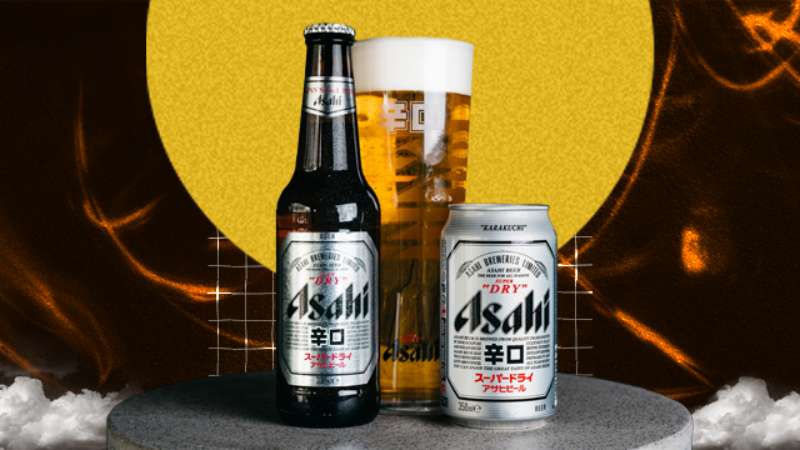
- Primary Elements: Custom-drawn Latin letterforms with angular, pointed terminals. Each letter tapers from a thicker center to sharp edges. The strokes lean slightly to the right. On the Asahi Super Dry label, the wordmark sits alongside kanji characters (辛口, meaning “dry”), wheat ear graphics, and the company’s full name.
- Official Introduction Date: 1986. The group corporate logomark was updated in April 2024.
- Designer: Kazumasa Nagai, head of Nippon Design Center, along with Masashi Uehara, Kahei Kiyono, and Yutaka Sasaki.
- Trademark Status: Registered trademark of Asahi Group Holdings, Ltd. Protected under international trademark law. Unauthorized commercial use is prohibited.
- Color Palette: The primary wordmark uses a deep blue (#004099). Product labels also feature silver/white backgrounds, black, red, and gold accents. The 2024 group logo added yellow for the “Sunrise Arc” element.
- Usage Context: Beer cans, bottles, draft tap handles, packaging design, advertising campaigns, corporate communications, digital platforms, merchandise, and event sponsorship materials.
How Has the Asahi Logo Evolved Over Time?
The Asahi logo has gone through several distinct phases since the late 1800s. Each version reflected the company’s position in the Japanese beer market and its broader cultural moment.
What’s interesting is how drastically the brand shifted its visual direction in the mid-1980s. That single change basically turned the company around.
Original Asahi Brewery Emblem (1889–Early 1900s)
Years Active: Late 1880s through early 1900s
The first Asahi logo drew heavily from Japanese graphic art traditions of the Meiji era. It was a vertically oriented oval medallion with a light yellow frame and a bright red stylized sun at its center.
Black capital letters spelled out the brand name in a traditional sans-serif font, while Japanese characters appeared on a ribbon below the sun image. The psychology of shapes was at play here. The oval form communicated stability and tradition, while the central sun disc tied the brand directly to its name (“morning sun”).
This wasn’t just a commercial mark. It was a cultural image that connected the brewery to Japanese identity during a period of rapid modernization.
Rising Sun Era and Raymond Loewy Influence (1900s–1985)
Years Active: Roughly early 1900s through 1985
Over the decades, the logo went through refinements. The rising sun and wave imagery remained central elements. At some point, the famed industrial designer Raymond Loewy (known for the Shell and Exxon logos, among many others) was involved with an Asahi design that featured a red imperial flag motif.
The color palette during this era relied on red, gold, and black. Red connected to the Japanese national flag. Gold suggested quality and premium positioning.
But here’s the thing. By the early 1980s, Asahi had slipped to third place in the Japanese beer market. The brand was struggling, and the traditional imagery wasn’t cutting it anymore. Something had to change, and it had to change fast.
Kazumasa Nagai Redesign (1986–2024)
Years Active: 1986 to present (with 2024 group-level additions)
In 1985, Asahi brought in Kazumasa Nagai, one of Japan’s most respected graphic designers and a founding member of Nippon Design Center. Nagai had already designed the 1972 Sapporo Winter Olympics emblem. He was not exactly playing it safe.
The new logo abandoned the historical rising sun emblem entirely. In its place: a bold wordmark with sharp, angular lettering in deep blue. Each letter tapers to a point, giving the whole thing a sense of forward motion. The strokes vary in thickness, which keeps the eye moving. Took me a while to really appreciate how much personality those diagonal cuts add.
The blue color was chosen specifically to represent water, Asahi’s most important ingredient. That’s a color psychology decision that most people wouldn’t consciously notice, but it works. You look at it and feel refreshed.
This rebrand coincided with the launch of Asahi Super Dry in 1987, which completely changed the Japanese beer market. Within a few years, Asahi overtook Kirin in sales. The logo and the product were inseparable parts of that success.
Asahi Group Holdings Update (2024–Present)
Years Active: April 2024 onward
In April 2024, Asahi Group Holdings added a new group corporate logomark. The core Nagai wordmark stays. But now it’s paired with a yellow “Sunrise Arc” above the text and the word “GROUP” underneath in the same signature blue.
The yellow arc represents the morning sun (the literal meaning of “asahi”) and was designed to communicate the brand’s name visually to a global audience that might not read Japanese. The fan shape created by the arc signals expansion.
Blue and yellow together represent Earth and Sun, water and light. At least that’s the official line. I think it also just looks clean and distinctive at a distance.
What Do the Design Elements of the Asahi Logo Mean?
Every part of the Asahi logo carries intentional meaning. The forward-leaning letterforms represent growth. The pointed terminals suggest precision and sharpness, which directly connects to the “Super Dry” product identity.
The varying stroke weights give the wordmark a sense of life and energy. Nothing about it feels static.
Why Did Asahi Choose These Specific Colors?
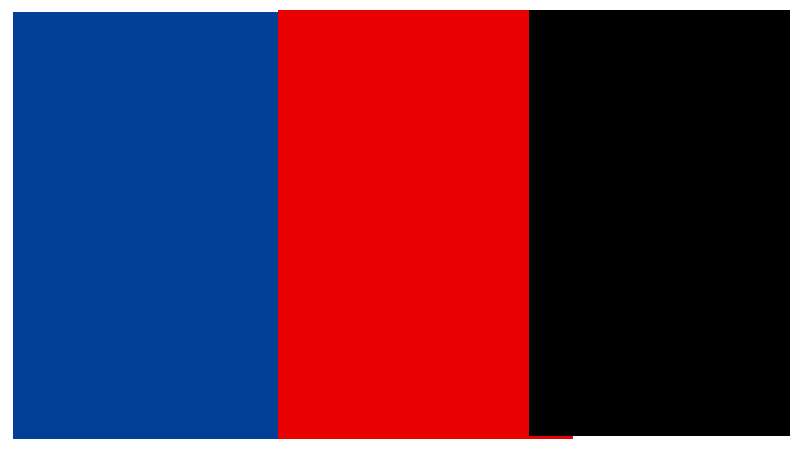
Deep Blue (#004099)
This is the primary color of the Asahi wordmark. According to color theory, blue communicates trust, reliability, and calm. But Nagai chose it specifically to reference water. Beer is mostly water, after all. The blue also creates a strong contrast against the silver backgrounds of Asahi’s cans and bottles.
In RGB values, this shade sits at approximately (0, 64, 153). For print applications using CMYK, it translates to roughly (100, 58, 0, 40). The closest Pantone match is around PMS 2945 C.
Silver/White
The background of Asahi Super Dry packaging is metallic silver. This reinforces the “dry” and “crisp” messaging. Silver reads as modern, premium, and clean. It’s doing a lot of heavy lifting that people don’t notice.
Red
Used in secondary label elements and the “SUPER DRY” text on product packaging. Red is a direct nod to the Japanese flag and carries cultural significance. If you look at other red logos across industries, you’ll see it consistently signals energy and boldness.
Yellow (2024 addition)
The Sunrise Arc in the group logo uses yellow to symbolize the morning sun, light, and warmth. Paired with blue, it creates a complementary color scheme that’s visually strong and easy to remember.
What Typography Style Is Used in the Asahi Logo?
The Asahi wordmark uses a fully custom typeface. It’s built on a Latin sans-serif foundation, but every letter has been individually redrawn. The strokes move from thick centers to sharp, pointed ends.
There’s a slight rightward slant across all the characters, which gives it that sense of forward motion I mentioned. The closest commercially available font is probably Rozza, but even that’s sharper and more geometric than what Nagai created.
The kerning between letters is tight but consistent. And the diagonal cuts on the stroke terminals? Those are what give it the Japanese calligraphic flavor without actually using any calligraphic forms. It’s a tricky balance, and they nailed it.
What Are the Hidden Meanings in the Asahi Logo?
The letters tilt upward to the right. Nagai stated this was intentional, meant to visualize growth and the idea of “rising,” which directly connects to the brand name (morning sun, rising sun).
The way the strokes thin out at their endpoints resembles brush strokes in Japanese calligraphy, even though the letterforms are entirely Latin. This creates a subtle bridge between Western typography and Japanese visual culture.
Some people see the angular letter shapes as evoking ice crystals or the crisp sensation of cold beer. Whether that was planned or not, it reinforces the product’s core identity as a dry, sharp-tasting lager.
How Does the Asahi Logo Compare to Competitor Logos?
Japanese beer branding is its own category. The major players (Asahi, Kirin, Sapporo, and Suntory) all lean into very different visual approaches, and the differences say a lot about each brand.
Kirin uses an illustration of a mythical kirin creature as its primary mark. That’s much more traditional and ornamental. Sapporo features a bold gold star on a black background, which is more of an emblem approach. Suntory tends toward cleaner, more corporate wordmarks.
Asahi sits in a middle ground. It’s a wordmark, so it’s modern and typographic. But the custom letterforms give it more personality than a standard corporate logotype. Among beer logos worldwide, it’s unusual because most major beer brands rely on crests, emblems, or illustrations.
Compare it to Western brands like Budweiser (ornate crest and script) or Heineken (the classic red star and green branding). Asahi feels more… minimal. More confident. It lets the typography do the work, which aligns with the principles of minimalist design. Brands like Carlsberg and Stella Artois lean much heavier into European heritage with their marks.
What Are the Technical Specifications of the Asahi Logo?
Official Color Codes
- Primary Blue (Wordmark): Hex: #004099 | RGB: (0, 64, 153) | CMYK: (100, 58, 0, 40) | Approximate Pantone: PMS 2945 C
- Silver (Packaging Background): Achieved through metallic printing substrates. No single hex equivalent accurately captures it. For digital mockups, #C0C0C0 or similar metallic gradients are commonly used.
- Red (Label Accents): Hex: approximately #E60012 | RGB: (230, 0, 18) | CMYK: (0, 100, 100, 0)
- Yellow (2024 Sunrise Arc): A warm gold-yellow used in the group corporate logomark
- Black (Label Text): Hex: #000000 | RGB: (0, 0, 0) | CMYK: (0, 0, 0, 100)
Dimensions and Proportions
Asahi maintains strict brand guidelines for logo usage. The wordmark follows a horizontal aspect ratio, roughly wider than it is tall, though exact proportions are controlled by the corporate style guide.
Clear space around the logo is typically defined as a set distance based on the height of a specific letter (often the “A”). Minimum size requirements exist for both print and digital applications to make sure the angular details in the letterforms stay readable.
For print design applications, the logo should be reproduced at a minimum DPI of 300 to maintain crisp edges on those pointed terminals. Digital applications generally use the vector graphics version of the logo to keep it sharp at any size.
What Cultural Impact Has the Asahi Logo Had?
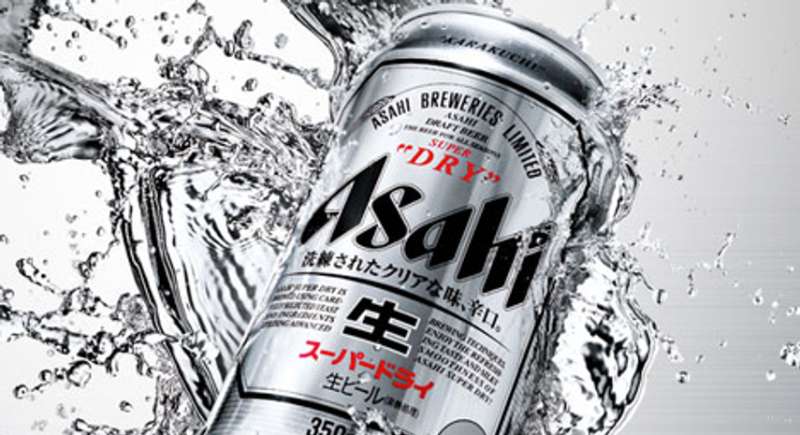
The 1986 redesign didn’t just save a beer brand. It became a case study in how identity design can turn around a failing business.
When Nagai replaced the traditional rising sun emblem with his angular blue wordmark, it was a real gamble. Asahi was in third place. Dropping a century of visual heritage could have backfired badly.
Instead, the new logo paired with Asahi Super Dry created one of the most successful brand relaunches in Japanese corporate history. Super Dry sold over 100 million cans in its first three years.
The logo became synonymous with modern Japanese culture in the late 1980s and 1990s. It showed up everywhere, from Tokyo neon to international export markets. The Asahi headquarters building in Sumida, Tokyo (designed by Philippe Starck, with its famous golden “Flamme d’Or” sculpture) became an architectural landmark that reinforced the brand’s identity as bold and unconventional.
Among famous graphic designers, Kazumasa Nagai’s work on the Asahi identity is frequently cited as one of the finest examples of corporate rebranding in Asia.
How Does the Asahi Logo Fit Into the Overall Brand Identity?
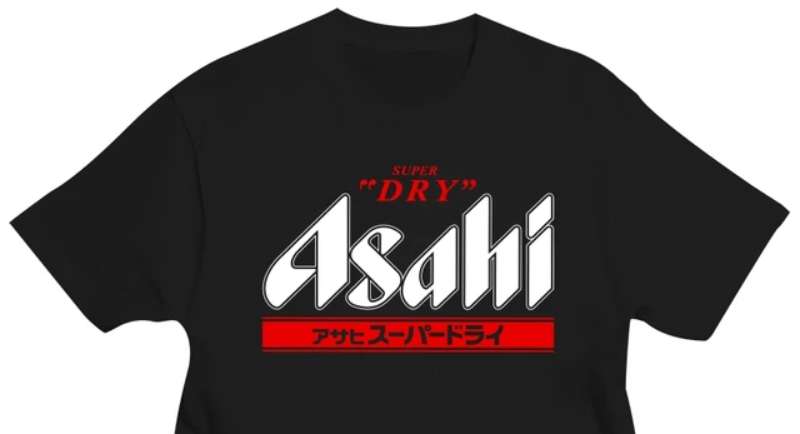
The logo is the anchor of a much larger brand system. It connects to the Asahi Super Dry label design, the packaging across different products (Asahi Draft, Asahi Dry Zero, and others), and the corporate identity of Asahi Group Holdings.
On the product level, the Asahi Super Dry can is its own piece of brand style guide execution. The silver metallic background, the bold blue wordmark, the red “SUPER DRY” text, and the kanji 辛口 all work together. The visual hierarchy puts the wordmark first, the product name second, and supporting text third.
At the corporate level, the 2024 group logomark extends this system. The yellow Sunrise Arc adds warmth and global aspiration to the established blue identity. The word “GROUP” underneath signals corporate breadth, covering beer, soft drinks, food, and more.
It’s a clean system. And the fact that the 1986 core wordmark has survived nearly four decades with only contextual additions (not redesigns) says something about how well the original logo design principles were applied.
How Should the Asahi Logo Be Used?
Official usage rules are governed by Asahi Group Holdings’ corporate brand guidelines. A few basics that apply broadly:
- Don’t alter the colors. The blue wordmark should always appear in its specified shade. Variations exist for different product lines (black, white, and colored versions for different packaging), but these are all controlled by the official guidelines.
- Don’t stretch, rotate, or distort it. The proportions and angles are part of the design. Changing them breaks the intentional rhythm of the letterforms.
- Maintain clear space. The logo needs breathing room. Crowding it with other elements reduces its impact and readability.
- Use official files. The logo should be reproduced from approved digital files, not recreated or approximated. This matters especially for the custom letterforms, which are easy to get wrong.
Where to access official logos: Asahi Group Holdings provides approved brand assets through its corporate communications channels and authorized media kits. Third-party use typically requires written permission from the company.
Trademark protection: The Asahi name and logo are registered trademarks globally. Using them for commercial purposes without authorization violates intellectual property law. This applies to merchandise, advertising, resale materials, and digital content.
If you’re working on a project that involves the Asahi brand, reach out to their corporate team first. Took me exactly one cease-and-desist notice (not from Asahi, from a different brand) to learn that lesson the hard way.
FAQ on The Asahi Logo
What does the Asahi logo look like?
The Asahi logo is a custom wordmark featuring the brand name in sharp, angular blue lettering. Each letter tapers from thick centers to pointed ends. The strokes lean slightly right, giving a sense of forward motion and growth.
Who designed the current Asahi beer logo?
Kazumasa Nagai, a founding member of Nippon Design Center, created the current Asahi Breweries logo in 1986. He worked alongside Masashi Uehara, Kahei Kiyono, and Yutaka Sasaki. The design replaced a century-old rising sun emblem.
What does “Asahi” mean in Japanese?
Asahi translates to “morning sun” in Japanese. It combines “asa” (morning) and “hi” (sun or day). This meaning directly influenced the brand’s visual identity, including the red sun in earlier logos and the yellow Sunrise Arc in the 2024 group logo.
Why is the Asahi logo blue?
Nagai chose blue specifically to represent water, the primary ingredient in beer. The deep blue shade also communicates trust and freshness. It creates a strong visual pop against the silver packaging of Asahi Super Dry cans and bottles.
When was the Asahi logo last updated?
The most recent update came in April 2024. Asahi Group Holdings introduced a new corporate logomark that keeps the original blue wordmark but adds a yellow arc and the word “GROUP.” The core Nagai wordmark from 1986 remains unchanged.
What font does the Asahi logo use?
Asahi uses a fully custom typeface. It’s not available commercially. The closest match is a font called Rozza, though it’s sharper. The logo’s letterforms blend a Latin sans-serif base with angular cuts that echo Japanese calligraphy traditions.
What are the official Asahi logo colors?
The primary wordmark color is a deep blue with hex code #004099. Product labels also use red, black, silver, and white. The 2024 group logo added yellow. Each color is specified in the company’s brand identity guidelines.
Did Raymond Loewy design an Asahi logo?
Yes. Before the 1986 redesign, Raymond Loewy contributed to an earlier Asahi visual identity that featured a red imperial flag motif. Nagai’s 1986 wordmark replaced Loewy’s design when Asahi Breweries decided to completely rebrand.
Can I use the Asahi logo for my project?
No, not without permission. The Asahi logo is a registered trademark of Asahi Group Holdings, Ltd. Any commercial use requires written authorization. Unauthorized reproduction on merchandise, advertising, or digital content violates intellectual property law.
How did the Asahi logo help revive the brand?
The 1986 rebrand paired with the launch of Asahi Super Dry in 1987 turned the company’s fortunes around completely. Asahi went from third place in Japan’s beer market to overtaking Kirin as the top-selling brewery within a decade.
Conclusion
The Asahi logo is a rare example of a corporate rebrand that actually worked on every level. Kazumasa Nagai’s 1986 wordmark didn’t just look good on a can. It helped pull a struggling brewery out of third place and into market dominance.
The angular blue letterforms, the connection to water and Japanese heritage, the deliberate forward lean. All of it still holds up nearly four decades later.
With the 2024 Asahi Group Holdings update adding the Sunrise Arc, the brand identity scales globally without losing what made it work in the first place. Few beer brand logos manage that kind of longevity.
If you’re studying brand recognition or beverage packaging graphics, this is one worth paying attention to.

Renowned for his expertise in logo design and visual branding, Bogdan has developed a multitude of logos for various clients.
His skills extend to creating posters, vector illustrations, business cards, and brochures. Additionally, Bogdan's UI kits were featured on marketplaces like Visual Hierarchy and UI8.
He also wrote in the past years on sites like Design Your Way, WebDesignerDepot, WPDean, Designmodo, Speckyboy, Slider Revolution, and more.
- The Windsurf Logo History, Colors, Font, And Meaning - 10 October 2026
- How to Remove Background From Product Photos (No Photoshop) - 10 October 2026
- How Designers can Build a Stronger Online Creative Identity - 9 October 2026

Bogdan Sandu is a seasoned designer who has been designing websites since 2008. Renowned for his expertise in logo design and visual branding, Bogdan has developed a multitude of logos for various clients. His skills extend to creating posters, vector illustrations, business cards, and brochures. Additionally, Bogdan's UI kits were featured on marketplaces like Visual Hierarchy and UI8. He also wrote in the past years on sites like Design Your Way, WebDesignerDepot, WPDean, Designmodo, Speckyboy, Slider Revolution, and more.
You Might Also Like