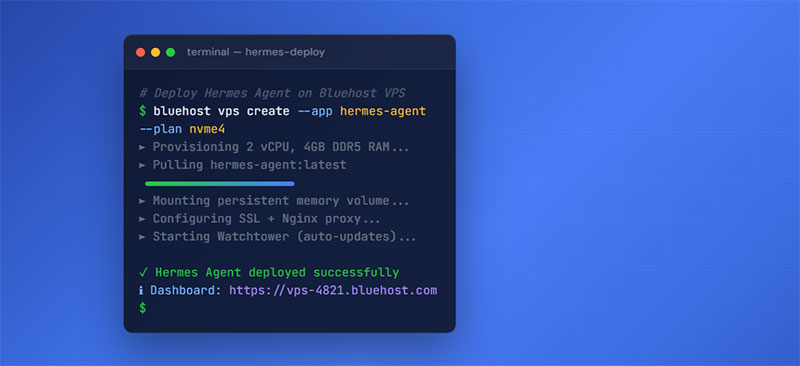
Hosting Hermes Agent on a dedicated server improves workflow efficiency because the agent stops being a chat window you open and close and becomes a worker that stays on. It runs around the clock, keeps what it learns between sessions, runs tasks on a schedule and takes commands from the messaging apps your team already uses. Most AI assistants work in a single session: you enter a prompt, get an answer and lose the context when the tab closes. That is fine for quick questions, but it breaks down when a workflow needs continuity, scheduling and accumulated knowledge.
What is Hermes Agent and why host it?
Hermes Agent is an AI agent from Nous Research. Run on your own laptop, it behaves like most local tools: it works while the machine is awake and plugged in. Run on a dedicated server, it keeps working whether you are at your desk or not. The video below is a short overview of what the agent does before any hosting decisions come into it.

The difference comes down to how tasks are handled, how knowledge is retained and how much manual effort disappears from daily operations. The comparison below summarizes it, and the sections that follow cover each point.
How does hosting Hermes Agent improve efficiency compared with running it locally?
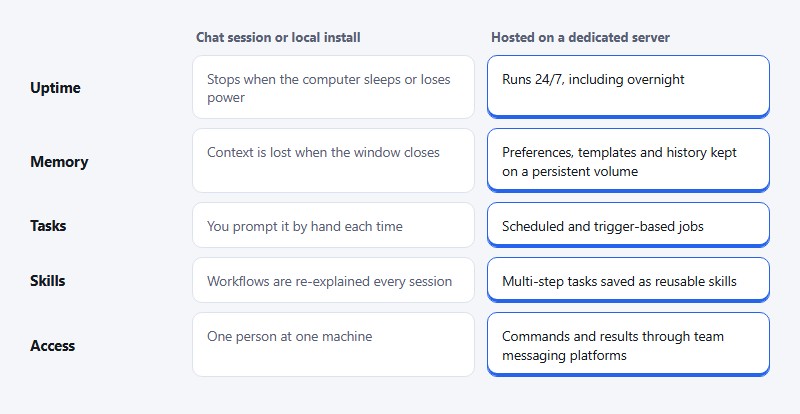
A hosted setup removes dependence on local hardware, adds scheduling, preserves memory and skills across restarts, and connects the agent to team messaging. Each of those saves time in a different way, and the first one is also the most obvious.
How does 24/7 operation help?
An AI tool installed on a personal computer stops the moment that machine sleeps or loses power. Hosting Hermes on a cloud server removes that limit. The agent can run data collection, API testing and report generation overnight without using local resources.
That turns lost hours into productive ones. Background jobs that used to wait for someone to start them can finish before the workday begins, so the team starts each morning with results already waiting.
Can Hermes Agent run scheduled and trigger-based tasks?
Yes, when it is hosted. A server environment supports scheduled and trigger-based workflows with built-in job management. You can set the agent to pull updates from code repositories, summarize server logs or monitor industry news at specific times and intervals.
This changes the agent from a tool you prompt by hand into an operations assistant that handles recurring work on a predictable schedule. You get fewer reminders to yourself and less time spent starting routine processes manually.
How does persistent memory save time?
AI assistants usually forget earlier conversations. On a persistent server volume, Hermes keeps a database of project preferences, structural templates and debugging history across sessions, for weeks or even months.
That ends the cycle of re-explaining company guidelines, code constraints or formatting standards at the start of every interaction. The agent picks up where it left off, which matters most on complicated, ongoing projects.
What are reusable skills and why do they matter?
Hermes can turn a complex multi-step task into a reusable command. It takes a workflow, say twenty steps, and condenses it into one executable skill. When hosting is configured correctly with persistent storage, those learned skills survive server restarts and stay available.
The next time a similar request comes in, execution is much faster. Over weeks and months, this self-improvement cycle shapes the agent into an assistant specialized for your own operations. The key setup detail is persistent storage: without it, a restart can wipe what the agent has learned.
How does Hermes Agent connect to team messaging?
A hosted agent behaves more like a team member than a terminal window. Connected to workplace messaging platforms, it lets you send commands from your phone and receive summarized results in your preferred channel. You can start a competitor analysis, request a data pull or approve a scheduled task from anywhere, and everyone on the team can reach the agent without logging into another interface.
What does self-hosting mean for data control and model choice?
Self-hosted deployments suit professionals and organizations that handle sensitive information. You decide where the data lives, so business information can stay behind your own firewall instead of passing through third-party services. Security is your responsibility in that case, and it is worth reading up on cloud security basics before you deploy.
A hosted setup also lets you switch between a wide range of AI models according to your cost and capability needs. You can optimize for speed, accuracy or budget without reconfiguring the agent’s core settings each time you change.
What should you check when choosing a server for Hermes Agent?
- Persistent storage, so memory and learned skills survive restarts.
- Enough capacity for scheduled jobs that run overnight.
- Where the server is located, if data residency matters to your organization.
- Which messaging platforms you plan to connect.
- Who is responsible for updates, backups and access control.
These checks matter more than the headline server price, because they decide whether the efficiency gains actually appear.
Frequently asked questions
Why host Hermes Agent instead of running it on my own computer?
A personal computer sleeps, restarts and gets switched off. A dedicated server keeps the agent running, so scheduled work and long-running jobs continue without you.
Does the agent really remember things between sessions?
On a persistent server volume it keeps project preferences, templates and debugging history across sessions, so you do not have to repeat standing instructions.
Is a self-hosted agent private?
It gives you control over where data is stored, which keeps sensitive information off third-party services you do not choose. You are also responsible for securing the server.
Is hosting Hermes Agent worth it for your workflow?
If you repeat the same tasks, need results ready at a set time or want a shared assistant for a team, yes. Start with one recurring job, such as a daily log summary, host it with persistent storage, and measure how much manual effort disappears. The gains build as the agent learns your preferences and recurring tasks.

Renowned for his expertise in logo design and visual branding, Bogdan has developed a multitude of logos for various clients.
His skills extend to creating posters, vector illustrations, business cards, and brochures. Additionally, Bogdan's UI kits were featured on marketplaces like Visual Hierarchy and UI8.
He also wrote in the past years on sites like Design Your Way, WebDesignerDepot, WPDean, Designmodo, Speckyboy, Slider Revolution, and more.
- Color Blindness Simulator - 28 November 2026
- Designing for the Patient in Pain: What Chiropractic Websites Need Before Anyone Books - 28 November 2026
- How to Design Marketing Materials That People Actually Keep - 27 November 2026

Bogdan Sandu is a seasoned designer who has been designing websites since 2008. Renowned for his expertise in logo design and visual branding, Bogdan has developed a multitude of logos for various clients. His skills extend to creating posters, vector illustrations, business cards, and brochures. Additionally, Bogdan's UI kits were featured on marketplaces like Visual Hierarchy and UI8. He also wrote in the past years on sites like Design Your Way, WebDesignerDepot, WPDean, Designmodo, Speckyboy, Slider Revolution, and more.
You Might Also Like