New Balance spent decades making running shoes that serious athletes actually wanted, then spent most of that time refusing to tell anyone about it.
The “Endorsed by No One” tagline from the 1990s wasn’t ironic. It was policy. The Boston-based brand genuinely believed product quality would do the selling. That bet worked, quietly, for a long time. Then around 2018 it stopped being enough.
New Balance Athletics, founded in 1906 and headquartered in Boston, Massachusetts, has worked with agencies including Arnold Worldwide (2010–2016), VML, ACE Content, The Rec League, and VMLY&R across key markets in the US, UK, Europe, Japan, South Korea, and Australia.
The brand does not disclose its advertising budget publicly, though it shifted 70% of marketing spend away from transaction-based tactics toward brand campaigns and athlete-led content between 2018 and 2024. Revenue hit a record $7.8 billion in 2024, up 20% year over year.
What Are New Balance Ads?
New Balance ads are performance and lifestyle-focused brand communications produced since the 1970s, appearing across TV, print, digital, out-of-home, and social media, built around independence, craftsmanship, and athletic authenticity. Primary creative agencies since 2018 include VML, VMLY&R, and The Rec League.
How has New Balance’s advertising identity evolved?
The brand went through several genuinely distinct phases, not just cosmetic rebrands.
The quiet decades before 2016 barely registered as advertising strategy. Then a full repositioning happened in a short window.
| Period | What changed | Key campaign |
|---|---|---|
| 1980s–1990s | Performance-first, anti-celebrity stance | “Endorsed by No One” |
| 1990s–2000s | Athlete roster shrinks to runners only | “Intelligent Choice” (revived 1980s slogan) |
| 2010–2016 | Arnold Worldwide era, UK cricket sponsorship | “There Are No Weekends in Sport” |
| 2018 | Full rebrand, new visual identity, new platform | “Fearlessly Independent Since 1906” |
| 2020–present | Culture-first, athlete and entertainer roster | “We Got Now” |
Which agencies have made New Balance ads?
New Balance has worked with a rotating roster rather than a single long-term partner. Arnold Worldwide held the agency-of-record position from roughly 2010 until mid-2016, when New Balance ended the relationship to consolidate global messaging.
| Agency | Period | Notable work |
|---|---|---|
| Arnold Worldwide | 2010–2016 | UK cricket, running campaigns |
| VML | 2018 | “Fearlessly Independent” brand platform |
| ACE Content | 2018 | “Declare Your Independence” campaign |
| The Rec League | 2020 | Original “We Got Now” Kawhi Leonard spot |
| VMLY&R | 2021–2022 | “We Got Now” extensions, “Hey You” |
| American Haiku | 2023 | “Grey Days” 990 campaign |
What is New Balance’s advertising strategy?

New Balance’s strategy is built on signing athletes before they peak, then building long-form narrative campaigns around them. The shift began in 2018 with a new brand platform and accelerated after 2020 with the NBA partnership and “We Got Now.”
The pivot was a direct response to a revenue plateau. In 2010, New Balance was at $1.8 billion. By the time they launched “Fearlessly Independent Since 1906” in 2018, the brand had realized it was invisible to the 13-to-34 demographic it needed.
The response wasn’t mass spending. It was selective, early bets: Coco Gauff at 14, Kawhi Leonard before his championship run, Shohei Ohtani as he crossed into mainstream US recognition.
By 2024, the brand had reversed its prior spend allocation, putting 70% of marketing dollars toward athlete campaigns and cultural collaborations instead of transactional search ads.
What emotional appeals does New Balance use?
New Balance ads consistently appeal to independence, self-determination, and athletic authenticity. The brand avoids aspirational fantasy in favor of depicting athletes as they actually work, compete, and exist.
The “We Got Now” campaign across 2020–2024 made this concrete: Kawhi Leonard playing piano alone in an empty school auditorium. Coco Gauff warming up before a match with no performance narrative attached.
These aren’t greatness ads in the Nike sense. They’re quieter. The appeal is “this person is real, this brand is theirs, maybe it’s yours too.”
The Grey Days campaign for the 990 took a different route, leaning into subcultural credibility rather than individual athletes.
Who is New Balance’s target audience?
New Balance formally defines its primary audience as “global independents”: consumers aged 13 to 34 who exist at the intersection of sports and culture. The brand also maintains a strong secondary audience of performance runners and heritage sneaker collectors.
This dual positioning is unusual and somewhat deliberate.
The “Worn by Supermodels in London and Dads in Ohio” campaign anchor worked precisely because it acknowledged both audiences at once. Younger consumers didn’t resent the dad-shoe association. They reclaimed it.
By 2024, New Balance had 88% brand awareness among US sneakerheads, with 40% reporting a positive opinion.
How does New Balance adapt ads for different markets?
New Balance runs regionally tailored campaigns, adjusting talent, cultural references, and media placement while maintaining the core platform messaging.
- Japan and South Korea: Separate talent, including Korean pop artist IU in a “We Got Now: Seoul” TV spot.
- UK: Cricket partnership replacing Adidas as England and Wales Cricket sponsor, with Joe Root-led ads.
- Europe and Australia: Grey Days got a 60-second cinema trailer cut, with out-of-home in France, Germany, Australia, and New Zealand.
- US: Heavier NBA and basketball focus, direct ties to Foot Locker retail activations.
What are the most iconic New Balance ad campaigns?
The 5 most significant campaigns are “Endorsed by No One” (1990s), “Fearlessly Independent Since 1906” (2018), “We Got Now” (2020–2024), “Grey Days” (2023), and “Run Your Way” (2023). Together they trace the brand’s full repositioning over three decades.
“Endorsed by No One” (1990s): what made it work?
A genuinely contrarian campaign that bet on product quality over personality. It worked for its era, then became a liability as competitor endorsement spending grew.
| Agency | In-house / undisclosed |
| Director | N/A (print-led) |
| Market | United States |
| Medium | Print, magazine advertising |
| Awards | None documented |
| Results | Established anti-celebrity brand identity; athlete roster shrunk to runners-only by 2010 |
The campaign was honest about what New Balance was: a brand for people who had already decided they didn’t need to be sold to. That’s a narrow audience, but a loyal one.
The problem came later. By the 2010s, that audience wasn’t growing. And a brand that refuses to court celebrities has a harder time breaking into culture.
The irony is that “Endorsed by No One” eventually required a “We Got Now” to undo it.
“Fearlessly Independent Since 1906” (2018): what made it work?
A full brand platform overhaul that gave New Balance a public identity it had never clearly stated. Created by VML (platform) and ACE Content (campaign), it launched February 2018 across TV, social, digital, and out-of-home globally.
| Agency | VML (brand platform); ACE Content (campaign) |
| Director | Philip Andelman (IDENTITY) |
| Market | Global |
| Medium | TV, digital, social, out-of-home |
| Awards | Industry press recognition |
| Results | Foundation for “We Got Now”; repositioned brand for 13–34 demographic |
The “Declare Your Independence” launch film featured Francisco Lindor, Rose Lavelle, Paul Rabil, Jürgen Klopp, and skater PJ Ladd.
The visual identity was redesigned at the same time, with new typography and iconography applied across all channels. VML built the system; ACE Content brought it to life on film.
What the brand wouldn’t say out loud: the timing was partly reactive. A 2016 political controversy (white nationalist groups misappropriated comments from a New Balance executive about trade policy) had left the brand needing a cultural reset. “Fearlessly Independent” did the reset, intentionally or not reframing the brand’s independence positioning away from any prior associations.
“We Got Now” (2020–2024): what made it work?
A multi-year brand campaign that became New Balance’s most expansive advertising effort, built around a growing athlete roster and an NBA global marketing partnership.
| Agency | The Rec League (2020 launch); VMLY&R (extensions) |
| Director | Various per installment |
| Market | Global |
| Medium | TV, digital, social, retail, NBA broadcast |
| Awards | Not formally awarded |
| Results | Revenue from ~$4.5B (2020) to $7.8B (2024); search traffic at 5-year high in 2024 |
The first spot aired February 28, 2020 during the LA Clippers vs. Denver Nuggets NBA broadcast: Kawhi Leonard at a piano, alone, no voiceover, no product close-ups.
From that launch, the campaign expanded to include Coco Gauff, Sadio Mané, Sydney McLaughlin-Levrone, Jack Harlow, Jaden Smith, Jamal Murray, Tyrese Maxey, Cameron Brink, Shohei Ohtani, and IU in South Korea. Each installment followed a similar format: athlete in an unexpected context, minimal dialogue.
The data side was more deliberate than the aesthetic suggested. Using Swayable for creative testing from 2023 onward, New Balance ran 7 rounds of testing with over 46,000 respondents. The Coco Gauff version outperformed 3 others on brand favorability and purchase intent, particularly with the target 13-to-34 audience.
What the brand probably wouldn’t highlight: the campaign’s success is partly about the athletes winning in real life. Gauff took the 2023 US Open wearing New Balance. Ohtani had a historic MLB season. The ads look prescient in hindsight, though whether the campaign would have held up through athlete underperformance is a question the results never forced anyone to answer.
“Grey Days” (2023): what made it work?
A celebration of the New Balance 990’s cultural legacy, shot in 16mm black and white by American Haiku. The campaign ran in US cinemas, across European out-of-home, and digitally in Japan, South Korea, Australia, Germany, France, and New Zealand.
| Agency | American Haiku |
| Director | Daniel Wolfe (Rascal production company) |
| Market | US, UK, Europe, Japan, South Korea, Australia |
| Medium | Cinema, digital, out-of-home, print (Thrasher magazine US) |
| Awards | Ads of the World feature |
| Results | Reinforced 990 as cultural touchstone; supported limited-edition Grey Days product drops |
The film deliberately avoided the celebrity format of “We Got Now.” Instead, it followed multiple communities connected to the grey 990: runners, skaters, Japanese sneaker collectors, DMV subculture figures.
Shot on 16mm in black and white (or grey, as the campaign insisted), it ran long-form in cinemas and in shorter cuts elsewhere. CMO Chris Davis described it as recognizing “sub-cultural New Balance fans who have stood by our brand and the emblem of grey for generations.”
The “Worn by Supermodels in London and Dads in Ohio” line came from this campaign and became one of the brand’s most-quoted references.
The honest version: Grey Days only works because the 990 genuinely has subcultural roots. A brand without that history couldn’t make this film. New Balance is, in a real sense, working with earned credibility that started in 1982.
“Run Your Way” (2023): what made it work?
A campaign featuring real runners and personal stories, positioned as a counterpoint to Nike’s achievement-driven running narrative. Ran across TV and digital in the US and internationally.
| Agency | Undisclosed |
| Director | N/A |
| Market | US, international |
| Medium | TV, digital, social |
| Awards | N/A |
| Results | Supported Fresh Foam running line; reinforced performance running credentials |
Where “We Got Now” focused on elite athletes and cultural crossover, “Run Your Way” went back to New Balance’s running roots. Real runners. Personal stories. No medals.
It competes for attention against much larger Nike and Adidas running budgets, so it lands more as a signal to the running community than a mass-market push. The message is basically: we haven’t forgotten where we started.
Given how hard the brand leaned into basketball and pop culture after 2020, that was probably worth saying.
New Balance print ads: a visual archive (1970s–2020s)
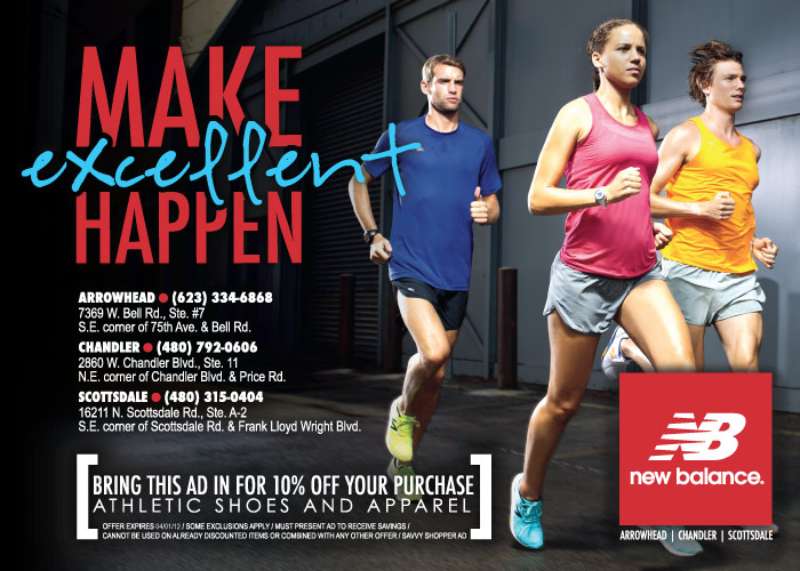


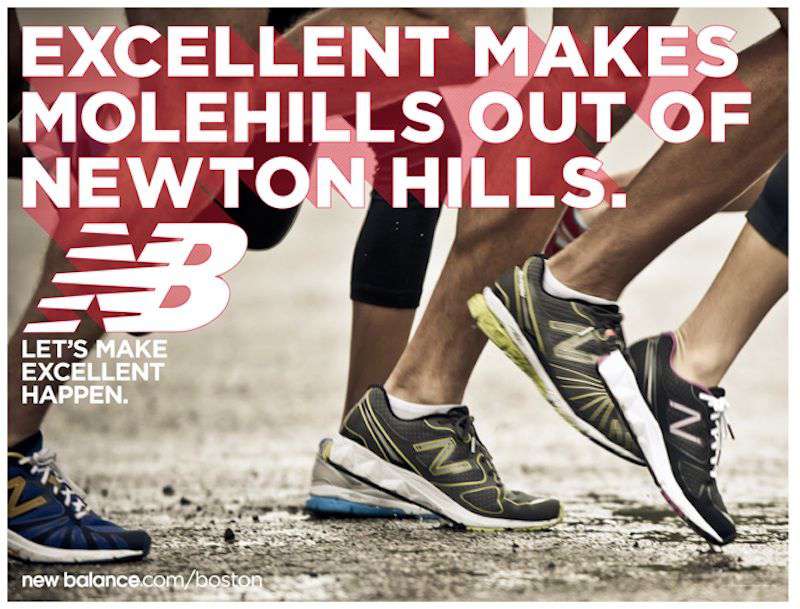
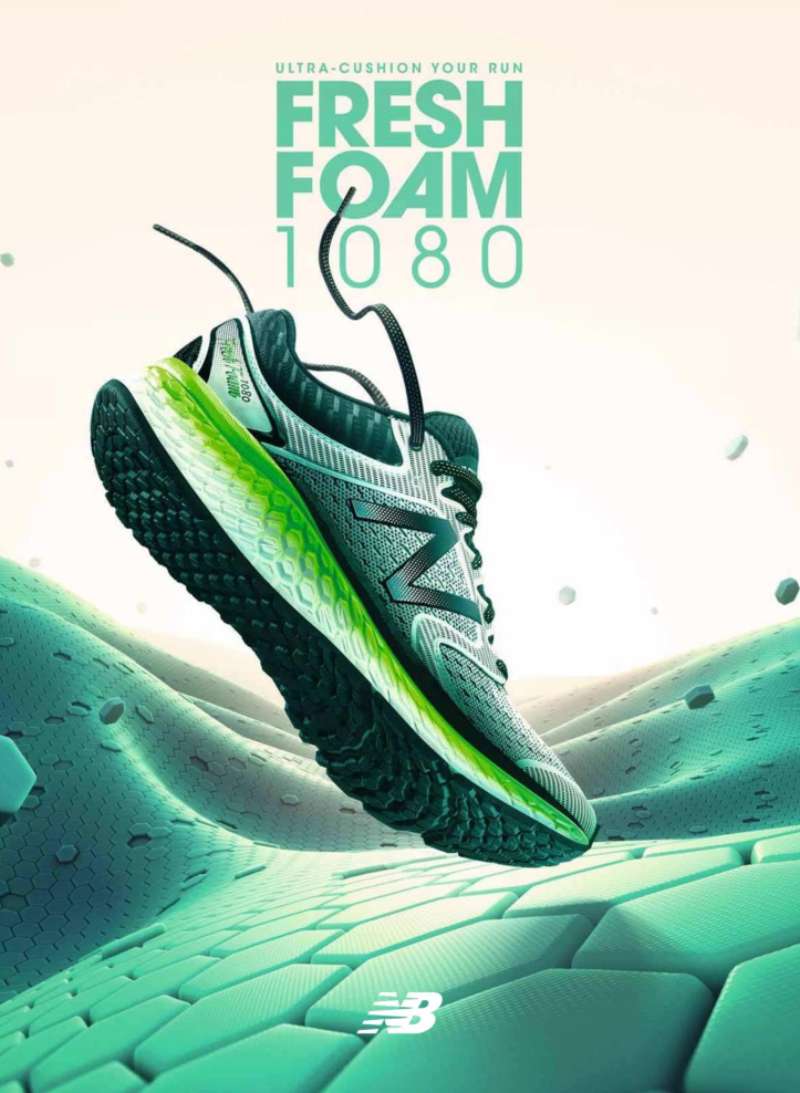
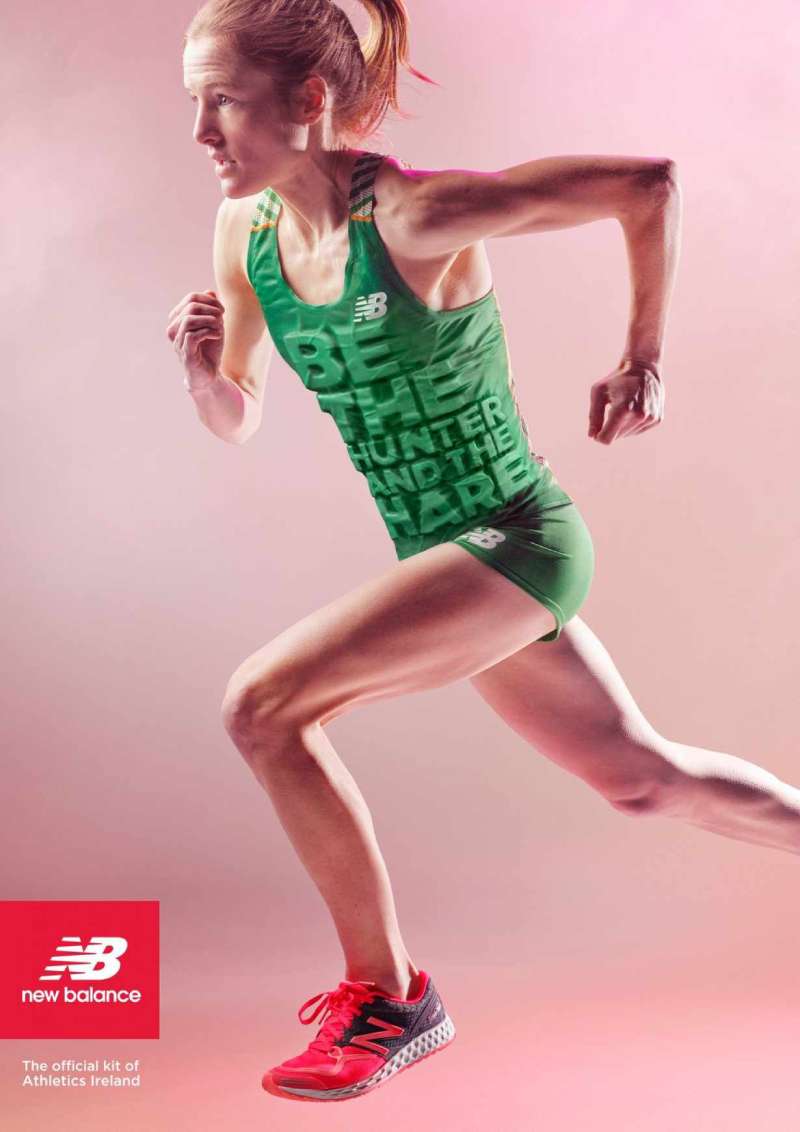
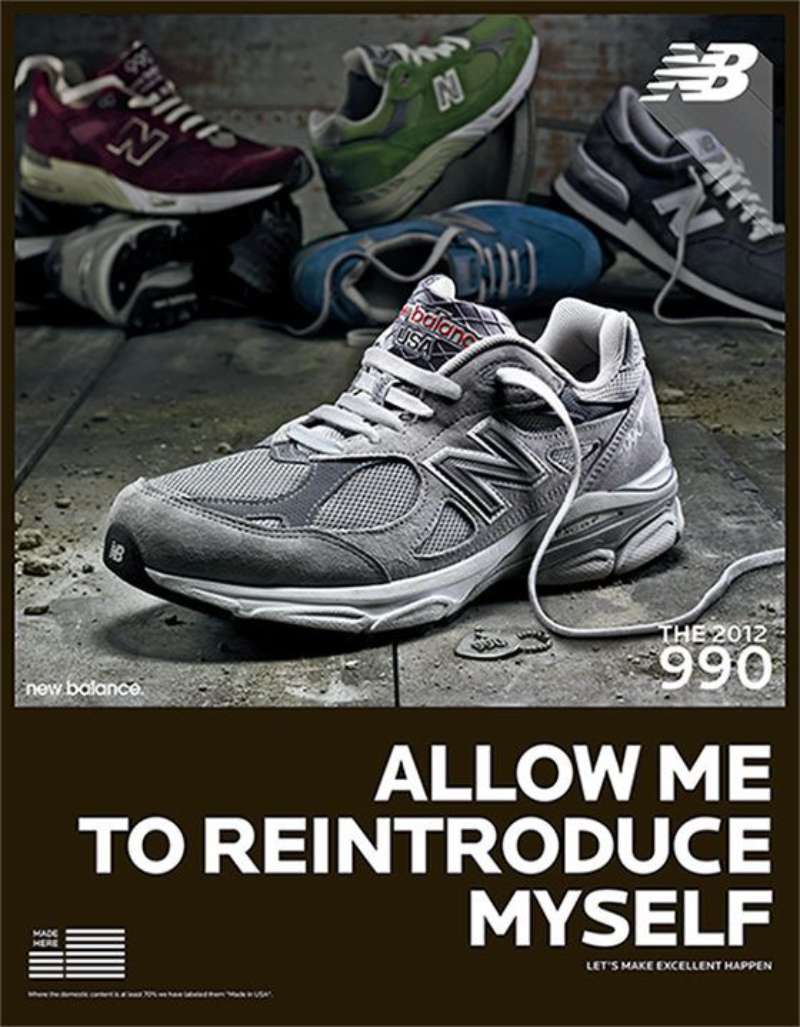
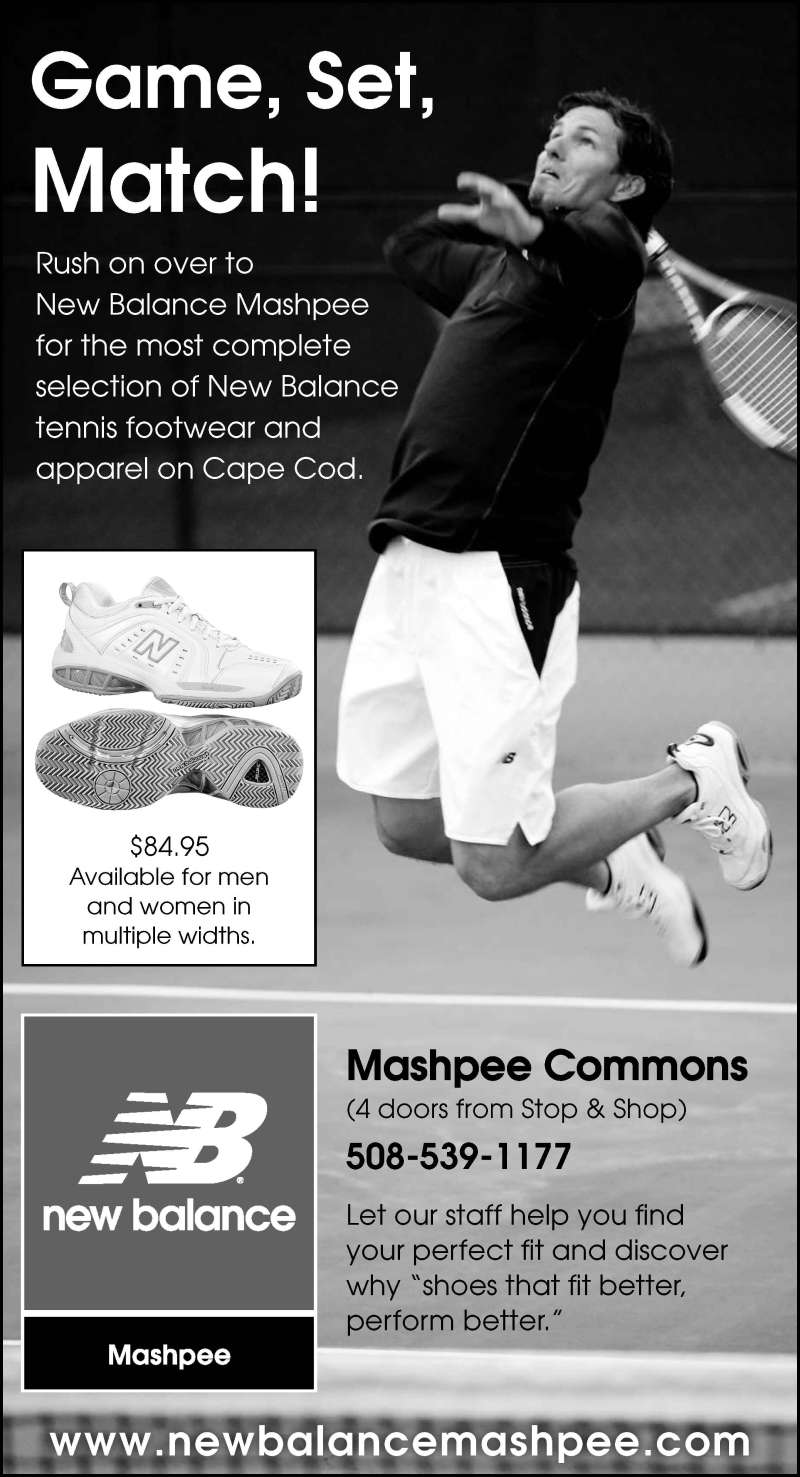
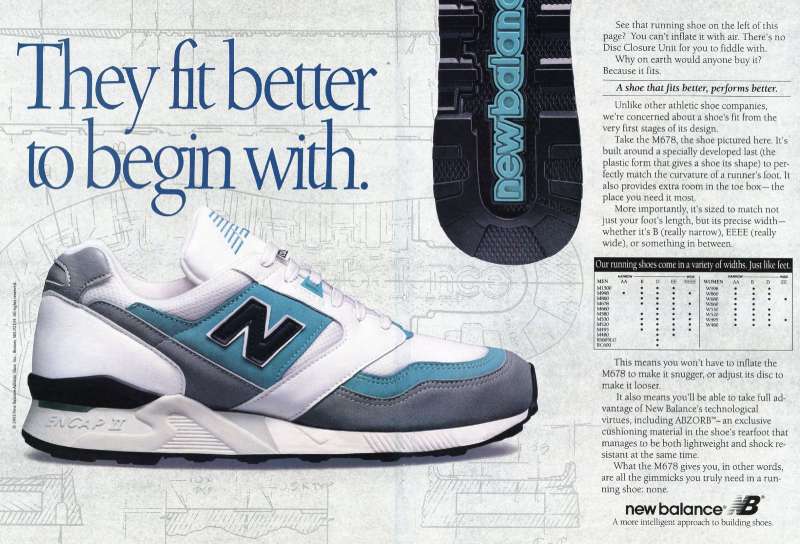
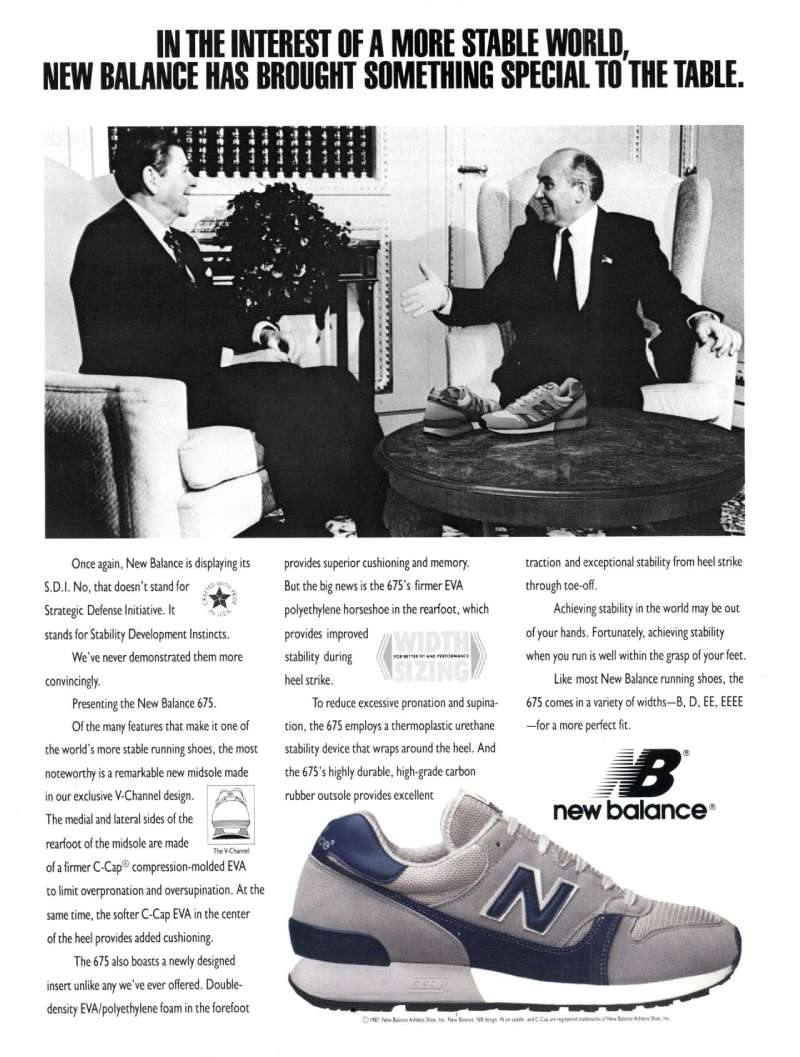

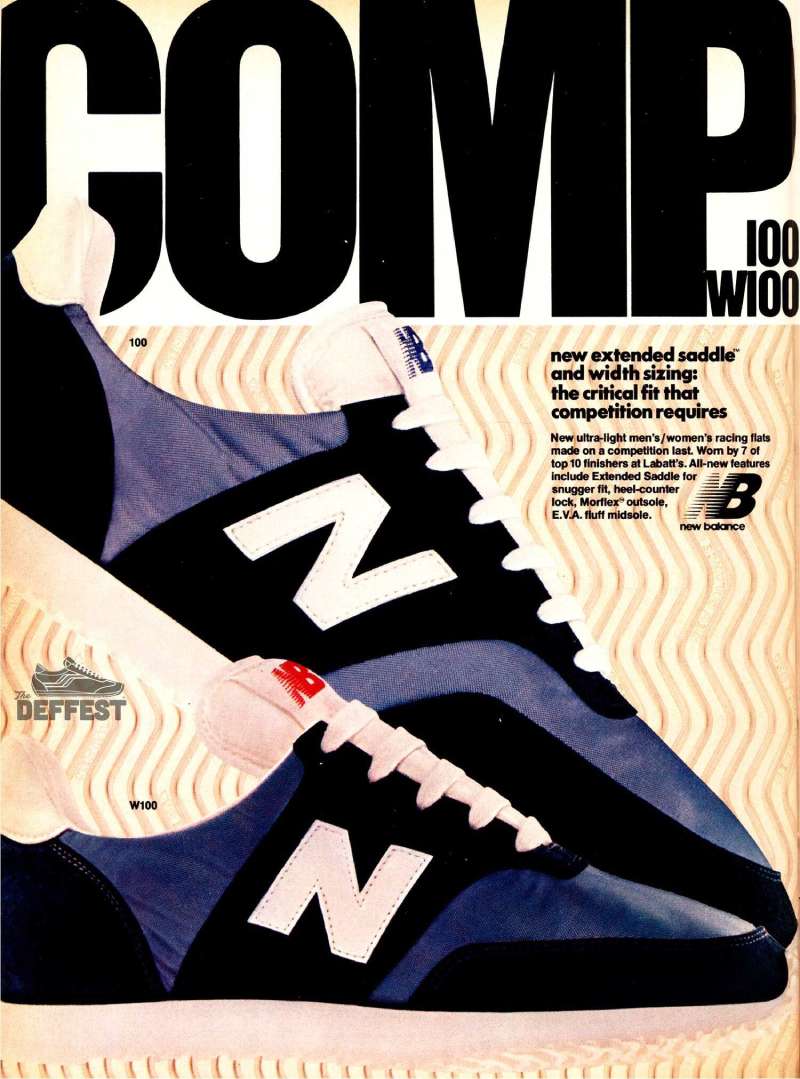
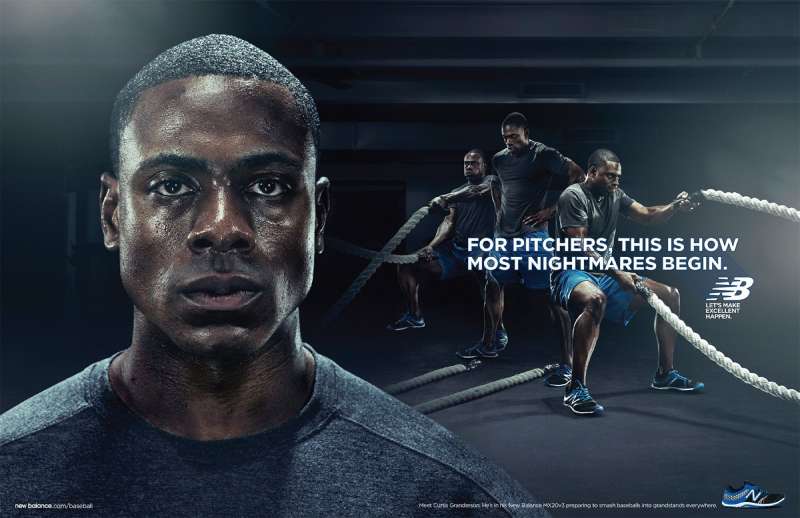
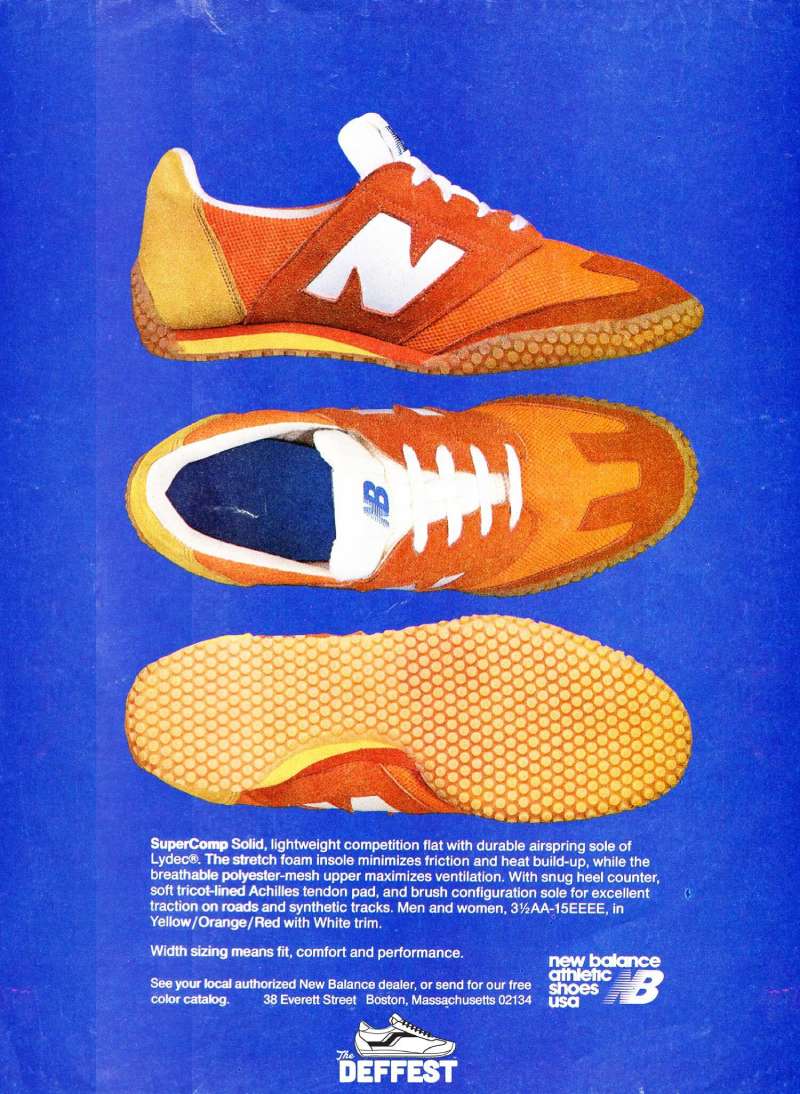
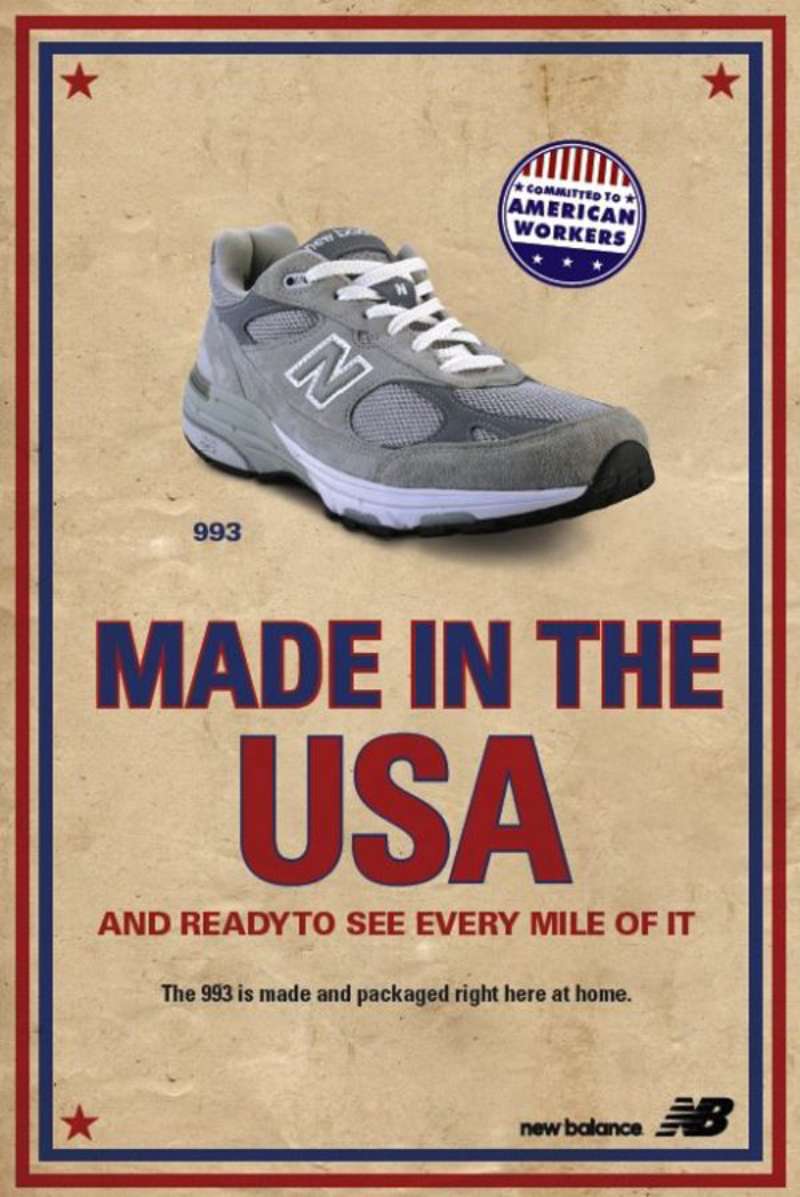
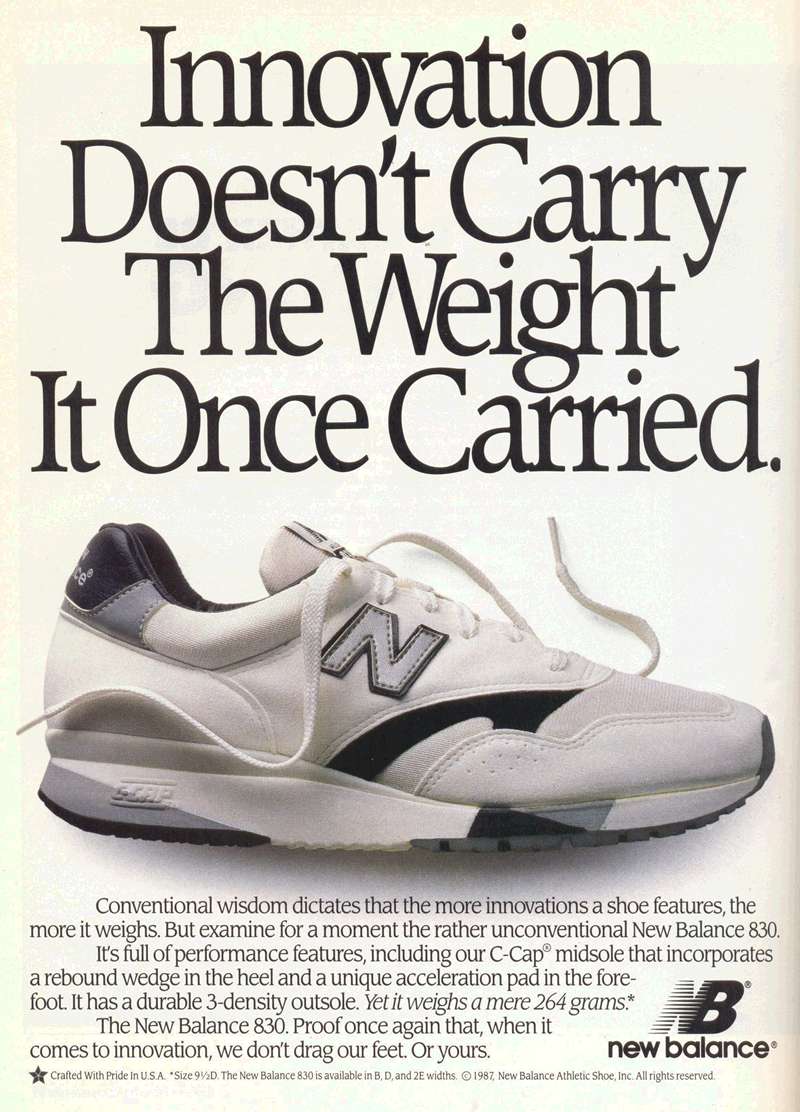
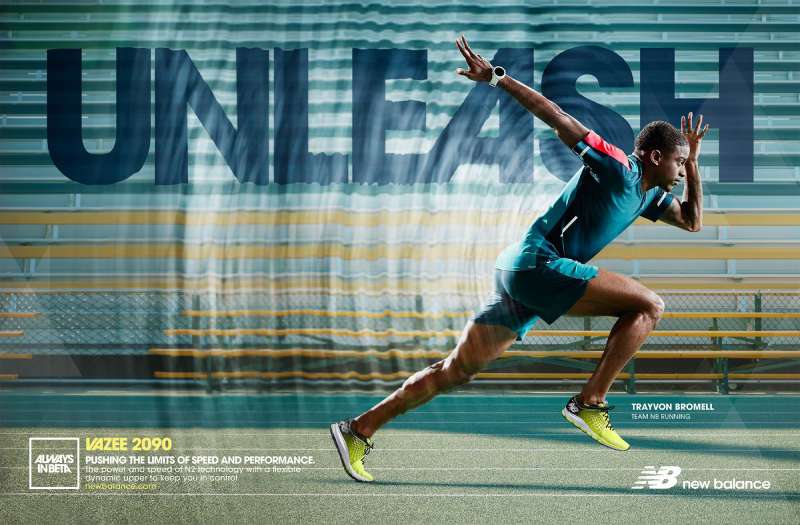
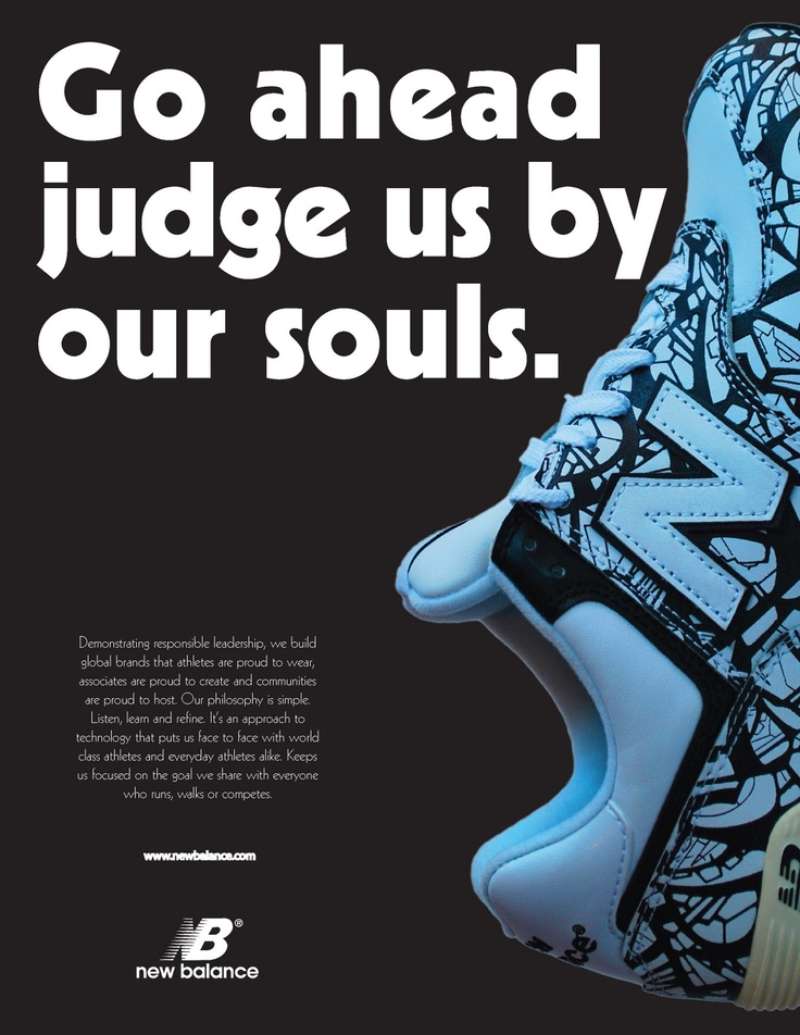
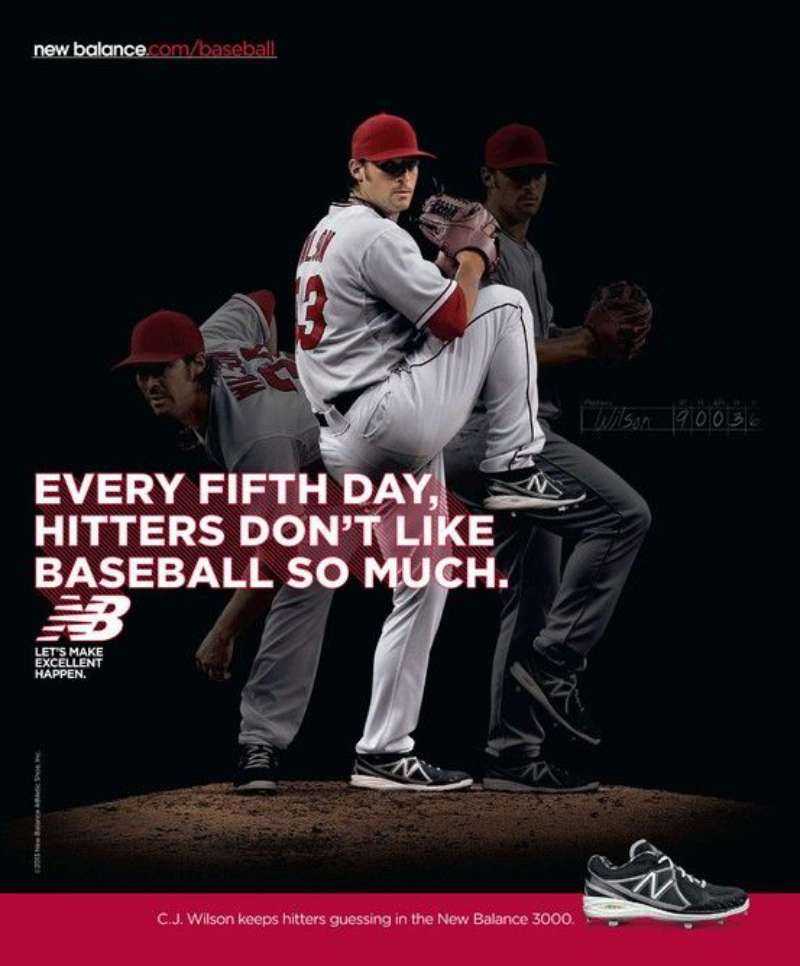


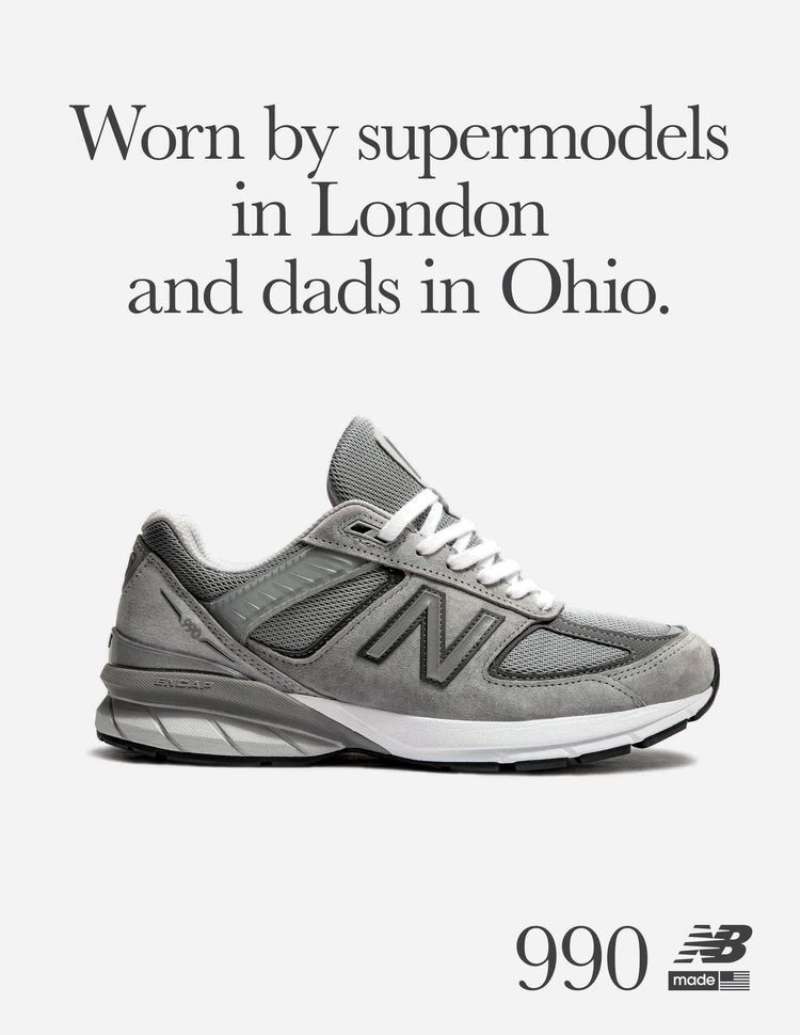


New Balance’s print advertising spans roughly five decades, appearing in running publications, lifestyle titles, and general sports media across the US, UK, Japan, and Europe. The work reflects the brand’s shift from purely functional messaging to cultural positioning.
By decade
1970s–1980s
Early print work was almost entirely functional: product specifications, heel support claims, biomechanics copy. Publications were runner-specific (Runner’s World, running club newsletters). No lifestyle angle. The brand was talking to serious runners in the language serious runners used.
The 990 launched in 1982 at $100, a significant price point for the era. Print ads around that release reflected the premium positioning with technical copy and minimal design.
1990s
The “Endorsed by No One” ethos translated directly to print: clean product shots, minimal copy, no celebrity. Magazine placements were still athlete-focused, which is the era that cemented the “dad shoe” association. The people buying these shoes in the 1990s are now in their 50s.
2000s
Print work in this decade was competent but not distinctive. BBDO and JWT both produced work for New Balance, including the “62, 55, 35” series. The work appeared in Ads of the World archives but didn’t define the brand.
2010s–2020s
Print became a smaller part of the mix as digital took over. The Grey Days campaign revived it meaningfully with Thrasher magazine placements and European out-of-home that felt considered. The “Fearlessly Independent” platform also produced strong typography-driven print work consistent with VML’s 2018 visual identity system.
Award-winning print ads
| Year | Campaign | Award | Agency |
|---|---|---|---|
| 2018 | Fearlessly Independent Since 1906 | Brand platform recognition (industry press) | VML |
| 2023 | Grey Days | Ads of the World feature | American Haiku |
Documented award wins for New Balance print specifically are limited. The brand’s recognition has historically come from cultural impact and campaign effectiveness rather than formal advertising awards.
How does New Balance advertise digitally?
New Balance runs campaigns across YouTube, Instagram, TikTok, Facebook, and its own channels, with a mix of brand storytelling content and product-specific ads. Since 2023, data-driven creative testing determines budget allocation before campaigns go live.
The Swayable partnership changed how New Balance thinks about digital spend. Rather than producing a campaign and running it, they test multiple creative versions with real audiences first. The key finding from 46,000 responses across 7 rounds: product name as headline, no sub-header.
The broader digital shift between 2018 and 2022 moved 70% of marketing budget away from Google transactional ads and toward brand campaigns on social and streaming platforms.
Most viewed YouTube ads
| Rank | Title | Year | Talent |
|---|---|---|---|
| 1 | We Got Now (launch) | 2020 | Kawhi Leonard |
| 2 | We Got Now: Basketball | 2023 | Leonard, Murray, Brink, Maxey |
| 3 | Hey You | 2022 | Jack Harlow, Kawhi Leonard |
| 4 | We Got Now (Coco Gauff) | 2020 | Coco Gauff |
| 5 | Grey Days | 2023 | Community-focused |
Social media and influencer approach
New Balance builds social content around athlete partners rather than traditional influencer programs, with a secondary UGC layer through the #MyNBalance campaign.
The timing of athlete signings is the interesting part. Coco Gauff was signed at 14, before her 2019 Wimbledon run made her a household name. Cooper Flagg was signed before the 2025 NBA Draft. The pattern is consistent: find athletes with genuine upside, sign early, build the relationship before the fame arrives.
That approach costs less upfront and produces more authentic content. An athlete who grew up with the brand talks about it differently than one who showed up to a shoot.
How do New Balance ads compare to competitors?
New Balance has deliberately avoided the achievement-and-greatness framing that Nike owns, and the luxury-lifestyle positioning Adidas has leaned into. The differentiator is early athlete investment combined with heritage credibility that neither competitor can easily replicate.
Nike spends around $3–4 billion annually on marketing. Adidas spent roughly $2.7 billion in 2023. New Balance doesn’t disclose its figure, but it’s operating at a fraction of that spend and still generated $7.8 billion in 2024 revenue.
The efficiency comes from the early-signing model and the 990’s earned cultural status. The shoe doesn’t need much advertising. It has 40 years of subcultural history that functions as earned media.
What New Balance hasn’t done: Super Bowl ads, sustained celebrity-lifestyle campaigns in the fashion sense, or the culture-manufacturing that Adidas pursued with Kanye West. Whether that’s principle or budget constraint depends on who you ask.
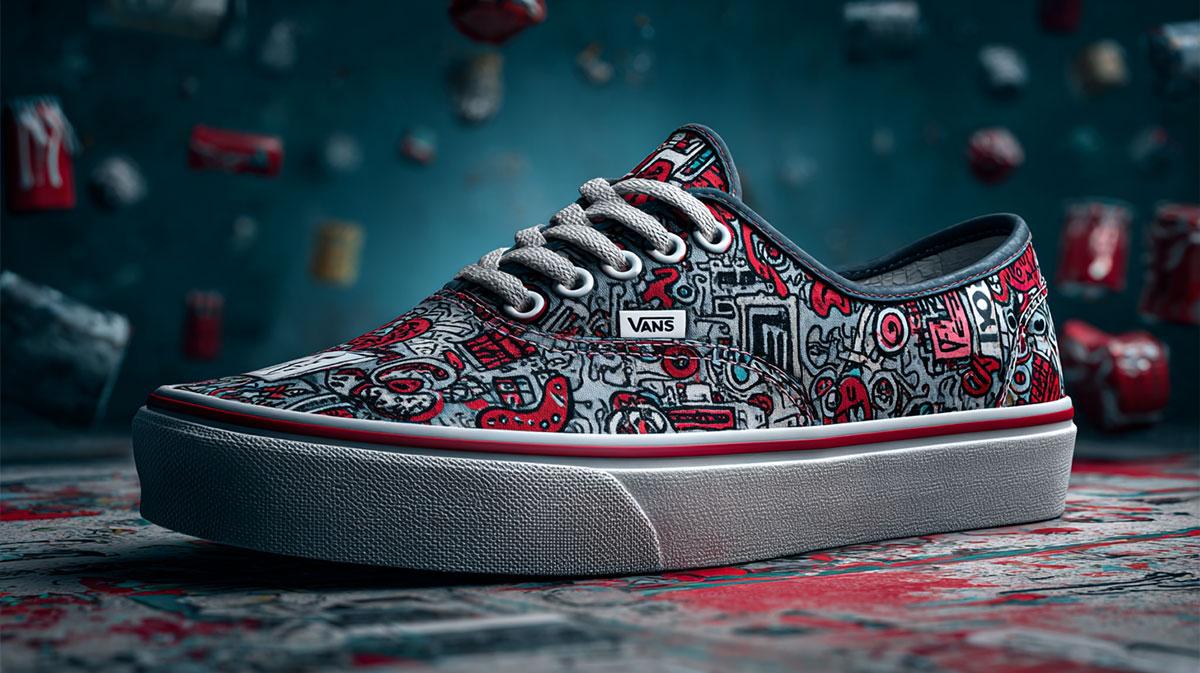
For comparison, Vans ads rely heavily on skateboarding subculture and music sponsorships, while Converse ads have leaned into youth culture and artistic self-expression for decades. New Balance sits in its own lane: neither subcultural niche nor mass-market.
Awards
| Year | Campaign | Award | Agency |
|---|---|---|---|
| 2018 | Fearlessly Independent Since 1906 | Industry recognition (brand platform) | VML / ACE Content |
| 2020 | We Got Now (launch) | NBA marketing partnership recognition | The Rec League |
| 2023 | Grey Days | Ads of the World feature | American Haiku |
Controversies
In November 2016, a New Balance VP’s comments about the Trans-Pacific Partnership were misappropriated by white nationalist groups online, framing New Balance as their preferred brand. New Balance publicly condemned white nationalism, but the episode damaged brand perception and accelerated the 2018 rebrand.
New Balance’s statement was unequivocal. The damage was real but not permanent. By 2024, the brand had fully recovered on awareness and favorability metrics.
The “Fearlessly Independent” launch in 2018 served as the definitive restatement of what the brand stood for, which in retrospect was probably more effective than any direct response would have been.
More brand advertising archives
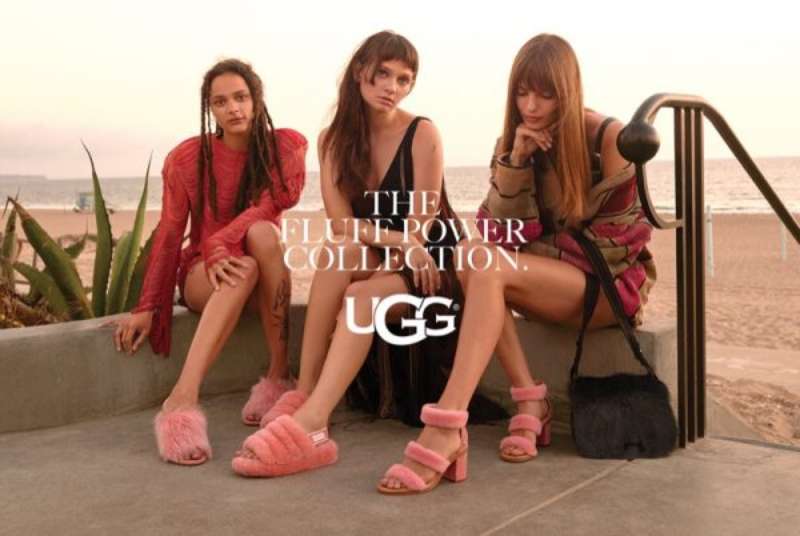
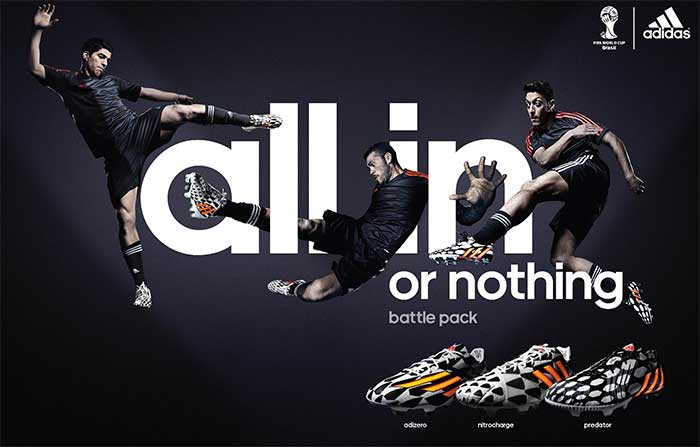
Looking at how different footwear brands approach advertising reveals genuinely different strategic choices. Reebok ads show what happens when a brand loses positioning clarity, while Puma ads offer a case study in sports-culture crossover done at a mid-tier budget.
Skechers ads take a comfort-first approach that skips culture entirely, and Steve Madden ads go in a completely different visual direction. Beyond footwear, Lacoste ads and Ralph Lauren ads demonstrate how lifestyle brands build long-term brand equity through consistent visual identity rather than campaign-by-campaign repositioning.
FAQ on New Balance Ads
What is New Balance’s most famous ad campaign?
“We Got Now” is the brand’s most recognized campaign, running from 2020 through 2024.
It featured Kawhi Leonard, Coco Gauff, Jack Harlow, and Shohei Ohtani across TV, digital, and social, tied to a global NBA marketing partnership.
Who makes New Balance ads?
No single agency holds the account. The Rec League produced the original “We Got Now” spot, VMLY&R extended it, VML built the “Fearlessly Independent” platform, and American Haiku made the Grey Days film.
When did New Balance start advertising?
Print campaigns go back to the 1970s, focused entirely on running performance.
The brand ran its first recognizable brand-level campaign, “Endorsed by No One,” in the 1990s, rejecting celebrity endorsements entirely.
How does New Balance advertising differ from Nike?
Nike leads with greatness and achievement. New Balance leans on independence, craft, and athletes shown in quiet, real moments.
“We Got Now” deliberately avoided the inspirational voiceover format Nike has used for decades.
Who are New Balance’s brand ambassadors in ads?
The current roster includes Coco Gauff, Kawhi Leonard, Shohei Ohtani, Sydney McLaughlin-Levrone, Tyrese Maxey, Jamal Murray, Cameron Brink, and Cooper Flagg.
Jack Harlow appeared in the 2022 “Hey You” spot alongside Leonard.
Why did New Balance use the “Endorsed by No One” tagline?
The brand was privately held and genuinely believed product quality should sell itself.
It positioned New Balance as the anti-hype choice for serious runners, a stance that built loyalty but eventually limited growth outside the core running audience.
How much does New Balance spend on advertising?
The brand does not disclose its budget publicly.
What’s known is that it shifted 70% of marketing spend away from transactional Google ads toward athlete-led brand campaigns between 2018 and 2024, coinciding with revenue growing to $7.8 billion.
What was the “Fearlessly Independent Since 1906” campaign?
A global brand platform launched in February 2018, created by VML and ACE Content.
It introduced a new visual identity and positioned New Balance as a brand built on independence, featuring athletes like Francisco Lindor, Rose Lavelle, and Jürgen Klopp.
What is the Grey Days campaign?
An annual campaign celebrating the New Balance 990 and its signature grey colorway.
The 2023 version, made by American Haiku and shot in 16mm black and white, ran in US cinemas and across European out-of-home, with placements in Thrasher magazine.
How does New Balance target younger audiences in its ads?
The brand signs athletes early, before they reach peak fame.
Coco Gauff was signed at 14, Cooper Flagg before the NBA Draft. This creates authentic relationships that show up differently in campaigns than late-career endorsement deals.
Conclusion
New Balance Ads tell the story of a brand that took the long way around, from anti-endorsement print campaigns to a $7.8 billion operation with one of the most talked-about athletic footwear marketing rosters in the industry.
The “We Got Now” platform didn’t come from nowhere. It came from decades of earned credibility with runners, sneaker collectors, and subcultures that never needed convincing.
What makes New Balance worth studying isn’t the production budgets or the celebrity signings. It’s the timing. Signing Coco Gauff at 14. Betting on the 990’s grey colorway before lifestyle sneaker culture caught up.
Brand storytelling works when the brand actually has a story. New Balance does.

Renowned for his expertise in logo design and visual branding, Bogdan has developed a multitude of logos for various clients.
His skills extend to creating posters, vector illustrations, business cards, and brochures. Additionally, Bogdan's UI kits were featured on marketplaces like Visual Hierarchy and UI8.
He also wrote in the past years on sites like Design Your Way, WebDesignerDepot, WPDean, Designmodo, Speckyboy, Slider Revolution, and more.
- Canva vs PowerPoint: Which Is Better for Presentations? - 22 September 2026
- How to Install Fonts on Mac (Step-by-Step Guide) - 20 September 2026
- From Mockup to Code: How AI-Augmented Development Speeds Up the Design Handoff - 19 September 2026

Bogdan Sandu is a seasoned designer who has been designing websites since 2008. Renowned for his expertise in logo design and visual branding, Bogdan has developed a multitude of logos for various clients. His skills extend to creating posters, vector illustrations, business cards, and brochures. Additionally, Bogdan's UI kits were featured on marketplaces like Visual Hierarchy and UI8. He also wrote in the past years on sites like Design Your Way, WebDesignerDepot, WPDean, Designmodo, Speckyboy, Slider Revolution, and more.
You Might Also Like