

The Netflix logo is one of the most instantly recognized brand marks in entertainment. That bold red wordmark, paired with the standalone “N” icon, shows up on every screen you can think of, from 65-inch TVs to tiny phone notifications.
Netflix, Inc. was founded in 1997 by Reed Hastings and Marc Randolph in Los Gatos, California. The company started as a DVD-by-mail rental service before becoming the streaming giant it is today, with over 283 million subscribers worldwide.
The current wordmark version launched in 2014. The “N” symbol followed in 2016. Across nearly three decades, Netflix has gone through roughly five distinct logo iterations, each one reflecting a shift in the company’s business model and brand positioning.
What Is the Netflix Logo?
The Netflix logo is a custom wordmark featuring the company name “NETFLIX” in bold, red uppercase letters with a subtle upward arch along the bottom edge. Introduced in its current form in 2014 by New York design studio Gretel, the logo represents the streaming platform’s focus on cinematic entertainment and content accessibility.
Here is a breakdown of its core attributes:
- Design Type: Wordmark (primary) and lettermark/monogram (secondary “N” icon)
- Primary Elements: Custom uppercase lettering with arched baseline, standalone ribbon-folded “N” symbol
- Official Introduction Date: 2014 for the current wordmark, June 2016 for the “N” icon
- Designer/Agency: Gretel (New York-based design studio) for the 2014 wordmark. Netflix Sans, the brand’s custom typeface used across the platform, was developed in 2018 with Dalton Maag
- Trademark Status: Registered with the USPTO. The wordmark (Registration No. 4236137) was filed in 2011 and registered in 2012. The stylized red wordmark (Registration No. 4788783) was filed in 2014 and registered in 2015. The “N” icon was trademarked in 2017. Netflix holds over 200 active trademark filings
- Color Palette: Netflix Red (#E50914), Black (#000000), White (#FFFFFF)
- Usage Context: Streaming app interfaces, original content title cards, marketing campaigns, merchandise, social media profiles, and the animated “Tudum” intro sequence
How Has the Netflix Logo Evolved Over Time?
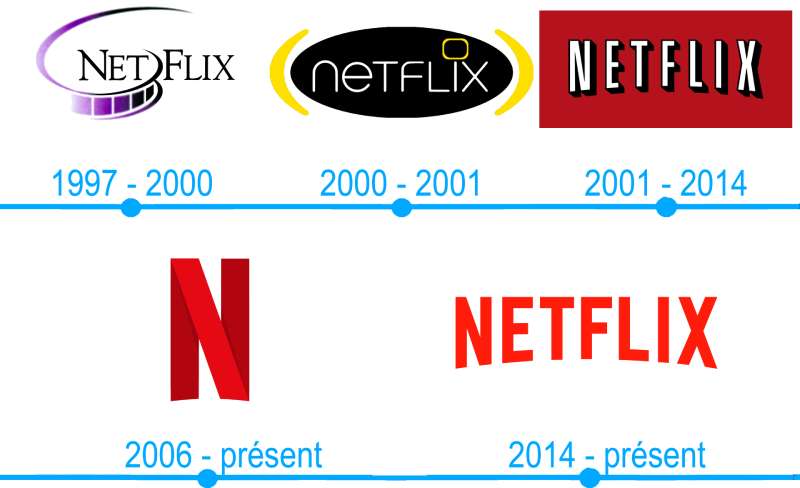
Netflix has redesigned its logo roughly five times since 1997. The journey goes from a film-reel-themed serif mark to the clean, flat red wordmark and ribbon “N” you see today.
Each version mirrored what the company was doing at the time, whether that was renting DVDs by mail or streaming original content to millions globally.
Original Netflix Logo (1997-2000)
Years Active: 1997-2000
The first Netflix logo had a classic, almost old-Hollywood feel to it. The company name was spelled out in a bold serif font with sharp, geometric letter endings. A purple-to-black film reel graphic curled out between the “T” and “F,” splitting the name into “Net” and “Flix.”
The letters “N” and “F” stood taller than the rest, adding some visual hierarchy to the mark.
Purple and black dominated the color palette. This made sense for a late-90s startup rooted in the physical movie business. The film strip literally showed you what the company did.
It felt right for the era. But it only lasted three years.
The Yellow and Black Oval Logo (2000-2001)
Years Active: 2000-2001
This one is the odd duck in Netflix’s history. And honestly, most people have never seen it.
The design shifted drastically. A solid black horizontal oval, framed by two rounded yellow brackets. Inside, “netflix” appeared in thin white lowercase letters. The dot above the “i” was replaced with a small yellow square.
Gone was the cinematic serif styling. The new look tried to feel modern, maybe even futuristic. It did not stick around long.
The yellow and black scheme felt disconnected from entertainment. It looked more like a tech startup logo than a movie service. Netflix clearly agreed, because this version barely made it through a single year.
The Red Background 3D Logo (2001-2014)
Years Active: 2001-2014
This is the version most people remember from the DVD-era and early streaming days. “NETFLIX” in tall white capital letters, spread across a deep red background. Each letter had a black outline and a bold diagonal drop shadow.
The look was cinematic, deliberate, like something you would see on a vintage movie title card. The sans-serif font was clean but the 3D treatment made it pop.
This version stuck around for 13 years. That is a long run. It carried Netflix through its transition from DVD rentals to streaming, through the launch of original content, through everything that turned the company into a household name.
The red was darker than what Netflix uses now. More theatrical. More mysterious. It worked for a company that was still building its identity in the entertainment space.
The Modern Flat Wordmark (2014-Present)
Years Active: 2014-present
In 2014, Netflix hired Gretel, a New York design studio, to rethink the brand. The result stripped away everything extra. No drop shadows. No outlines. No red background.
Just the word “NETFLIX” in bold red letters on a clean background.
The font was based on a blend of Gotham Book and Gotham Bold. Letters got heavier and bolder. The bottom edges of the letterforms arch slightly upward toward the center, giving the wordmark a subtle cinematic curve.
Gretel’s concept was called “the stack,” meant to represent an infinite catalog of personalized content. The approach leaned heavily into minimalist design principles that were gaining popularity across the tech and media industries at the time.
Red became brighter. The specific shade, Netflix Red (#E50914), was chosen to feel energetic and digital-friendly. It works equally well on dark and light backgrounds, which matters when your logo lives on millions of different screens.
The “N” Icon (2016-Present)
Years Active: 2016-present
This was not a replacement. It was an addition.
In June 2016, Netflix introduced a standalone “N” lettermark. The full wordmark did not work well on mobile apps and social media profiles where space is tight. So they created something that could stand on its own.
The icon shows the letter “N” formed by what looks like a folded red ribbon, with two vertical strokes and a diagonal connector. The different sections use varying shades of red to create a sense of depth and dimension.
It usually sits on a black background, and it animates in the now-famous “Tudum” intro before Netflix originals. Netflix themselves said it best: there is power in owning a letter of the alphabet.
What Do the Design Elements of the Netflix Logo Mean?
Every piece of the Netflix logo was picked for a reason. The color, the letterforms, the curve along the bottom of the wordmark. None of it is random.
The red grabs attention. The clean letters signal confidence and modernity. The arched baseline gives a cinematic widescreen feel, which ties back to what Netflix actually does: deliver movies and shows.
Why Did Netflix Choose These Specific Colors?
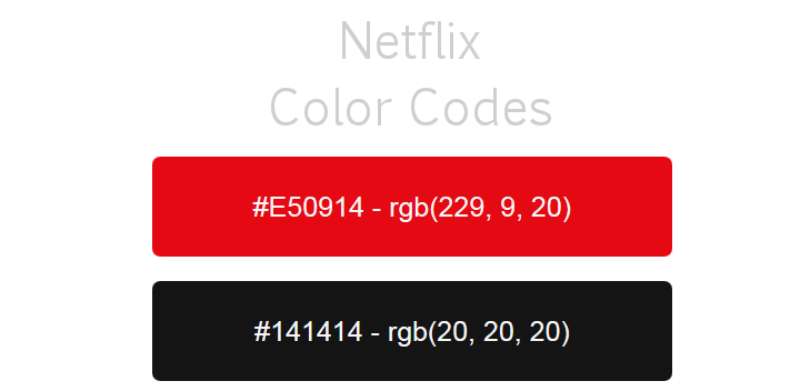
Netflix Red is the backbone of the whole identity. Here is what the colors communicate:
Netflix Red – Hex: #E50914, RGB: (229, 9, 20), CMYK: (0, 96, 93, 2), Pantone: 1795 C. Red signals energy, excitement, and passion. It is the go-to color for entertainment brands. Think about how many red logos dominate the media and food industries.
The psychology behind color choices like this is straightforward. Red triggers urgency and emotional arousal. For a platform that wants you to hit play and keep watching, that is exactly the right signal to send.
Black – Hex: #000000. Used primarily as the background for the “N” icon and streaming interfaces. Black adds contrast and creates a theater-like atmosphere. There is a reason movie theaters are dark.
White – Hex: #FFFFFF. Functions as the background for the flat wordmark and provides breathing room. The simplicity of white against red keeps the focus tight.
What Typography Style Is Used in the Netflix Logo?
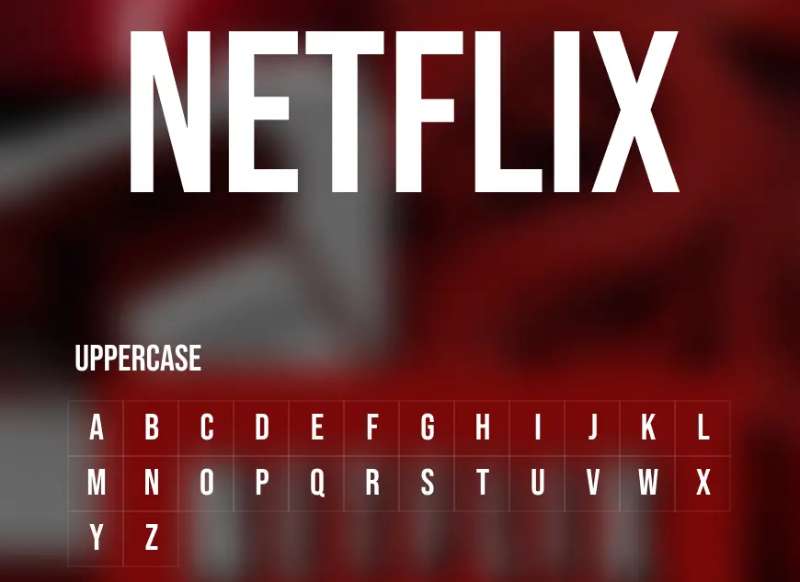
The Netflix wordmark uses a custom letterform based on Gotham Book and Gotham Bold. The uppercase characters are bold and wide, with straight-cut tops and slightly elongated or shortened bars at the bottom to create that arched effect.
In 2018, Netflix went further and created Netflix Sans, a proprietary typeface developed with foundry Dalton Maag. This sans-serif family comes in weights from thin to black and handles everything from billboard headlines to subtitle text.
The lowercase “t” in Netflix Sans has an arched cut inspired by the wordmark’s cinemascopic curve. That is the kind of detail most people never notice, but it ties the whole system together.
Netflix moved away from licensing Gotham partly because font licensing costs were adding up globally. Building a custom typeface saved money and gave the brand something entirely its own.
What Are the Hidden Meanings in the Netflix Logo?
The name itself splits into “Net” (internet) and “Flix” (movies). The original 1997 logo made this literal with a film strip between the two halves.
The “N” icon’s ribbon-fold design suggests depth and layering, like scrolling through an endless content library. Some people see a play button in the diagonal stroke. That was likely intentional.
The arched bottom edge of the wordmark mimics a widescreen or cinemascope frame. It is a subtle nod to the movie-watching experience, baked right into the letter shapes. Gretel and the Netflix team have been fairly open about these choices, which makes the symbolism less “hidden” and more “quietly embedded.”
How Does the Netflix Logo Compare to Competitor Logos?
Netflix sits in a crowded field of streaming platforms, and each one takes a different approach to branding. The Netflix wordmark is flat, bold, and entirely typographic. Compare that to Disney+, which leans on decades of character-driven brand recognition.
The Hulu logo uses a friendly lowercase wordmark in green, a completely different energy. HBO keeps things tight and institutional. Amazon Prime Video goes with a blue-and-teal palette that feels more corporate than cinematic.
What makes Netflix stand out is the consistency. That red is everywhere and it is always the same red. When you see that specific shade on a dark background, your brain says “Netflix” before you even read the letters. Few competitors have that kind of instant recognition.
Among tech company logos, Netflix is interesting because it does not use an abstract symbol as its primary mark. No swooshes, no abstract shapes. Just the name. And then a single letter for small spaces. That directness is unusual in the streaming space, and it works precisely because the content library does the heavy lifting for brand affinity.
What Are the Technical Specifications of the Netflix Logo?
Official Color Codes:
- Primary – Netflix Red: Hex: #E50914 | RGB: (229, 9, 20) | CMYK: (0, 96, 93, 2) | Pantone: 1795 C
- Secondary – Black: Hex: #000000 | RGB: (0, 0, 0) | CMYK: (0, 0, 0, 100)
- Tertiary – White: Hex: #FFFFFF | RGB: (255, 255, 255) | CMYK: (0, 0, 0, 0)
Dimensions and Proportions:
Netflix’s brand guidelines require a minimum contrast ratio of 2.25:1 between the logo and its background for clear visibility. The “N” symbol always uses two tones of red to create dimension, keeping it distinct from the flat red of the full wordmark.
The primary background for the “N” icon is black, designed to mimic a theater-like viewing environment. Clear space around the logo must be maintained to prevent visual clutter, though Netflix has not publicly shared exact pixel-level minimum size requirements.
For digital use, the logo is available in vector graphics formats (SVG, EPS) and raster formats (JPEG, PNG). Vector versions scale to any size without quality loss, which is critical when the same logo appears on a phone icon and a highway billboard.
What Cultural Impact Has the Netflix Logo Had?
The Netflix logo (and the “Tudum” sound that goes with it) has become a cultural shorthand. “Netflix and chill” turned the brand name into a verb, essentially. The red “N” is recognizable across virtually every country the service operates in.
Few logos from the streaming era have reached this level of pop culture saturation. The animated “N” ribbon intro before original content has become its own moment. People recognize it by sound alone.
Netflix’s branding has influenced how other film company logos approach their visual identities in the digital age. The shift toward flat, scalable, screen-first design was something Netflix pushed early, and competitors followed.
How Does the Netflix Logo Fit Into the Overall Brand Identity?
The logo is just one layer of a larger system. Netflix’s brand identity includes the wordmark, the “N” icon, the “Tudum” sonic branding, Netflix Sans as the official typeface, and a strict color system built around that signature red.
Everything connects. The arched curve on the wordmark shows up in Netflix Sans’s lowercase “t.” The ribbon fold on the “N” uses the same red tones as the wordmark. The dark UI of the streaming app mirrors the black background of the icon.
Netflix publishes brand guidelines that cover how every piece works together. This kind of systematic thinking, where each element reinforces the next, is what turns a logo into a brand identity. It is not about one mark. It is about the whole ecosystem speaking the same language.
How Should the Netflix Logo Be Used?
Official Do’s:
- Use the logo in its approved colors (Netflix Red on white/light backgrounds, or white on dark backgrounds)
- Maintain required clear space around the logo at all times
- Use official files from the Netflix Brand Site (brand.netflix.com) for any authorized usage
- Check that background contrast meets the 2.25:1 minimum ratio
Official Don’ts:
- Do not alter the logo’s colors, proportions, or spacing
- Do not place the logo on busy or low-contrast backgrounds
- Do not recreate the logo using substitute fonts
- Do not animate the logo in unauthorized ways
- Do not use the Netflix name or logo to imply endorsement without permission
Where to Access Official Logos: Netflix provides approved logo assets through its official brand site at brand.netflix.com. Media partners and licensed producers can access assets through dedicated partner portals.
Trademark Protection: Netflix is a registered trademark of Netflix, Inc. The company holds over 200 active trademark filings with the USPTO, covering everything from the wordmark and “N” icon to the “Tudum” sound mark (a sensory trademark registered in 2017). Unauthorized use of the Netflix logo can result in legal action under federal trademark law.
FAQ on The Netflix Logo
What Does the Netflix Logo Look Like?
The Netflix logo is a bold red wordmark spelling “NETFLIX” in custom uppercase letters. The bottom edge arches slightly upward. A separate “N” ribbon icon works as the app symbol on smaller screens.
Who Designed the Current Netflix Logo?
New York design studio Gretel created the 2014 wordmark. Netflix also partnered with Dalton Maag in 2018 to build Netflix Sans, a custom typeface used across all brand materials and the streaming platform’s interface.
What Font Does the Netflix Logo Use?
The wordmark blends Gotham Book and Gotham Bold into a custom letterform. Netflix Sans, the brand’s proprietary sans-serif typeface, handles everything else. It comes in weights from thin to black.
What Are the Official Netflix Logo Colors?
Netflix Red (#E50914) is the primary color. Black (#000000) serves as the icon background. White (#FFFFFF) provides contrast. The red carries a Pantone value of 1795 C.
Why Is the Netflix Logo Red?
Red signals energy and excitement. It grabs attention fast, which matters for an entertainment brand competing for screen time. The specific shade was chosen to look sharp across digital displays, from phones to TVs.
What Does the Netflix “N” Icon Mean?
The standalone “N” launched in 2016 for mobile apps and social media. It looks like a folded ribbon with varying red shades that create depth. Netflix built it because the full wordmark was too wide for small screens.
How Many Times Has the Netflix Logo Changed?
About five times. The 1997 original had a purple film reel. A short-lived yellow oval came in 2000. The red 3D version ran from 2001 to 2014. The flat wordmark arrived in 2014, and the “N” icon followed in 2016.
Is the Netflix Logo Trademarked?
Yes. Netflix holds over 200 active trademark filings with the USPTO. The wordmark, the red “N” icon, and even the “Tudum” sound are all registered. Unauthorized use can lead to legal action.
Can I Use the Netflix Logo for My Project?
Only with permission. Netflix provides official assets through brand.netflix.com for authorized partners. Using the logo without a license, especially to imply endorsement, violates their brand style guide and trademark protections.
What Is the “Tudum” Sound in the Netflix Logo Animation?
The “Tudum” is a sonic branding element composed by Oscar-winning sound designer Lon Bender. It plays during the animated “N” intro before original content. Netflix registered it as a sensory trademark in 2017.
Conclusion
The Netflix logo has gone from a film-reel serif mark to one of the most recognized symbols in streaming. Each redesign matched a real shift in the business, not just a design trend.
That red wordmark and ribbon “N” now carry the same instant recognition as logos from companies like Sony or Adobe.
The takeaway is simple. Strong logo design principles, a clear color palette, and a willingness to simplify over time can turn a startup’s brand mark into a global icon.
Netflix proved that less really does work better on screen.

Renowned for his expertise in logo design and visual branding, Bogdan has developed a multitude of logos for various clients.
His skills extend to creating posters, vector illustrations, business cards, and brochures. Additionally, Bogdan's UI kits were featured on marketplaces like Visual Hierarchy and UI8.
He also wrote in the past years on sites like Design Your Way, WebDesignerDepot, WPDean, Designmodo, Speckyboy, Slider Revolution, and more.
- How to Install Fonts on Mac (Step-by-Step Guide) - 20 September 2026
- From Mockup to Code: How AI-Augmented Development Speeds Up the Design Handoff - 19 September 2026
- The Beehiiv Logo History, Colors, Font, And Meaning - 18 September 2026

Bogdan Sandu is a seasoned designer who has been designing websites since 2008. Renowned for his expertise in logo design and visual branding, Bogdan has developed a multitude of logos for various clients. His skills extend to creating posters, vector illustrations, business cards, and brochures. Additionally, Bogdan's UI kits were featured on marketplaces like Visual Hierarchy and UI8. He also wrote in the past years on sites like Design Your Way, WebDesignerDepot, WPDean, Designmodo, Speckyboy, Slider Revolution, and more.
You Might Also Like


