The Houston Astros logo is one of the most recognized marks in Major League Baseball. It carries over six decades of Texas baseball history, tied directly to the city’s connection to the American space program and NASA’s Johnson Space Center.
The current version, introduced in 2013, features a beveled white “H” placed over an orange five-pointed star inside a navy blue circular badge. It replaced the brick red and black design that the team used from 2000 to 2012.
Since the franchise started as the Houston Colt .45s in 1962, the team has gone through seven different primary logo designs. Each one reflected a specific period in the team’s identity, from frontier-themed branding to space-age imagery to the retro railroad look of the early 2000s.
The Astros’ visual identity has always tracked closely with changes in stadium, ownership, and league affiliation. The 2013 rebrand, designed by Todd Radom in collaboration with MLB and Fanbrandz, marked the team’s move from the National League to the American League West.
What Is the Houston Astros Logo?
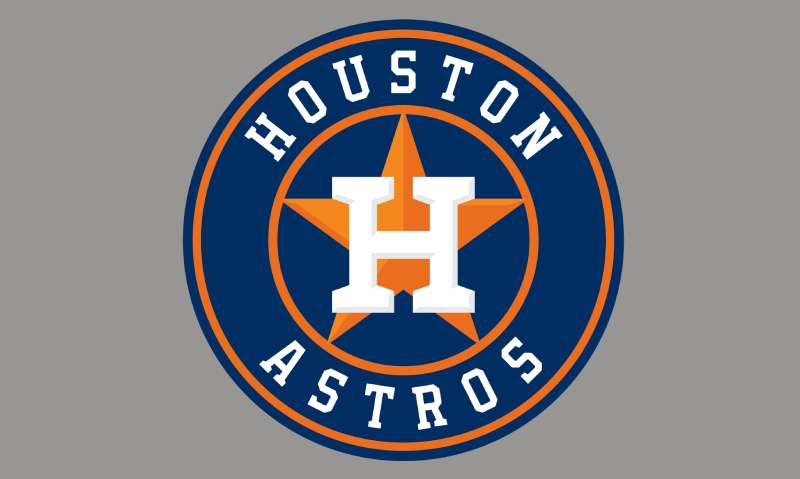
The Houston Astros logo is a circular badge featuring a white serif letter “H” over an orange five-pointed star, enclosed in a navy blue circle with double orange rings and the words “HOUSTON ASTROS” in white uppercase lettering. It was officially introduced in 2013.
Design Type: Combination mark (emblem style). It combines a monogram letter, a geometric star symbol, and a wordmark inside a circular badge format.
Primary Elements: Uppercase serif “H” with a thin gray outline, a three-dimensional faceted orange star, a navy blue circular field, double orange concentric rings, and “HOUSTON” / “ASTROS” text arched inside the outer band.
Official Introduction Date: November 2, 2012 (unveiled). Used on-field starting with the 2013 MLB season.
Designer/Agency: Todd Radom, working with MLB Properties and Fanbrandz. The font closely matches Player Bold, a geometric slab serif designed by Patrick Griffin and published by Canada Type.
Trademark Status: Registered with the United States Patent and Trademark Office (USPTO). The mark was filed on November 2, 2012, and registered in 2014 under Registration Number 4464765. Houston Astros, LLC holds 59 active trademarks with USPTO, covering the logo, wordmarks, mascot, and anniversary designs.
Color Palette:
- Navy Blue: Hex #002D62
- Orange: Hex #EB6E1F
- Light Orange: Hex #F4911E
- White: Hex #FFFFFF
Usage Context: Game uniforms, caps (New Era), merchandise (Fanatics), Minute Maid Park signage, digital platforms, broadcast graphics, and all official MLB licensed products.
How Has the Houston Astros Logo Evolved Over Time?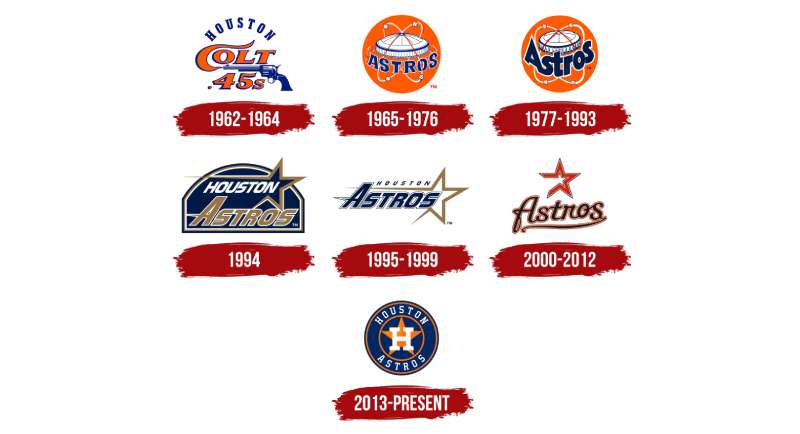
The franchise has used seven different primary logos since 1962. The designs moved from a Colt revolver to Astrodome imagery, then a shooting star, a scripted wordmark, and finally the current H-star badge.
Each change came during a major transition. New stadium, new ownership, new league. The branding always followed.
Houston Colt .45s Logo (1962-1964)
Years Active: 1962-1964
Design Description: A blue-and-white Colt Peacemaker revolver with a wisp of smoke forming the letter “C.” The team name “COLT .45s” appeared in large orange letters, with “Houston” arched above in a classic college serif typeface.
Color Scheme: Blue, orange, and white.
Context: The franchise entered the National League as an expansion team in 1962 alongside the New York Mets. The Colt .45s name referenced “the gun that won the West,” chosen through a fan naming contest. A trademark dispute with Colt’s Manufacturing Company forced the name change after three seasons.
Cultural Significance: This was the team’s frontier identity, reflecting Texas pride. The pistol imagery was bold for a baseball team but became legally problematic, pushing the franchise toward its space-themed future.
Astrodome Era Logo (1965-1976)
Years Active: 1965-1976
Design Description: A white Astrodome stadium centered on an orange circle, with two baseballs orbiting around it like satellites. The word “ASTROS” curved along the bottom in royal blue.
Color Scheme: Orange, royal blue, and white.
Context: The team moved into the Astrodome, the first domed sports stadium, known as the “Eighth Wonder of the World.” The new name “Astros” honored Houston’s role in the space program.
Key Changes from Previous: Complete departure from the firearm theme. Space-age imagery replaced frontier branding entirely.
Cultural Significance: This logo captured the excitement of the Space Race era. The orbiting baseballs looked like atomic models, connecting baseball to science and progress. It remains one of the most praised vintage MLB designs.
Updated Astrodome Logo (1977-1993)
Years Active: 1977-1993
Design Description: Similar concept to the previous version but with a modernized look. The Astrodome was shown from a slightly higher angle, the “ASTROS” text was significantly altered, and the overall proportions shifted.
Color Scheme: Navy blue, orange, and white.
Designer: The 1975 rainbow uniform design was developed by McCann Erickson, the team’s ad agency at the time, under direction from VP Gary Rollins.
Key Changes from Previous: Different angle on the stadium illustration, modified typeface, and adjusted proportions. This version appeared alongside the famous “Tequila Sunrise” rainbow uniforms that debuted in 1975.
Cultural Significance: The rainbow-striped uniforms became one of the most iconic (and polarizing) looks in MLB history. The logo itself was more of a refinement, but its association with those uniforms makes it deeply nostalgic for fans.
Shooting Star Logo (1994)
Years Active: 1994 (one season only)
Design Description: A gold shooting star streaked across the front of a navy blue Astrodome silhouette. The “Astros” wordmark appeared in white and gold italics, with “Houston” in smaller text above.
Color Scheme: Navy blue, gold, and white.
Key Changes from Previous: The orange was dropped for gold. The Astrodome moved to the background. The overall look was sharper and more aggressive, with forward-leaning italic text suggesting speed.
Cultural Significance: This was the first major rebrand in franchise history. It lasted only one season before the team simplified even further, removing the Astrodome entirely.
Streamlined Star Logo (1995-1999)
Years Active: 1995-1999
Design Description: The Astrodome was removed completely, leaving just the gold shooting star and the team name in navy blue italics. A small “Houston” appeared above the main wordmark.
Color Scheme: Navy blue, gold, and white.
Key Changes from Previous: Much simpler composition. The stadium disappeared, and the star became the primary graphic element.
Cultural Significance: This coincided with the final years at the Astrodome before the move to what would become Minute Maid Park. The minimalist approach to removing the stadium signaled that the team was ready for something new.
Vintage Star and Script Logo (2000-2012)
Years Active: 2000-2012
Design Description: An open-ended vintage star in brick red, sand, and black, with a flowing scripted “Astros” wordmark below it. The look leaned heavily into old-timey railroad and train-station themes.
Color Scheme: Brick red (Hex #9A3324), sand, and black.
Context: The team moved to Enron Field (later renamed Minute Maid Park), built near Houston’s historic Union Station. The entire visual identity shifted to match the ballpark’s train theme.
Key Changes from Previous: Completely different color palette. Gone were the blues and golds. The script font replaced the italic block letters. The star shape changed from a shooting comet to a static, vintage-style open star.
Cultural Significance: The Astros won their first pennant wearing this design in 2005. But the look felt disconnected from the space-themed name. Fans were already wearing Tequila Sunrise throwbacks more than the current gear, which was a clear signal.
Current H-Star Badge (2013-Present)
Years Active: 2013-present
Design Description: A bold white serif “H” over a faceted orange five-pointed star, enclosed in a navy blue circle. Double orange rings separate the inner star from the outer band, which carries “HOUSTON” above and “ASTROS” below in white uppercase letters.
Color Scheme: Navy blue, orange, and white.
Designer: Todd Radom, with MLB Properties and Fanbrandz.
Key Changes from Previous: Return to the original navy and orange color combination. The train theme was completely abandoned. The badge format replaced the star-and-script design.
Cultural Significance: This logo has been worn during the most successful period in franchise history, including World Series titles in 2017 and 2022. The design nods to both the original 1962 color scheme and Houston’s space heritage. Fans and commentators have noted its similarity to the Hollywood Walk of Fame star format.
What Do the Design Elements of the Houston Astros Logo Mean?
Every part of the current Astros logo connects to Houston’s identity and the franchise’s baseball heritage. The star, the letter, the circle, the colors. None of it is random.
The five-pointed star is the most obvious reference. Texas is the Lone Star State, and Houston is tied to NASA and space exploration. The star pulls double duty there.
What Does the Star Symbol Represent?
The orange five-pointed star sits at the center of the badge and serves as the focal point of the whole design.
It references both the Texas Lone Star and the franchise’s connection to the space industry. Houston’s Johnson Space Center has been part of the city’s identity since the 1960s.
The star also connects to the team’s original name change. When the Colt .45s became the Astros in 1965, stars and space imagery took over the branding completely. The psychology behind the star shape works well here. Stars suggest ambition, excellence, and aspiration.
Why Did the Houston Astros Choose These Specific Colors?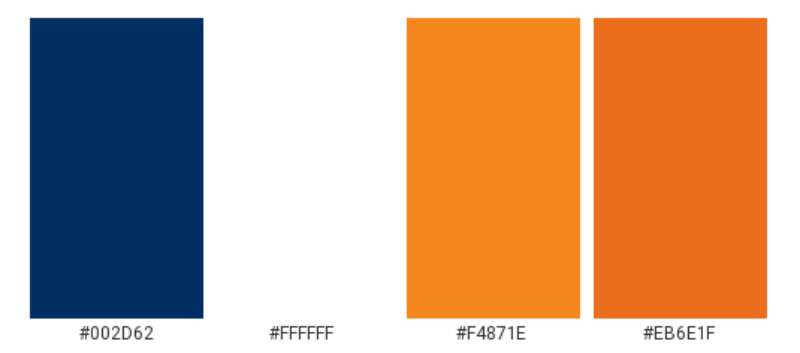
Navy Blue (#002D62)
Pantone PMS 648 C. Navy serves as the primary background color. It conveys authority, stability, and professionalism. In color psychology, deep blue builds trust and reliability.
Navy has been present in the Astros’ branding since the very beginning. The original 1962 Colt .45s used blue, and the Astrodome-era logos used royal blue. Returning to navy in 2013 was a deliberate callback.
Orange (#EB6E1F and #F4911E)
Pantone PMS 158 C (primary orange) and PMS 1495 C (light orange). Orange brings energy, enthusiasm, and warmth. It stands out against the deep navy and creates strong contrast.
This was also an original franchise color. The 1965 Astrodome logo had an orange background. The color dipped out during the 2000-2012 brick red era, and bringing it back felt like a homecoming for fans. Brands that use orange in their logos tend to feel approachable and energetic.
White (#FFFFFF)
White is used for the central “H” letter and the team name text. It creates clean readability against the navy background and adds a sense of precision to the design.
What Typography Style Is Used in the Houston Astros Logo?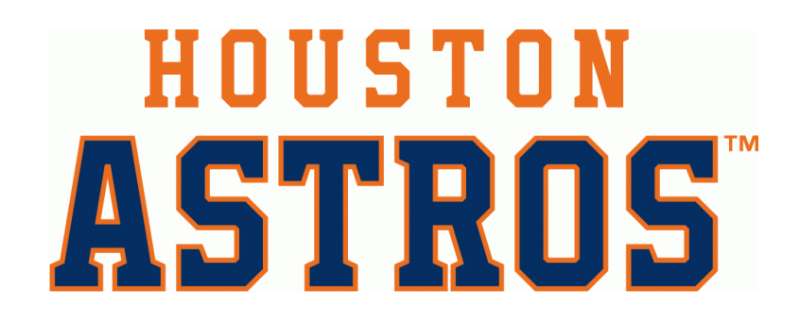
The typography in the current logo closely matches Player Bold, a geometric slab serif designed by Patrick Griffin and published by Canada Type.
The letterforms are strong, blocky, and have thick rectangular serifs. The uppercase “H” at the center looks stable because of its even weight distribution and clean geometry.
The “HOUSTON ASTROS” text in the outer ring uses a college-style serif face. It feels traditional without being old-fashioned. This is a big shift from the flowing script of the 2000-2012 era, which looked more nostalgic than athletic. Your mileage may vary on whether that was a good or bad thing, but the current type feels undeniably sportier.
Readability was clearly a priority. The previous logo had “Houston” in such small text that it was barely visible at smaller sizes. The current design fixes that by giving both words equal weight inside the badge ring.
What Are the Hidden Meanings in the Houston Astros Logo?
The circular badge format is shaped like a seal, which carries connotations of authority and official status. Some designers have pointed out its resemblance to the stars on Hollywood’s Walk of Fame.
The faceted star has a three-dimensional quality to it. It’s not flat. Those angled planes catch the eye and give the mark a sense of depth that most baseball logos don’t bother with.
The double orange rings between the star and the outer text band create a layered feel. Think of it like concentric orbits, a quiet reference back to the original Astrodome logo where baseballs orbited the stadium. Whether that was intentional or just a happy accident, at least in my reading of it, the connection is there.
How Does the Houston Astros Logo Compare to Competitor Logos?
Among baseball team logos, the Astros badge sits in the “circular emblem” category alongside teams like the New York Yankees (top hat and bat inside a circle), the Milwaukee Brewers (glove monogram), and the St. Louis Cardinals (birds on bat).
What separates the Astros mark is its simplicity within that format. The single letter “H” over a star is quick to read. Compare that to the Toronto Blue Jays logo, which has a bird, a maple leaf, and a baseball all competing for attention.
Among American League West division rivals, the Texas Rangers also use a “T” in a circle, while the Seattle Mariners use a compass-styled “S.” The Astros’ star element is what gives them a distinct edge in recognition. It’s also the most colorful mark in the division, since both the Oakland Athletics and Mariners lean on green-and-blue or green-and-gold palettes.
From a pure design perspective, the Astros badge works well at any size. On a cap, on a scoreboard, on a phone screen. That’s where some of the more complex NFL logos or even other NBA logos struggle.
What Are the Technical Specifications of the Houston Astros Logo?
Official Color Codes
Navy Blue (Primary)
Orange (Secondary)
- Hex: #EB6E1F
- RGB: (235, 110, 31)
- CMYK: (3, 70, 100, 0)
- Pantone: PMS 158 C
Light Orange (Accent)
- Hex: #F4911E
- RGB: (244, 145, 30)
- CMYK: (1, 51, 100, 0)
- Pantone: PMS 1495 C
White
- Hex: #FFFFFF
- RGB: (255, 255, 255)
- CMYK: (0, 0, 0, 0)
Dimensions and Proportions
The logo is built inside a perfect circle. The inner star and “H” monogram occupy roughly the center 60% of the badge area. The outer text band takes the remaining space between the inner orange ring and the outer blue edge.
For print, the logo should not be reproduced smaller than 0.5 inches in diameter to keep the text readable. Digital applications on screens should keep it above 32 pixels wide as a minimum.
Clear space around the mark should equal at least the width of the outer blue ring on all sides. That means nothing, no text, no other graphics, should crowd the badge.
The logo is available as vector graphics (SVG, EPS, AI) for scalable use and as bitmap formats (JPEG, PNG) for web and digital use. For high-quality print output, files should be at least 300 DPI.
What Cultural Impact Has the Houston Astros Logo Had?
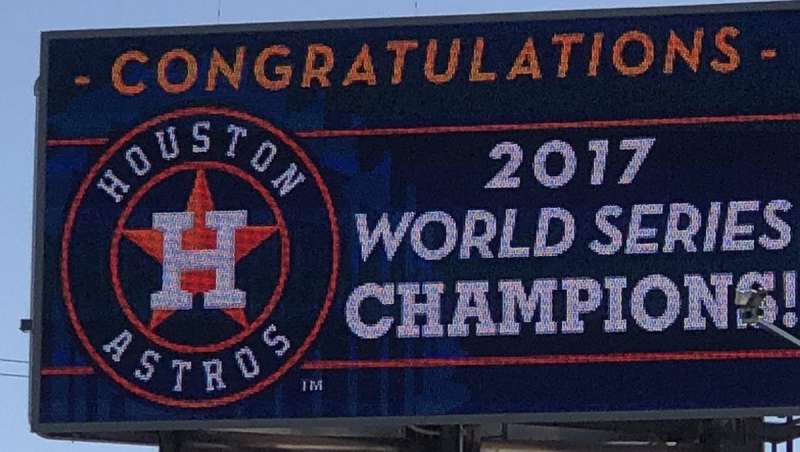
The Astros brand has become inseparable from Houston’s identity. After Hurricane Harvey devastated the city in 2017, the team’s World Series run that same year turned the logo into a symbol of resilience. You saw “Houston Strong” patches on the jerseys. Bumper stickers, flags, murals. The H-star was everywhere.
The 2022 World Series win reinforced the mark’s status as a championship emblem. Merchandise sales consistently rank among the top ten in MLB.
But the cultural story isn’t one-dimensional. The sign-stealing scandal of the 2017 season created real tension around the brand. For a few years there, wearing the Astros logo in certain ballparks was… let’s just say it drew strong reactions.
The older logos carry their own legacy too. The Tequila Sunrise rainbow uniforms from the 1977-1993 era are some of the most sought-after throwback items in all of sports. Nike periodically releases retro Astros gear featuring the Astrodome logo, and it sells out quickly. The retro designs have become popular well beyond baseball fans, showing up in streetwear and fashion circles.
How Does the Houston Astros Logo Fit Into the Overall Brand Identity?
The logo sits at the center of a broader system that includes the wordmark, cap logos, alternate marks, uniform designs, and Minute Maid Park branding. Everything ties back to the navy, orange, and white brand guidelines.
The “H” monogram appears on its own as the primary cap logo, without the outer ring or text. This simplified version works at the smallest sizes where the full badge would lose detail.
The team mascot, Orbit (a green alien in an Astros uniform), extends the space theme into physical appearances and digital content. There’s also the wordmark version, where “HOUSTON” and “ASTROS” are stacked with the star above.
Since the 2013 rebrand, the Astros have also brought back rainbow elements from the Tequila Sunrise era as trim details on batting practice gear and City Connect uniforms. This connects the current brand to the franchise’s most beloved vintage era without changing the primary identity. Smart move, honestly. It keeps older fans invested while the clean badge format works for newer audiences.
How Should the Houston Astros Logo Be Used?
Official Usage Guidelines:
The Houston Astros logo, name, and all associated marks are the property of Houston Astros, LLC, and Major League Baseball. Any commercial use requires written permission from MLB Properties, Inc.
Do’s:
- Use the logo in its complete, unaltered form
- Maintain proper clear space around the badge
- Use official color codes for all reproductions
- Keep the minimum size requirements for readability
Don’ts:
- Do not stretch, rotate, or skew the logo
- Do not alter the colors or rearrange any elements
- Do not place the logo on busy backgrounds that reduce visibility
- Do not create derivative logos or combine it with other marks without authorization
Where to Access Official Logos: Official logo files are available through MLB’s licensing portal. Media outlets can request assets through the Houston Astros media relations department. Fanatics and New Era use approved files for all licensed merchandise.
Trademark Protection: The H-star badge was registered with USPTO in 2014. Houston Astros, LLC holds 59 active trademarks covering the logo, wordmarks, mascot design, anniversary marks, and uniform designs. Unauthorized reproduction or commercial use can result in legal action under federal trademark law.
FAQ on The Houston Astros Logo
What does the Houston Astros logo look like?
The current Astros primary logo is a navy blue circular badge with a white serif “H” placed over an orange five-pointed star. Double orange rings frame the inner design, and the words “HOUSTON ASTROS” appear in white uppercase around the outer band.
When did the Astros change their logo to the current design?
The current Houston Astros emblem was unveiled on November 2, 2012, and first worn during the 2013 MLB season. The rebrand coincided with the team’s move from the National League to the American League West.
Who designed the current Houston Astros logo?
Todd Radom designed the 2013 Astros brand identity in collaboration with MLB Properties and Fanbrandz. The typeface closely matches Player Bold, a geometric slab serif created by Patrick Griffin at Canada Type.
What do the colors in the Houston Astros logo mean?
The Astros color scheme uses navy blue (#002D62) for stability, orange (#EB6E1F) for energy, and white for clarity. Navy and orange were the franchise’s original colors in 1962. The 2013 rebrand restored them after the brick red era.
How many logos have the Houston Astros had?
The franchise has used seven primary logos since starting as the Houston Colt .45s in 1962. Major redesigns happened in 1965, 1977, 1994, 1995, 2000, and 2013. Each reflected a change in stadium, ownership, or league affiliation.
What is the star in the Astros logo?
The orange star represents Texas as the Lone Star State and Houston’s deep ties to NASA and the space program. The faceted, three-dimensional star sits behind the “H” letter. It has been a core part of Astros brand identity since the 1990s.
What font does the Houston Astros logo use?
The Astros logo typography closely resembles Player Bold, published by Canada Type. It is a geometric slab serif with thick rectangular serifs. The “HOUSTON ASTROS” text in the outer ring uses a college-style serif face.
Why did the Astros change from brick red to navy and orange?
New owner Jim Crane wanted a fresh start when the team moved to the American League in 2013. The brick red and black scheme from 2000 to 2012 never connected with fans the way the original navy and orange did. The return felt like a homecoming.
Is the Houston Astros logo trademarked?
Yes. Houston Astros, LLC registered the H-star badge with the USPTO in 2014 under Registration Number 4464765. The franchise holds 59 active trademarks covering logos, wordmarks, the Orbit mascot, and anniversary designs.
What was the original Houston Astros logo?
The franchise’s first logo belonged to the Houston Colt .45s (1962-1964) and featured a blue Colt Peacemaker revolver. When the team became the Astros in 1965, they introduced the Astrodome roundel with orbiting baseballs on an orange circle.
Conclusion
The Houston Astros logo tells the story of a franchise that has reinvented itself multiple times across six decades of Major League Baseball. From the Colt .45s revolver to the Astrodome roundel to the current H-star badge, every version tracked a specific chapter in the team’s history.
The 2013 design brought back the original navy and orange palette, gave the team a clean badge that scales well across caps, jerseys, and digital screens, and connected the brand to Houston’s Space City roots.
It also happens to be the mark worn during two World Series titles. That kind of association sticks.
Whether you care about the principles behind great logo design or just want to rep your team, the Astros emblem does its job. It’s simple, it’s bold, and it belongs to Houston.

Renowned for his expertise in logo design and visual branding, Bogdan has developed a multitude of logos for various clients.
His skills extend to creating posters, vector illustrations, business cards, and brochures. Additionally, Bogdan's UI kits were featured on marketplaces like Visual Hierarchy and UI8.
He also wrote in the past years on sites like Design Your Way, WebDesignerDepot, WPDean, Designmodo, Speckyboy, Slider Revolution, and more.
- The Cursor Logo History, Colors, Font, And Meaning - 24 September 2026
- Top 7 Web Design Subscription Services That Replace Full-Time Hires - 24 September 2026
- Canva vs PowerPoint: Which Is Better for Presentations? - 22 September 2026

Bogdan Sandu is a seasoned designer who has been designing websites since 2008. Renowned for his expertise in logo design and visual branding, Bogdan has developed a multitude of logos for various clients. His skills extend to creating posters, vector illustrations, business cards, and brochures. Additionally, Bogdan's UI kits were featured on marketplaces like Visual Hierarchy and UI8. He also wrote in the past years on sites like Design Your Way, WebDesignerDepot, WPDean, Designmodo, Speckyboy, Slider Revolution, and more.
You Might Also Like