The font on your Android screen affects how long you read, how much you trust what you see, and whether your eyes give up after ten minutes.
Finding the best fonts for Android is not just a design preference. It is a readability decision that plays out across hundreds of different screen densities, OEM skins, and app environments.
Android runs on 3.9 billion devices worldwide, from budget phones at 160 dpi to flagship displays pushing 480 dpi. A typeface that renders clearly on one device can fall apart on another.
This guide covers the top options for Android typography, including system fonts, custom typefaces for app development, and practical picks for everyday users who want better text rendering on their phones.
You will learn which typefaces hold up at small sizes, which work best for mobile UI design, and how font licensing affects what you can actually use in a commercial Android app.
The Best Fonts For Android
Android typography runs on a mix of system defaults, Google Fonts, and third-party options. The fonts below cover UI design, reading apps, and custom Android experiences. Each entry includes specs pulled from actual font documentation, not guesswork.
Roboto together with Open Sans accounts for 51% of all Google Font views as of 2024. That number tells you something about where Android typography actually lands in practice.
—
Roboto
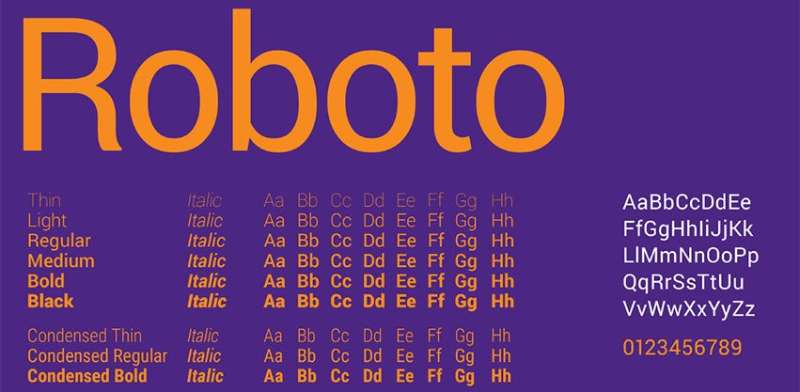
Roboto is a neo-grotesque sans-serif typeface designed by Christian Robertson in 2011, released by Google as the Android system font. It delivers clean text rendering across a wide range of screen sizes and densities.
Roboto suits Android UI design because its dual mechanical-geometric skeleton with open curves maintains legibility at sizes as small as 10px on low-DPI screens. Google uses it across Google Play, YouTube, Google Maps, and Google Images since 2013.
—
What makes Roboto suitable for Android?
Roboto has a moderate x-height and wide letter apertures in characters like “c”, “e”, and “a,” which reduces misread characters at small UI sizes. The 2014 redesign for Android 5.0 Lollipop made letterforms rounder and wider, improving clarity on displays ranging from small smartphones to large-format screens. The variable font version (Roboto Flex) includes 12 adjustable axes, including optical size.
Key attributes:
| Attribute | Value |
| Classification | Neo-grotesque sans-serif |
| Designer | Christian Robertson, 2011 |
| Weight range | Thin 100 to Black 900 (9 weights + italics) |
| Variable font | Yes (Roboto Flex, 12 axes) |
| Recommended sizes | 10px–14px for UI labels; 18px+ for headings |
| Letter-spacing default | 0 |
| License | OFL (Apache for older versions) |
| Available on | Google Fonts, Adobe Fonts |
| Price | Free |
—
How does Roboto perform at Android UI rendering?
Roboto renders clearly on both low-DPI (160 dpi) and high-DPI (480 dpi+) Android screens. Its neo-grotesque structure keeps stroke contrast low, which prevents visual noise at notification bar sizes (12px–13px). The Roboto Flex variable font reduces HTTP requests by covering all weight variations in a single file.
—
What are the best pairings for Roboto in Android apps?
Roboto pairs with Roboto Slab for heading-to-body contrast within a single font ecosystem, and with Noto Sans when multilingual script coverage is required. The Roboto + Roboto Slab pairing is standard practice in Material Design documentation.
—
What are the limitations of Roboto for Android?
Roboto has narrow apertures compared to Inter or Open Sans, which limits legibility at sizes below 10px on low-resolution screens. The Google Fonts distribution of Roboto Flex excludes some parametric axes available in the GitHub version.
—
Roboto – Recommended Use Cases Within Android Typography
- Best for: System UI labels, navigation bars, notification text, Material Design apps
- Avoid for: Long-form reading at sizes below 12px on LDPI screens
- Optimal weight: Regular 400 for body; Medium 500 for subheadings; Bold 700 for CTAs
- Optimal size range: 12px–16px for body; 20px–32px for headings
—
Open Sans
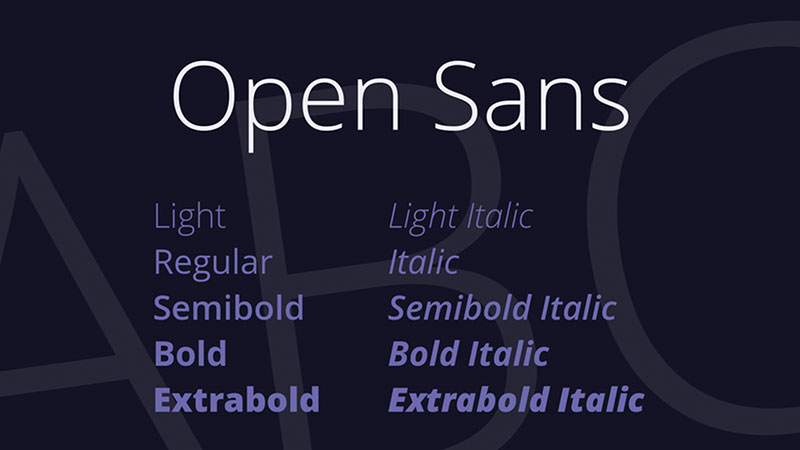
Open Sans is a humanist sans-serif typeface designed by Steve Matteson in 2010, commissioned by Google and released in 2011. It renders legibly across screen sizes and resolutions with a neutral appearance suited to both body copy and UI elements.
Open Sans works best for content-heavy Android apps because its wide character apertures and large x-height maintain readability in body text down to 11px. It is the second most widely used typeface on Google Fonts, serving over 4 billion views per day across 20 million websites.
—
What makes Open Sans suitable for Android?
Open Sans has a large x-height, which makes lowercase letters appear bigger relative to capitals, improving readability on small screens where text compresses. Its humanist classification introduces subtle stroke variation that reduces visual fatigue in extended reading sessions. The variable font version, released in March 2021, covers 6 weights with matching italics in a single file.
Key attributes:
| Attribute | Value |
| Classification | Humanist sans-serif |
| Designer | Steve Matteson, 2010 |
| Weight range | Light 300 to Extra Bold 800 (6 weights + italics) |
| Variable font | Yes (wdth + wght axes) |
| Recommended sizes | 11px–15px for body; 20px+ for headings |
| Letter-spacing default | 0 |
| License | Apache License 2.0 / OFL |
| Available on | Google Fonts, Adobe Fonts |
| Price | Free |
—
How does Open Sans perform at Android reading contexts?
Open Sans maintains consistent stroke weight across its letter forms, which reduces rendering artifacts on mid-range Android devices with 240–320 dpi screens. Its wide letter spacing (compared to Roboto) gives each character more breathing room, making it better suited to paragraph text in reading apps and email clients than to condensed navigation labels.
—
What are the best pairings for Open Sans in Android apps?
Open Sans pairs with Montserrat for geometric contrast in headings while keeping body text neutral, and with Lato when a warmer, more humanist tone is needed throughout the interface. The Open Sans + Montserrat combination is widely used in Android news and productivity apps.
—
What are the limitations of Open Sans for Android?
Open Sans lacks a Thin (100) weight, which limits its use in minimalist UI designs that require ultra-light typography. Its wide character spacing can reduce the number of characters per line on narrow smartphone screens (below 360dp width), requiring additional line breaks in label text.
—
Open Sans – Recommended Use Cases Within Android Typography
- Best for: Body text in reading apps, email clients, news feeds, form labels
- Avoid for: Navigation bars, condensed UI labels on narrow screens
- Optimal weight: Regular 400 for body; Semi-Bold 600 for section headers
- Optimal size range: 13px–17px for body copy; 22px+ for article headings
—
Noto Sans
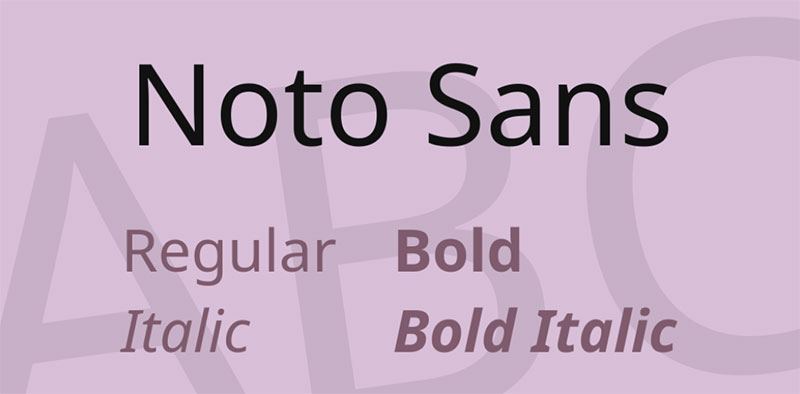
Noto Sans is an unmodulated sans-serif typeface developed by Google as part of the Noto font collection, designed to support all modern and ancient languages written in the Unicode standard. It provides a unified typographic system across Latin, Cyrillic, Greek, and hundreds of non-Latin scripts.
Noto Sans optimizes multilingual Android apps because it eliminates “tofu” (missing-glyph boxes) across over 800 supported languages. Google uses it as the fallback font on Android for all languages not covered by Roboto, including Chinese, Japanese, Korean, Thai, and Hindi.
—
What makes Noto Sans suitable for Android?
Noto Sans maintains consistent optical weight, line height, and character proportions across all its script variants. This consistency ensures that switching from Latin to Devanagari or CJK text within the same UI does not break layout metrics. It is available as a variable font with weight and width axes.
Key attributes:
| Attribute | Value |
| Classification | Humanist sans-serif |
| Designer | Google (multiple contributors) |
| Weight range | Thin 100 to Black 900 |
| Variable font | Yes |
| Recommended sizes | 12px–16px for body; 18px+ for UI headers |
| License | OFL |
| Available on | Google Fonts, notofonts.github.io |
| Price | Free |
—
How does Noto Sans perform at multilingual Android rendering?
Noto Sans is the only typeface designed specifically to match metrics across 800+ language scripts, which prevents layout shifts when language content changes at runtime. Its stroke weight and spacing remain optically consistent whether the app is rendering English, Arabic, or Korean, making it the standard fallback in Android’s system font stack.
—
What are the best pairings for Noto Sans in Android apps?
Noto Sans pairs with Roboto for apps that use Latin as the primary script but need multilingual fallback coverage. It pairs with Poppins when a more geometric primary typeface is needed alongside broad language support in the fallback stack.
—
What are the limitations of Noto Sans for Android?
Noto Sans is designed for coverage and consistency, not personality. Its neutral character makes it unsuitable as a primary display font in brand-forward Android apps. Loading the full Noto Sans family for all scripts significantly increases app bundle size.
—
Noto Sans – Recommended Use Cases Within Android Typography
- Best for: Multilingual apps, system font fallback stack, global-audience apps
- Avoid for: Brand-driven display headings; single-language apps where bundle size matters
- Optimal weight: Regular 400 for body; Bold 700 for headings
- Optimal size range: 12px–16px for body copy across scripts
—
Lato
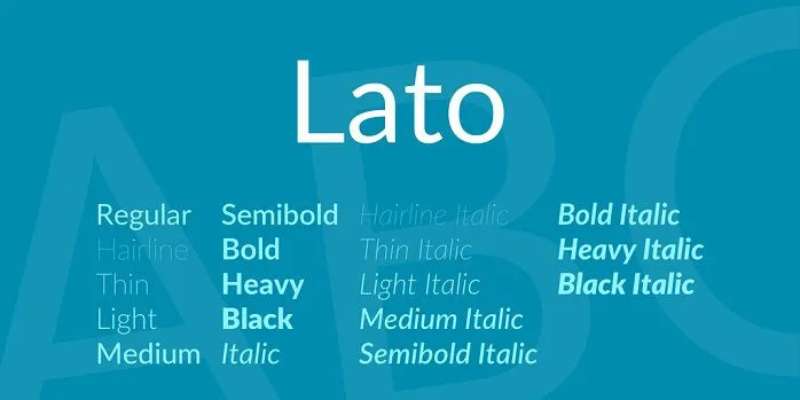
Lato is a humanist sans-serif typeface designed by Lukasz Dziedzic in 2010, distributed under the Open Font License through Google Fonts. It balances transparent body text performance with distinctive letterform traits that appear at larger display sizes.
Lato suits Android apps requiring a professional but approachable voice because its classical uppercase proportions maintain visual harmony at heading sizes while its sans-serif construction stays clean at 12px–14px body text.
—
What makes Lato suitable for Android?
Lato’s design explicitly targets the tension between transparent body text and expressive display use. Its semi-rounded letterforms reduce visual fatigue in content-dense Android interfaces. The font covers Latin, Extended Latin, and Cyrillic, which is adequate for most Western and Eastern European Android markets.
Key attributes:
| Attribute | Value |
| Classification | Humanist sans-serif |
| Designer | Lukasz Dziedzic, 2010 |
| Weight range | Thin 100 to Black 900 (5 weights + italics) |
| Variable font | No |
| Recommended sizes | 13px–17px for body; 20px+ for headers |
| License | OFL |
| Available on | Google Fonts |
| Price | Free |
—
How does Lato perform at Android body text rendering?
Lato’s semi-rounded terminals and balanced stroke contrast perform consistently across 240–480 dpi Android screens. Spotify and BuzzFeed have used Lato in their Android UI, confirming its cross-platform rendering reliability. It is not available as a variable font, so each static weight requires a separate font file load.
—
What are the best pairings for Lato in Android apps?
Lato pairs with Merriweather when serif body text is needed below editorial headings set in Lato Bold, and with Montserrat when a full sans-serif hierarchy is preferred. The Lato + Merriweather combination works well in Android reading and journalism apps.
—
What are the limitations of Lato for Android?
Lato does not support a variable font axis, which means loading multiple weights requires multiple file requests or preloading. Its character set does not cover CJK scripts, limiting its use in East Asian Android markets without a supplementary fallback font.
—
Lato – Recommended Use Cases Within Android Typography
- Best for: Android news apps, content dashboards, professional productivity apps
- Avoid for: Apps targeting East Asian or Arabic-language markets
- Optimal weight: Regular 400 for body; Bold 700 for section headers and CTAs
- Optimal size range: 13px–16px for body; 24px–36px for display headings
—
Montserrat
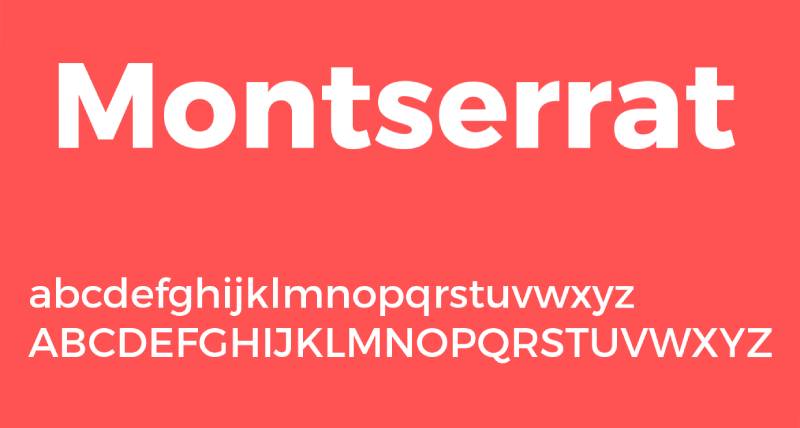
Montserrat is a geometric sans-serif typeface designed by Julieta Ulanovsky in 2011, inspired by urban signage typography from the Montserrat neighborhood in Buenos Aires. It provides strong visual presence at large sizes with clean geometric construction.
Montserrat works best for Android app headings and branding elements because its geometric letterforms render with high contrast at 20px+ on all screen densities. It is used across major Android apps in e-commerce, fintech, and lifestyle categories.
—
What makes Montserrat suitable for Android?
Montserrat’s geometric construction gives it strong visual weight differentiation between its 18 available styles, allowing designers to build clear typographic hierarchy within a single font family. Its large x-height improves lowercase legibility at mid-range sizes (16px–20px).
Key attributes:
| Attribute | Value |
| Classification | Geometric sans-serif |
| Designer | Julieta Ulanovsky, 2011 |
| Weight range | Thin 100 to Black 900 (9 weights + italics) |
| Variable font | Yes |
| Recommended sizes | 16px–24px for UI headings; 13px+ for body in light weights |
| Letter-spacing default | 0 (designers often add +0.5px–1px tracking at small sizes) |
| License | OFL |
| Available on | Google Fonts |
| Price | Free |
—
How does Montserrat perform at Android heading display?
Montserrat renders with high stroke uniformity at sizes above 18px, which makes it effective for app store screenshots, onboarding screens, and card headers. At sizes below 13px, its geometric apertures narrow and reduce legibility, making it a poor choice for label or caption text in dense Android layouts.
—
What are the best pairings for Montserrat in Android apps?
Montserrat pairs with Open Sans for a clean heading-to-body separation where both fonts share neutral geometric DNA, and with Lora when editorial warmth is needed in the body text. The Montserrat + Open Sans combination is the most widely used pairing in Android productivity and SaaS apps.
—
What are the limitations of Montserrat for Android?
Montserrat’s tight apertures on characters like “c”, “e”, and “a” reduce legibility at 11px and below, making it unsuitable for body text in data-dense screens. Its strong geometric character makes it less neutral than Roboto or Open Sans for apps requiring typographic restraint.
—
Montserrat – Recommended Use Cases Within Android Typography
- Best for: App headings, onboarding screens, card titles, CTA buttons in branded apps
- Avoid for: Body text below 13px; data tables; dense UI label text
- Optimal weight: SemiBold 600 for subheadings; Bold 700–ExtraBold 800 for hero text
- Optimal size range: 18px–48px for headings; 14px–16px minimum for body if used
—
Poppins
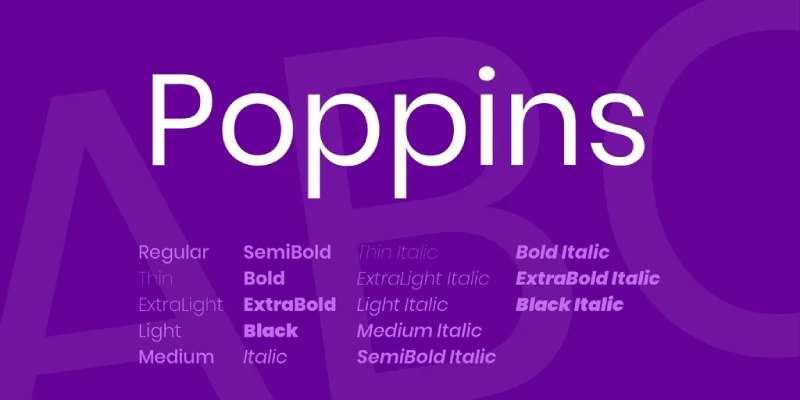
Poppins is a geometric sans-serif typeface designed by the Indian Type Foundry (Jonny Pinhorn and Ninad Kale), released through Google Fonts in 2014. It is built on a pure geometric base and supports both Devanagari and Latin writing systems.
Poppins optimizes Android apps targeting South Asian audiences or modern consumer brands because its circular letterforms render cleanly across all screen densities and its Devanagari support covers Hindi, Marathi, and Sanskrit scripts natively.
—
What makes Poppins suitable for Android?
Poppins has a uniform circular geometry across all characters, producing consistent stroke weight that renders without artifacts at 160–640 dpi on Android. Its 9 available weights with matching italics give Android developers full typographic hierarchy from a single font family download. It is the only geometric sans-serif on this list with first-class Devanagari support.
Key attributes:
| Attribute | Value |
| Classification | Geometric sans-serif |
| Designer | Indian Type Foundry (Jonny Pinhorn, Ninad Kale), 2014 |
| Weight range | Thin 100 to Black 900 (9 weights + italics) |
| Variable font | No |
| Recommended sizes | 14px–18px for body; 20px+ for headings |
| Letter-spacing default | 0 |
| License | OFL |
| Available on | Google Fonts |
| Price | Free |
—
How does Poppins perform at Android UI rendering?
Poppins renders with high geometric consistency at mid-range sizes (14px–24px), making it effective for card-based Android layouts. Its circular “o” forms and near-equal stroke width maintain readability in dark mode, where thinner strokes sometimes wash out. Below 12px, its geometric apertures close slightly, which can reduce character disambiguation.
—
What are the best pairings for Poppins in Android apps?
Poppins pairs with Noto Sans for multilingual coverage when Devanagari headings need a matching Latin body font, and with Merriweather when a serif-to-geometric contrast is needed for editorial Android apps.
—
What are the limitations of Poppins for Android?
Poppins is not available as a variable font, so using multiple weights requires loading separate static font files, which increases memory usage in Android apps. Its geometric construction makes it less readable than humanist options (Open Sans, Lato) for extended body text at sizes below 14px.
—
Poppins – Recommended Use Cases Within Android Typography
- Best for: Consumer apps, social feeds, SaaS dashboards, apps targeting Hindi-language markets
- Avoid for: Dense body text below 14px; apps requiring variable font efficiency
- Optimal weight: Regular 400 for body; SemiBold 600 for navigation; Bold 700 for CTAs
- Optimal size range: 14px–18px for body; 22px–40px for headings
—
Source Sans Pro
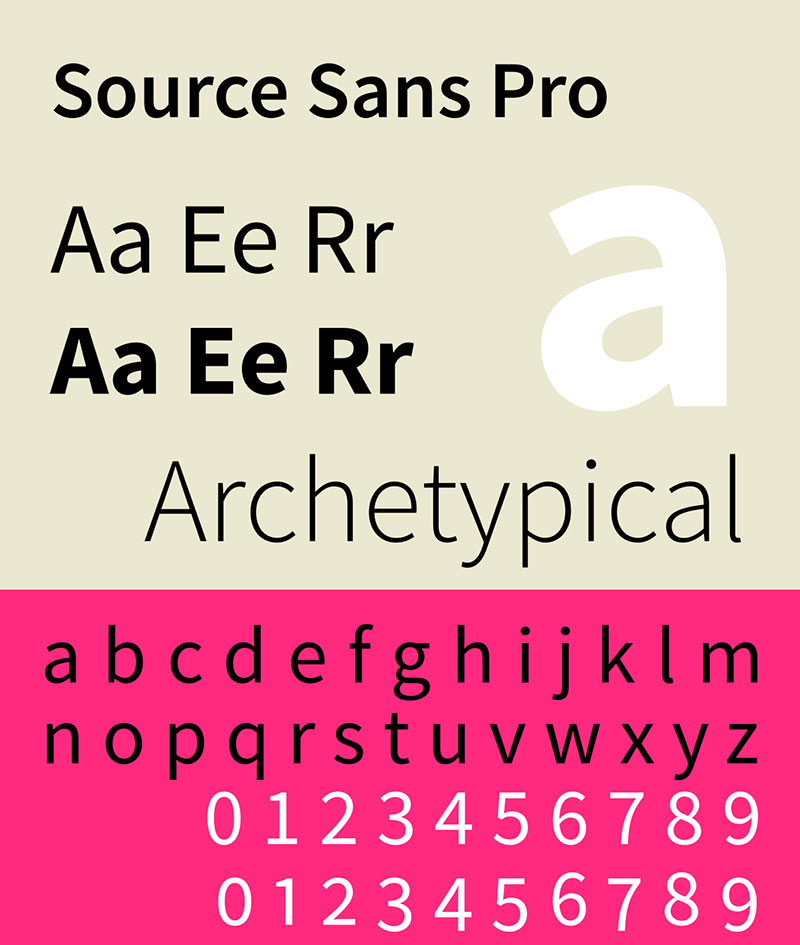
Source Sans Pro is a humanist sans-serif typeface designed by Paul D. Hunt in 2012, released as Adobe’s first open-source typeface. It draws on Franklin Gothic, News Gothic, and Lightline Gothic as structural references, and targets user interface legibility as its primary use case.
Source Sans Pro suits Android apps requiring a wide x-height with strong italic style support because its large x-height (comparable to Open Sans) and true italic variant maintain readability across long-form content at 12px–16px.
—
What makes Source Sans Pro suitable for Android?
Source Sans Pro has a large x-height and open apertures, both of which contribute to legibility on mid-range Android screens at body text sizes. Its 6 weights with true italics give it more stylistic range than many comparable free fonts. The typeface was specifically designed for UI use, with optical spacing optimized for screen rendering rather than print.
Key attributes:
| Attribute | Value |
| Classification | Humanist sans-serif |
| Designer | Paul D. Hunt, 2012 |
| Weight range | ExtraLight 200 to Black 900 (6 weights + italics) |
| Variable font | Yes (Source Sans 3) |
| Recommended sizes | 12px–16px for body; 20px+ for section headers |
| Letter-spacing default | 0 |
| License | OFL |
| Available on | Google Fonts, Adobe Fonts |
| Price | Free |
—
How does Source Sans Pro perform at Android body text rendering?
Source Sans Pro renders with low stroke contrast across its weight range, which reduces visual noise at body text sizes on medium-DPI Android screens (240–320 dpi). Its italic styles are true italics (not oblique), which improves emphasis rendering in reading apps and document editors. The updated variable font version (Source Sans 3) is more efficient for Android delivery than loading multiple static weights.
—
What are the best pairings for Source Sans Pro in Android apps?
Source Sans Pro pairs with Playfair Display for editorial Android apps where serif headings contrast against neutral body copy, and with Open Sans when two humanist sans-serifs are needed for distinct hierarchy levels without strong contrast.
—
What are the limitations of Source Sans Pro for Android?
The older static version of Source Sans Pro requires loading separate files for each weight. The ExtraLight (200) weight renders poorly on low-DPI screens below 200 dpi, where thin strokes disappear. Language support, while broad for Latin-based scripts, does not include CJK or Arabic without a companion font.
—
Source Sans Pro – Recommended Use Cases Within Android Typography
- Best for: Document editors, reading apps, professional productivity apps, Android web apps
- Avoid for: ExtraLight weights on low-DPI devices; CJK multilingual projects
- Optimal weight: Regular 400 for body; SemiBold 600 for subheadings; Bold 700 for navigation
- Optimal size range: 12px–16px for body; 20px–32px for headings
—
Inter

Inter is a neo-grotesque sans-serif typeface designed by Rasmus Andersson, publicly released on August 22, 2017. It was created specifically for computer screen readability at small sizes, using a tall x-height, ink traps, and open apertures as core design features. Andersson developed Inter while working at Figma, where Roboto’s legibility at small UI sizes was the specific problem it was built to solve.
Inter optimizes Android UI apps requiring high legibility at 10px–14px because its tall x-height and open “c”, “e”, and “a” apertures reduce character misreads at small screen densities. For the 12 months ending May 2025, Inter was accessed 414 billion times on Google Fonts, a 57% year-over-year increase.
—
What makes Inter suitable for Android?
Inter uses ink traps at stroke intersections and open counters specifically to improve rasterization at small sizes, which directly addresses Android’s rendering challenges on 160–320 dpi screens. Its optical size axis (in the variable version) automatically adjusts letter proportions based on rendered size. The family supports 9 weights with italics across 147 languages and 2,000+ glyphs.
Key attributes:
| Attribute | Value |
| Classification | Neo-grotesque sans-serif |
| Designer | Rasmus Andersson, 2017 |
| Weight range | Thin 100 to Black 900 (9 weights + italics) |
| Variable font | Yes (optical size + weight axes) |
| Optical sizes | Yes (text and display) |
| Recommended sizes | 10px–14px for dense UI; 16px+ for body |
| Letter-spacing default | 0 (optical size axis adjusts tracking automatically) |
| License | OFL |
| Available on | Google Fonts, rsms.me/inter |
| Price | Free |
—
How does Inter perform at small-size Android UI rendering?
Inter’s ink traps and open apertures make it among the most legible options at 10px–12px on Android’s standard 160 dpi baseline. Figma, Notion, NASA, and GitHub all use Inter as their primary UI typeface. The Google Fonts distribution of Inter removes some OpenType features (tabular figures, stylistic sets) to reduce file size, so developers needing the full feature set should self-host from rsms.me.
—
What are the best pairings for Inter in Android apps?
Inter pairs with Playfair Display for apps where editorial serif headings contrast against a clean functional body, and with Source Sans Pro when two screen-optimized humanist typefaces are needed with clear visual differentiation.
—
What are the limitations of Inter for Android?
The Google Fonts version of Inter lacks several OpenType features present in the full release, including tabular figures and contextual alternates, which limits its use in financial data displays without self-hosting. Early versions of Inter were not optimized for very large display sizes, though the Inter Display subfamily added in version 4.1 addresses this.
—
Inter – Recommended Use Cases Within Android Typography
- Best for: Dense data UIs, settings screens, label text below 14px, design-tool-inspired apps
- Avoid for: Financial data displays requiring tabular figures (use self-hosted version instead)
- Optimal weight: Regular 400 for body; Medium 500 for navigation; SemiBold 600 for headings
- Optimal size range: 10px–16px for UI text; 20px–32px for section headings
—
Nunito
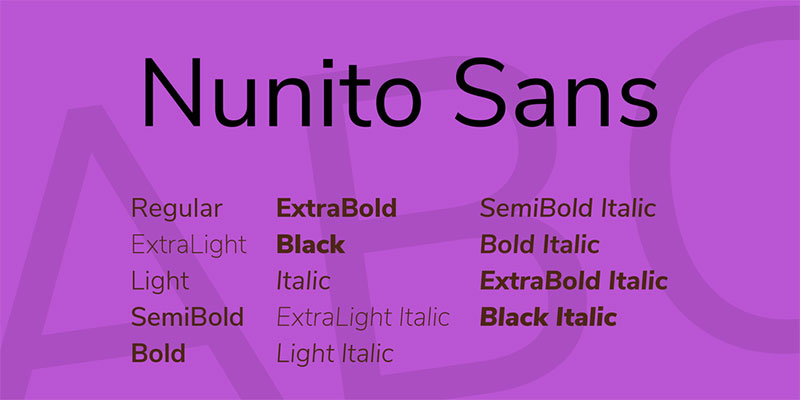
Nunito is a well-balanced rounded sans-serif typeface designed by Vernon Adams, later extended by Jacques Le Bailly. The original Nunito (display, rounded terminals) was supplemented by Nunito Sans (standard terminals, more neutral). Both are available through Google Fonts under the OFL.
Nunito suits Android apps targeting younger audiences or consumer-facing products because its rounded terminals produce a visually soft and approachable character that renders consistently across 240–480 dpi screens.
—
What makes Nunito suitable for Android?
Nunito has a high x-height and geometric proportions, with the rounded terminal design providing clear character distinction on smaller screens. Nunito Sans offers 14 weights from ExtraLight to Black with matching italics, giving Android developers extensive hierarchy control from a single family. Duolingo uses Nunito as part of its Android UI, citing its friendly and readable character as a brand fit.
Key attributes:
| Attribute | Value |
| Classification | Rounded sans-serif |
| Designer | Vernon Adams (extended by Jacques Le Bailly) |
| Weight range | ExtraLight 200 to Black 900 (14 weights in Nunito Sans) |
| Variable font | Yes |
| Recommended sizes | 13px–16px for body; 20px+ for UI headings |
| License | OFL |
| Available on | Google Fonts |
| Price | Free |
—
How does Nunito perform at Android UI rendering?
Nunito’s rounded terminals render with slightly more pixel area at stroke ends compared to flat-terminal fonts, which improves visibility on low-DPI screens where individual pixels are large. Its geometric base maintains consistent optical weight across the weight range, preventing the uneven gray color that some humanist fonts show in body text blocks.
—
What are the best pairings for Nunito in Android apps?
Nunito pairs with Playfair Display for lifestyle or consumer apps where editorial serif headings need a soft sans-serif body companion, and with Poppins when a fully geometric system is preferred with consistent circular forms across both heading and body levels.
—
What are the limitations of Nunito for Android?
Nunito’s rounded terminals add slight optical width to characters, which reduces character density per line on narrow Android screens (below 360dp). This makes it less efficient than Roboto or Inter for information-dense UIs like dashboards or data tables.
—
Nunito – Recommended Use Cases Within Android Typography
- Best for: Consumer apps, education apps, onboarding flows, apps targeting younger audiences
- Avoid for: Data-dense dashboards; narrow-screen devices below 360dp width
- Optimal weight: Regular 400 for body; SemiBold 600 for UI labels; Bold 700 for headings
- Optimal size range: 13px–16px for body; 20px–32px for headings
—
Fira Sans
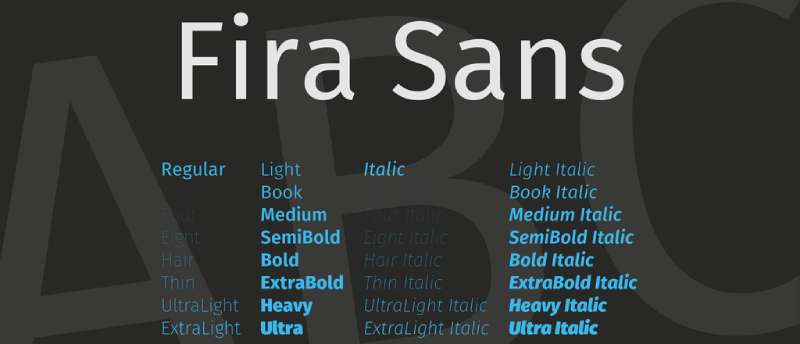
Fira Sans is a humanist sans-serif typeface designed by Erik Spiekermann, Ralph du Carrois, Anja Meiners, and Botio Nikoltchev of Carrois Type Design, released in 2013. It was commissioned by Mozilla for Firefox OS, with a design philosophy prioritizing small-screen legibility and mobile interface performance.
Fira Sans suits Android apps requiring a wide weight range with strong screen legibility because it was designed from the ground up for mobile UI rendering, with a higher x-height, wider frame, and looser letter spacing than its structural ancestor, FF Meta.
—
What makes Fira Sans suitable for Android?
Fira Sans has a higher x-height and wider letter spacing than FF Meta, both optimized for small-screen rendering. Its 16 weights cover an unusually wide range from Thin (100) to Heavy (900), giving Android designers more granular weight control than most free fonts offer. The humanist classification means letterforms carry subtle stroke contrast that reduces reading fatigue in body text.
Key attributes:
| Attribute | Value |
| Classification | Humanist sans-serif |
| Designer | Erik Spiekermann / Carrois Type Design, 2013 |
| Weight range | Thin 100 to Heavy 900 (16 weights + italics) |
| Variable font | Unofficial (Firava project) |
| Recommended sizes | 12px–16px for body; 20px+ for headings |
| Letter-spacing default | Wide (wider than Roboto by design) |
| License | OFL |
| Available on | Google Fonts, Mozilla CDN |
| Price | Free |
—
How does Fira Sans perform at Android small-screen rendering?
Fira Sans was tested against the character constraints of Firefox OS handsets, covering displays from 96 dpi up to 326 dpi. Its wider letter spacing and taller x-height improve character disambiguation at 11px–13px compared to Roboto. The ultra-light weights (below Thin) use fractional coordinates and can render inconsistently on some Android rendering engines. Mozilla recommends using weights from Thin (100) upward for reliable screen output.
—
What are the best pairings for Fira Sans in Android apps?
Fira Sans pairs with variable fonts like Inter or Source Sans 3 when a mixed static-variable font stack is being assembled, and with Roboto Slab for apps that need a slab serif heading voice against a neutral body font.
—
What are the limitations of Fira Sans for Android?
There is no official variable font version of Fira Sans. The Firava project provides an unofficial variable adaptation, but it is not production-ready for all Android rendering environments. Ultra-light weights below Thin use fractional coordinates that may not render correctly on all Android rendering engines.
—
Fira Sans – Recommended Use Cases Within Android Typography
- Best for: Technical apps, productivity tools, Firefox-ecosystem apps, apps requiring 16+ weight options
- Avoid for: Ultra-light weight use on low-end Android devices; variable font-first build pipelines
- Optimal weight: Regular 400 for body; Medium 500 for subheadings; Bold 700 for navigation and CTAs
- Optimal size range: 12px–16px for body; 20px–36px for headings
—
Android Font Selection: Quick Reference
| Font | Classification | Best Use Case | Variable Font | License |
| Roboto | Neo-grotesque sans-serif | System UI, Material Design | Yes (Flex) | OFL |
| Open Sans | Humanist sans-serif | Reading apps, body text | Yes | OFL / Apache 2.0 |
| Noto Sans | Humanist sans-serif | Multilingual apps | Yes | OFL |
| Lato | Humanist sans-serif | Professional content apps | No | OFL |
| Montserrat | Geometric sans-serif | Branded headings, consumer apps | Yes | OFL |
| Poppins | Geometric sans-serif | Consumer apps, Devanagari support | No | OFL |
| Source Sans Pro | Humanist sans-serif | Document editors, reading | Yes (v3) | OFL |
| Inter | Neo-grotesque sans-serif | Dense UI, small-size labels | Yes | OFL |
| Nunito | Rounded sans-serif | Consumer, education apps | Yes | OFL |
| Fira Sans | Humanist sans-serif | Technical apps, wide weight needs | No (official) | OFL |
What makes a font suitable for Android?
Not every font that looks good on a desktop renders well on a phone. Android devices span a DPI range from ldpi (120 dpi) up to xxxhdpi (640 dpi), and a typeface that reads cleanly at 480 dpi can become muddy or thin at 160 dpi.
Android holds 72.77% of the global mobile OS market as of November 2025, with dominant share in India (95.21%), Indonesia (86.8%), and Brazil (81.45%), where mid-range and budget devices run the majority of active installs (commandlinux.com, 2025).
Those markets matter for font choice. A typeface needs to perform on a $120 Xiaomi before it needs to perform on a Pixel 9.
| Criterion | What it controls | Why it matters for Android |
| X-height | Lowercase letter height relative to cap height | Higher x-height improves readability at 12sp–14sp |
| Aperture width | Opening size in letters like “c”, “e”, “a” | Wide apertures prevent misread characters at low DPI |
| Stroke contrast | Difference between thick and thin strokes | Low contrast fonts render cleaner at small sizes |
| Variable font support | Single file covers all weights via axes | Reduces APK size; supported from API level 26 |
Android’s text rendering pipeline runs on the Skia graphics engine with HarfBuzz handling glyph shaping. At small sizes, fonts with narrow apertures or high stroke contrast create visual noise that the Skia rasterizer cannot fully compensate for.
Material Design 3 defines a type scale with 15 styles across Display, Headline, Body, and Label categories. The standard body size is 16sp. Android 16’s Expressive type scale now favors 18sp as the baseline for high-density OLED displays to reduce sub-pixel flickering.
Variable font support arrived with Android API level 26 (Android 8.0 Oreo). The Google Fonts Downloadable Fonts API reaches API level 14 and above, which covers 95%+ of active Android devices in the wild, according to Google Developers documentation.
For font licensing in APKs, the SIL Open Font License (OFL) permits embedding, modification, and redistribution without cost. The Apache License 2.0 carries the same permissions. All ten fonts covered in this article are OFL or Apache licensed, which makes them safe for commercial APK distribution without additional agreements.
—
How do Android system fonts differ from custom fonts in apps?
There are two entirely different contexts when someone asks about fonts on Android. One is the system font, which controls text across Settings, notifications, and the launcher. The other is the in-app typeface, which developers choose and bundle themselves.
Confusing these two leads to wrong font choices. A font that works as a system replacement may not behave the same way when loaded as an asset inside a specific app.
| Context | Controlled by | Method | Scope |
| System font | OEM / user via Settings | Theme Store, iFont, HiFont | All system UI |
| In-app font | Developer | res/font folder or Downloadable Fonts API | That app only |
System font customization on Android
AOSP default: Roboto has been the Android open-source system font since Android 4.1 (Jelly Bean, 2012), with Noto Sans handling script fallback for languages not covered by Roboto, including Chinese, Japanese, Korean, Thai, and Hindi.
OEMs override this. Samsung ships SamsungOne as its default typeface on Galaxy devices, accessible through Settings > Display > Font size and style > Font style > Download fonts, which opens the Galaxy Store. Xiaomi MIUI uses its own font system, and OnePlus OxygenOS offers limited system font options without root access.
HiFont, one of the most widely used font manager apps on Android, supports direct system font replacement without root on Samsung Galaxy S7, S8, S9, and Note series devices. Most other manufacturers require root for system-level font changes.
In-app font implementation for developers
Android provides two standard methods for developers to use custom typefaces.
res/font folder: Declare fonts as XML resources in Android Studio. Works from API level 16 with Support Library 26.
Downloadable Fonts API: Request fonts from a provider (Google Fonts) instead of bundling them in the APK. Available from API level 26 natively; backported to API level 14 via AndroidX Core. Google documents that this approach reduces APK size, increases installation success rates, and allows multiple apps to share a cached copy of the same font, saving device storage and cellular data.
Research by Google shows that every 6 MB increase in app size reduces installation conversion by approximately 1%. Bundling multiple static font weights adds up quickly: a single variable font file covering all 9 weights of Inter or Roboto is more efficient than loading 9 separate static TTF files.
The practical takeaway: if you are building a consumer-facing Android app targeting emerging markets, use the Downloadable Fonts API for Google Fonts and limit bundled font weights to 2–3 maximum for apps that cannot depend on a network connection.
—
Which fonts render most accurately on low-to-mid range Android screens?
The Samsung Galaxy A12 is the most popular Android phone globally, holding 1.57% of the market as of November 2024 (AppBrain SDK data). It runs a 720p display at roughly 269 dpi. That is the real benchmark for font performance, not a Pixel 9 Pro’s 489 dpi display.
Android 14 is currently the most-used version at 25.8% market share, but Android 10 through 13 collectively represent around 52% of active devices. Font choices need to render well across this fragmented install base.
Which fonts work on 240–320 dpi screens?
These are the fonts from the list that hold up at body text sizes (12sp–16sp) on mid-range DPI screens:
- Roboto (Regular 400, Medium 500): designed specifically for Android mid-range clarity after the 2014 redesign
- Inter: ink traps at stroke intersections improve rasterization at 10px–12px on 240 dpi screens
- Open Sans: wide apertures and large x-height maintain character separation at 11sp
- Noto Sans: consistent optical weight across Latin and non-Latin scripts on the same screen
- Fira Sans: designed for Firefox OS handsets covering 96–326 dpi; wider letter spacing than Roboto at equivalent sizes
Poppins and Montserrat are geometric fonts with relatively narrow apertures. At sizes below 14sp on 240 dpi screens, their “c”, “e”, and “a” forms close slightly, reducing character disambiguation. Both work well at heading sizes (20sp and above) but are weaker choices for dense body copy on low-end Android hardware.
Which fonts work in Android dark mode?
Dark mode changes the rendering dynamics. Light text on a dark background blooms slightly at stroke edges, which makes thin weights (100–300) disappear or look washed out on OLED panels.
Safe in dark mode: Roboto Regular 400, Inter Regular 400, Open Sans Regular 400, Noto Sans Regular 400.
Avoid in dark mode below 16sp: Lato Light 300, Source Sans Pro ExtraLight 200, Fira Sans Thin 100.
Material Design 3’s dark mode guidelines recommend using font weights of 400 or higher for body text in dark themes. The 4.5:1 minimum contrast ratio from WCAG 2.1 applies regardless of light or dark mode.
—
How does font licensing affect Android app distribution?
Bundling a font in an APK without the right license is a legal risk. It is also surprisingly common. The licensing question is different depending on whether you are embedding font files, serving them via the Downloadable Fonts API, or using them in a WebView.
| License type | APK bundling | Downloadable Fonts API | Commercial use |
| OFL (SIL Open Font License) | Permitted | Permitted | Permitted, free |
| Apache License 2.0 | Permitted | Permitted | Permitted, free |
| Commercial (Monotype, etc.) | Requires per-app or per-device license | Varies by agreement | Paid |
All ten fonts in this article (Roboto, Open Sans, Noto Sans, Lato, Montserrat, Poppins, Source Sans Pro, Inter, Nunito, Fira Sans) are released under the OFL or Apache 2.0. They can be bundled in commercial Android APKs, modified, and redistributed without licensing fees.
One note on Roboto: older versions were released under the Apache License 2.0. The current versions (Roboto, Roboto Condensed, Roboto Flex, Roboto Mono, Roboto Serif) have been re-licensed to OFL. The re-license does not create backward compatibility issues for existing apps.
Downloadable Fonts API and licensing: When you use Google Fonts through the Downloadable Fonts API, Google serves the font files. You do not embed them in your APK. The OFL license still applies to the font data, but the distribution method shifts the delivery responsibility to Google, not your app.
WebView usage: If your Android app renders text through a WebView using a Google Fonts CSS import, the font is fetched from Google’s CDN on demand. No additional licensing is required beyond the OFL for any of the ten fonts listed here.
Commercial fonts like those from Monotype or Fontsmith use per-app or per-device licensing models. These can run from a few hundred dollars to several thousand annually depending on monthly active users. For most Android projects, the OFL catalog on Google Fonts is wide enough that commercial licensing is rarely necessary.
—
How do font pairing choices affect Android UI readability?
Material Design 3 recommends using a maximum of two font families per Android app interface. Beyond two, visual hierarchy breaks down and rendering overhead increases from loading additional font files.
The most common mistake in Android typography pairing is combining two geometric fonts. Poppins + Montserrat is a popular-looking combination that actually reduces typographic contrast. Both use circular forms and similar stroke widths, which collapses the heading-to-body distinction on smaller screens.
What font pairings work in Android UI design?
Geometric heading + humanist body (recommended):
- Montserrat Bold 700 (headings) + Open Sans Regular 400 (body)
- Poppins SemiBold 600 (headings) + Lato Regular 400 (body)
Single-family weight pairing (most efficient):
- Roboto Regular 400 (body) + Roboto Bold 700 (headings)
- Inter Regular 400 (body) + Inter SemiBold 600 (UI labels, navigation)
Single-family pairings using a variable font deliver all weight variations from one file. For a Roboto Flex or Inter variable font, the full weight range from 100 to 900 loads as a single HTTP request or asset, versus 4–9 separate static font files for the same coverage.
Google’s research shows that every 6 MB added to an app’s size lowers install conversion by 1%. Bundling 5 static font weights at roughly 70–90 KB each adds ~400 KB before any other content. That is a meaningful cost in emerging markets where the Galaxy A12 is the target device.
What font size and weight combinations improve Android accessibility?
WCAG 2.1 specifies a minimum 4.5:1 contrast ratio for normal text. Android’s sp unit scales automatically with the user’s system font size preference, which means your layout must remain functional when text scales up to 200%.
Practical weight and size rules from Material Design 3 and WCAG:
- Body text: 16sp minimum, Regular 400 weight
- Labels and captions: 12sp minimum, Regular 400 or Medium 500
- Navigation items: 12sp–14sp, Medium 500
- Bold 700 required for text below 14sp to meet contrast and legibility standards
Android’s Accessibility Scanner tool flags text that falls below minimum contrast thresholds. Test with the largest accessibility font scale enabled (200% of the default) before shipping. Fonts with variable width axes (Roboto Flex, Inter variable, Open Sans variable) adapt better to aggressive text scaling than static fonts, which may reflow at extreme sizes.
—
How do you install custom fonts on Android?
The answer depends almost entirely on the device manufacturer. Stock Android (Google Pixel) offers no system-level font replacement without root. Samsung, Xiaomi, and OnePlus all handle it differently.
Samsung Galaxy font installation
Samsung supports font changes natively through One UI without root access.
- Go to Settings > Display > Font size and style
- Tap Font style
- Tap Download fonts (opens Galaxy Store automatically)
- Select and install a font; it applies system-wide immediately
Samsung pushed a SamsungOne Font v2.3 update in September 2023 with improvements to rendering and bug fixes. Custom fonts downloaded via the Galaxy Store integrate with One UI’s font rendering stack and do not require rebooting.
Using iFont and HiFont for other Android devices
Both apps serve the same function: they act as font managers that download typeface files and apply them at the system level.
iFont: Works on non-rooted Samsung devices. For most other manufacturers (HTC, Motorola, Lenovo, Huawei), root access is required to change the system font through iFont.
HiFont: Supports Samsung Galaxy S7, S8, S9, and Note series without root. Supports other manufacturers with root. Includes a custom font loader that accepts local TTF files placed in a folder called “Zitiguanjia” in the device’s root directory.
Before installing either app, check the permissions it requests. Font manager apps that request access to contacts, location, or SMS have no legitimate reason to do so. Stick to apps with narrow permission scopes: storage access and the ability to write to system settings.
Stock Android and Pixel devices
Google Pixel devices running stock Android do not support system font replacement without root access. The only adjustment available through Settings > Display is font size (not typeface). Third-party font generators that use Unicode characters work in social apps and messaging but do not change the rendering engine or actual system typeface.
Xiaomi MIUI and OnePlus OxygenOS both offer limited font customization through their respective theme stores, similar to Samsung’s Galaxy Store approach. The font selection is smaller and the third-party font ecosystem is less developed than Samsung’s.
For apps targeting Android users who want font control on non-Samsung devices, rooting remains the only reliable method for system-level replacement. For most users, the more practical option is installing apps that offer in-app font selection, like reading apps (Moon+ Reader, ReadEra) that let users pick from bundled typeface options within the app itself.
FAQ on The Best Fonts For Android
What is the default font on Android?
Roboto is the default Android system font, introduced with Android 4.0 Ice Cream Sandwich in 2011. Google designed it specifically for mobile screens. Samsung devices ship with SamsungOne instead, overriding Roboto at the OEM level across One UI.
What is the most readable font for Android?
Roboto and Open Sans consistently rank highest for Android readability. Both have large x-heights and wide apertures that hold up at 12sp–14sp on mid-range screens. Inter is a strong alternative for dense UI text at small sizes.
Can you change the system font on Android without rooting?
Yes, on Samsung Galaxy devices. Go to Settings > Display > Font size and style > Font style > Download fonts. Most other Android manufacturers, including Google Pixel, require root access for system-level font replacement.
What fonts work best for Android app development?
Roboto, Inter, and Noto Sans are the top choices for Android UI development. All three support Material Design 3 typography guidelines, render cleanly across DPI ranges, and are available via the Downloadable Fonts API from API level 14 and above.
Are Google Fonts free to use in Android apps?
Yes. All Google Fonts are released under the SIL Open Font License or Apache License 2.0. Both licenses permit embedding fonts in commercial Android APKs, modifying them, and redistributing them without licensing fees or royalty payments.
What is the best font for reading on an Android screen?
Open Sans and Lato are the most reliable options for long-form reading on Android. Their humanist construction and balanced letter spacing reduce eye fatigue. Source Sans Pro is another solid pick, especially in reading apps and document editors at 14sp–16sp.
Do variable fonts work on Android?
Variable fonts are supported from Android API level 26 (Android 8.0 Oreo) and above. Roboto Flex, Inter, Open Sans, Montserrat, and Nunito all offer variable versions. A single variable font file replaces multiple static weight files, reducing APK size.
What font does Samsung use on Galaxy phones?
Samsung uses SamsungOne as the default typeface across its Galaxy lineup. It is a proprietary sans-serif font designed for One UI. Users can replace it through Settings > Display > Font style without rooting, using fonts from the Galaxy Store.
What is the best font size for Android body text?
Material Design 3 sets 16sp as the standard body text size. Android uses sp (scalable pixels) rather than px, so text scales automatically with the user’s system font size preferences. The minimum accessible body size is 14sp at Regular 400 weight.
What font pairing works best for Android UI design?
Montserrat Bold 700 paired with Open Sans Regular 400 is one of the most effective combinations for Android apps. Alternatively, use a single variable font like Roboto Flex across all weights to reduce file load and maintain typographic consistency throughout the interface.
Conclusion
This conclusion is for an article presenting the best fonts for Android, and the core takeaway is straightforward: typeface selection directly affects legibility, APK performance, and user experience across a deeply fragmented device landscape.
Roboto remains the foundation of Android typography. But Inter, Noto Sans, and Open Sans each serve specific needs, from dense UI labels to multilingual script coverage.
Font weight range, variable font support, and OFL licensing are practical filters, not afterthoughts.
Whether you are customizing a Samsung Galaxy through the theme store or implementing a custom typeface via the Downloadable Fonts API in Android Studio, the right choice depends on screen density, Material Design 3 guidelines, and your target audience.
Pick for the device your users actually hold, not the one on your desk.

Renowned for his expertise in logo design and visual branding, Bogdan has developed a multitude of logos for various clients.
His skills extend to creating posters, vector illustrations, business cards, and brochures. Additionally, Bogdan's UI kits were featured on marketplaces like Visual Hierarchy and UI8.
He also wrote in the past years on sites like Design Your Way, WebDesignerDepot, WPDean, Designmodo, Speckyboy, Slider Revolution, and more.
- The Windsurf Logo History, Colors, Font, And Meaning - 10 October 2026
- How to Remove Background From Product Photos (No Photoshop) - 10 October 2026
- How Designers can Build a Stronger Online Creative Identity - 9 October 2026

Bogdan Sandu is a seasoned designer who has been designing websites since 2008. Renowned for his expertise in logo design and visual branding, Bogdan has developed a multitude of logos for various clients. His skills extend to creating posters, vector illustrations, business cards, and brochures. Additionally, Bogdan's UI kits were featured on marketplaces like Visual Hierarchy and UI8. He also wrote in the past years on sites like Design Your Way, WebDesignerDepot, WPDean, Designmodo, Speckyboy, Slider Revolution, and more.
You Might Also Like