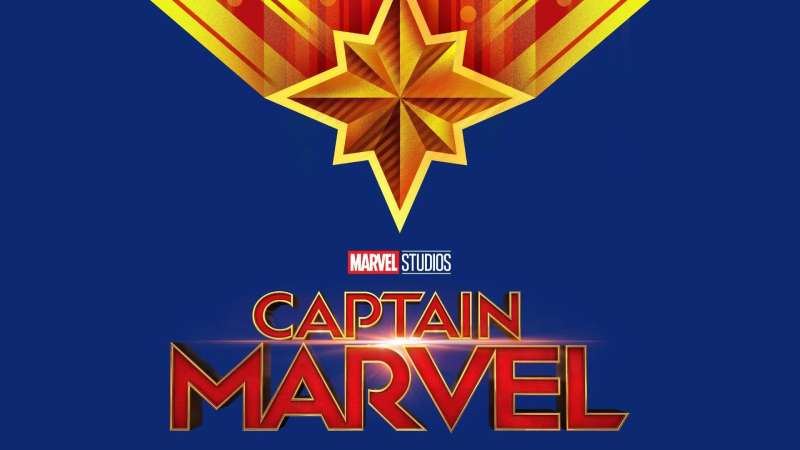
The Captain Marvel logo is one of the most recognizable symbols in superhero branding, built around a gold star emblem set against a red and blue costume design. It represents Carol Danvers, one of Marvel’s most powerful characters, and has gone through several meaningful redesigns since her comics debut. The current version, introduced in 2012 alongside Kelly Sue DeConnick’s relaunch of the character, reflects a deliberate shift toward a more military, confident identity. That redesign by Jamie McKelvie remains the basis for everything fans and studios use today.
What Is the Captain Marvel Logo?
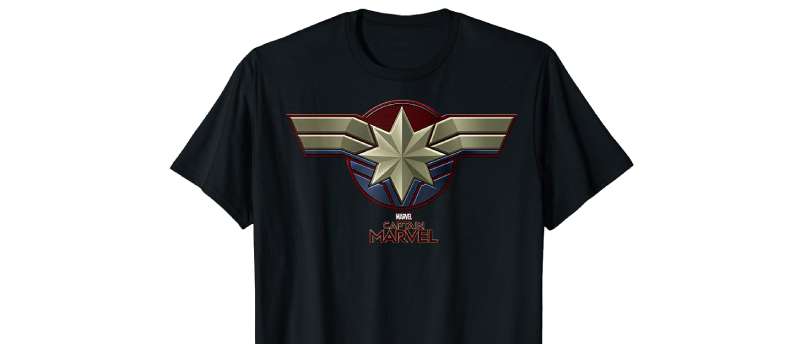
The Captain Marvel logo is a combination mark featuring a gold star chest emblem paired with bold, custom-styled lettering. Introduced in its modern form in 2012, it was designed by Jamie McKelvie to signal Carol Danvers’s transition from Ms. Marvel to Captain Marvel, reflecting strength, authority, and cosmic identity.
- Design Type: Combination mark (emblem + wordmark)
- Primary Elements: Gold star symbol, bold sans-serif lettering, red and blue color field
- Official Introduction Date: 2012 (comics); adapted for film in 2019
- Designer/Agency: Jamie McKelvie (comics redesign); Marvel Studios design team (film adaptation)
- Trademark Status: Trademarked by Marvel Entertainment, LLC under The Walt Disney Company
- Color Palette: Red (#C41E3A), Blue (#003087), Gold (#FFD700)
- Usage Context: Comics, merchandise, film marketing, digital platforms, theme park branding, apparel
How Has the Captain Marvel Logo Evolved Over Time?
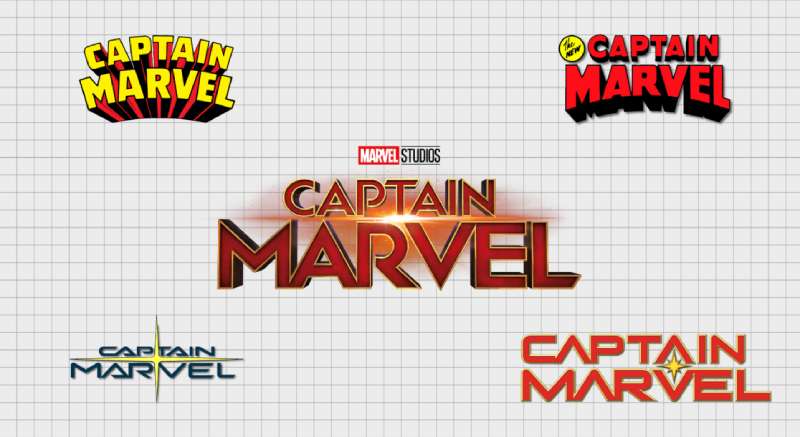
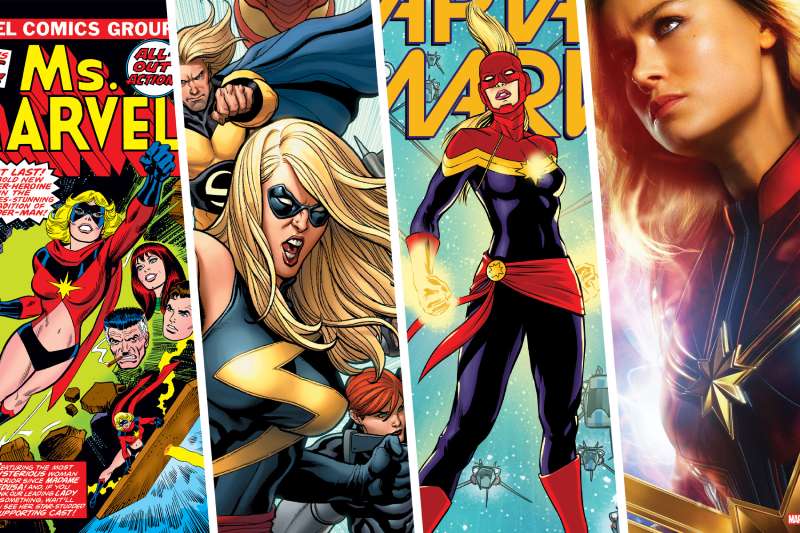
The logo’s history stretches back to the 1960s and has gone through at least six distinct visual identities. Each shift tracked changes in who wore the name, what the character stood for, and where Marvel wanted to position her in their lineup.
Original Mar-Vell Captain Marvel Logo (1967-1977)
- Years Active: 1967-1977
- Design Description: Bold red wordmark with minimal stylization; accompanied by a Kree military uniform design featuring a red and blue divided color scheme
- Color Scheme: Red and blue, with gold accents
- Designer: Gene Colan (primary character visual design)
- Context: The name “Captain Marvel” was trademarked by Marvel to prevent DC from using it; Mar-Vell was a Kree alien warrior, so the logo carried a military structure
- Key Changes from Previous: First use of the name; no previous version existed
- Cultural Significance: Established the red/blue color identity that would persist across every future iteration
Monica Rambeau Captain Marvel Logo (1982-1987)
- Years Active: 1982-1987
- Design Description: White costume with minimal graphic elements; the wordmark during this era used a cleaner, more editorial style
- Color Scheme: White, black
- Designer: Roger Stern and John Romita Jr.
- Context: Monica Rambeau became the first woman and first Black character to carry the Captain Marvel name; her design intentionally broke from the Kree military aesthetic
- Key Changes from Previous: Complete departure from the red/blue palette; cleaner, more streamlined costume silhouette
- Cultural Significance: A notable step in Marvel’s diversity efforts, though largely unacknowledged at the time
Ms. Marvel / Carol Danvers Transition Logo (1977-2012)
- Years Active: 1977-2012
- Design Description: Carol Danvers operated as Ms. Marvel for most of this period; her costume used a black and gold lightning bolt design, later transitioning to a red and blue version before her 2012 rebrand
- Color Scheme: Black, gold, red
- Designer: Dave Cockrum (original Ms. Marvel costume)
- Context: Carol existed in the shadow of Mar-Vell for decades, with her visual identity shifting multiple times as writers tried to define her role
- Key Changes from Previous: Introduced the lightning bolt motif that would later evolve into the star emblem
- Cultural Significance: The lightning bolt became a shorthand for Carol’s power; it planted the seed for what McKelvie would later transform
Modern Captain Marvel Logo (2012-Present)
- Years Active: 2012-present
- Design Description: Gold star chest emblem on a red and blue divided suit; wordmark uses a bold, slightly condensed sans-serif with strong horizontal emphasis
- Color Scheme: Red (#C41E3A), Royal Blue (#003087), Gold (#FFD700)
- Designer: Jamie McKelvie
- Context: Kelly Sue DeConnick’s relaunch repositioned Carol as Marvel’s premier female hero; McKelvie’s design needed to communicate authority and cosmic scale
- Key Changes from Previous: Star replaced lightning bolt; full helmet silhouette added; color palette became cleaner and more saturated
- Cultural Significance: This version became the definitive Carol Danvers look, used in the 2019 film and The Marvels (2023), and is now the standard across all Marvel merchandise
What Do the Design Elements of the Captain Marvel Logo Mean?

Every element in the current logo carries specific intent. The star, the color split, the typography – none of it was accidental. McKelvie and DeConnick were deliberate about building a visual identity that communicated military rank, cosmic power, and personal evolution all at once.
The gold star is the anchor of the whole design. It sits at the center of the chest, functioning as both a rank insignia and a power symbol. Stars in superhero design traditionally signal leadership or national identity (think Captain America’s shield). Here, it signals something closer to military achievement, which fits Carol’s Air Force background.
Why Did Captain Marvel’s Designers Choose These Specific Colors?
The color palette is a deliberate three-part system, and each color does a specific job.
Red (#C41E3A)
Red covers the upper chest and shoulders. In color psychology, red communicates urgency, power, and action. For Captain Marvel, it reinforces her combative, frontline nature. She doesn’t wait – she moves first.
Royal Blue (#003087)
Blue grounds the design. It signals authority, loyalty, and stability – traits directly tied to Carol’s military identity. The deep navy tone in particular reads as institutional and serious, which separates this design from brighter, more playful superhero palettes. If you compare it to red logos or blue logos more broadly, the combination here skews more toward authority than energy.
Gold (#FFD700)
The gold star is the contrast point. Gold logos typically signal prestige or achievement, and that’s exactly what the star is communicating: Carol earned this. The hue sits warm against the cooler red and blue, creating a complementary color scheme effect that naturally draws the eye to the chest emblem first.
What Typography Style Is Used in the Captain Marvel Logo?
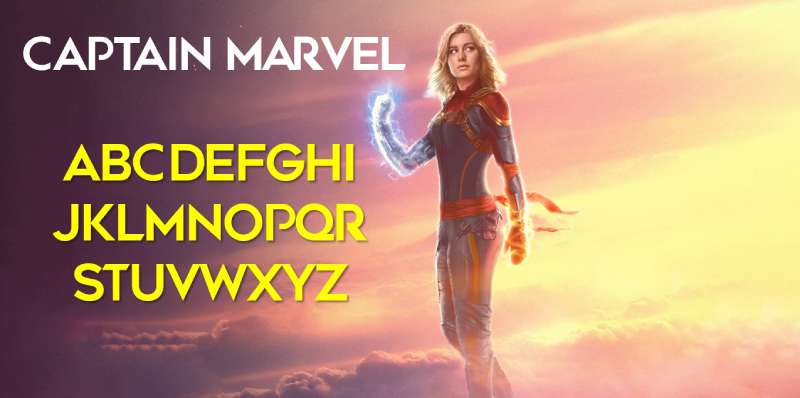
The wordmark uses a bold, condensed sans-serif with strong geometric structure. It’s not a standard off-the-shelf font – Marvel’s design team customized the letterforms to give it weight and authority without feeling stiff.
The characters are tightly spaced. Tracking is kept minimal, which increases the sense of density and power.
There’s no decorative detail in the letterforms. No serifs, no flourishes. A sans-serif font choice at this weight reads as modern and direct – which mirrors what the character is supposed to represent.
The typography has remained largely consistent since 2012. The film version made minor adjustments for readability at large scale, but the core structure stayed intact.
What Are the Hidden Meanings in the Captain Marvel Logo?
The star’s position at the chest is not arbitrary. In military tradition, chest insignia indicates rank and unit. Placing the star there grounds Carol in her Air Force identity, even as she operates in space.
The diagonal color split on the suit (red above, blue below, or in some versions a vertical split on the arms) creates a visual tension that communicates duality – human and Kree, pilot and cosmic warrior.
McKelvie has mentioned in interviews that the mohawk-style helmet fin, which appears in some logo adaptations, was a conscious nod to both Spartan warrior imagery and jet fighter cockpit silhouettes. It connects the ancient and the technological without using either directly.
Whether intentional or not, the gold star on red and blue also reads as patriotic. Fans have pointed out the flag-coded color reading since the design launched, though Marvel has never officially confirmed this was a deliberate choice.
How Does the Captain Marvel Logo Compare to Competitor Logos?
Within superhero logos more broadly, Captain Marvel’s design sits in an interesting middle ground – more complex than a single-element mark but cleaner than many of its Marvel peers.
Compare it to the Spider-Man logo: Spider-Man’s mark is primarily typographic with a web motif, leaning heavily on the wordmark. Captain Marvel’s logo leads with the emblem. The star does more communicative work than the lettering.
The Iron Man logo is another useful comparison. Both feature chest-mounted emblems as the primary design element, but Iron Man’s arc reactor is circular and centered, suggesting technology and precision. The Captain Marvel star is asymmetric in its visual weight and reads warmer.
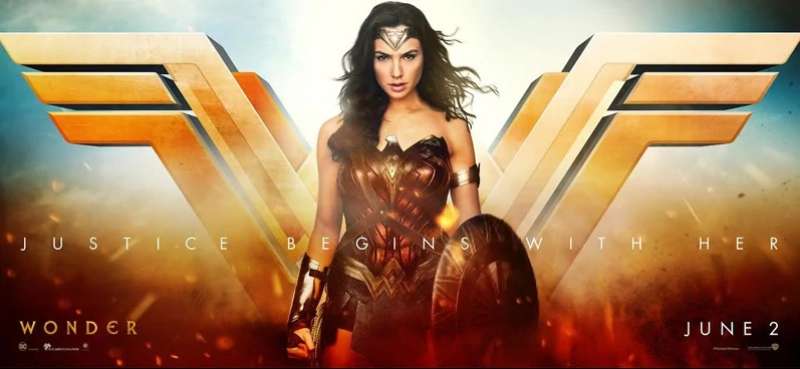
Against DC’s Wonder Woman logo, the difference is even more pronounced. Wonder Woman’s WW mark leans into mythological and ornamental design territory. Captain Marvel’s star is blunt by comparison – military-coded, not decorative.
The Captain America logo is probably the closest visual relative: both use star imagery, both use red/white/blue color families, both carry patriotic-adjacent readings. The key difference is that Captain America’s shield is a defensive symbol. Captain Marvel’s star reads as an offensive one – something you lead with, not hide behind.
What Are the Technical Specifications of the Captain Marvel Logo?
Official Color Codes
- Primary Color: Red
- Hex: #C41E3A
- RGB: (196, 30, 58)
- CMYK: (0, 85, 70, 23)
- Pantone: 200 C
- Secondary Color: Royal Blue
- Hex: #003087
- RGB: (0, 48, 135)
- CMYK: (100, 64, 0, 47)
- Pantone: 287 C
- Accent Color: Gold
- Hex: #FFD700
- RGB: (255, 215, 0)
- CMYK: (0, 16, 100, 0)
- Pantone: 116 C
Dimensions and Proportions
- Aspect Ratio: Approximately 3:1 (wordmark); 1:1 (star emblem standalone)
- Minimum Size Requirements: Star emblem should not be reproduced below 16px in digital contexts; 0.5 inches in print
- Clear Space Specifications: A minimum clear space equal to the height of the star emblem should surround the logo on all sides
- File Formats: Vector graphics (SVG, AI, EPS) for scalable use; PNG with transparency for digital; high-DPI bitmap exports for raster contexts
- Official Usage Guidelines: Available through Marvel’s brand licensing portal; unauthorized reproduction is prohibited under trademark law
What Cultural Impact Has the Captain Marvel Logo Had?
The 2012 redesign arrived at a specific moment in comics culture. Female-led titles were struggling commercially, and Marvel’s bet on a fully relaunched Carol Danvers – with a new name, new logo, new creative team – was genuinely risky.
It worked. The “Carol Corps,” a fan community that formed almost immediately after the relaunch, adopted the star emblem as their symbol. People got tattoos of it. They put it on handmade costumes. That kind of grassroots adoption doesn’t happen often with corporate IP, and it’s a direct result of how well the logo communicated something fans wanted to identify with.
The 2019 film extended that reach significantly. The logo appeared on merchandise across dozens of categories – apparel, accessories, school supplies, home goods. It became one of Marvel Studios’ most licensed marks of that release cycle.
There’s also the real-world military connection. The logo’s Air Force-adjacent design led to actual collaborations with the U.S. Air Force around the film’s release. Pilots and service members posted photos in Captain Marvel gear. The design created a feedback loop between fictional military symbolism and real institutional pride.
How Does the Captain Marvel Logo Fit Into the Overall Brand Identity?
The logo sits within a carefully managed Marvel brand system. It’s one node in a much larger network of connected characters, marks, and visual identities – all governed by Marvel’s brand guidelines and the broader Disney brand architecture.
Within that system, Captain Marvel occupies a specific position: the cosmic tier. Her logo family (used across comics, films, and merchandise) clusters with characters like Thor and the Guardians of the Galaxy rather than street-level heroes like Daredevil or the Punisher. The color saturation and the star emblem signal scale.
The logo also functions as a focal point within the broader Avengers visual system. When Marvel designs ensemble promotional materials, Carol’s star consistently gets placed at or near center-frame – a deliberate visual hierarchy choice that reflects her positioning as a flagship character.
Her mark connects directly to Kamala Khan (Ms. Marvel) and Monica Rambeau through shared color language and the explicit narrative lineage that The Marvels built on screen. That shared identity system is intentional – Marvel uses consistent design elements across related characters to build visual families that audiences intuitively recognize.
How Should the Captain Marvel Logo Be Used?
Official Usage Guidelines
- Do: Use official files sourced from Marvel’s licensed brand portal; maintain color accuracy using specified hex/Pantone codes; preserve clear space around the mark; use vector formats for print applications
- Don’t: Alter the color scheme, stretch or distort the proportions, add effects like drop shadows or gradients without authorization, place the logo on visually competing backgrounds, or reproduce it at sizes below minimum specifications
Where to Access Official Logos
- Marvel’s official brand licensing program (for commercial use)
- Marvel’s press kit portal (for editorial and journalistic use)
- Authorized merchandise partners receive files directly from Marvel Entertainment’s asset management system
Licensing Information
- The Captain Marvel logo is the intellectual property of Marvel Entertainment, LLC, a subsidiary of The Walt Disney Company
- Commercial use requires a formal licensing agreement
- Fan art and non-commercial use operates in a gray area; Marvel generally tolerates non-commercial fan reproductions but does not grant formal permission
- Using the logo on products for sale without licensing is a trademark infringement
Trademark Protection
- The name “Captain Marvel” and associated logos are federally registered trademarks
- Marvel maintains these registrations actively, including against third-party filings that might create consumer confusion
- The trademark history of the name itself is extensive – Marvel has held it since 1967 specifically to prevent other publishers from using it commercially
FAQ on The Captain Marvel Logo
What does the Captain Marvel logo look like?
It’s a combination mark: a gold star chest emblem paired with bold, condensed sans-serif lettering.
The color scheme is red, royal blue, and gold. Clean, military-coded, and instantly recognizable across comics and film merchandise.
Who designed the Captain Marvel logo?
Jamie McKelvie created the modern Captain Marvel symbol in 2012 for Kelly Sue DeConnick’s comic relaunch.
The Marvel Studios design team adapted it for the 2019 film. McKelvie’s core star emblem and color structure stayed largely intact through both versions.
What does the star symbol on the Captain Marvel logo mean?
The star functions as a military rank insignia, directly tied to Carol Danvers’s background as a U.S. Air Force pilot.
It replaced the lightning bolt from her Ms. Marvel era. The shift signaled a deliberate move toward authority and leadership rather than raw power.
What are the official colors of the Captain Marvel logo?
The three official colors are red (Hex #C41E3A), royal blue (Hex #003087), and gold (Hex #FFD700).
Pantone equivalents are 200 C, 287 C, and 116 C respectively. These have remained consistent across the comics and MCU branding since 2012.
How many times has the Captain Marvel logo changed?
There have been at least six distinct visual identities since Mar-Vell’s debut in 1967.
Major changes came with each new character taking the Captain Marvel name: Mar-Vell, Monica Rambeau, and Carol Danvers. The 2012 McKelvie redesign is the most significant and enduring version.
What font is used in the Captain Marvel logo?
The wordmark uses a custom-modified condensed sans-serif – not a standard retail typeface.
Marvel’s design team adjusted the letterforms for weight and density. Tight tracking and strong horizontal emphasis give it that authoritative, no-nonsense feel consistent with Carol’s character framing.
Where can I download the Captain Marvel logo PNG?
Official high-resolution files are available through Marvel’s press kit portal for editorial use.
Commercial use requires a formal licensing agreement with Marvel Entertainment. Fan and non-commercial use operates in a gray area – Marvel generally tolerates it but grants no formal permission for Captain Marvel logo PNG downloads.
How does the Captain Marvel logo compare to other superhero logos?
It sits closer to the Thor logo and Black Widow logo in terms of military seriousness.
Unlike the Deadpool logo or Hawkeye logo, which lean more graphic and loose, Captain Marvel’s mark is structured and emblem-driven. The gold star emblem is the clearest differentiator.
Is the Captain Marvel logo trademarked?
Yes. The logo and the name “Captain Marvel” are federally registered trademarks held by Marvel Entertainment, LLC, a subsidiary of The Walt Disney Company.
Marvel has actively maintained this trademark since 1967 – originally to block other publishers from using the name commercially. Unauthorized reproduction for commercial purposes is infringement.
What is the difference between the comic and movie versions of the Captain Marvel logo?
The core star emblem and red/blue/gold palette carried over directly from comics to film.
The MCU version made minor typography adjustments for large-format readability and refined the Captain Marvel chest emblem proportions slightly for costume manufacturing. Functionally, both versions trace back to McKelvie’s 2012 design.
Conclusion
The Captain Marvel logo is more than a costume detail – it’s a complete visual argument for who Carol Danvers is as a character.
The gold star emblem, the red and blue color split, the tight condensed wordmark – every choice by Jamie McKelvie in 2012 still holds up across comics, film, and MCU merchandise today.
Few superhero emblems manage to communicate military rank, cosmic scale, and personal identity simultaneously without becoming cluttered.
This one does. And that’s exactly why the Carol Danvers insignia has stayed essentially unchanged for over a decade.

Renowned for his expertise in logo design and visual branding, Bogdan has developed a multitude of logos for various clients.
His skills extend to creating posters, vector illustrations, business cards, and brochures. Additionally, Bogdan's UI kits were featured on marketplaces like Visual Hierarchy and UI8.
He also wrote in the past years on sites like Design Your Way, WebDesignerDepot, WPDean, Designmodo, Speckyboy, Slider Revolution, and more.
- The Windsurf Logo History, Colors, Font, And Meaning - 10 October 2026
- How to Remove Background From Product Photos (No Photoshop) - 10 October 2026
- How Designers can Build a Stronger Online Creative Identity - 9 October 2026

Bogdan Sandu is a seasoned designer who has been designing websites since 2008. Renowned for his expertise in logo design and visual branding, Bogdan has developed a multitude of logos for various clients. His skills extend to creating posters, vector illustrations, business cards, and brochures. Additionally, Bogdan's UI kits were featured on marketplaces like Visual Hierarchy and UI8. He also wrote in the past years on sites like Design Your Way, WebDesignerDepot, WPDean, Designmodo, Speckyboy, Slider Revolution, and more.
You Might Also Like