Three frogs croaking one word each sold more beer than any product claim ever did.
Budweiser ads run on that logic. Ninety years of campaigns built on symbols instead of arguments, from the 1933 Clydesdale hitch to “Whassup?!” to the Super Bowl films Anomaly still makes.
This page collects the work campaign by campaign, with the agency, year and market attached to each one.
You also get the design layer most galleries skip:
- The bowtie frame and why it never changes
- Script lettering, red saturation, gold accents
- Layout habits inside the Life magazine print ads
- How the TV spots withhold the product
Everything is dated and credited. No unlabeled album.
Budweiser advertising spans more than 90 years, 5 lead agencies and 6 flagship campaign platforms, from the 1933 Clydesdale hitch that marked the repeal of Prohibition to the 2025 FIFA Club World Cup platform “Celebration in the Making.”
The work runs on repeated visual symbols and almost no product argument. Television, full-page magazine spreads and stadium sponsorship carry most of it.
This page covers the named campaigns with the agency, year and market behind each one, plus the layout, lettering and color decisions that hold the whole thing together.
Budweiser Advertising at a Glance
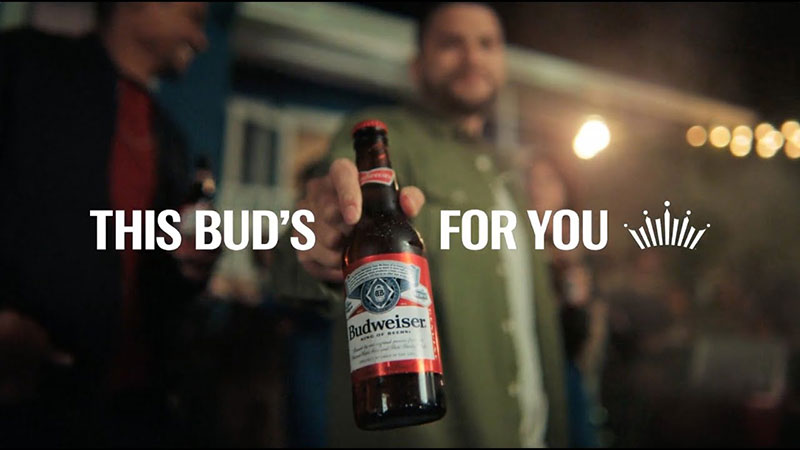
Budweiser has advertised nationally since 1933 and worked primarily with D’Arcy Masius Benton & Bowles, DDB Chicago and Anomaly. Its best-known campaigns are “This Bud’s for You,” the Budweiser Frogs and “Whassup?!” The visual signature combines a red bowtie, white script lettering and a gold crown.
| Attribute | Value |
|---|---|
| First major campaign | Clydesdale hitch launch, 1933, St. Louis |
| Lead agencies | D’Arcy Masius Benton & Bowles (1915-1994), DDB Chicago (1994-2010s), Goodby Silverstein & Partners (1998), Anomaly (2013-present), Wieden+Kennedy NY (World Cup work) |
| Best-known taglines | “Where there’s life… there’s Bud” (1956), “This Bud’s for You” (1979), “King of Beers,” “Whassup?!” (1999), “Bring Home the Bud” (2022) |
| Primary media | Super Bowl television, Life magazine spreads, radio, stadium signage, YouTube |
| Awards | Cannes Lions Film Grand Prix 2000, Grand Clio 2000, USA Today Ad Meter first place 2013 and 2014 |
| Visual signature | Bowtie frame, white script wordmark, gold crown, Clydesdale silhouette |
Which Budweiser Ad Campaigns Are the Most Famous?
Six campaigns define the brand: “Where There’s Life… There’s Bud” (1956), “This Bud’s for You” (1979), the Budweiser Frogs (1995), “Whassup?!” (1999), the Clydesdale Super Bowl films (1986 to present), and “Bring Home the Bud” (2022).
Each one replaced the previous creative device rather than sitting alongside it. That single-platform discipline is rarer than it sounds.
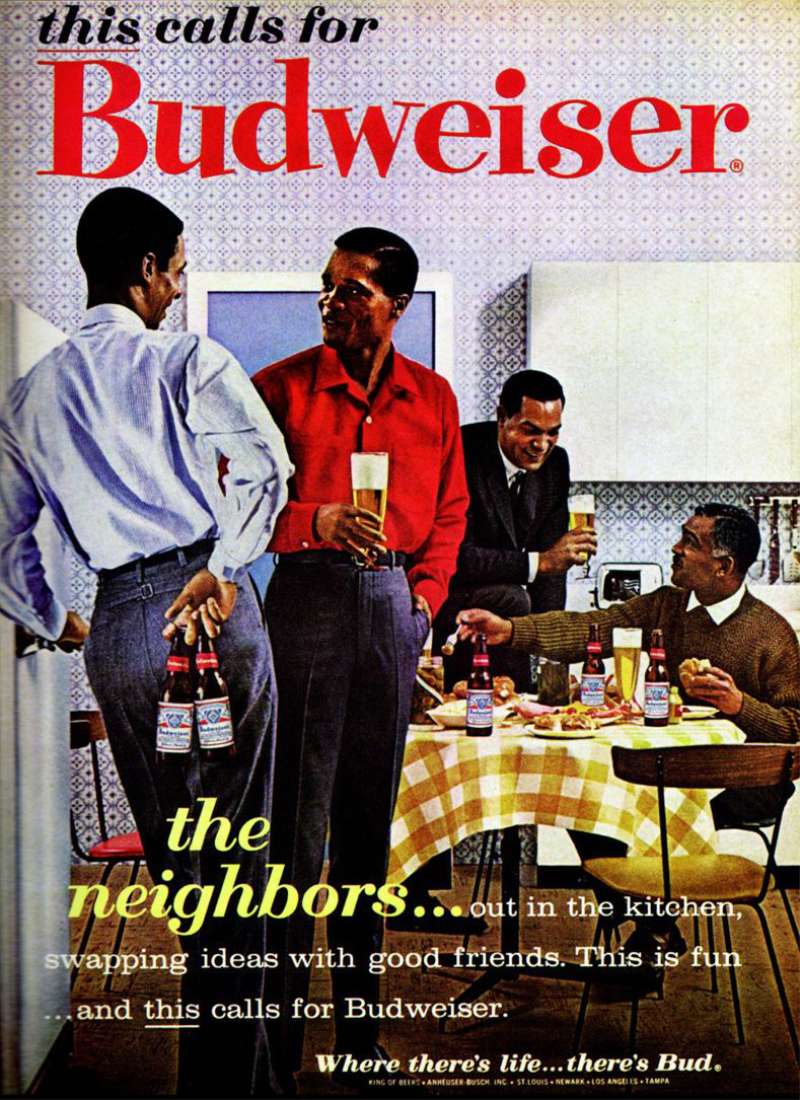
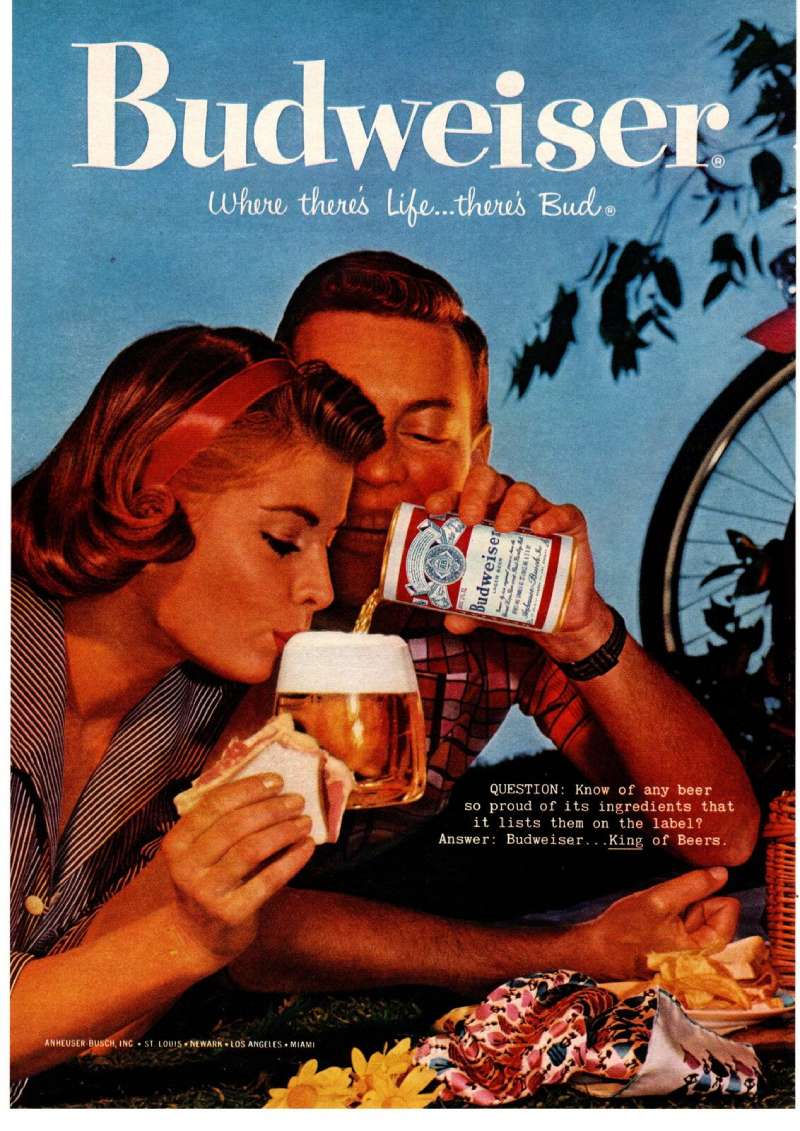
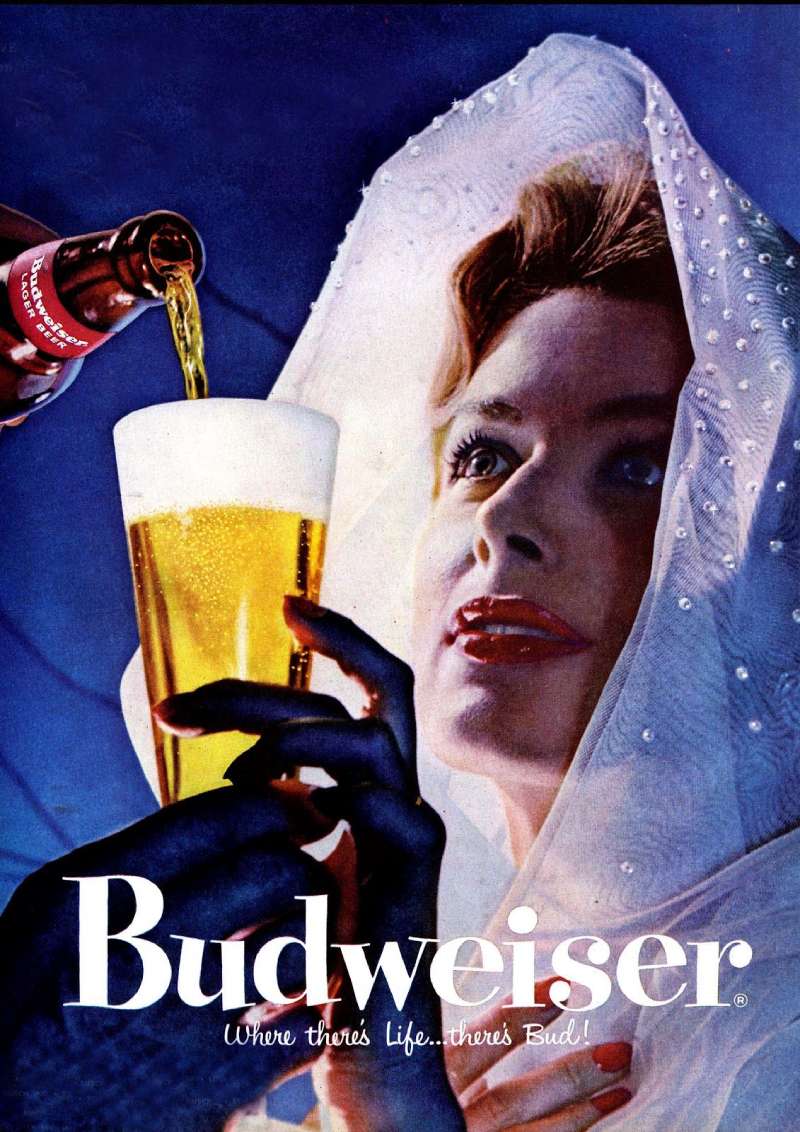
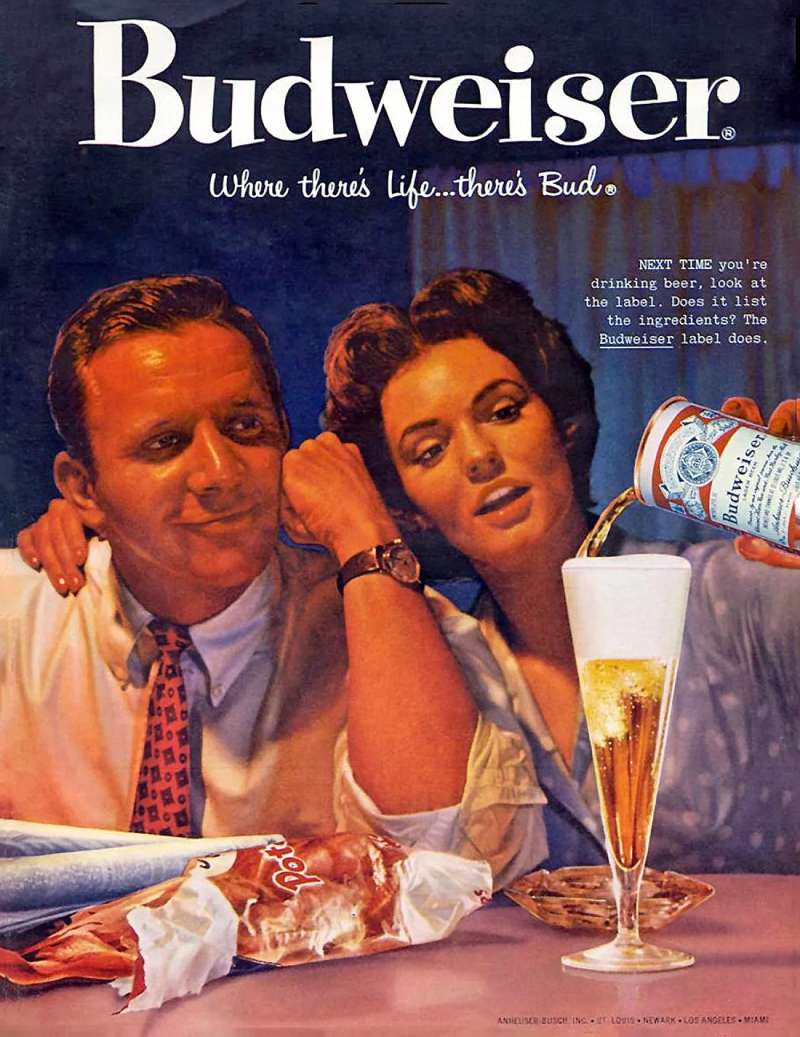
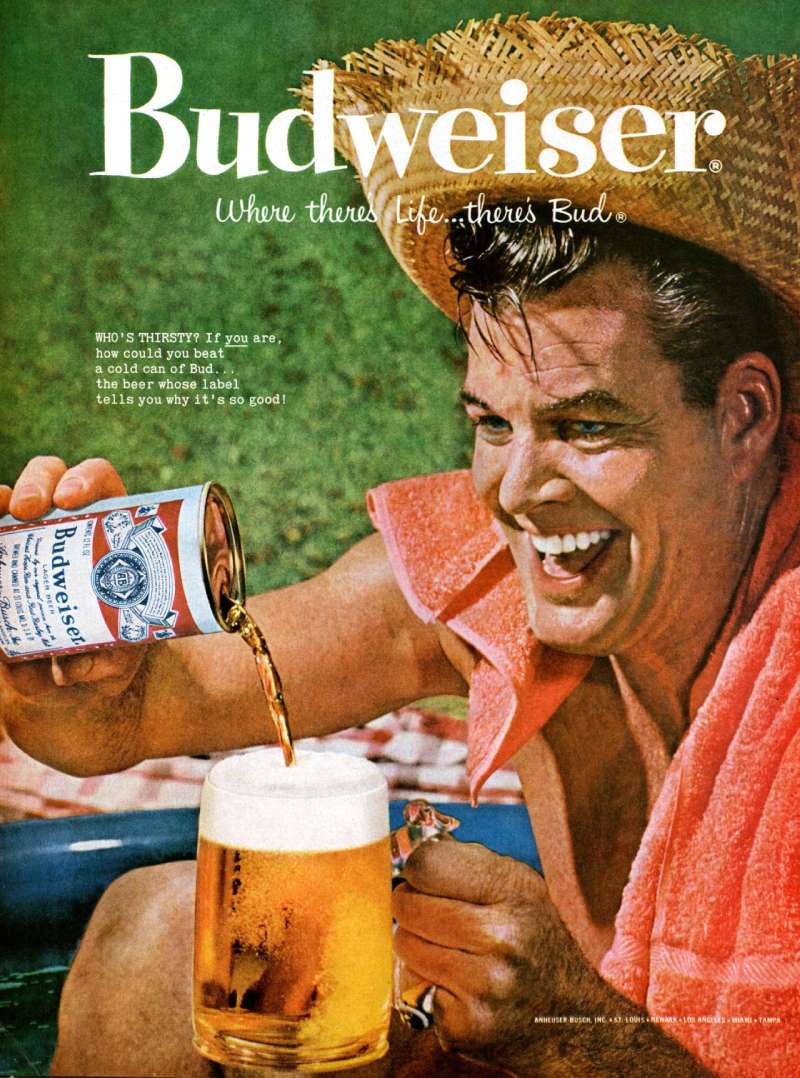
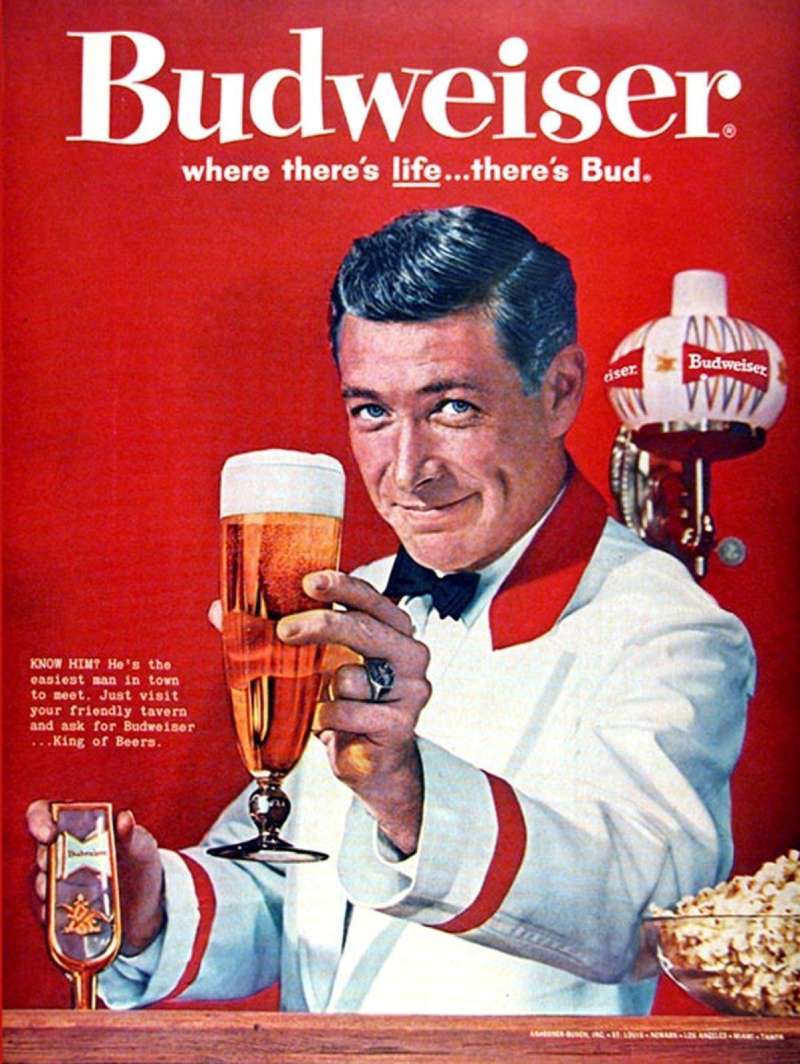
Where There’s Life… There’s Bud (1956-1970s)
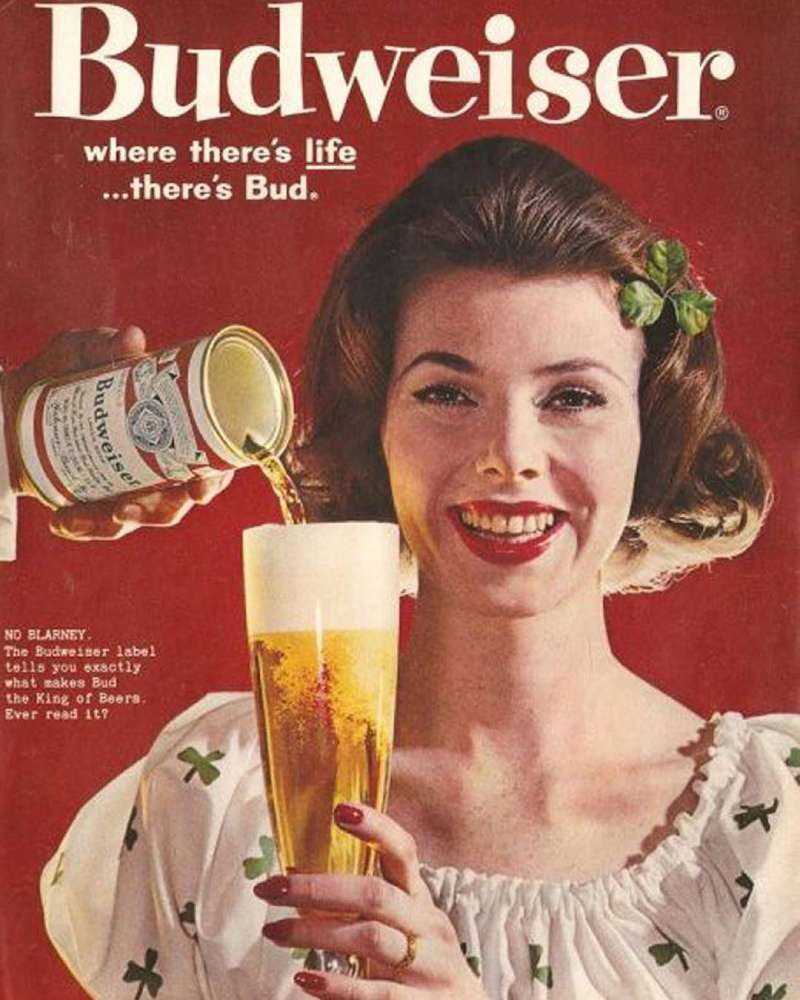
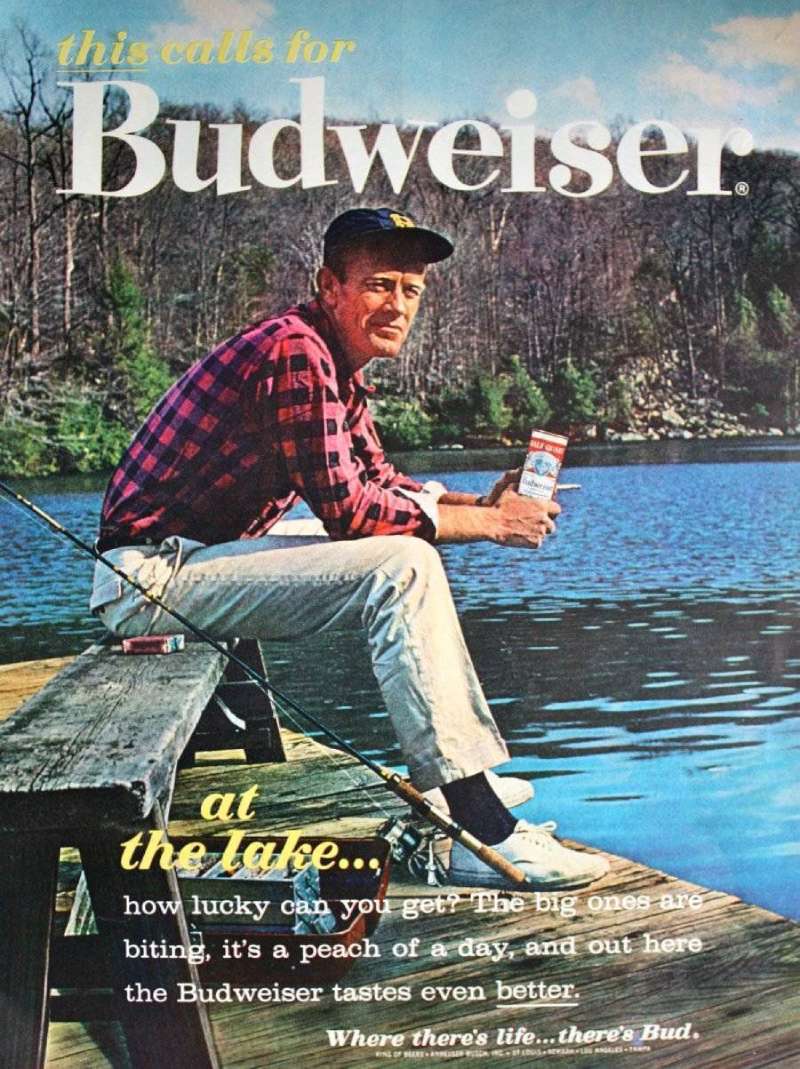
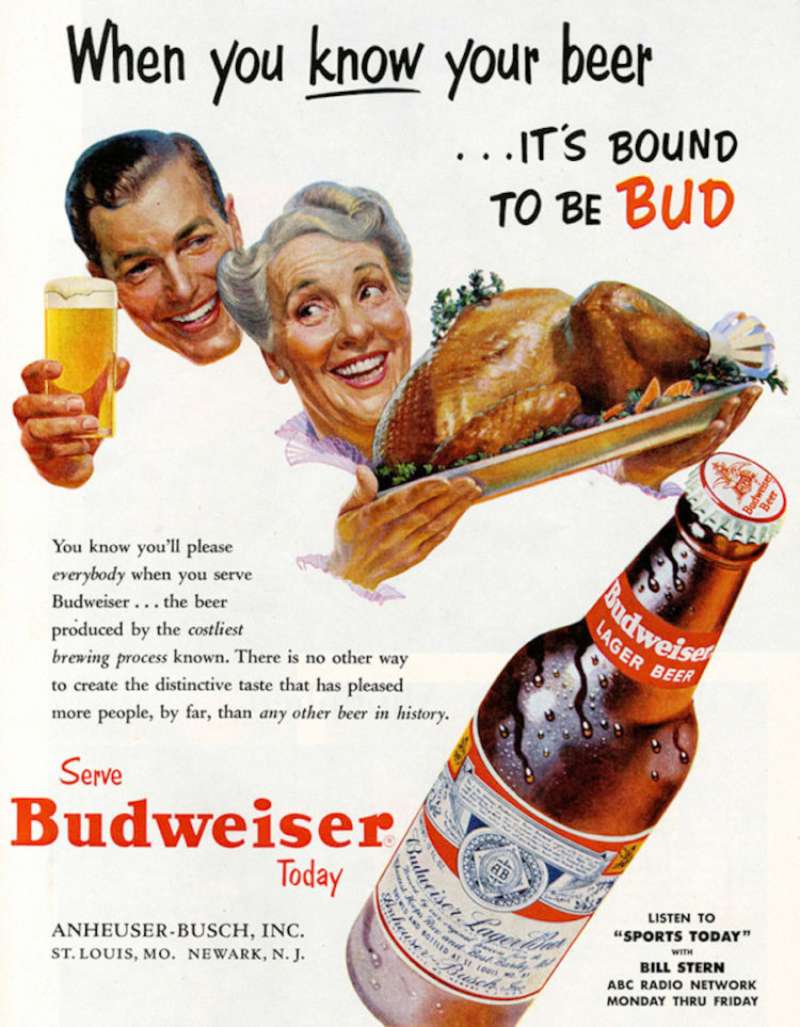
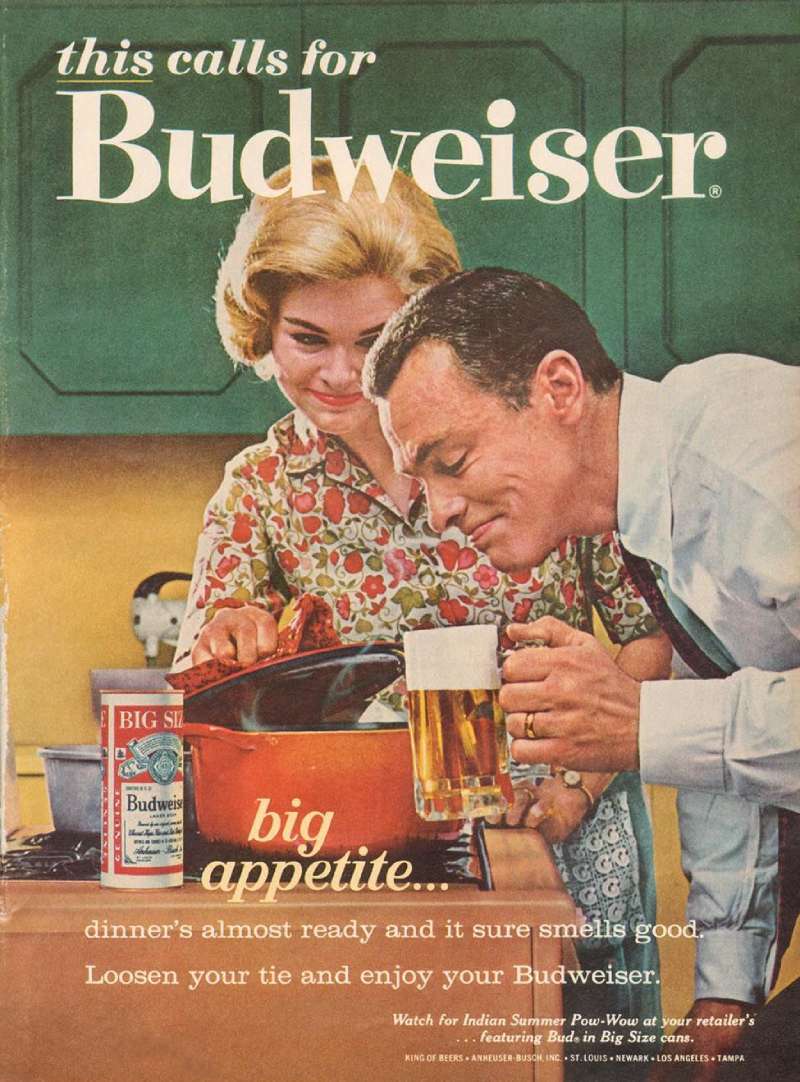
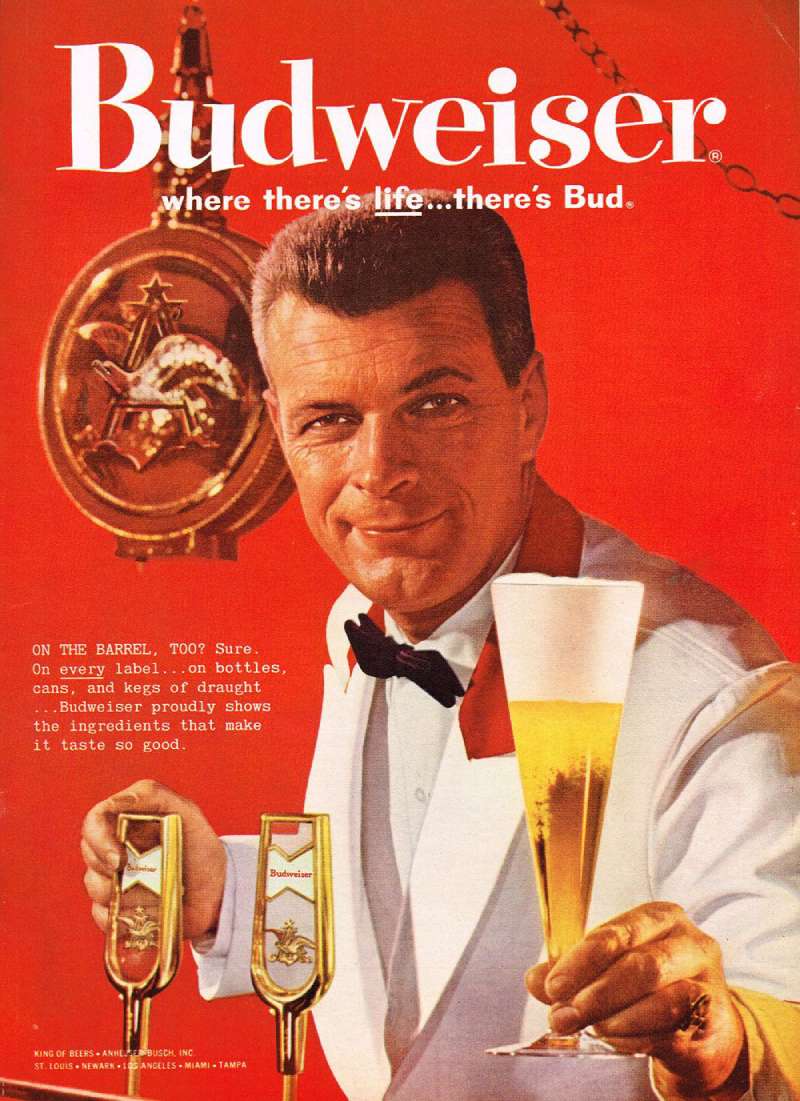
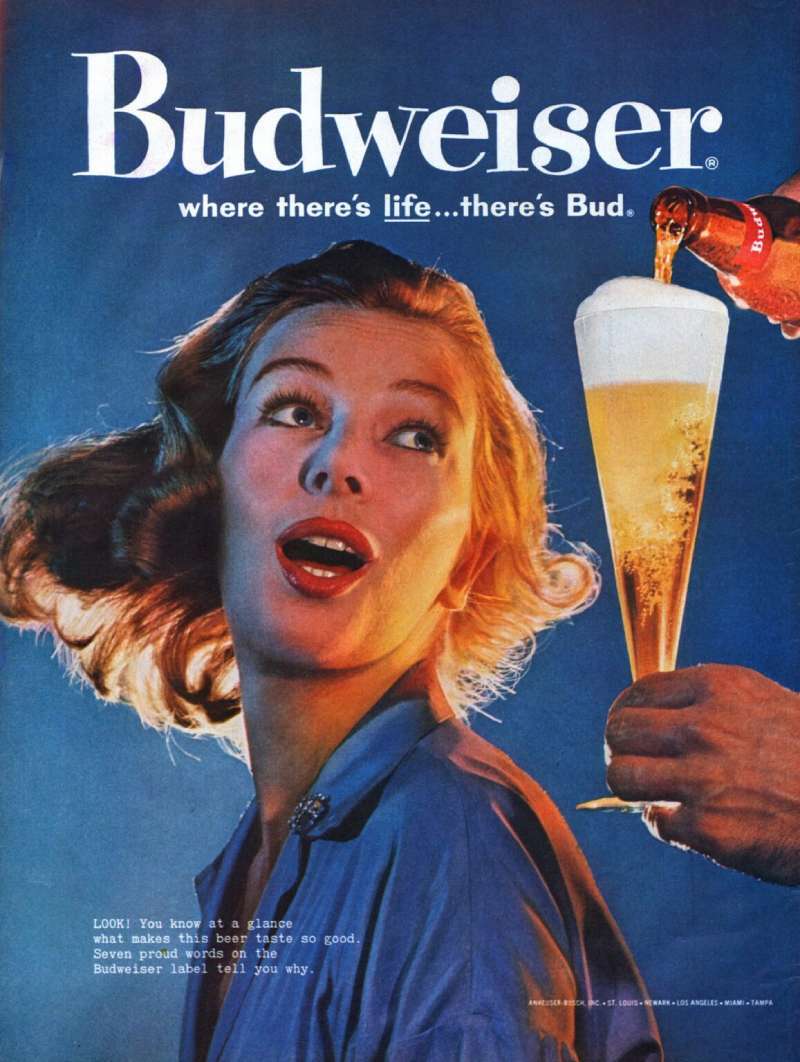
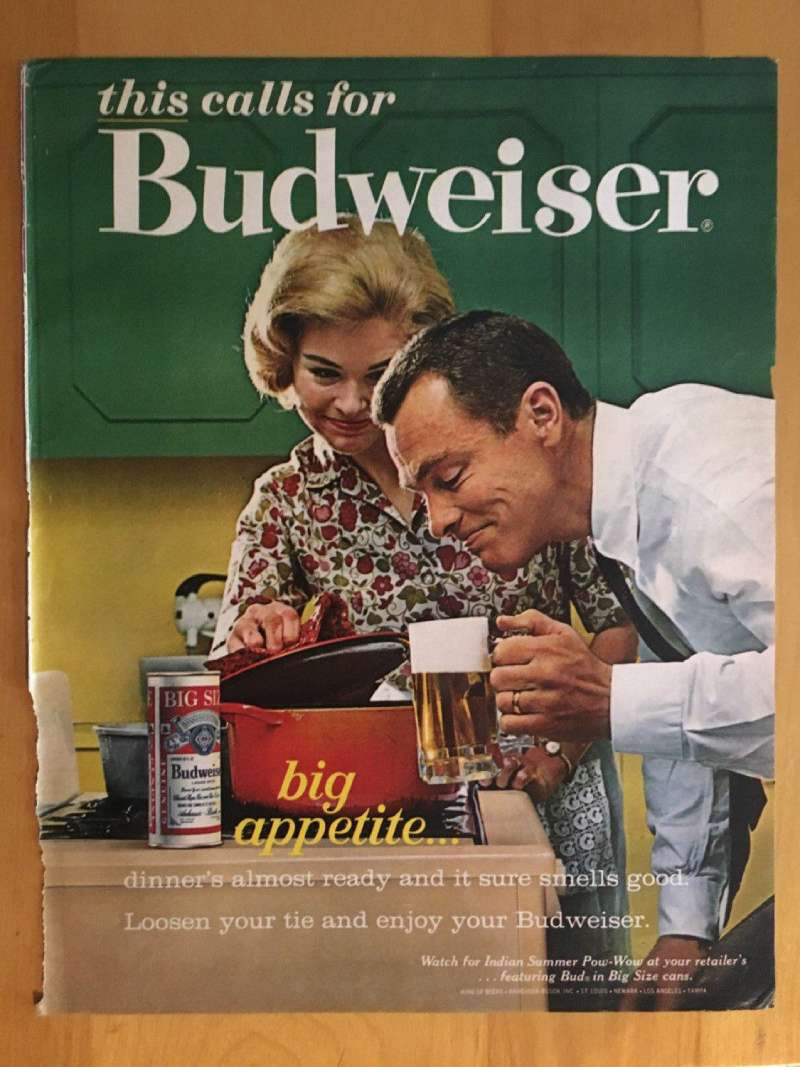
D’Arcy built this platform around full-page Life magazine spreads showing a single hosting moment, usually a meal, a card table or a beach evening. The line ran through the late 1960s in national print and radio.
Layout logic: photograph occupies the top two-thirds, headline sits on the fold, body copy and bottle anchor the lower left.
Copy device: the ads named ingredients on the label, an early trust play in a category with no ingredient disclosure.
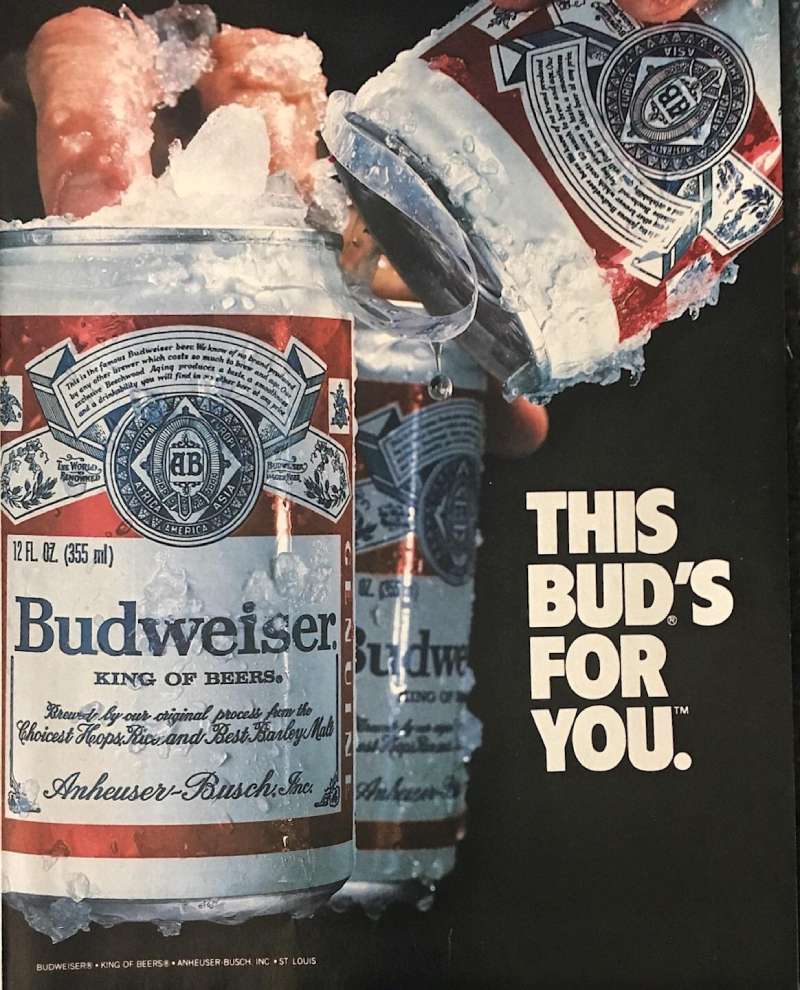
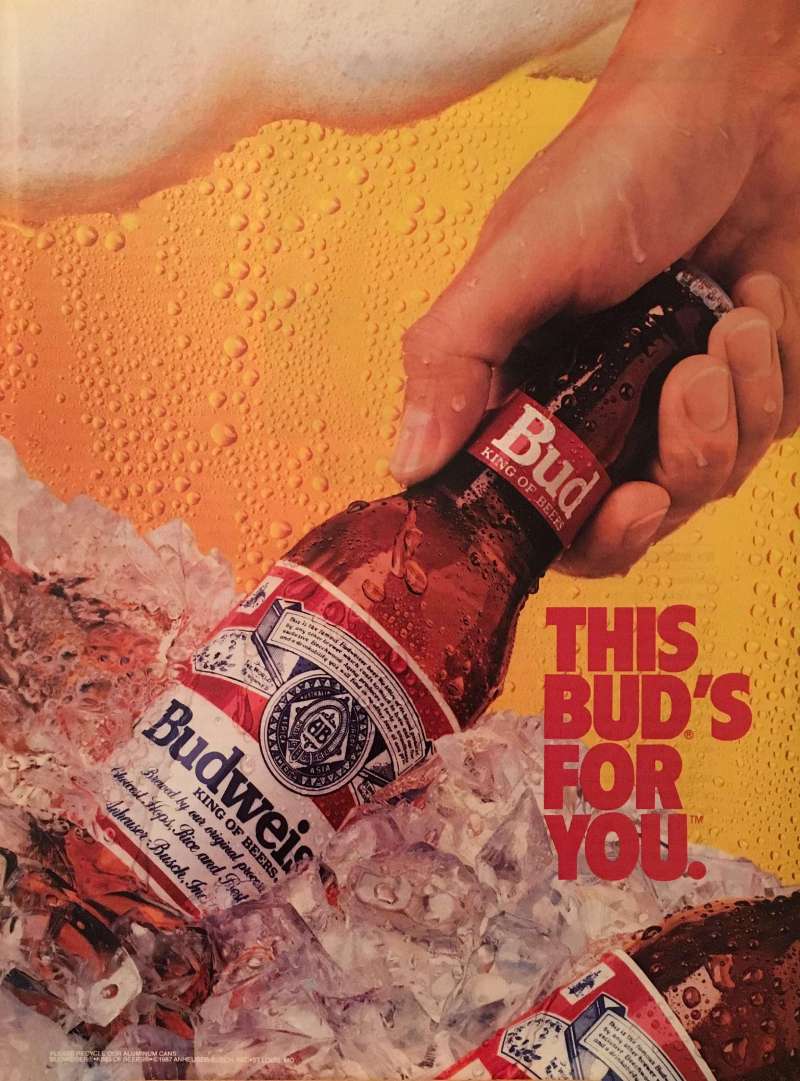
This Bud’s for You (1979-1994)

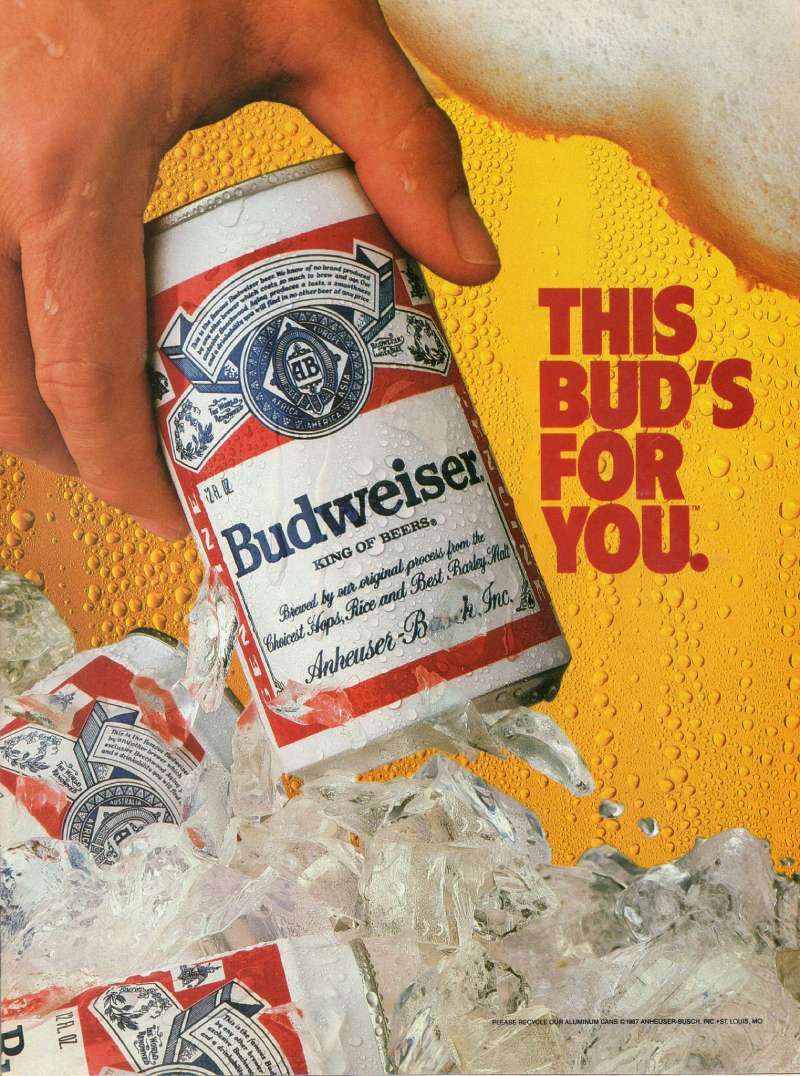
D’Arcy created “This Bud’s for You” in 1979 for the US market, built on blue-collar tradespeople finishing a shift. The line stayed in rotation for roughly 15 years across television, radio and outdoor.
Budweiser sales climbed from 35 million to 86 million barrels during the tagline’s run, according to advertising archives tracking the period.
- Grain and hop imagery pushed out, human hands pushed in
- Warm tungsten light, no studio product shots
- Tagline set flush right, always after the last visual beat
The Budweiser Frogs (1995-1999)

Three animatronic frogs croaking one syllable each. The 30-second spot ran during Super Bowl XXIX on January 29, 1995, written by David Swaine, Michael Smith and Mark Choate at DMB&B St. Louis and directed by Gore Verbinski.
Stan Winston Studio built the puppets. The brand name was the entire script.
Budweiser’s total licensing program grew more than 50% in 1995, with 21% of that revenue coming from Frogs merchandise (Animation World Network).
Goodby, Silverstein & Partners added the chameleons Louie and Frankie at Super Bowl XXXII in 1998, turning a sound gag into a serialized cast.
Whassup?! (1999-2002)

DDB Chicago adapted Charles Stone III’s short film “True” into a Budweiser spot that debuted on Monday Night Football in December 1999 and ran again at Super Bowl XXXIV. Stone directed and cast his own friends after auditioning 80 people.
Awards: Cannes Lions Film Grand Prix 2000 and the Grand Clio, the third US Film Grand Prix of that decade.
Result: Budweiser supermarket sales grew 4.8% over the first five months of 2000, per Anheuser-Busch at the time.
The visual grammar was deliberately cheap. Handheld framing, domestic interiors, no beauty lighting on the bottle.
Clydesdale Super Bowl Films (1986-Present)

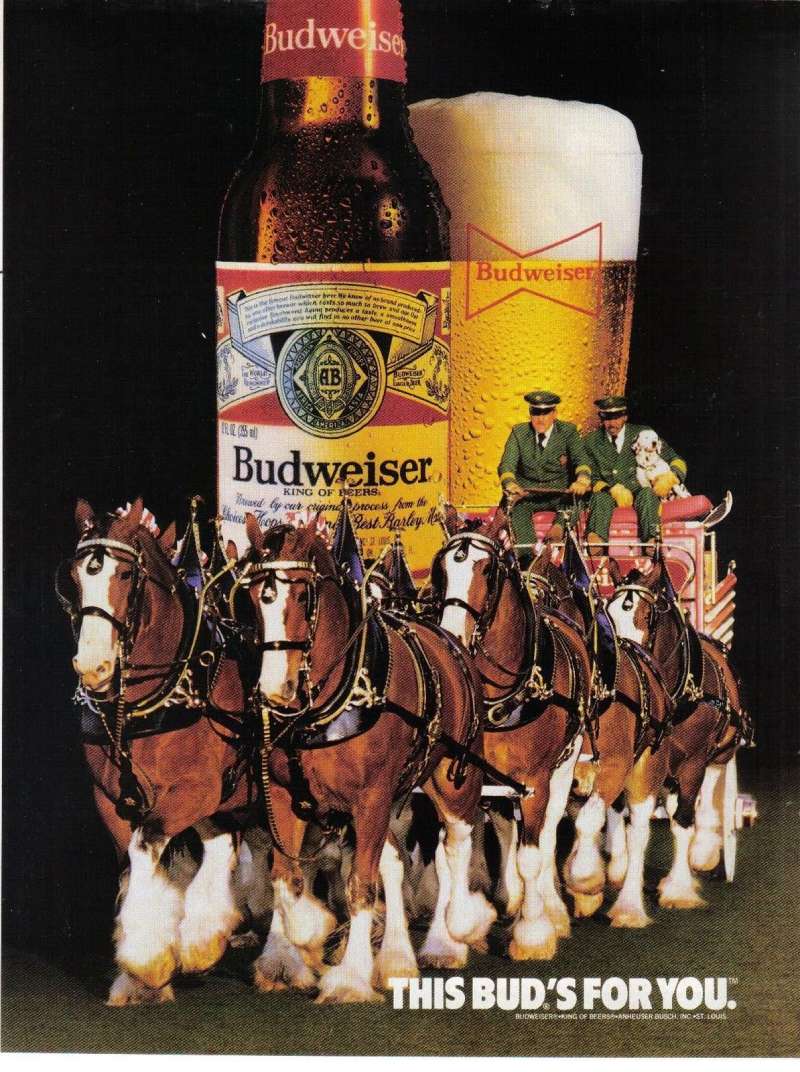
The Clydesdales made their Super Bowl debut in 1986 with “Here Comes the King” and have appeared 47 times through Super Bowl LIX in 2025, according to Marketing Brew. Anomaly has handled the modern films since 2013.
| Spot | Year | Note |
|---|---|---|
| Brotherhood | 2013 | USA Today Ad Meter winner, Anomaly |
| Puppy Love | 2014 | Ad Meter winner, director Jake Scott, 17 horses and 8 Labrador puppies |
| Born the Hard Way | 2017 | Adolphus Busch origin film, director Chris Sargent |
| First Delivery | 2025 | Clydesdale foal lead, 47th Super Bowl appearance |
“Puppy Love” reached 35 million YouTube views before kickoff and 1.38 million shares, per Unruly.
Bring Home the Bud (2022-Present)

Budweiser launched “Bring Home the Bud” for the 2022 FIFA World Cup in Qatar, then reran it for the 2023 Women’s World Cup and the 2025 FIFA Club World Cup. Red branded crates deliver free beer to the winning nation or club.
Creative lead: Wieden+Kennedy New York made the 2023 film “The World Is Yours to Take” with Lionel Messi.
2025 platform: “Celebration in the Making,” anchored by a 60-second spot called “ThunderBud” set to AC/DC’s “Thunderstruck.”
Market scope: activation across more than 40 countries, with fan zones in Manchester, London and Brazil.
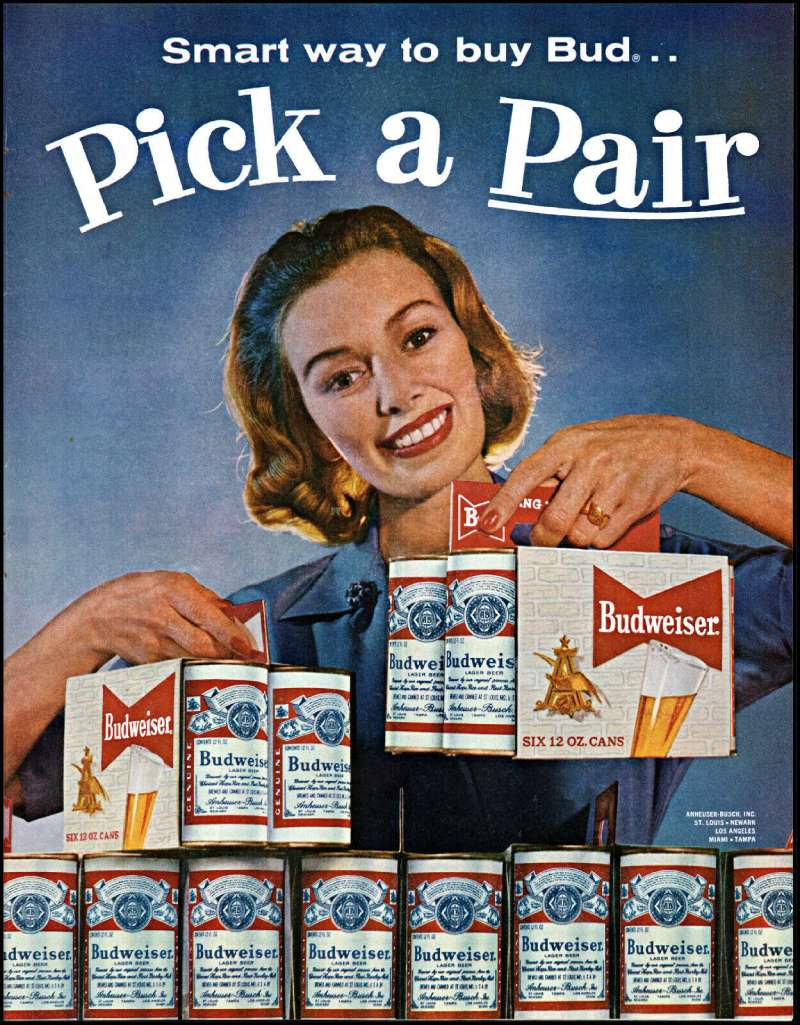
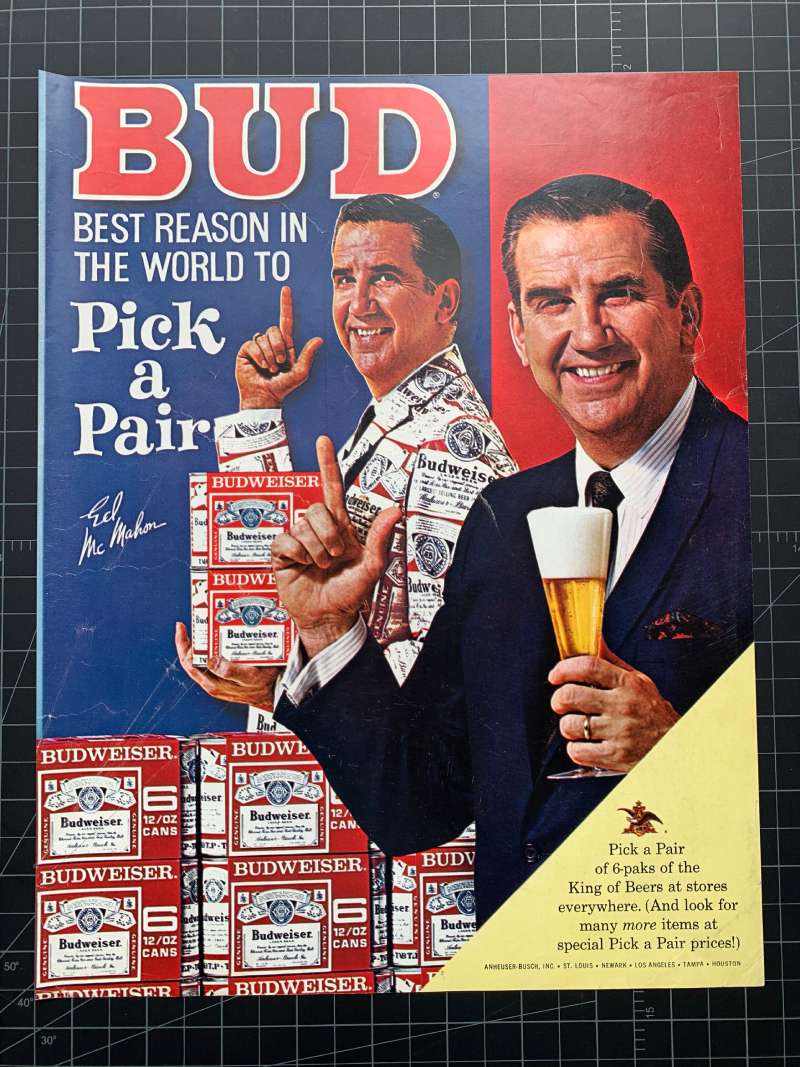
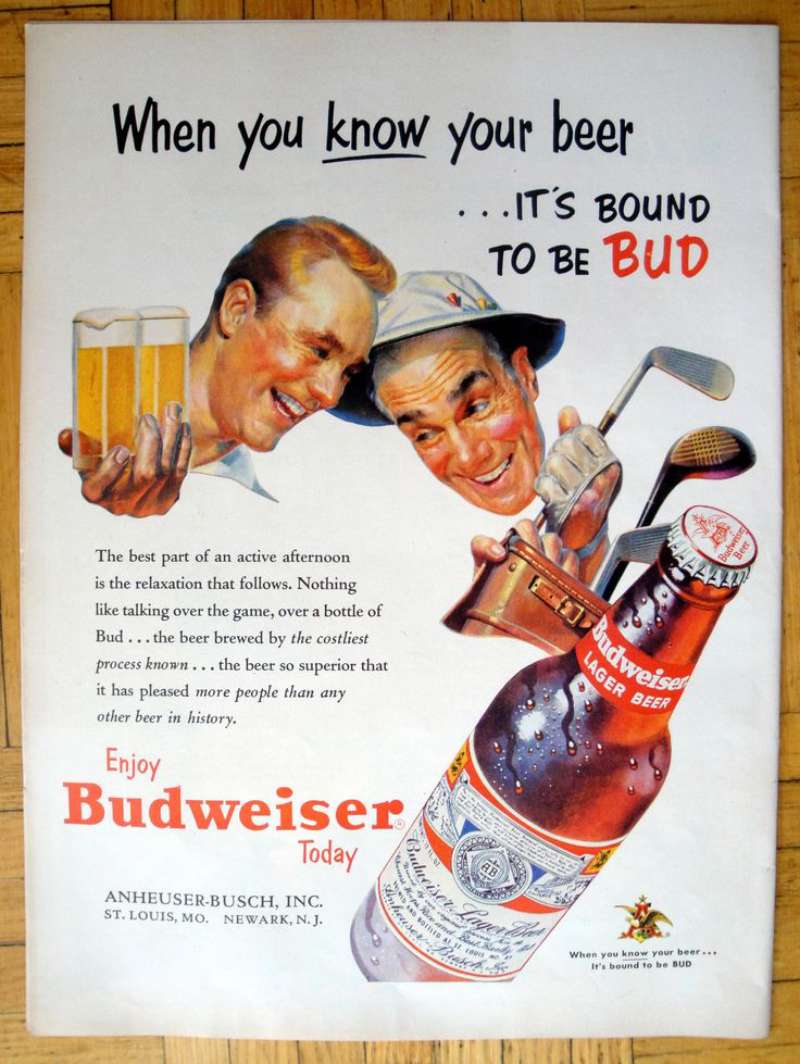
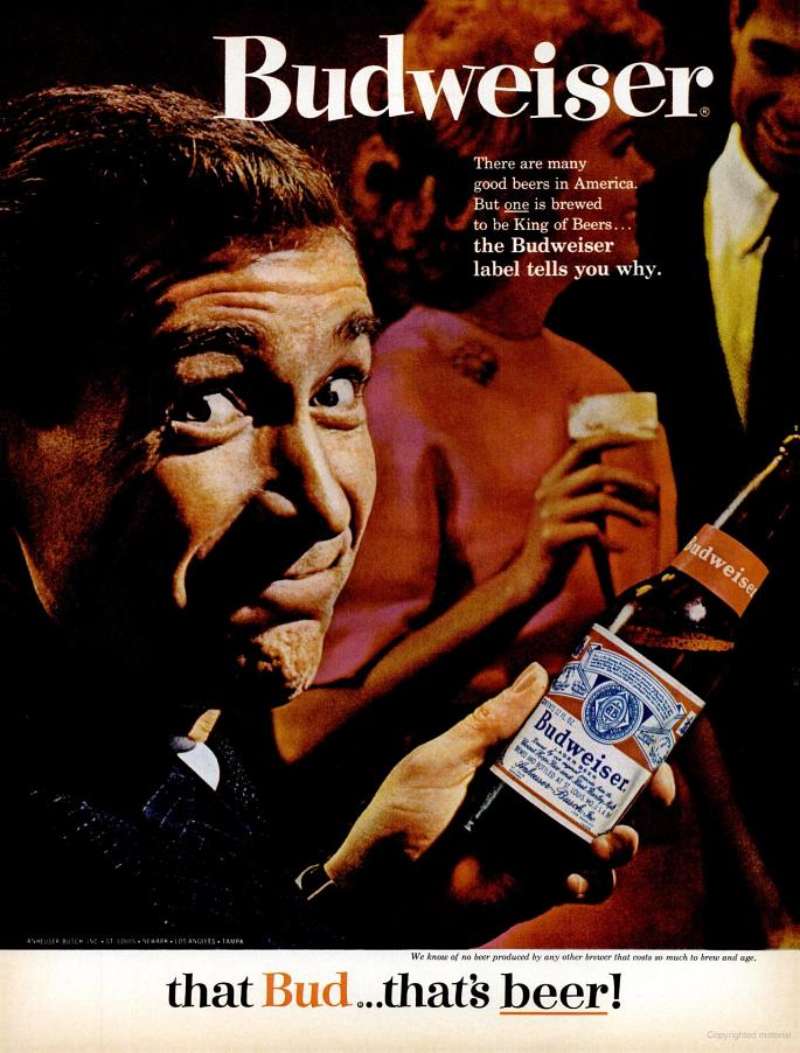
Budweiser Print Ads From the Life Magazine Era (1948-1969)

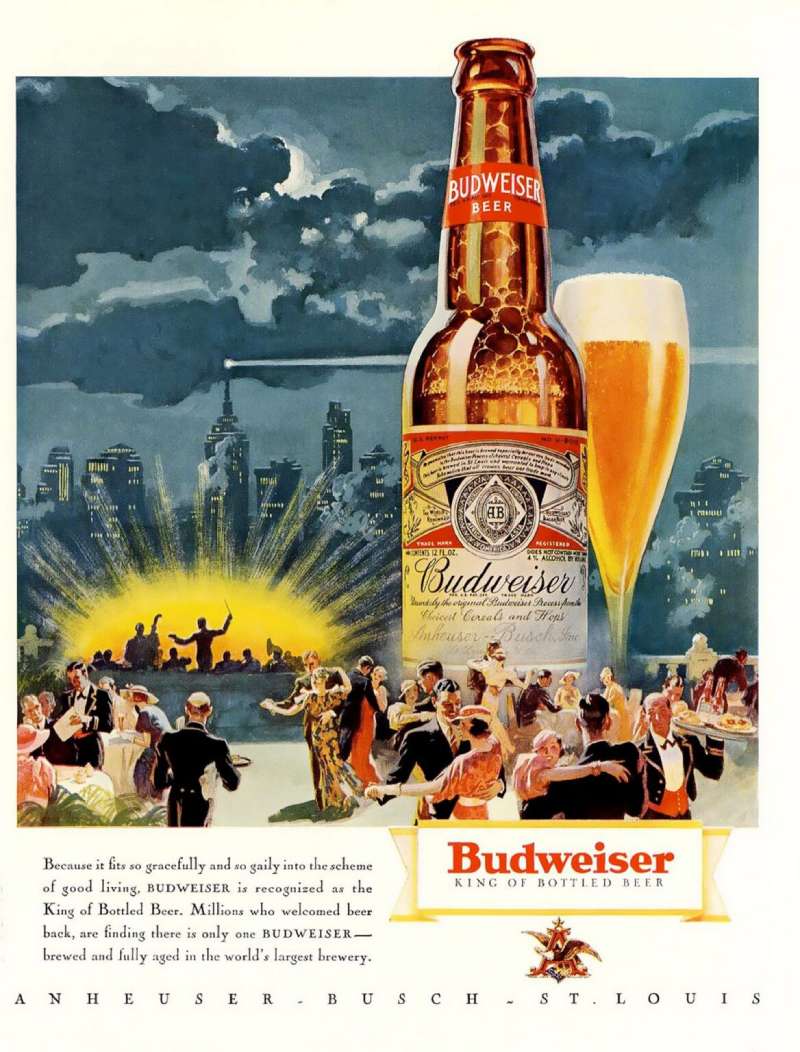
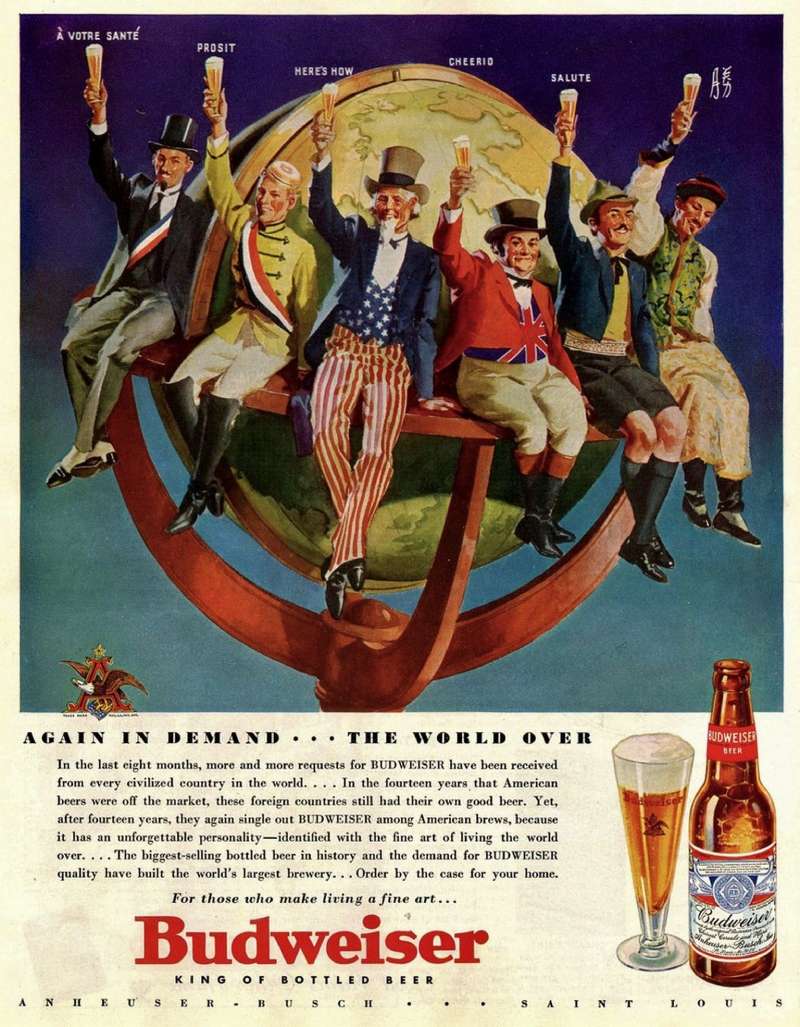
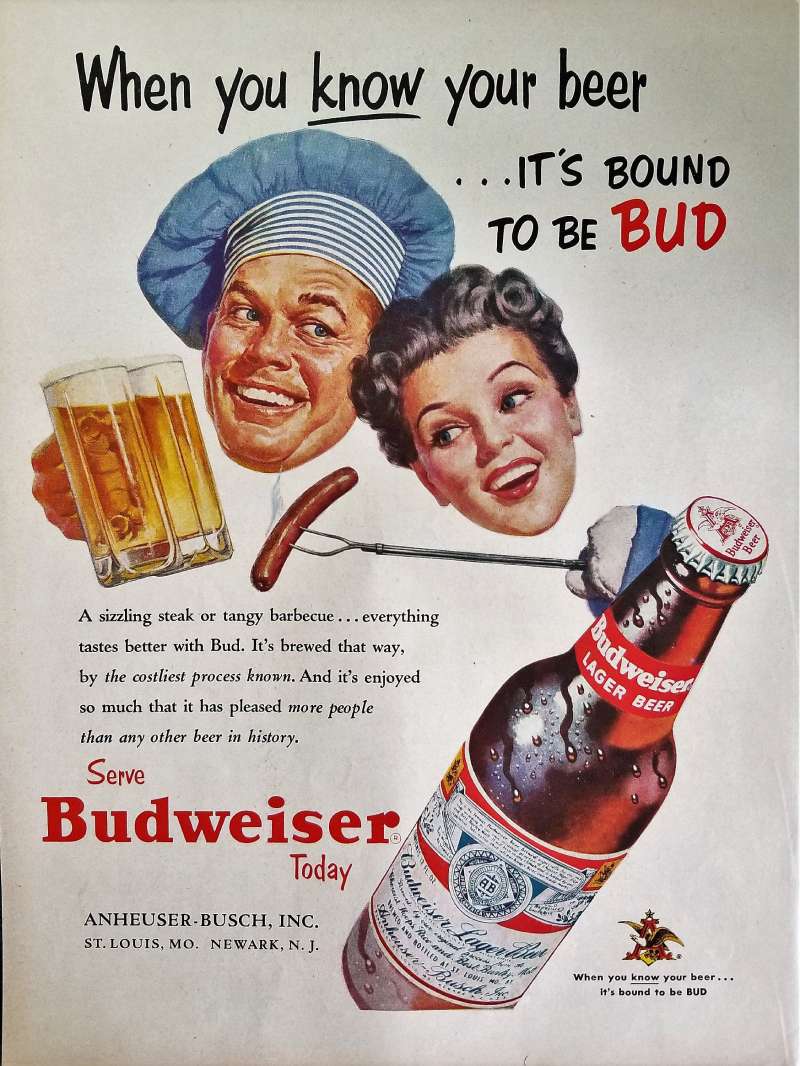
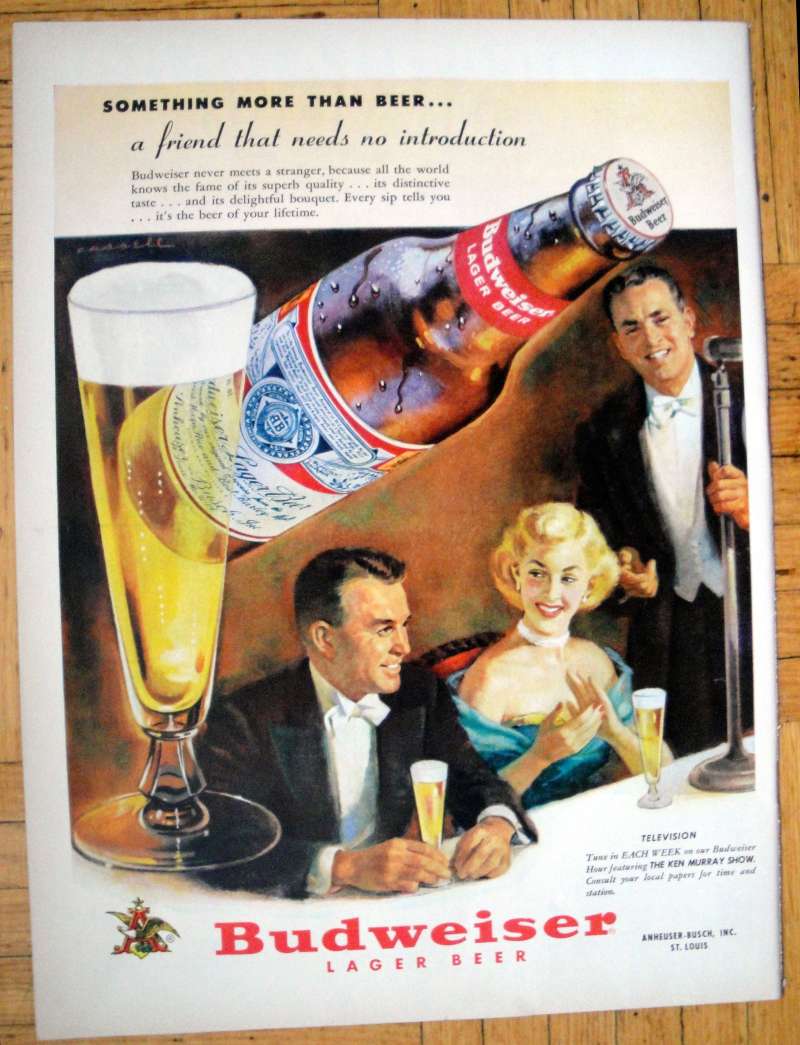
The postwar magazine work is the deepest archive the brand has, and most of it never carried a campaign name.
Recurring subjects include a 1948 Wells Fargo stagecoach illustration, 1954 bowling scenes tied to ABC radio sponsorship, and dozens of 1957 to 1961 dinner-table setups.
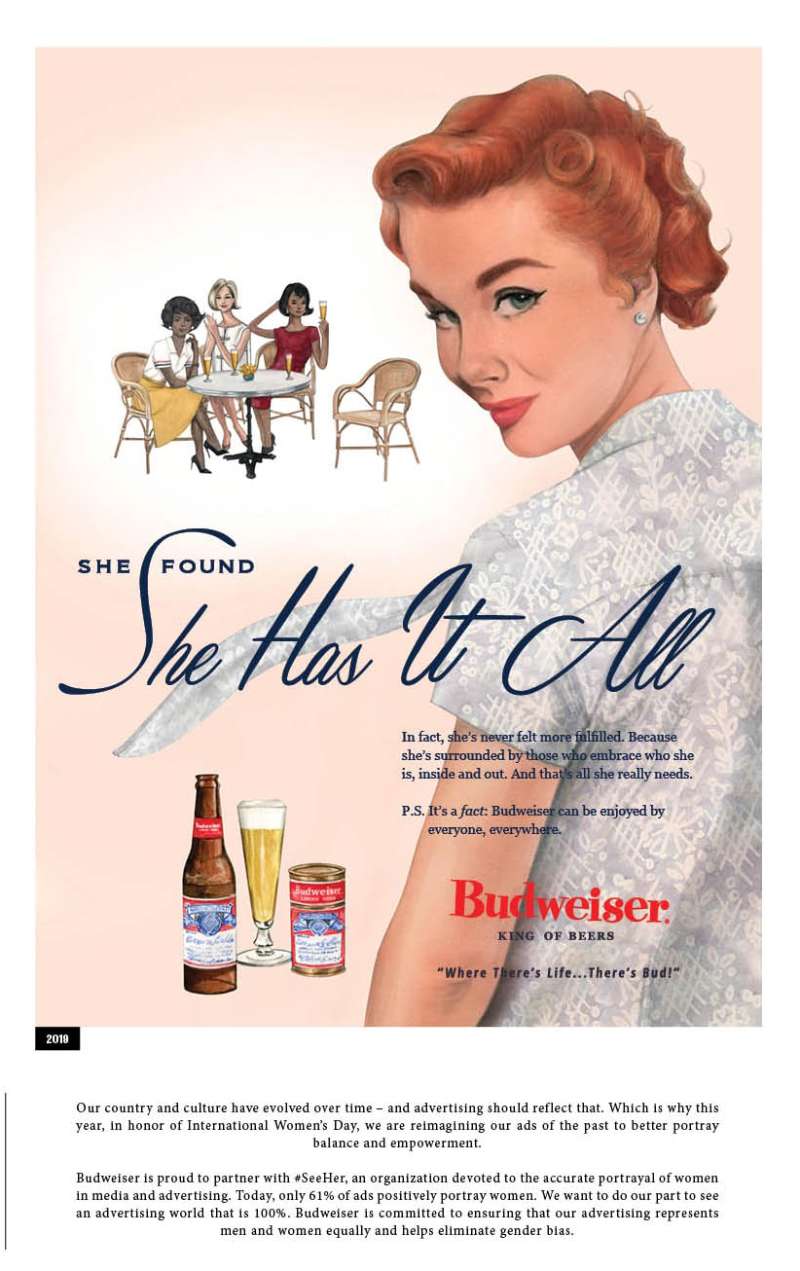
In 2019, Budweiser reworked three of these 1950s and 1960s layouts with the #SeeHer initiative and ran them in The New York Times, Chicago Tribune and Los Angeles Times. Same grid, same lettering, rewritten headline and reversed roles.
How Do Budweiser Print Ads Work Visually?
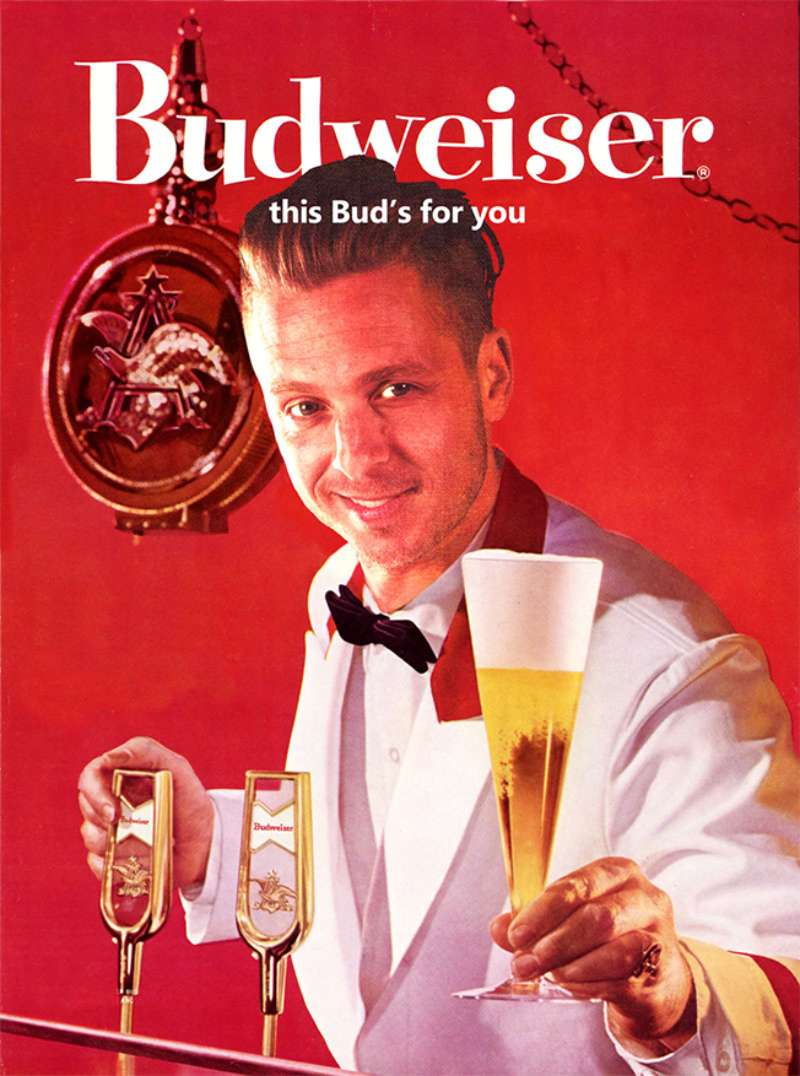
Budweiser print ads use a three-zone vertical structure: photograph on top, headline across the optical center, wordmark and bottle at the base. The palette holds at red, white and gold with black text. The bowtie carries recognition, so the layout never has to work hard.
The wordmark does the heavy lifting. White script lettering against saturated red is the single most consistent element across seven decades of layouts.
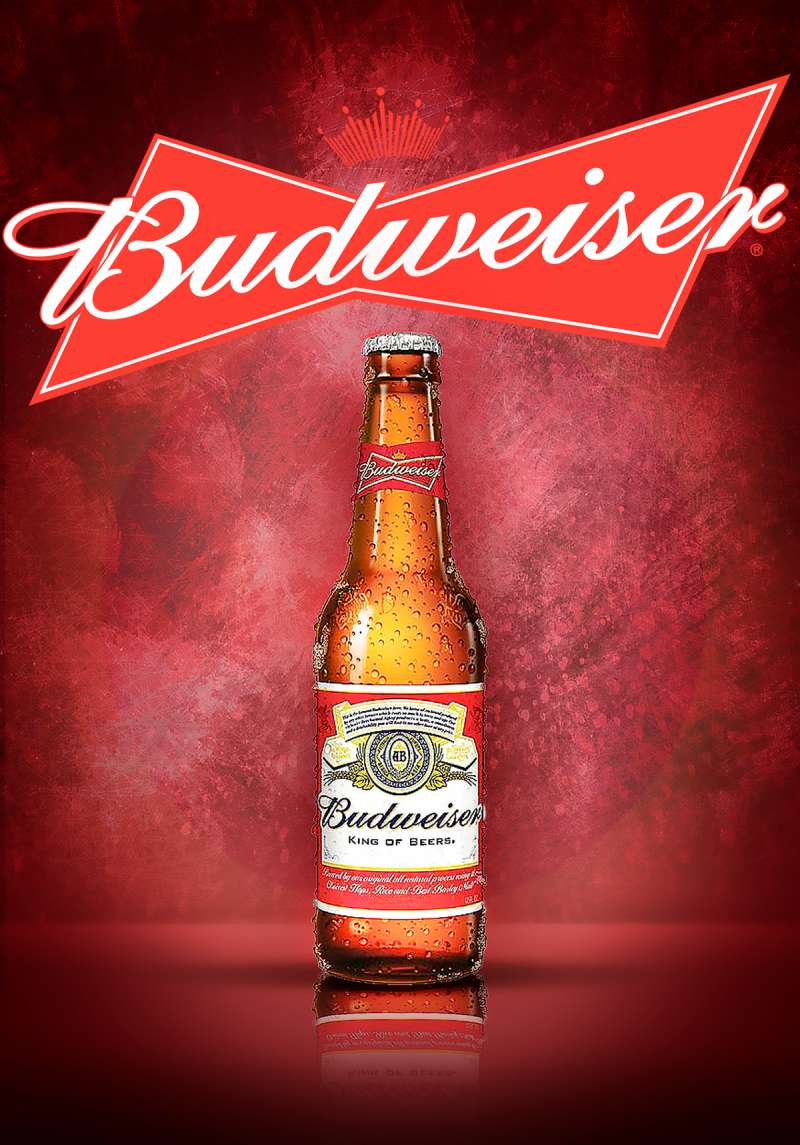
Logo Design Magazine traces the red bowtie frame to the late 1950s label redesign, after which it became the brand’s default containing shape.
Red at that saturation reads as appetite and heat, which is why the emotional weight of specific colors matters more here than in most drinks categories. Gold accents do the “King of Beers” work without a single word of copy.
Three structural habits worth stealing:
- The headline sits below the optical center, never above the image
- Body copy runs in a single narrow column, rarely more than 60 words
- The bottle is photographed with condensation and side light, never flat
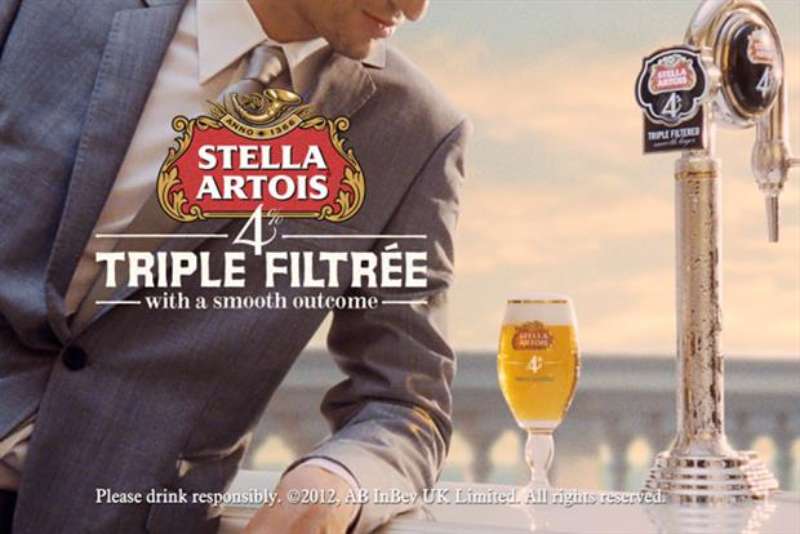
Budweiser also uses far less empty breathing room than its European rivals. The frames are full, warm and busy. Compare that to Stella Artois, where the negative area is the whole point.
The order in which the eye moves through a layout is fixed by scale rather than by tonal separation, since the photography is usually mid-key throughout.
How Do Budweiser TV Commercials Differ From Its Print Ads?
Budweiser television work is narrative and often silent. Print work is declarative and copy-led. The commercials withhold the product until the final 5 seconds, while the print layouts put the bottle in the first eye path. Sound design replaces headline copy almost entirely.
Frogs (1995, DMB&B St. Louis, director Gore Verbinski). Three animatronic frogs on lily pads croak “Bud,” “Weis,” “Er” until the camera pulls back to a neon sign. No dialogue, no actor, no beer pour.
Whassup?! (1999, DDB Chicago, director Charles Stone III). Four friends on split screen repeat one word for 60 seconds. The bottle appears in hand, never in a hero shot.
Puppy Love (2014, Anomaly, director Jake Scott). A Labrador puppy escapes an adoption barn to reach a Clydesdale. Around 60 scenes were shot for a 60-second cut, with music carrying the entire emotional line.
Born the Hard Way (2017, Anomaly, director Chris Sargent). Adolphus Busch travels from Germany to St. Louis in 1857 and meets Eberhard Anheuser. Eight months of production, and the only branding is a Clydesdale cameo and a closing line.
This is narrative structure applied to a visual brief rather than a product argument. The print work has never attempted it.
How Has Budweiser Advertising Evolved Since 1933?
Budweiser advertising moved through 5 distinct strategic eras: heritage symbolism (1933-1955), domestic aspiration (1956-1978), working-class identity (1979-1994), character comedy (1995-2002), and sentimental Americana (2013-present). Each shift followed a change of agency or a change of drinker.
| Era | Strategic shift | Representative work |
|---|---|---|
| 1930s-1940s | Post-Prohibition legitimacy | Clydesdale hitch, 1933 |
| 1950s-1960s | Home and hospitality | “Where there’s life… there’s Bud” |
| 1970s-1980s | Labor and pride | “This Bud’s for You,” 1979 |
| 1990s | Comedy and merchandising | Frogs, 1995; Lizards, 1998 |
| 2010s-2020s | Nostalgia and global football | “Puppy Love,” “Bring Home the Bud” |
The economics changed alongside the creative. Anheuser-Busch held exclusive beer advertising rights at the Super Bowl for 33 consecutive years, from 1989 to 2022, and spent an estimated $470.5 million on Budweiser Super Bowl airtime between 1967 and 2020.
By the 2025 game, a 30-second slot ran around $8 million and four AB InBev brands competed for attention inside the same broadcast.
Which Agencies Created Budweiser Advertising?
Five agencies produced the campaigns that matter. D’Arcy Masius Benton & Bowles held the account for 79 years until 1994. DDB Chicago replaced it. Goodby, Silverstein & Partners handled the 1998 lizard work. Anomaly took the flagship films from 2013. Wieden+Kennedy New York makes the FIFA films.
D’Arcy Masius Benton & Bowles created “This Bud’s for You” in 1979 and the original Frogs spot before Anheuser-Busch dismissed the agency in 1994.
DDB Chicago produced the “Whassup?!” campaign in 1999 and won the Cannes Film Grand Prix for it in 2000, with associate creative director Vinny Warren identifying the source short film.
Goodby, Silverstein & Partners introduced Louie and Frankie at Super Bowl XXXII in 1998 and extended the swamp world for two more years.
Anomaly wrote and produced “Brotherhood” (2013), “Puppy Love” (2014) and “Born the Hard Way” (2017), winning the USA Today Ad Meter twice in a row.
Wieden+Kennedy New York made “The World Is Yours to Take” for the 2023 FIFA Women’s World Cup in collaboration with FIFA.
What Can Designers Learn From Budweiser Ads?
Budweiser gives designers 5 transferable rules, all of them about restraint rather than invention. The brand has changed message five times and changed its containing shape zero times.
- Lock one containing shape and never redraw it, the way the bowtie survived every rebrand
- Hold the palette to two colors plus a metallic accent, and let the restricted color set carry recognition
- Set the tagline in the brand lettering at one weight, never two
- Place the copy block below the optical center so the photograph reads first
- Build the mascot before you build the message, then let the mascot outlive it
The uncomfortable lesson: most of Budweiser’s best work contains no design innovation at all. Three frogs on a log won a decade. That is a lettering and layout problem solved once in 1957 and left alone since.
How Do Budweiser Ads Compare to Coors Light and Stella Artois Ads?
Budweiser sells heritage. Coors Light advertising sells temperature and refreshment, which is why its layouts run cold blue and silver against Budweiser’s warm red. The contrast is strategic, not stylistic.
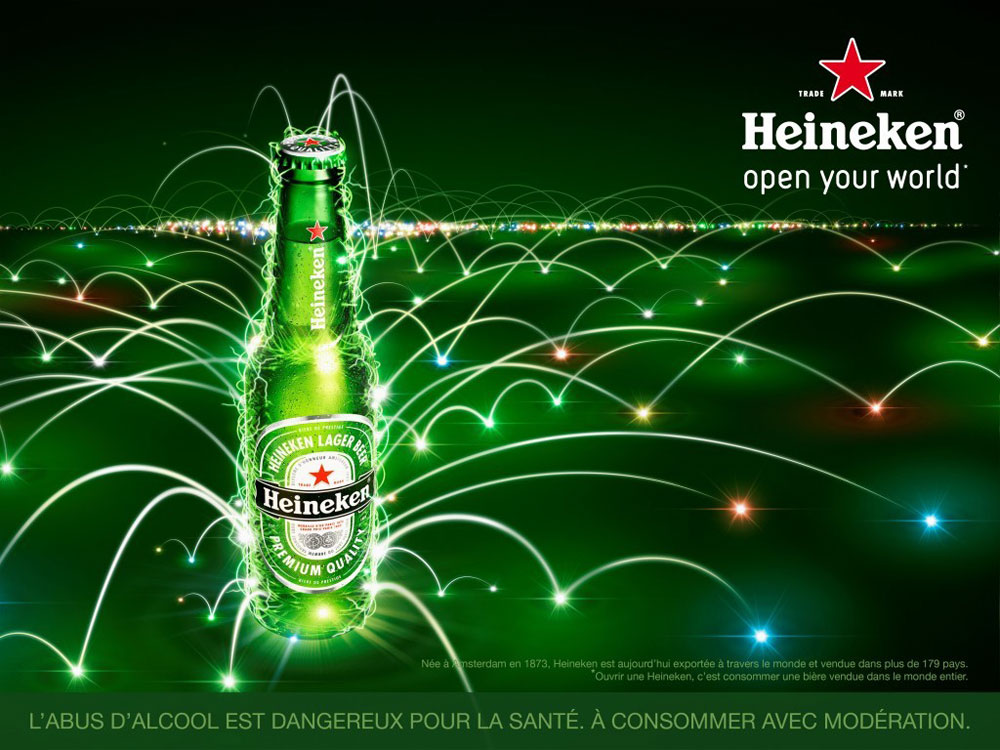
Stella Artois campaigns take the opposite path on density. Stella’s print work uses wide margins, thin serif lettering and a single centered object. Budweiser fills the frame with people and props.
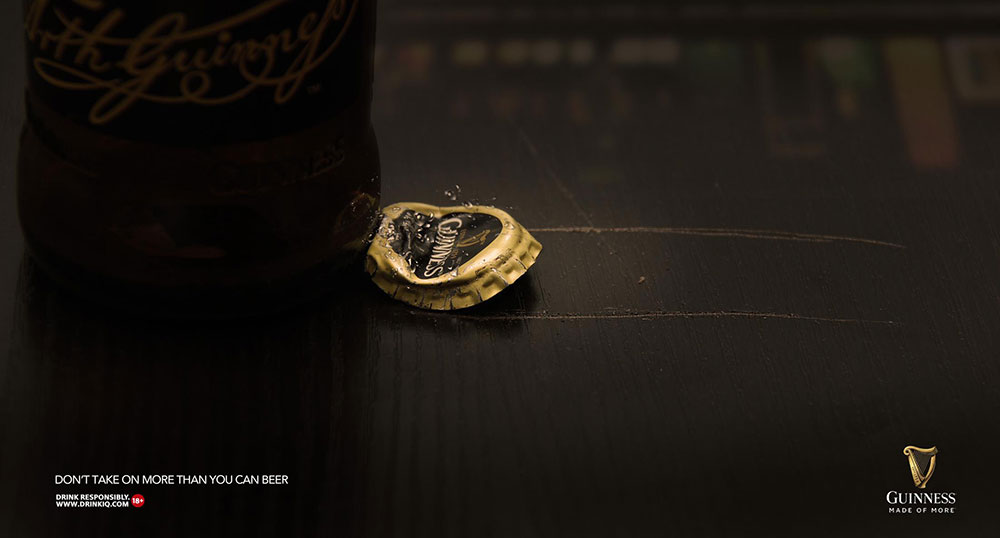
Guinness advertising is the closest philosophical relative, since both brands built decades of work on a single visual property that never changes. Guinness protects the black-and-white contrast the way Budweiser protects the bowtie.
Modelo advertising now outspends Budweiser in the US and took the top-selling position, which explains why the 2025 Clydesdale film leaned harder on 1933 than on any product claim. When a competitor owns the present, you sell the past.
What Makes Budweiser Advertising Work?
Consistency of form, not consistency of message.
The brand has changed what it says roughly every fifteen years. It has barely changed how it looks in ninety.
That split is the whole trick. A frog, a puppy, a bricklayer and a foal have nothing in common as ideas, but they all arrive inside the same red frame, the same white lettering, the same warm light.
Recognition does the selling, so the creative never has to.
The cost is real. Work built this heavily on symbols ages badly when the symbol stops meaning anything to a younger drinker, and the brand has spent the last decade betting that 1933 still carries weight.
For anyone practicing commercial layout and campaign design, that trade is the lesson worth copying.
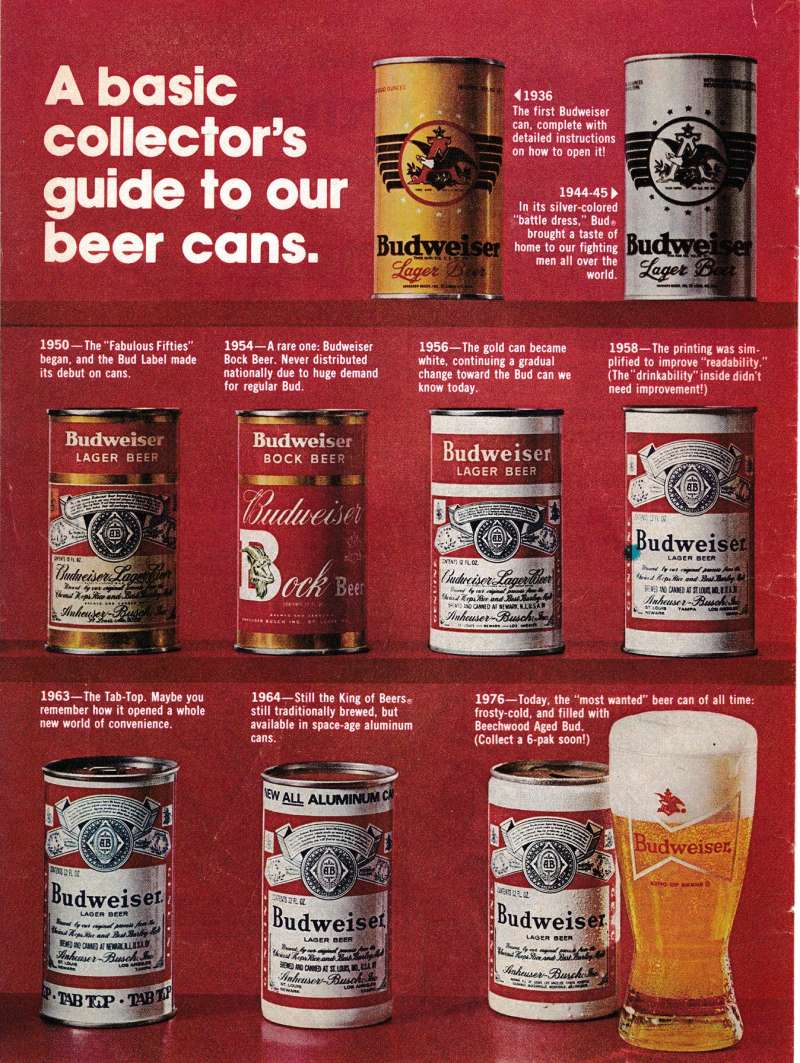
Evolution of Budweiser Ads



FAQ on Budweiser Ads
What is Budweiser’s most famous slogan?
“This Bud’s for You” is the one people quote. D’Arcy Masius Benton & Bowles wrote it in 1979 and it stayed in rotation until 1994, outlasting every other line the brand has run.
Why did Budweiser stop using the frogs?
The brand phased them out in 1999 after complaints that children recognized the characters too easily. Budweiser wrote the exit into the campaign itself, with Louie the Lizard telling Bud, Weis and Er they had been “canned.”
Who directed the Whassup commercial?
Charles Stone III directed it for DDB Chicago. The spot came from his own short film “True,” and after auditioning around 80 actors he cast his childhood friends instead.
Has Budweiser ever won a Cannes Lion?
Yes. “Whassup?!” took the Film Grand Prix at Cannes in 2000, only the third US Film Grand Prix that decade. Anheuser-Busch also collected two Bronze Lions that year, one for the Louie the Lizard spot “Ferret Expose.”
How many Super Bowl ads have featured the Clydesdales?
The horses reached their 47th Super Bowl appearance with “First Delivery” in 2025, per Marketing Brew. Their debut came in 1986 with “Here Comes the King.”
Why do Budweiser ads use Clydesdale horses?
August A. Busch Jr. and Adolphus Busch III gave their father a six-horse hitch in 1933 to mark the repeal of Prohibition. The gift became a permanent brand mascot rather than a one-off stunt.
What was Budweiser’s most controversial commercial?
“Born the Hard Way” in 2017. The Adolphus Busch immigration story landed days after a US travel ban, and #BoycottBudweiser trended on Super Bowl Sunday. Anomaly had worked on it for eight months.
Does Budweiser still run print advertising?
Yes, though at low volume. MediaRadar logs print alongside digital and national TV in the brand’s recent media mix, including a June 2025 magazine placement. Most budget now sits in broadcast and stadium sponsorship.
What music appears in Budweiser commercials?
Licensed tracks carry most of the modern films. “Old School Delivery” used The Band’s “The Weight” in 2024, and the 2025 Club World Cup spot “ThunderBud” ran on AC/DC’s “Thunderstruck.”
Is Budweiser still the biggest Super Bowl beer advertiser?
Not exclusively. AB InBev held category exclusivity from 1989 to 2022, and once it lapsed the game filled with rival beer ads. In 2025 the company still ran four brands, with Modelo sitting the year out.
Conclusion
Budweiser ads reward study more than admiration.
Ninety years of tagline changes, agency handovers and Ad Meter wins sit on top of one unchanged visual system, and that gap is where the useful lessons live.
Pull the ones that transfer:
- Name the campaign, the agency and the year before you judge the work
- Track what the brewery kept, not what it replaced
- Watch how a print advertisement and a Super Bowl commercial split the same job
DDB Chicago, D’Arcy and Anomaly each rebuilt the message. None of them touched the King of Beers wordmark.
Steal that discipline. A brand system outlives whatever campaign idea you are defending this quarter.

Renowned for his expertise in logo design and visual branding, Bogdan has developed a multitude of logos for various clients.
His skills extend to creating posters, vector illustrations, business cards, and brochures. Additionally, Bogdan's UI kits were featured on marketplaces like Visual Hierarchy and UI8.
He also wrote in the past years on sites like Design Your Way, WebDesignerDepot, WPDean, Designmodo, Speckyboy, Slider Revolution, and more.
- The Windsurf Logo History, Colors, Font, And Meaning - 10 October 2026
- How to Remove Background From Product Photos (No Photoshop) - 10 October 2026
- How Designers can Build a Stronger Online Creative Identity - 9 October 2026

Bogdan Sandu is a seasoned designer who has been designing websites since 2008. Renowned for his expertise in logo design and visual branding, Bogdan has developed a multitude of logos for various clients. His skills extend to creating posters, vector illustrations, business cards, and brochures. Additionally, Bogdan's UI kits were featured on marketplaces like Visual Hierarchy and UI8. He also wrote in the past years on sites like Design Your Way, WebDesignerDepot, WPDean, Designmodo, Speckyboy, Slider Revolution, and more.
You Might Also Like