The Toronto Raptors logo represents the National Basketball Association franchise based in Toronto, Canada.
Founded in 1995 as part of the NBA’s expansion into Canada, the Raptors became the league’s only remaining Canadian team after the Vancouver Grizzlies relocated in 2001.
The current logo design, introduced in 2015 by creative agency Sid Lee, features a basketball with three claw marks.
The franchise has undergone four primary logo iterations throughout its 30-year history, evolving from an animated dinosaur character to a sleek, modern basketball emblem.
What is the Toronto Raptors Logo?

The Toronto Raptors logo is a circular emblem featuring a red basketball with three black claw marks, surrounded by white text reading “Toronto Raptors” on a black background. Officially introduced during the 2015-16 season and designed by Montreal-based creative agency Sid Lee, the logo symbolizes the predatory nature and aggressive playing style of the team through abstract claw imagery rather than literal dinosaur representation.
The current design represents a complete departure from the franchise’s original mascot-based identity.
Design Type: Combination mark featuring both symbol and wordmark elements
Primary Elements:
- Circular black field
- Basketball with diagonal claw marks
- Sans-serif typography wrapping the perimeter
- Three diagonal slash marks representing raptor claws
Official Introduction Date: December 19, 2014 (soft launch), officially implemented 2015-16 season
Designer/Agency: Sid Lee (Toronto/Montreal-based creative agency)
Trademark Status: Registered trademark owned by Maple Leaf Sports & Entertainment Ltd. (MLSE)
Color Palette:
- Red: Pantone PMS 200 C, Hex #CE1141
- Black: Pantone PMS Black 6 C, Hex #000000
- Silver: Pantone PMS Cool Gray 8 C, Hex #A1A1A4
- Gold: Pantone PMS 872 C, Hex #B4975A (alternate versions)
- White: Hex #FFFFFF
Usage Context: Team jerseys, court floor graphics, merchandise, digital platforms, promotional materials, broadcasting graphics
How Has the Toronto Raptors Logo Evolved Over Time?
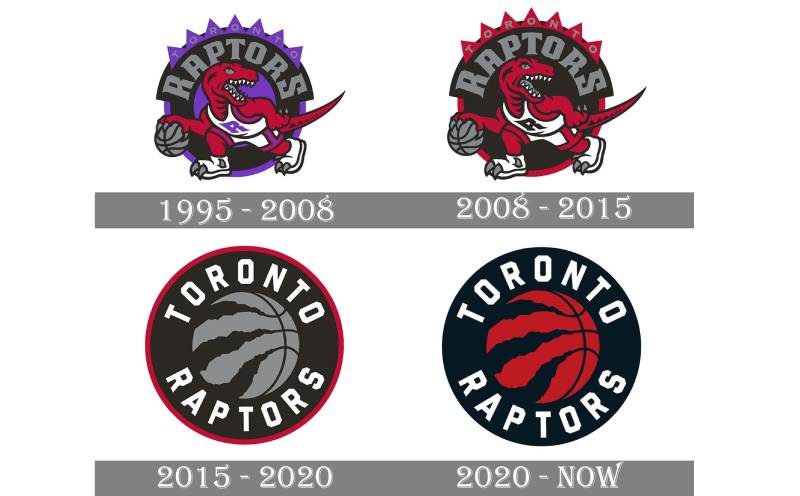
The Toronto Raptors logo has undergone three major redesigns since 1995, shifting from a cartoonish dinosaur mascot to a minimalist claw mark design. The evolution reflects the franchise’s maturation from an expansion team capitalizing on Jurassic Park popularity to a championship-caliber organization with sophisticated branding that emphasizes intensity over novelty.
Original Toronto Raptors Logo (1995-2008)
Years Active: 1995-2008
Design Description: Red velociraptor wearing white basketball uniform with “R” on chest, dribbling silver basketball
Color Scheme: Purple, red, black, and “Naismith silver” (named after Canadian basketball inventor James Naismith)
Designer: Created for franchise launch
Context: Designed to capitalize on Jurassic Park film popularity from 1993. The dinosaur wore white sneakers with exposed toe claws.
Key Changes from Previous: Initial franchise identity, no predecessor
Cultural Significance: Became seventh in league merchandise sales by end of 1994 despite team not yet playing. Represented 1990s sports branding trend toward bold, animated mascots.
The logo featured seven triangular peaks above a circular purple field with black frame.
“Toronto” appeared in smaller text above “Raptors” along the top arc.
Modified Dinosaur Logo (2008-2015)
Years Active: 2008-2015
Design Description: Same velociraptor design with updated color palette, removing purple entirely
Color Scheme: Red, black, and silver
Designer: Internal modification of original design
Context: Franchise distanced itself from purple to create more aggressive, intimidating appearance
Key Changes from Previous: Purple background replaced with black, uniform colors changed from white/purple to white/black
Cultural Significance: Worn during Chris Bosh era and beginning of Kyle Lowry/DeMar DeRozan partnership that led to sustained playoff success
The circular backdrop became entirely black instead of purple.
Frame triangles changed from black to red, matching the raptor character.
Current Minimalist Logo (2015-2020)
Years Active: 2015-2020
Design Description: Circular black emblem with red border, featuring silver basketball with three black claw marks
Color Scheme: Black, red, silver, and white
Designer: Sid Lee creative agency
Context: Launched alongside “We The North” campaign for franchise’s 20th anniversary season and 2016 All-Star Game hosting
Key Changes from Previous: Complete departure from dinosaur imagery, abstract claw representation, modern sans-serif font
Cultural Significance: Represented franchise maturation and shift toward sophisticated, internationally appealing brand identity
The launch faced criticism for disorganized rollout, with black-and-white version shown first.
Some compared it to the Brooklyn Nets logo.
Refined Current Logo (2020-Present)
Years Active: 2020-present
Design Description: Same circular design with basketball now colored red instead of silver, no red border outline
Color Scheme: Black, red, and white (silver eliminated)
Designer: Modification of Sid Lee design
Context: Color refinement during championship era, adding visual punch
Key Changes from Previous: Silver basketball became red, red border removed but white space border added, increased letter spacing
Cultural Significance: This is the logo worn during the franchise’s 2019 NBA championship run and continuing success under Scottie Barnes and young core
The basketball’s red coloring creates stronger contrast against black background.
Cleaner appearance without external red outline makes the design more versatile.
What Do the Design Elements of the Toronto Raptors Logo Mean?
The three diagonal claw marks tearing across the basketball symbolize the predatory aggression and relentless competitive spirit associated with velociraptors. These marks reference the team name derived from “Velociraptor,” the prehistoric predator known for speed, intelligence, and deadly claws, while maintaining visual connection to basketball through the recognizable ball shape.
Why Did Toronto Raptors Choose These Specific Colors?
Red (Pantone PMS 200 C): Represents Canada’s national identity through the maple leaf flag, while conveying aggression, energy, and passion on the court.
Red has remained consistent throughout all logo iterations since 1995.
Black (Pantone PMS Black 6 C): Symbolizes strength, power, and intimidation, creating emphasis and sophistication.
Black became more prominent after purple was eliminated in 2008.
Silver (Pantone PMS Cool Gray 8 C): Originally honored James Naismith, the Canadian who invented basketball in 1891. Represents modernity and sleekness, though largely phased out in 2020 version.
Gold (Pantone PMS 872 C): Appears in alternate logos, including Drake-inspired gold and black variant for special promotional nights at Scotiabank Arena.
What Typography Style Is Used in the Toronto Raptors Logo?

The logo uses a custom bold sans-serif font with block lettering that emphasizes strength and readability.
The typeface features geometric construction with consistent stroke width and squared terminals. Characters maintain even spacing around the circular perimeter for balance and rhythm. The font spacing was increased in the 2020 refinement for improved legibility at small sizes.
What Are the Hidden Meanings in the Toronto Raptors Logo?
The circular shape symbolizes unity and the continuous motion of basketball gameplay.
Three claw marks specifically reference the three-toed structure of velociraptor feet. The diagonal alignment suggests forward momentum and attacking movement. The basketball’s seam lines follow standard ball construction while allowing the claw marks to appear as if they’ve torn through the surface, creating depth perception.
How Does the Toronto Raptors Logo Compare to Competitor Logos?
The Raptors logo stands as one of the few NBA designs featuring abstract symbolism rather than literal mascot representation. While teams like the Chicago Bulls logo and Miami Heat logo use stylized animal or flame imagery, the Raptors employ subtle claw marks that suggest their namesake without depicting it directly.
Compared to Division Rivals:
The Boston Celtics logo maintains traditional leprechaun imagery from 1946, creating storytelling through character.
The Philadelphia 76ers logo uses numeric representation with historical patriotic symbolism.
The New York Knicks logo features classic triangular basketball design with orange and blue triadic color scheme.
Design Philosophy Differences:
Teams like the Golden State Warriors logo and Los Angeles Lakers logo prioritize geographical identity over aggressive symbolism. The Raptors’ approach aligns more with the Milwaukee Bucks logo and Memphis Grizzlies logo in featuring fierce animal representation, though with greater abstraction.
The Raptors design reflects minimalist design principles popular in contemporary sports branding.
Many traditional franchises like the Detroit Pistons logo maintain vintage aesthetics while newer designs pursue cleaner, more versatile marks.
What Are the Technical Specifications of the Toronto Raptors Logo?
Official Color Codes:
Primary Color: Red
Secondary Color: Black
- Pantone: PMS Black 6 C
- Hex: #000000
- RGB: (6, 25, 34)
- CMYK: (30, 0, 0, 100)
Accent Color: Silver
- Pantone: PMS Cool Gray 8 C
- Hex: #A1A1A4
- RGB: (161, 161, 164)
- CMYK: (0, 1, 0, 43)
Alternate Color: Gold
- Pantone: PMS 872 C
- Hex: #B4975A
- RGB: (180, 151, 90)
- CMYK: (20, 30, 70, 15)
Dimensions and Proportions:
Circular design maintains 1:1 aspect ratio for optimal reproduction across digital and print media.
Minimum size requirements specify 0.5 inches diameter for print applications to ensure legibility.
Clear space specifications require protective area equal to the height of the letter “T” in “Toronto” surrounding all sides.
Official usage guidelines prohibit stretching, rotating, or recoloring outside approved color psychology palette.
File Format Specifications:
Vector graphics formats (.EPS, .SVG, .AI) required for print reproduction.
DPI requirements specify 300 minimum for print, 72 for web design applications.
JPEG and PNG formats available for digital use with transparent backgrounds.
What Cultural Impact Has the Toronto Raptors Logo Had?
The 2015 logo redesign coincided with the “We The North” campaign that transformed Canadian basketball culture and fan engagement.
The campaign’s 60-second commercial received 500,000 views in two days after Drake and Justin Bieber retweeted it. “We The North” merchandise, including flags and apparel, became ubiquitous throughout Toronto and across Canada during playoff runs. The branding helped establish “Jurassic Park,” the outdoor viewing area at Scotiabank Arena where thousands gather during playoff games.
The logo appears on championship memorabilia from the franchise’s 2019 NBA title, their first in team history.
International players like Pascal Siakam from Cameroon, Serge Ibaka from the Republic of Congo, and Jonas Valanciunas from Lithuania wore the claw mark design while representing Toronto’s multicultural identity.
Drake’s involvement as global ambassador led to special gold and black alternate logos for “Drake Night” promotional events.
The simplified claw mark design proved more versatile for merchandise than the previous dinosaur character.
How Does the Toronto Raptors Logo Fit Into the Overall Brand Identity?

The logo anchors a comprehensive brand system built around the “We The North” positioning.
This identity celebrates Toronto’s status as the NBA’s only Canadian team and embraces outsider mentality. The claw mark motif repeats throughout brand guidelines, appearing on court designs, jersey trim, and promotional materials. Maple leaf elements incorporated into uniform waistbands reinforce Canadian pride while the “T” symbol references Toronto’s “T-Dot” nickname.
Court floor graphics at Scotiabank Arena feature oversized claw marks at center court.
Jersey chevrons point upward, visually reinforcing the “North” directional branding.
The visual hierarchy places the basketball claw mark as primary identifier across all touchpoints.
Secondary marks include simplified claw symbols, wordmarks, and anniversary editions for milestone seasons.
How Should the Toronto Raptors Logo Be Used?
Official Usage Do’s:
- Maintain specified color codes for print and digital reproduction
- Use approved file formats from official brand assets
- Preserve minimum size requirements for legibility
- Maintain clear space around logo perimeter
- Apply logo on approved background colors (white, black, red)
Official Usage Don’ts:
- Never stretch, compress, or distort aspect ratio
- Don’t add drop shadows, effects, or outlines
- Never rotate or tilt the circular design
- Don’t place logo on busy or low-contrast backgrounds
- Avoid recreating logo from scratch rather than using official files
Where to Access Official Logos:
Official team logos available through NBA Media Central for credentialed media.
Licensed merchandise partners receive asset packages through MLSE licensing department.
Public domain versions exist for editorial and news usage under fair use guidelines.
Licensing Information:
Toronto Raptors logo is registered trademark of Maple Leaf Sports & Entertainment Ltd.
Commercial usage requires licensing agreement through MLSE or NBA Properties.
Merchandise production requires approval through official licensing channels.
Trademark Protection Details:
Logo protected under Canadian and U.S. trademark law.
MLSE actively enforces trademark rights against unauthorized commercial usage.
Editorial and news usage permitted under standard journalistic fair use provisions.
FAQ About the Toronto Raptors Logo
When was the Toronto Raptors logo created?
The original dinosaur logo was created in 1995 for the franchise’s inaugural season. The current claw mark design was created by Sid Lee in 2014, soft-launched December 19, 2014, and officially implemented for the 2015-16 season to coincide with the team’s 20th anniversary.
Who designed the Toronto Raptors logo?
Creative agency Sid Lee, based in Toronto and Montreal, designed the current logo. The agency also created the “We The North” campaign that accompanied the rebrand. Executive Creative Director Tom Koukodimos and Executive Director Jeffrey Da Silva led the project, which took 18 months to complete.
What do the colors in the Toronto Raptors logo mean?
Red represents Canadian national identity and aggressive competitive spirit. Black symbolizes strength, power, and intimidation. Silver originally honored James Naismith, Canada’s basketball inventor. The monochrome colors combined with red create sophisticated, modern appearance while maintaining ties to Canada’s red-and-white flag.
How many times has the Toronto Raptors logo been redesigned?
The franchise has featured four primary logo iterations. The original dinosaur design (1995-2008) was modified in 2008 to remove purple. A complete redesign occurred in 2015 featuring the claw mark basketball. A refinement in 2020 changed the basketball from silver to red and removed the outer border.
Where can I download the official Toronto Raptors logo?
Official high-resolution logos are available through NBA Media Central for credentialed media members. For licensed merchandise and commercial use, contact MLSE licensing department. Public domain versions for editorial use can be found through sports logo databases and team press materials, though commercial usage requires licensing.
Is the Toronto Raptors logo trademarked?
Yes, the logo is a registered trademark owned by Maple Leaf Sports & Entertainment Ltd. (MLSE). Both Canadian and United States trademark protection exists. Commercial usage requires licensing agreements, though editorial and news usage is permitted under fair use provisions. MLSE actively protects trademark rights.
What font is used in the Toronto Raptors logo?
The logo uses a custom bold sans-serif typeface created specifically for the team. The font features geometric construction, consistent stroke width, and squared terminals designed for strength and legibility. It’s not a publicly available font but a proprietary design element of the brand identity system.
Why did Toronto Raptors choose a raptor for their logo?
The Raptors name and dinosaur imagery capitalized on Jurassic Park’s 1993 popularity when the franchise launched in 1995. The velociraptor represented speed, intelligence, and predatory aggression. While the current logo no longer shows the dinosaur directly, the claw marks maintain this fierce, competitive symbolism appealing to younger audiences.
Conclusion
The Toronto Raptors logo has evolved from animated dinosaur mascot to sophisticated claw mark emblem, reflecting franchise maturation from expansion team to NBA champion.
The current design, created by Sid Lee in 2015, balances Canadian identity through red coloring with aggressive symbolism through abstract claw marks. Technical specifications ensure consistent reproduction across merchandise, digital platforms, and arena graphics. The logo’s cultural impact extends beyond basketball, becoming a symbol of Canadian pride and the successful “We The North” campaign that united fans nationwide during the 2019 championship run and continues resonating today.
If you liked this article about the Toronto Raptors logo, you should check out this article about the Chicago Bulls logo.
There are also similar articles discussing the Golden State Warriors logo, the Miami Heat logo, the Houston Rockets logo, and the Detroit Pistons logo.
And let’s not forget about articles on the Milwaukee Bucks logo, the Cleveland Cavaliers logo, the Utah Jazz logo, and the Memphis Grizzlies logo.

Renowned for his expertise in logo design and visual branding, Bogdan has developed a multitude of logos for various clients.
His skills extend to creating posters, vector illustrations, business cards, and brochures. Additionally, Bogdan's UI kits were featured on marketplaces like Visual Hierarchy and UI8.
He also wrote in the past years on sites like Design Your Way, WebDesignerDepot, WPDean, Designmodo, Speckyboy, Slider Revolution, and more.
- Canva vs PowerPoint: Which Is Better for Presentations? - 22 September 2026
- How to Install Fonts on Mac (Step-by-Step Guide) - 20 September 2026
- From Mockup to Code: How AI-Augmented Development Speeds Up the Design Handoff - 19 September 2026

Bogdan Sandu is a seasoned designer who has been designing websites since 2008. Renowned for his expertise in logo design and visual branding, Bogdan has developed a multitude of logos for various clients. His skills extend to creating posters, vector illustrations, business cards, and brochures. Additionally, Bogdan's UI kits were featured on marketplaces like Visual Hierarchy and UI8. He also wrote in the past years on sites like Design Your Way, WebDesignerDepot, WPDean, Designmodo, Speckyboy, Slider Revolution, and more.
You Might Also Like