The Golden State Warriors logo features the Bay Bridge spanning across a circular blue and gold emblem. This architectural symbol represents the franchise’s connection to both San Francisco and Oakland.
The Warriors compete in the NBA’s Pacific Division. Their visual identity ranks among professional basketball’s most recognizable brands. The current logo design debuted July 17, 2010 after an 18-month collaboration between the Warriors, NBA, and Adidas.
Founded in Philadelphia in 1946, the franchise relocated to California in 1962. The team has redesigned its logo 10 times throughout its history. Each iteration reflected geographic moves, cultural shifts, or brand modernization efforts that aligned with franchise evolution.
What is the Golden State Warriors Logo?
The Warriors logo displays the Bay Bridge’s eastern span in golden yellow within a Warriors Blue circular frame, with “GOLDEN STATE” and “WARRIORS” in Copperplate typeface arched around the circle. Unveiled July 17, 2010, the design resulted from Warriors-NBA-Adidas collaboration symbolizing San Francisco-Oakland connection.
Design Type: Emblem with architectural landmark
Primary Elements:
- Bay Bridge silhouette rendered in golden yellow
- Circular Warriors Blue frame with golden yellow accent ring
- Dual-weight Copperplate typography for team name
- Layered design creating architectural depth
Official Introduction Date: July 17, 2010
Designer/Agency: Golden State Warriors organization, NBA, and Adidas (18-month collaborative project)
Trademark Status: Registered trademark in 2011 with United States Patent and Trademark Office
Color Palette:
- Warriors Blue: #1D428A (Pantone PMS 7687 C)
- Golden Yellow: #FFC72C (Pantone PMS 123 C)
Usage Context: Primary application on jerseys, court designs, merchandise, digital platforms, Chase Center branding, promotional materials, and licensed products
How Has the Golden State Warriors Logo Evolved Over Time?
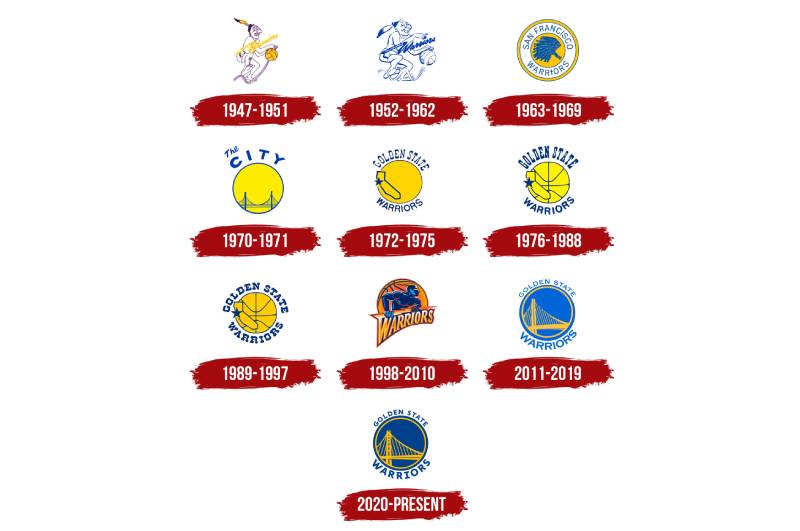
The Warriors logo transformed from Native American imagery in Philadelphia (1946) to architectural symbolism today across eight decades. Major redesigns occurred in 1969 with “The City” Golden Gate Bridge logo, 1971 with California state outline, 1997 with superhero character, and 2010 with Bay Bridge, refined in 2019.
Original Philadelphia Warriors Logo (1946-1951)
Years Active: 1946-1951
Design Description: Cartoon Native American figure dribbling yellow basketball, drawn in purple lines with single yellow feather featuring blue tip
Color Scheme: Purple, yellow, and blue
Designer: Unknown
Context: Created for inaugural Basketball Association of America season when franchise began operations in Philadelphia
Key Changes from Previous: First logo design for the franchise, establishing initial visual identity
Cultural Significance: Reflected common 1940s sports mascot practices, now recognized as culturally insensitive imagery requiring discontinuation
Philadelphia Warriors Redesign (1951-1962)
Years Active: 1951-1962
Design Description: Native American figure in blue ink dribbling basketball, with “Philadelphia” on banner extending from “W” in “Warriors”
Color Scheme: Blue and white
Designer: Unknown
Context: Emphasized team name prominence while maintaining Native American theme during Philadelphia era
Key Changes from Previous: Eliminated yellow coloring, added “Philadelphia” wordmark integrated into design, strengthened all linework
Cultural Significance: Era included 1956 NBA Championship victory over Fort Wayne Pistons with Hall of Fame trio Paul Arizin, Tom Gola, Neil Johnston
San Francisco Warriors Logo (1962-1969)
Years Active: 1962-1969
Design Description: Circular medallion with thin yellow outline, thick white frame, small yellow center containing Native American headdress
Color Scheme: Yellow, white, and blue
Designer: Unknown
Context: Team relocated from Philadelphia to San Francisco Bay Area, requiring geographic rebranding
Key Changes from Previous: First major geographic rebranding, introduced circular format influencing future designs
Cultural Significance: Marked NBA westward expansion, Wilt Chamberlain era including his historic 100-point game against New York Knicks in 1962
“The City” Logo (1969-1971)
Years Active: 1969-1971
Design Description: Solid yellow circle with blue outline featuring Golden Gate Bridge silhouette, “The City” inscription arched above
Color Scheme: Blue and yellow
Designer: Unknown
Context: Warriors playing home games primarily in Oakland and San Diego while representing San Francisco
Key Changes from Previous: Removed Native American imagery completely, introduced bridge symbolism, created first logo excluding city name
Cultural Significance: First professional sports team creating logo without city or state name, cable car design appeared on jersey backs
Golden State Warriors California Logo (1971-1975)
Years Active: 1971-1975
Design Description: Yellow circle containing blue California state outline with five-pointed star over Bay Area, “Golden State” in Wild West typeface above, “Warriors” in sans-serif font below
Color Scheme: Blue and yellow
Designer: Unknown
Context: Team adopted “Golden State” moniker to represent entire California rather than single city
Key Changes from Previous: Replaced bridge with state outline, introduced star marker for Bay Area location, Wild West typography reflected gold rush heritage
Cultural Significance: Represented franchise’s 1975 NBA Championship victory over Washington Bullets, widely considered one of basketball’s greatest upsets
Warriors Basketball Logo (1975-1988)
Years Active: 1975-1988
Design Description: California outline with star and number “14” on yellow background, “Warriors” above and “Basketball” below
Color Scheme: Blue and yellow
Designer: Unknown
Context: Post-championship era design refinement maintaining California geographic theme
Key Changes from Previous: Simplified wordmark replacing “Golden State,” added player number reference creating unique identifier
Cultural Significance: Spanned rebuilding period after championship success, bridged eras of franchise history
Refined California Logo (1988-1997)
Years Active: 1988-1997
Design Description: Polished version with darker yellow shade, refined blue tone, updated typography featuring rounded bold lines and softened angles
Color Scheme: Darker blue and golden yellow
Designer: Unknown
Context: Team modernization efforts reflecting late 1980s and 1990s design trends
Key Changes from Previous: Refined color saturation, sleeker typeface, cleaner lines throughout composition
Cultural Significance: “Run TMC” era with Tim Hardaway, Mitch Richmond, and Chris Mullin forming exciting trio
Superhero Logo (1997-2010)
Years Active: 1997-2010
Design Description: Blue masked superhero holding lightning bolt attached to “W” in “WARRIORS,” orange basketball background with gradient effects
Color Scheme: Blue, orange, yellow, and black with gradients
Designer: Unknown
Context: Complete visual identity overhaul abandoning geographic symbolism for character-based design
Key Changes from Previous: Abandoned all geographic symbolism for character design, introduced orange as primary color replacing traditional blue-yellow scheme
Cultural Significance: Most radical departure from traditional branding, coincided with “We Believe” playoff run in 2007
Bay Bridge Logo (2010-2019)
Years Active: 2010-2019
Design Description: Light blue circular frame with double yellow-blue outline, elegant Bay Bridge span in yellow, serif font Copperplate for team name
Color Scheme: Royal Blue (#006BB6) and golden yellow
Designer: Warriors organization, NBA, and Adidas collaborative effort
Context: Return to Bay Area symbolism during Oracle Arena era, 18-month development process
Key Changes from Previous: Replaced superhero with architectural landmark, returned to blue-yellow palette, introduced sophisticated serif typography
Cultural Significance: Preceded dynasty era with championships in 2015, 2017, 2018, including historic 73-9 season
Current Bay Bridge Logo (2019-Present)
Years Active: 2019-Present
Design Description: Updated with darker Warriors Blue (#1D428A), more accurate Bay Bridge portrayal reflecting completed eastern span, refined bridge details and enhanced circular band depth
Color Scheme: Warriors Blue and golden yellow
Designer: Warriors organization refinement
Context: Chase Center opening in San Francisco, team’s return to city after Oakland years
Key Changes from Previous: More accurate bridge depiction matching completed structure, darker blue shade for better contrast, refined architectural details
Cultural Significance: Represents team’s return to San Francisco, continues championship legacy with 2022 title
What Do the Design Elements of the Golden State Warriors Logo Mean?
The Bay Bridge symbolizes unity between San Francisco and Oakland, representing the Warriors’ geographic connection to both cities. Former CMO Jen Millet stated the bridge represents “ability to connect people” across the Bay Area. The circular frame symbolizes cyclical game nature and enduring fan support, conveying togetherness and community.
What Does the Bay Bridge Represent?
The Bay Bridge embodies regional connection between San Francisco and Oakland. The eastern span became iconic before construction completion, with Warriors representatives meeting architect Donald MacDonald in 2008 to view designs. The bridge replaced the Golden Gate Bridge from 1969’s “The City” logo, acknowledging Oakland’s importance alongside San Francisco while reflecting California’s frontier spirit.
Why Did Golden State Choose These Specific Colors?
Warriors Blue (#1D428A)
- Color name: Warriors Blue
- Hex/Pantone code: #1D428A, Pantone PMS 7687 C
- Symbolic meaning: Trust, loyalty, excellence, professionalism, strength
- Psychological impact: Conveys authority and stability
- Regional/historical connection: Represents Bay Area oceanic elements
Golden Yellow (#FFC72C)
- Color name: Golden Yellow
- Hex/Pantone code: #FFC72C, Pantone PMS 123 C
- Symbolic meaning: Energy, success, ambition, opportunity
- Psychological impact: Generates excitement and optimism
- Regional/historical connection: References California gold rush heritage and “Golden State” nickname
The blue-gold combination remained consistent since 1951 (except 1997-2010). The 2019 update darkened blue for greater visual impact.
What Typography Style Is Used in the Warriors Logo?

The Warriors use Copperplate Gothic, with “GOLDEN STATE” in Copperplate Medium and “WARRIORS” in Copperplate Bold, both designed by Frederic W. Goudy in 1901. This glyphic serif font conveys tradition and strength. Clean uppercase letterforms ensure readability across all applications, with arched text following the circular frame creating harmonious balance.
What Are the Hidden Meanings in the Warriors Logo?
The circular shape represents cyclical basketball seasons and enduring fan support. The Bay Bridge’s eastern span wasn’t completed when the logo debuted in 2010, symbolizing forward progress. The bridge literally facilitated team relocation from Oakland’s Oracle Arena to San Francisco’s Chase Center in 2019. The catenary curve represents engineering excellence paralleling team performance standards.
How Does the Warriors Logo Compare to Other NBA Logos?
The Warriors logo distinguishes itself within NBA logos through architectural landmark focus. Most teams feature animals (Chicago Bulls logo, Memphis Grizzlies logo, Toronto Raptors logo) or basketballs (Brooklyn Nets logo, Boston Celtics logo). The Warriors tell stronger geographic stories than the Miami Heat logo or Los Angeles Lakers logo.
The circular format appears in several designs including Phoenix Suns logo and Washington Wizards logo. The blue-yellow scheme is shared with Denver Nuggets logo and Indiana Pacers logo.
The Warriors demonstrate sophisticated minimalism compared to busier designs like the Charlotte Hornets logo. Architectural precision matches the San Antonio Spurs logo in regional identity attention. The evolution mirrors broader NBA trends toward cleaner, more adaptable designs for digital platforms.
What Are the Technical Specifications of the Warriors Logo?
Official Color Codes:
Warriors Blue:
Golden Yellow:
- Pantone: PMS 123 C
- Hex: #FFC72C
- RGB: (255, 199, 44)
- CMYK: (0, 19, 89, 0)
Dimensions and Proportions:
- Aspect ratio: 1:1 circular design for primary mark
- Minimum size: 0.5 inches diameter (print), 72 pixels (digital)
- Clear space: Equals “W” height in “WARRIORS” on all sides
- Official usage guidelines: No stretching, exact color palette required, no modifications permitted
Available in vector graphics (EPS, SVG), PNG transparent background, and JPEG formats.
What Cultural Impact Has the Warriors Logo Had?
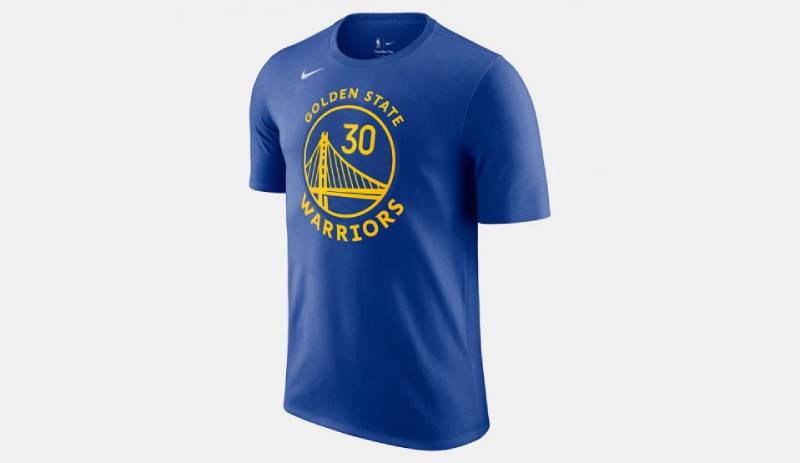
The Warriors logo transcended sports branding to become Bay Area cultural symbol appearing on buildings, murals, and street art throughout San Francisco and Oakland.
“The City” logo (1969-1971) achieved cult status, with throwback jerseys becoming top sellers decades later. The current logo symbolizes the dynasty era with championships in 2015, 2017, 2018, and 2022.
How Does the Warriors Logo Fit Into Overall Brand Identity?
The logo anchors comprehensive brand ecosystem extending to Chase Center design, uniform variations, digital presence, and community programs. Elements include primary Bay Bridge logo, secondary 2024 “W” resembling basketball net, alternate logos (California outline, “The City” throwback), “Dub Nation” fan branding, and mascot-free identity focusing on player performance and regional pride.
How Should the Warriors Logo Be Used?
Official Usage Do’s:
- Personal, non-commercial use
- Editorial and news coverage
- Educational purposes
- Social media profile images (personal accounts)
Don’ts:
- Commercial merchandise production without licensing
- Implying official endorsement
- Modifying colors or proportions
- Using outdated versions
Access: Official logos available through NBA.com media resources and Warriors.com press area (credentials required). High-resolution versions for commercial use require licensing through NBA Properties.
Licensing: The logo is registered trademark of Golden State Warriors, LLC. Commercial use requires formal licensing agreement. Licensed manufacturers pay royalties for merchandise production rights.
Trademark Protection: Logo protected under federal trademark law, registered in 2011. The Warriors organization actively enforces trademark rights against unauthorized commercial use and counterfeit merchandise.
FAQ About the Golden State Warriors Logo
When was the Warriors logo created?
The original Philadelphia Warriors logo debuted in 1946 when the franchise joined the Basketball Association of America. The current Bay Bridge logo was unveiled July 17, 2010, following an 18-month development process with the NBA and Adidas. The design received refinement in 2019 with more accurate bridge portrayal and deeper color saturation coinciding with Chase Center opening.
Who designed the Warriors logo?
The current logo resulted from collaborative effort between the Golden State Warriors organization, NBA, and Adidas during an 18-month creative process. Specific individual designers remain uncredited in official materials. The creative process involved marketing teams, professional designers, and franchise leadership. Architect Donald MacDonald’s eastern span design for the actual Bay Bridge inspired the logo’s architectural depiction and geometric precision.
What do the colors in the Warriors logo mean?
Warriors Blue (#1D428A) represents trust, loyalty, excellence, professionalism, and strength, reflecting team values and Bay Area oceanic elements. Golden Yellow (#FFC72C) symbolizes energy, success, opportunity, and California’s gold rush heritage inspiring the “Golden State” nickname. The blue-yellow combination remained consistent since 1951 (except 1997-2010), creating immediate brand recognition connecting to California’s natural landscapes and color psychology principles.
How many times has the Warriors logo been redesigned?
The Warriors logo underwent 10 major redesigns since 1946: 1946 original Native American design, 1951 Philadelphia update, 1962 San Francisco circular medallion, 1969 “The City” logo, 1971 California outline, 1975 basketball variation, 1988 refined version, 1997 superhero character, 2010 Bay Bridge introduction, and 2019 Bay Bridge refinement. Each redesign reflected franchise relocations, name changes, or intentional brand evolution aligned with team direction and market positioning.
Where can I download the official Warriors logo?
Official Warriors logos for editorial and non-commercial use are available through NBA.com media resources section and Warriors.com press area, both requiring proper media credentials. High-resolution versions for commercial applications require formal licensing agreements through NBA Properties, Inc. Fans should use only low-resolution versions for personal, non-commercial projects. Unauthorized commercial reproduction violates trademark protections and may result in legal action including cease-and-desist orders.
Is the Warriors logo trademarked?
Yes, the Warriors logo is registered trademark of Golden State Warriors, LLC, protected under federal trademark law through registration with the United States Patent and Trademark Office. The team registered the current Bay Bridge logo trademark in 2011, one year after introduction. The trademark provides exclusive commercial rights and legal protection against unauthorized use. NBA Properties manages licensing for all official merchandise production and commercial applications.
What font is used in the Warriors logo?
The Warriors logo uses Copperplate Medium for “GOLDEN STATE” and Copperplate Bold for “WARRIORS,” both designed by Frederic W. Goudy in 1901. Copperplate Gothic is glyphic serif typeface featuring small, sharp serifs conveying tradition and strength. The font appears consistently on jerseys, merchandise, and all official team branding. Clean uppercase letterforms ensure perfect readability across digital and print applications while maintaining professional institutional character.
Why did Warriors choose Bay Bridge for their logo?
The Warriors selected the Bay Bridge to represent geographic connection between San Francisco and Oakland, uniting the entire Bay Area under one unifying symbol. The bridge embodies teamwork and collaboration, core team values. Unlike the Golden Gate Bridge specific to San Francisco, the Bay Bridge physically connects both cities where the Warriors played throughout California history. The eastern span’s modern architecture symbolizes forward progress while honoring regional identity and graphic design principles.
Conclusion
The Golden State Warriors logo represents more than sports team identification. The Bay Bridge emblem connects franchise history to regional geography, symbolizing unity and forward progress through architectural precision. The circular format and blue-gold color scheme create instant brand recognition globally.
The logo evolved through 10 iterations spanning eight decades. The current design balances tradition with innovation, establishing the Warriors among the NBA’s most distinctive brands. The Bay Bridge symbolism positions the franchise within Bay Area culture while maintaining championship excellence standards for future generations.

Renowned for his expertise in logo design and visual branding, Bogdan has developed a multitude of logos for various clients.
His skills extend to creating posters, vector illustrations, business cards, and brochures. Additionally, Bogdan's UI kits were featured on marketplaces like Visual Hierarchy and UI8.
He also wrote in the past years on sites like Design Your Way, WebDesignerDepot, WPDean, Designmodo, Speckyboy, Slider Revolution, and more.
- The Cursor Logo History, Colors, Font, And Meaning - 24 September 2026
- Top 7 Web Design Subscription Services That Replace Full-Time Hires - 24 September 2026
- Canva vs PowerPoint: Which Is Better for Presentations? - 22 September 2026

Bogdan Sandu is a seasoned designer who has been designing websites since 2008. Renowned for his expertise in logo design and visual branding, Bogdan has developed a multitude of logos for various clients. His skills extend to creating posters, vector illustrations, business cards, and brochures. Additionally, Bogdan's UI kits were featured on marketplaces like Visual Hierarchy and UI8. He also wrote in the past years on sites like Design Your Way, WebDesignerDepot, WPDean, Designmodo, Speckyboy, Slider Revolution, and more.
You Might Also Like