The BNP Paribas logo is one of the most recognized symbols in European banking. It represents a financial institution that manages over €2.5 trillion in assets and operates across 65 countries. The logo has gone through meaningful changes since the 1999 merger that created the bank, each version reflecting shifts in how BNP Paribas wanted to position itself globally. As a piece of corporate logo design, it sits in a category where stability and trust matter more than trendiness.
Within bank logo history, the BNP Paribas mark stands out for its deliberate use of green at a time when most major European banks defaulted to blue. That choice alone says something. It has become a reliable identifier across physical branches, digital platforms, and financial documents worldwide.
The current version is a combination mark combining a wordmark with a stylized four-lobed star symbol. It was introduced following the 1999 merger between Banque Nationale de Paris and Paribas. The design communicates stability and international reach, two things any major financial institution needs to project.
The bank itself was founded in 1999 through that merger, though both predecessor institutions date back much further. BNP traces to 1966, Paribas to 1872. The logo has gone through three major iterations since the merger.
What Is the BNP Paribas Logo?
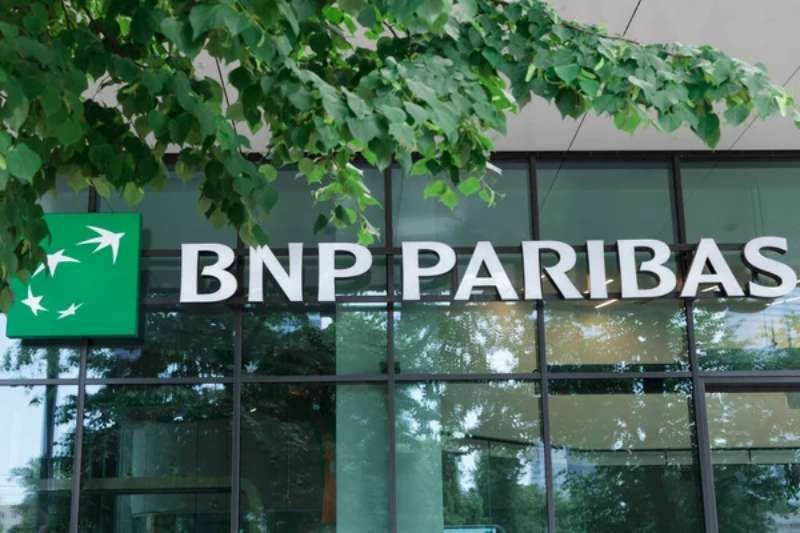
The BNP Paribas logo is a combination mark featuring a stylized four-pointed star symbol alongside the “BNP Paribas” wordmark in a custom sans-serif typeface. Introduced in 1999 following the merger of Banque Nationale de Paris and Paribas, it uses the bank’s signature green and white color palette to signal growth and financial reliability.
- Design Type: Combination mark (icon + wordmark)
- Primary Elements: Four-lobed star symbol, custom sans-serif wordmark
- Official Introduction Date: 1999 (post-merger), refreshed in 2009
- Designer/Agency: Landor Associates (1999 merger identity)
- Trademark Status: Registered trademark in the European Union and internationally across all major markets
- Color Palette: BNP Paribas Green (#00965E), White (#FFFFFF), with secondary use of black for certain applications
- Usage Context: Branch signage, digital banking platforms, marketing materials, financial documents, merchandise, and sponsorship assets
How Has the BNP Paribas Logo Evolved Over Time?
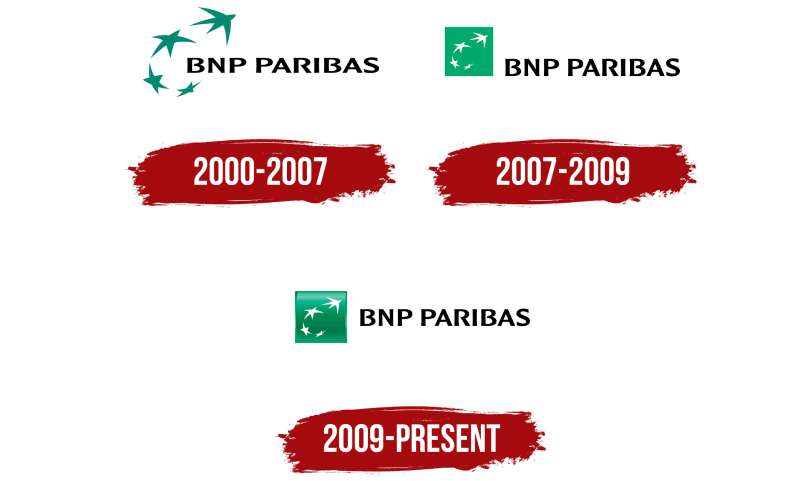
The BNP Paribas logo history spans the individual identities of two predecessor banks, the creation of a unified mark in 1999, a refinement in 2009, and ongoing digital adaptations. Each stage reflects changes in the bank’s scale, strategy, and the design standards of its era.
Banque Nationale de Paris Logo (1966–1999)
- Years Active: 1966–1999
- Design Description: A geometric mark with a stylized representation of the BNP initials, accompanied by a wordmark in a structured serif typeface
- Color Scheme: Dark blue and white
- Designer: Not publicly attributed
- Context: Created when Banque Nationale de Paris was established through the merger of two French state-owned banks
- Key Changes from Previous: This was the founding identity, replacing the separate identities of BNCI and CNEP
- Cultural Significance: Represented French state banking during a period of nationalization and post-war economic growth
Paribas Logo (Pre-1999)
- Years Active: Early 1970s–1999
- Design Description: A wordmark-based identity with clean, modern letterforms reflecting the bank’s position as an international investment bank
- Color Scheme: Blue tones, consistent with financial sector norms at the time
- Designer: Not publicly attributed
- Context: Paribas had evolved from the Banque de Paris et des Pays-Bas, founded in 1872, and needed an identity that reflected its shift toward global capital markets
- Key Changes from Previous: Modernized the older typographic identity as the bank restructured through the 1970s and 1980s
- Cultural Significance: Represented European investment banking ambition during the deregulation era
BNP Paribas Merger Logo (1999–2009)
- Years Active: 1999–2009
- Design Description: Introduced the four-lobed star symbol alongside the combined wordmark. The star was designed to suggest dynamism and international reach. Typography used a clean sans-serif treatment
- Color Scheme: BNP Paribas Green (#00965E) introduced as the primary brand color, replacing the blue used by both predecessor banks
- Designer: Landor Associates
- Context: The 1999 merger created the largest bank in France and one of the largest in Europe. A new, unified identity was needed immediately
- Key Changes from Previous: Completely new identity. The shift from blue to green was the most striking departure from both predecessor brands
- Cultural Significance: Marked the consolidation of French banking and BNP Paribas’s ambition to compete at a global level
Refined BNP Paribas Logo (2009–Present)
- Years Active: 2009–present
- Design Description: A cleaner, more refined version of the 1999 mark. The four-lobed star became slightly more geometric and precise. The wordmark was adjusted for better digital legibility. Overall the identity was tightened for consistency across digital and physical applications
- Color Scheme: BNP Paribas Green retained as primary, with cleaner white space usage
- Designer: Internal brand team with agency support
- Context: As digital banking grew, the 1999 identity needed adjustments to work cleanly at small sizes on screens
- Key Changes from Previous: Typography refinements, tighter proportions on the star symbol, improved scalability
- Cultural Significance: Reflected the bank’s shift toward digital-first customer experiences while maintaining continuity with the post-merger identity
What Do the Design Elements of the BNP Paribas Logo Mean?

The BNP Paribas logo uses a four-lobed star symbol paired with a clean wordmark to communicate stability, international reach, and forward momentum. Each element was deliberately chosen to project trust and growth, the two things a major financial institution needs to communicate above everything else.
The four-lobed star is the most discussed element of the logo.
Some interpretations connect the four lobes to the bank’s four core business divisions. Others see it as a compass, pointing in all directions to suggest global presence.
The official framing centers on growth and dynamism.
Whether or not you read deeper meaning into it, the shape works. It’s memorable, it scales well, and it doesn’t look like anything else in the financial sector.
Why Did BNP Paribas Choose These Specific Colors?
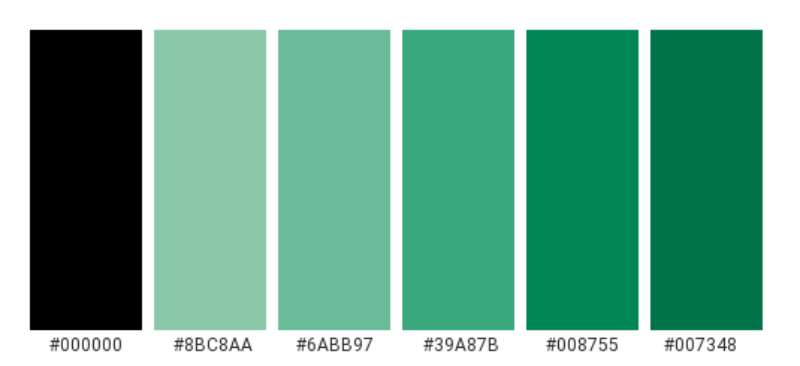
BNP Paribas Green (#00965E)
- Color Name: BNP Paribas Green
- Hex Code: #00965E
- Pantone: Pantone 340 C (approximate)
- Symbolic Meaning: Growth, renewal, financial health, sustainability
- Psychological Impact: Green signals safety and positive movement. In financial contexts, it connects directly to profit and upward performance
- Brand/Industry Connection: Most major European banks use blue. BNP Paribas’s choice of green was a deliberate differentiator. It worked. Today, that green is immediately associated with the bank across its markets
White (#FFFFFF)
- Color Name: White
- Hex Code: #FFFFFF
- Symbolic Meaning: Clarity, transparency, trust
- Psychological Impact: White creates breathing room around the green, preventing the brand from feeling heavy or institutional
- Brand/Industry Connection: Standard in financial services for backgrounds and reversed logo applications
The decision to move away from blue was significant. Looking at blue logos across the banking sector, you can see just how dominant that color is. BNP Paribas stood apart, and that distinctiveness paid off in brand recognition terms. The green also connects to the bank’s sustainability messaging, which has become more prominent in its communications over the past decade. Green logos in financial services are relatively rare, which makes BNP Paribas’s palette even more recognizable.
Understanding color theory helps explain why this works so well. Green sits in a psychologically active part of the spectrum. It’s neither as aggressive as red nor as passive as blue. For a bank trying to project both reliability and growth, it hits the right note.
What Typography Style Is Used in the BNP Paribas Logo?
The BNP Paribas wordmark uses a custom sans-serif font with clean, geometric characteristics. The letterforms are consistent in weight, with no dramatic contrast between thick and thin strokes.
This creates a sense of stability and modernity at the same time.
The “BNP” portion appears in the same weight as “Paribas,” with a subtle size difference establishing typographic hierarchy without breaking the overall unity of the wordmark.
The font choice was updated in the 2009 refresh for better screen legibility. At small sizes, the letterforms remain clear and distinct. That matters a lot when a logo needs to work on mobile banking apps, card chips, and digital ads simultaneously.
Rounded terminals on several letters soften what could otherwise feel like a cold corporate wordmark. It’s a small detail that makes a difference in how approachable the brand feels.
What Are the Hidden Meanings in the BNP Paribas Logo?
The four-lobed star shape is the element most people try to decode.
One reading connects it to the four compass points, suggesting the bank’s global reach. Another connects the lobes to BNP Paribas’s four main business lines: retail banking, corporate and institutional banking, investment solutions, and international retail banking.
Neither interpretation has been officially confirmed as the intended meaning.
What Landor has discussed publicly is the idea of movement and energy captured in a stable form. The shape radiates outward from its center, suggesting expansion while remaining visually grounded.
There’s also an interesting read on the Gestalt principles at play here. The four lobes read as a unified star rather than four separate shapes, which is exactly what you want from a symbol representing a bank built from multiple merged institutions.
How Does the BNP Paribas Logo Compare to Competitor Logos?
BNP Paribas sits in a category where most major competitors default to blue, geometric shapes, and conservative typography. The green color choice alone sets it apart. But beyond color, the four-lobed star is more distinctive than most banking symbols, which tend toward abstract initials, shields, or simple geometric marks.
Compared to the HSBC logo, which uses a bold red and white hexagonal mark, BNP Paribas is softer in its visual energy but more distinctive in color within the European banking context.
The Deutsche Bank logo uses a slanted line inside a square, a minimal geometric approach that communicates precision but has less visual warmth.
The Barclays logo uses a blue eagle, a more literal symbol that has strong heritage recognition but less flexibility across modern digital applications.
The Societe Generale logo is perhaps the closest comparison, being another French bank that underwent identity work around the same era. But it relies on red and black with a simple square mark, which feels more aggressive than the BNP Paribas green.
The ING logo is interesting to compare because ING also moved toward orange as a distinctive color. Both ING and BNP Paribas made bold choices to avoid the industry default blue, and both have benefited from the distinctiveness that created.
Looking at Citigroup’s logo, you see a different approach: a wordmark with a simple arc above the “i,” relying on blue and the recognizable Citi name rather than a strong symbol mark. BNP Paribas’s combination mark gives it an advantage in environments where wordmarks alone struggle to stand out.
Among bank logos broadly, BNP Paribas occupies a specific position: European, premium, distinctly green, and more symbolically complex than most of its peers.
What Are the Technical Specifications of the BNP Paribas Logo?
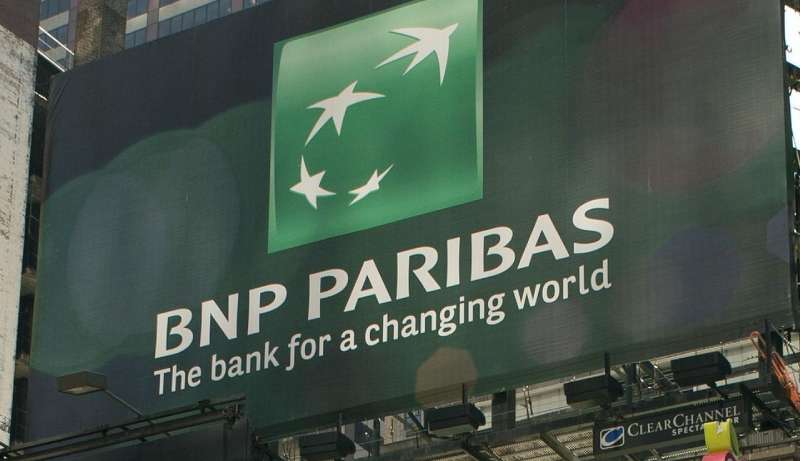
Official Color Codes:
- Primary Color: BNP Paribas Green
- Hex: #00965E
- RGB: (0, 150, 94)
- CMYK: (100, 0, 63, 41)
- Pantone: 340 C (approximate match)
- Secondary Color: White
- Hex: #FFFFFF
- RGB: (255, 255, 255)
- CMYK: (0, 0, 0, 0)
- Pantone: N/A (process white)
- Tertiary Color: Black (for specific applications)
- Hex: #000000
- RGB: (0, 0, 0)
- CMYK: (0, 0, 0, 100)
- Pantone: Process Black C
Dimensions and Proportions:
- Aspect Ratio: The standard horizontal lockup maintains approximately a 4:1 width-to-height ratio for the full combination mark
- Minimum Size Requirements: The full combination mark should not be reproduced smaller than 25mm wide in print; digital minimum is approximately 80px wide
- Clear Space Specifications: A clear space equal to the height of the star symbol is maintained around all edges of the logo
- Official Usage Guidelines: The logo must always appear in the primary green on white, white on green, or black on white. No other color combinations are permitted in standard usage. The symbol and wordmark must not be separated for standard applications
For print work, the DPI standard for the logo is 300 for all printed materials. For digital use, the logo is supplied as an SVG (using vector graphics format) for web applications, ensuring clean rendering at any size. JPEG versions exist for specific use cases but are not preferred due to compression artifacts around the green color fields.
What Cultural Impact Has the BNP Paribas Logo Had?
The BNP Paribas logo has become one of the most visible brand marks in European sport and culture, largely through the bank’s extensive sponsorship program. It is probably most widely recognized outside banking circles through its long-running partnership with Roland Garros, the French Open tennis tournament.
That association has done real work for the brand.
Millions of people who have never interacted with BNP Paribas as a bank have seen that green logo courtside for decades. It has connected the brand to prestige, high performance, and French cultural identity simultaneously.
The logo also appears through BNP Paribas’s sponsorship of the ATP and WTA tours more broadly, Formula 1 partnerships at various points, and major arts and cultural sponsorships across Europe.
Within France specifically, the logo carries institutional weight. It’s associated with one of the country’s most important private-sector employers and a bank that has been central to French economic life since the late 19th century through its predecessor institutions.
Internationally, the logo functions as a marker of European financial credibility. In markets where BNP Paribas operates through local subsidiaries under different names, the parent brand logo still appears as a quality signal.
The green color has also taken on a second layer of meaning in recent years as BNP Paribas has pushed sustainability messaging hard. The color now reads as both a brand identifier and a values statement.
How Does the BNP Paribas Logo Fit Into the Overall Brand Identity?
The logo is the anchor of a broad brand identity system that covers everything from the bank’s branch environments to its digital products, sponsorship assets, employee communications, and subsidiaries. Each component connects back to the four-lobed star symbol and the BNP Paribas green.
The brand system includes several subsidiary brands that sit under the BNP Paribas umbrella.
Hello bank!, BNP Paribas’s digital banking brand, uses the parent identity as a foundation while adding a more casual, approachable tone for younger audiences.
Arval, the fleet management business, uses the BNP Paribas green in its own identity system, creating a clear visual family connection without directly copying the parent mark.
Nickel, the accessible banking brand acquired by BNP Paribas, operates with more independence visually, but the corporate parent relationship is made clear in brand guidelines.
The brand style guide governs how all these identities interact. It defines when the BNP Paribas master brand appears alongside subsidiary marks, how much visual independence subsidiaries can maintain, and which elements are non-negotiable across all applications.
The logo’s visual hierarchy within marketing materials consistently places the four-lobed star as the primary recognition element, with the wordmark as secondary confirmation. This works because the star has become recognizable enough on its own in markets where BNP Paribas has strong presence.
The overall identity system reflects minimalist design principles: limited colors, clear type, consistent spacing, and a symbol strong enough to anchor the entire system without needing decoration.
How Should the BNP Paribas Logo Be Used?
Official Usage Guidelines:
- Do: Use the logo in its approved color combinations (green on white, white on green, black on white)
- Do: Maintain the required clear space around the logo at all times
- Do: Use official supplied files (vector formats preferred) rather than screenshots or low-resolution versions
- Do: Contact BNP Paribas brand communications for official assets if you are an authorized partner or supplier
- Don’t: Separate the star symbol from the wordmark in standard applications
- Don’t: Alter the colors, proportions, or rotation of the logo
- Don’t: Place the logo on busy photographic backgrounds without an approved treatment
- Don’t: Add effects such as shadows, outlines, or gradients to the logo
- Don’t: Reproduce the logo below minimum size requirements
Where to Access Official Logos:
Official BNP Paribas logo files are available to authorized partners, journalists, and institutional stakeholders through BNP Paribas’s press office and brand portal. The bank does not offer public downloads of its official brand assets. Unauthorized use of the logo for commercial purposes is prohibited under trademark law.
Licensing and Trademark Protection:
The BNP Paribas logo is a registered trademark in the European Union and in all major markets where the bank operates. Unauthorized reproduction, modification, or commercial use is subject to legal action. Sponsorship partners and suppliers receive specific usage rights defined in their agreements, which govern exactly how and where the logo may appear in co-branded contexts.
For media use, BNP Paribas’s press relations team handles requests for official logo files and usage approvals.
FAQ on The BNP Paribas Logo
What does the BNP Paribas logo look like?
It’s a combination mark: a four-lobed star symbol paired with the “BNP Paribas” wordmark in a custom sans-serif typeface.
The star symbol sits to the left of the wordmark. The whole thing runs in BNP Paribas green on white, or reversed white on green.
What color is the BNP Paribas logo?
The primary brand color is BNP Paribas Green, hex #00965E.
White is the secondary color. Black versions exist for specific print applications. No other color combinations are approved for standard use.
What does the star in the BNP Paribas logo represent?
The four-lobed star suggests growth, dynamism, and global reach.
Some read the four lobes as representing the bank’s core business divisions. BNP Paribas has never officially confirmed one single interpretation. The shape was designed by Landor Associates in 1999.
When was the BNP Paribas logo created?
The current identity was introduced in 1999, when Banque Nationale de Paris and Paribas merged to form BNP Paribas.
A refined version followed in 2009, improving digital legibility without changing the core symbol or wordmark structure.
Has the BNP Paribas logo ever changed?
Yes. Both predecessor banks had separate identities before the 1999 merger.
The post-merger logo was refined in 2009 for better screen performance. That’s three meaningful iterations since the BNP Paribas brand identity was first established.
What font is used in the BNP Paribas logo?
The wordmark uses a custom typeface based on geometric sans-serif principles.
Letterforms are consistent in weight with rounded terminals. The 2009 refresh adjusted the logo typography specifically for digital legibility at small sizes.
What are the official BNP Paribas logo color codes?
The primary green: hex #00965E, RGB (0, 150, 94), CMYK (100, 0, 63, 41), Pantone 340 C approximate.
Secondary white: hex #FFFFFF. The color palette is tightly controlled across all brand applications globally.
Why did BNP Paribas choose green for its logo?
Green was a deliberate move away from the blue used by most European banks, including both BNP and Paribas before the merger.
The color psychology behind green signals growth and financial health. It also gave the new combined bank a distinctive visual identity from day one.
Where can I download the official BNP Paribas logo?
Official BNP Paribas logo files are not publicly available for download.
Authorized partners and press contacts can request high-resolution vector assets through BNP Paribas’s brand and press office. Unauthorized commercial use is prohibited under trademark law.
How does the BNP Paribas logo compare to other bank logos?
Most major European banks use blue. BNP Paribas is one of very few that built its entire corporate brand identity around green.
Compared to peers like UBS, Wells Fargo, and JP Morgan Chase, the BNP Paribas mark stands out through both color choice and its distinctive star symbol.
Conclusion
The BNP Paribas logo is a case study in deliberate brand differentiation within a sector that rarely takes visual risks.
The four-lobed star, the custom wordmark, and that distinctive green have held together across 25 years of digital transformation, global expansion, and subsidiary growth.
That kind of brand consistency doesn’t happen by accident.
From the 1999 post-merger identity to the 2009 refinement, every change served a purpose. The BNP Paribas corporate image remains one of the most recognized in European financial services, and the logo is a big reason why.

Renowned for his expertise in logo design and visual branding, Bogdan has developed a multitude of logos for various clients.
His skills extend to creating posters, vector illustrations, business cards, and brochures. Additionally, Bogdan's UI kits were featured on marketplaces like Visual Hierarchy and UI8.
He also wrote in the past years on sites like Design Your Way, WebDesignerDepot, WPDean, Designmodo, Speckyboy, Slider Revolution, and more.
- The Windsurf Logo History, Colors, Font, And Meaning - 10 October 2026
- How to Remove Background From Product Photos (No Photoshop) - 10 October 2026
- How Designers can Build a Stronger Online Creative Identity - 9 October 2026

Bogdan Sandu is a seasoned designer who has been designing websites since 2008. Renowned for his expertise in logo design and visual branding, Bogdan has developed a multitude of logos for various clients. His skills extend to creating posters, vector illustrations, business cards, and brochures. Additionally, Bogdan's UI kits were featured on marketplaces like Visual Hierarchy and UI8. He also wrote in the past years on sites like Design Your Way, WebDesignerDepot, WPDean, Designmodo, Speckyboy, Slider Revolution, and more.
You Might Also Like