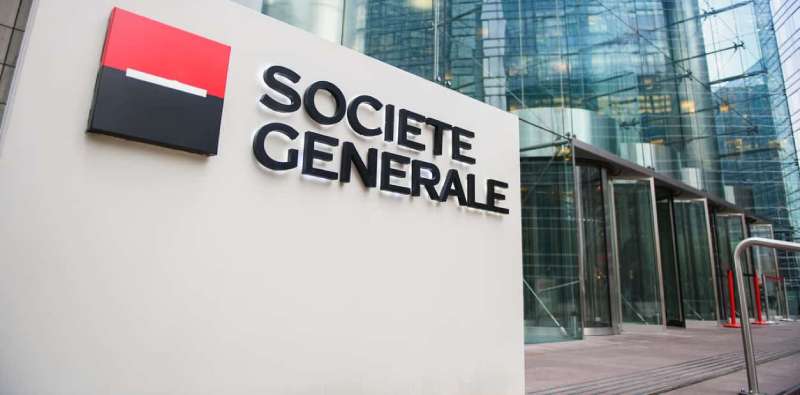
The Societe Generale logo is one of the most recognizable symbols in European banking. It uses a bold red square paired with clean, modern typography to signal strength and financial authority. The design has gone through several updates since the bank was founded in 1864, with each iteration reflecting shifts in how the brand wanted to present itself globally.
Within the history of bank logos, Societe Generale’s visual identity sits in an interesting place. It leans into bold color and geometric simplicity at a time when many competitors were still relying on coats of arms and ornate crests. That decision aged well.
The current version was introduced in 2023 as part of a broader brand refresh. The bank worked with external branding consultants to modernize the mark while keeping its core red identity intact. Founded in Paris in 1864, the bank has now gone through at least five distinct logo iterations over more than 150 years.
What Is the Societe Generale Logo?

The Societe Generale logo is a combination mark featuring a red square symbol alongside a bold sans-serif wordmark. The current version was introduced in 2023, developed with agency support, and uses the brand’s signature red to communicate energy, trust, and financial strength in global markets.
- Design Type: Combination mark (icon + wordmark)
- Primary Elements: Red square symbol, custom sans-serif logotype
- Official Introduction Date: 2023 (current version); previous major refresh in 2006
- Designer/Agency: Developed with external branding consultants (agency not publicly named for 2023 refresh)
- Trademark Status: Registered trademark; protected under EU and international trademark law
- Color Palette: Primary Red (#E30613), Black (#000000), White (#FFFFFF)
- Usage Context: Bank branches, digital platforms, marketing materials, corporate communications, co-branded financial products, investor relations
How Has the Societe Generale Logo Evolved Over Time?
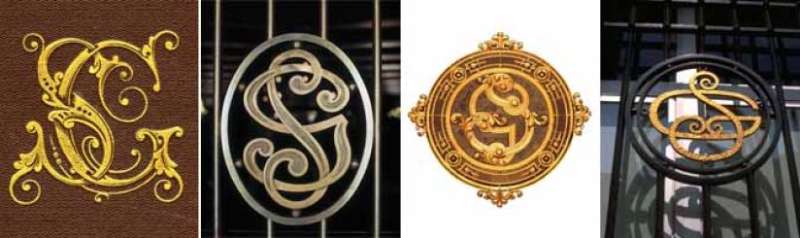
The Societe Generale logo has moved from ornate 19th-century heraldic design toward sharp, geometric minimalism. The biggest shift came in the mid-20th century when the bank dropped decorative elements in favor of a cleaner mark. The 2023 refresh refined that direction further without breaking from the brand’s red identity.
Original Societe Generale Logo (1864-1960s)
- Years Active: 1864 to approximately the 1960s
- Design Description: Elaborate heraldic-style mark with ornate lettering; reflected 19th-century European banking convention
- Color Scheme: Dark blues and blacks, minimal use of color
- Designer: Unknown
- Context: Founded in 1864 under Napoleon III to support French industrial expansion; the logo conveyed institutional authority
- Key Changes from Previous: N/A (original)
- Cultural Significance: Positioned the bank as a serious, establishment institution in 19th-century Paris
Mid-Century Transition Logo (1960s-1980s)
- Years Active: 1960s to early 1980s
- Design Description: Simplified wordmark; moved away from heraldic imagery toward cleaner sans-serif lettering
- Color Scheme: Early introduction of red as a brand color
- Designer: Unknown
- Context: Post-war modernization across French industry; banks across Europe were shedding old crests for cleaner identities
- Key Changes from Previous: Dropped ornate illustration; introduced cleaner type
- Cultural Significance: Reflected France’s economic modernization push in the postwar decades
The Red Square Era Logo (1980s-2006)
- Years Active: Early 1980s to 2006
- Design Description: Introduction of the iconic red square symbol; the mark that became synonymous with the brand internationally
- Color Scheme: Red and black
- Designer: Unknown (likely handled by an internal or French design agency)
- Context: The bank’s international expansion period; needed a mark that worked across global markets
- Key Changes from Previous: Introduced the geometric square symbol; red became dominant
- Cultural Significance: Gave the brand a globally recognizable, country-agnostic symbol that could stand alone
2006 Modernization Logo (2006-2023)
- Years Active: 2006 to 2023
- Design Description: Refined version of the red square mark with updated typography; cleaner proportions, improved digital legibility
- Color Scheme: Red (#E30613) and Black (#000000)
- Designer: External branding agency (not publicly disclosed)
- Context: Digital banking boom; the mark needed to function clearly on screens and mobile
- Key Changes from Previous: Tighter proportions, improved font weight, adjusted spacing
- Cultural Significance: First logo version designed with digital-first use cases in mind
Current Societe Generale Logo (2023-Present)
- Years Active: 2023 to present
- Design Description: Refined combination mark; streamlined symbol with updated custom wordmark
- Color Scheme: Red (#E30613), Black (#000000), White (#FFFFFF)
- Designer: External consultants (undisclosed)
- Context: Post-merger integration following the consolidation of SocGen’s retail banking brands in France
- Key Changes from Previous: Subtle refinements to letterform spacing and symbol geometry; updated for modern brand system use
- Cultural Significance: Signals the bank’s move toward a unified, simplified brand structure after years of operating multiple sub-brands
What Do the Design Elements of the Societe Generale Logo Mean?
The Societe Generale logo uses a red square as its core symbol, representing stability and decisiveness. The wordmark sits alongside it in a bold sans-serif, reinforcing clarity and authority. Together, the elements communicate a bank that wants to be seen as direct, modern, and globally capable.
Understanding what a well-built logo actually communicates requires looking at every element as a deliberate choice. Nothing in a mark like this happens by accident.
What Does the Red Square Symbol Represent?
The square is a universally understood shape for stability and structure. In financial branding, it signals solidity. The red color turns that stability into something active rather than passive.
The square also creates a strong focal point in the overall mark. Your eye lands there first, then moves to the wordmark. That reading order is intentional.
The psychology of shapes plays a real role here. Squares and rectangles read as trustworthy, ordered, and reliable. For a bank handling billions in assets, those associations matter more than being visually exciting.
Why Did Societe Generale Choose These Specific Colors?
Red is the dominant brand color, and it’s been central to the identity since at least the 1980s. Here’s how each color functions in the system:
- Red (#E30613)
- Pantone: Pantone 485 C (approximate match)
- Symbolic meaning: Energy, urgency, action
- Psychological impact: Triggers attention and recall; one of the highest-visibility colors in brand design
- Brand connection: Among major red logos in finance, SocGen’s red is distinctive for its saturation and consistency
- Black (#000000)
- Symbolic meaning: Authority, precision, sophistication
- Psychological impact: Grounds the red; prevents the identity from feeling too aggressive
- Brand connection: Standard in financial services; see also the BNP Paribas logo for a comparable French banking approach
- White (#FFFFFF)
- Symbolic meaning: Clarity, openness, accessibility
- Psychological impact: Provides breathing room in the system; supports legibility
- Brand connection: Used primarily as background and negative space in the overall brand system
The color theory behind this palette is fairly straightforward. Red and black is a high-contrast pairing that prioritizes recognition over nuance. It works across every format, from a tiny mobile icon to a building facade.
What Typography Style Is Used in the Societe Generale Logo?
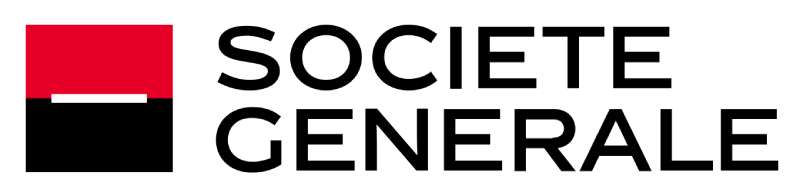
The wordmark uses a custom-adjusted sans-serif font, likely based on a modified version of a geometric or humanist sans family.
The letterforms are clean and slightly condensed, which keeps the full name readable at smaller sizes. Tracking is tight but not compressed to the point of hurting readability.
The typography has been updated gradually with each brand refresh. The current version feels more refined than the 2006 iteration, with slightly more consistent stroke weights and better spacing between letters.
The typographic hierarchy in the logo is simple: one weight, one size, no secondary type element. That restraint is part of what makes it work at scale.
What Are the Hidden Meanings in the Societe Generale Logo?
There’s no confirmed “hidden meaning” in the red square beyond its straightforward symbolic role. The bank hasn’t published designer statements pointing to subliminal geometry or concealed iconography.
That said, some observers note that the square’s proportions and positioning relative to the wordmark follow principles consistent with the golden ratio. Whether that was intentional or incidental isn’t confirmed.
The emphasis created by the red square does function as an implicit signal of authority. It draws attention before the name does, which means the symbol is doing brand recognition work independently of the text.
How Does the Societe Generale Logo Compare to Competitor Logos?
Among major European bank logos, Societe Generale’s mark stands out for its commitment to a single dominant color and geometric simplicity. Most competitors use blue, rely on abstract monograms, or layer multiple graphic elements. SocGen’s approach is more direct.
Here’s how it compares to key competitors:
- Societe Generale vs. BNP Paribas: BNP Paribas uses green with a stylized figure mark. Both are French banks with strong brand consistency, but BNP leans into a more conceptual symbol while SocGen keeps it geometric and abstract.
- Societe Generale vs. Deutsche Bank: Deutsche Bank’s slanted square-in-square is arguably the most minimalist bank logo in Europe. SocGen’s red square is bolder in color but similar in its reliance on a single geometric form.
- Societe Generale vs. HSBC: HSBC uses a red-and-white hexagonal mark derived from a Scottish flag pattern. Both brands use red prominently, but HSBC’s mark carries more historical narrative while SocGen’s is more abstract.
- Societe Generale vs. Barclays: Barclays uses an eagle symbol in blue. More illustrative and traditional compared to SocGen’s pure geometry.
- Societe Generale vs. UniCredit: UniCredit’s red circle mark is the closest visual cousin to SocGen’s square. Both use red geometric shapes, but UniCredit’s circle reads as softer and more pan-European, while SocGen’s square feels more assertive.
The pattern here is clear. SocGen sits in the “bold geometry + strong color” camp, closer to Deutsche Bank and UniCredit than to the more illustrative or symbol-heavy approaches used by HSBC and Barclays.
What Are the Technical Specifications of the Societe Generale Logo?
Official Color Codes
- Primary Color: Red
- Hex: #E30613
- RGB: (227, 6, 19)
- CMYK: (0, 97, 92, 11)
- Pantone: 485 C (approximate)
- Secondary Color: Black
- Hex: #000000
- RGB: (0, 0, 0)
- CMYK: (0, 0, 0, 100)
- Pantone: Black C
- Accent Color: White
- Hex: #FFFFFF
- RGB: (255, 255, 255)
- CMYK: (0, 0, 0, 0)
- Pantone: N/A
Dimensions and Proportions
- Aspect ratio: Approximately 4:1 (full combination mark, symbol + wordmark); the square symbol itself maintains a 1:1 ratio
- Minimum size requirements: Not publicly published, but standard brand practice recommends no smaller than 20px height for digital use
- Clear space specifications: Typically defined as the height of the square symbol on all sides; exact measurements are in the internal brand manual
- Official usage guidelines: Available to partners and media through Societe Generale’s official press and brand portal; the logo is provided in vector graphics formats (SVG, EPS, AI) and raster formats (PNG, JPEG) for various applications
For digital applications, the logo is typically supplied with a transparent background. For print, the brand uses Pantone-matched colors to ensure consistency across materials. DPI requirements follow standard brand guidelines: 72 DPI for screen use, 300 DPI minimum for print.
What Cultural Impact Has the Societe Generale Logo Had?
The Societe Generale logo carries significant cultural weight in France and across European financial markets. It’s been on storefronts, sponsorship boards, and digital platforms for decades, building recognition that goes well beyond the financial sector.
The bank has been a major sponsor in European sports, particularly Formula 1 and rugby, which put the red square in front of hundreds of millions of viewers globally. That exposure accelerated brand recognition in markets where SocGen had limited retail presence.
During the 2008 financial crisis, the logo briefly became associated with the Jerome Kerviel trading scandal, one of the largest rogue trading losses in banking history. The brand survived, and the identity remained unchanged, which itself says something about how deeply the mark was embedded in people’s perception of the institution.
In France specifically, the red square has become shorthand for “major bank” in visual culture. It appears regularly in films, news graphics, and political discussions about French financial institutions. That kind of cultural integration is rare and takes decades to build.
How Does the Societe Generale Logo Fit Into the Overall Brand Identity?
The logo is the anchor of a wider identity system that includes a strict color palette, a defined typographic system, and specific rules for co-branding with subsidiary businesses. The red square functions as the consistent thread across every touchpoint.
The brand guidelines govern how the logo interacts with photography, iconography, and layout. The brand style guide specifies approved color combinations, minimum sizes, and restricted uses.
The visual hierarchy in SocGen’s brand materials consistently places the logo in a position of authority, usually top-left in digital interfaces or prominently centered in print. That positioning is consistent across markets.
Subsidiary brands and co-branded products typically feature the parent logo in a reduced but still prominent position. The balance between parent brand visibility and sub-brand identity is a known challenge in large financial groups, and SocGen manages it by keeping the red square always recognizable even at smaller scales.
The graphic design principles embedded in the system, particularly around alignment and white space, reflect a brand that has matured significantly from its earlier, less disciplined iterations.
How Should the Societe Generale Logo Be Used?
Official Usage Guidelines
- Do use: Official logo files obtained directly from Societe Generale’s press portal or brand team
- Do use: Approved color versions (full color, black, white) as specified in brand documentation
- Do maintain: Required clear space around the mark; never crowd the logo with other elements
- Do not: Alter the colors, proportions, or arrangement of elements
- Do not: Apply effects such as drop shadows, gradients, or outlines to the logo
- Do not: Reproduce the logo on backgrounds that reduce legibility
- Do not: Use the logo to imply endorsement or partnership without written permission
Where to Access Official Logos
Official logo files are available through Societe Generale’s media and press relations portal at societegenerale.com. Partners and vendors requiring brand assets should request them directly through the bank’s communications or marketing teams.
Licensing and Trademark Protection
The Societe Generale name and logo are registered trademarks in the European Union and internationally. Unauthorized use, reproduction, or modification of the mark is prohibited under trademark law. Third-party vendors, sponsors, and media outlets must obtain explicit written permission before using the logo in any commercial or editorial context.
For journalists and press use, Societe Generale typically provides logo files under specific usage terms. These terms are outlined in the bank’s media kit and press pack, available on request from their communications department.
FAQ on The Societe Generale Logo
What Does the Societe Generale Logo Look Like?
It’s a combination mark: a solid red square symbol paired with a bold sans-serif wordmark spelling out the full bank name.
The red is unmistakable. No gradients, no illustrative elements. Just geometry and type.
What Color Is the Societe Generale Logo?
The primary brand color is a saturated red, hex code #E30613, close to Pantone 485 C.
Black and white complete the palette. The red has stayed consistent across every major logo iteration since the 1980s.
When Was the Current Societe Generale Logo Introduced?
The most recent version launched in 2023 as part of a broader corporate brand refresh following internal restructuring.
It refined the existing identity rather than replacing it. The red square survived intact.
Who Designed the Societe Generale Logo?
The 2023 refresh involved external branding consultants, though Societe Generale has not publicly named the agency responsible.
Earlier iterations from the 1980s onward also lack confirmed designer attribution in public records.
How Many Times Has the Societe Generale Logo Changed?
The brand has gone through at least five distinct logo iterations since the bank’s founding in 1864.
The biggest shift was the move from ornate heraldic design to the clean geometric red square mark.
What Does the Red Square in the Societe Generale Logo Represent?
The square signals stability and structure. Red adds energy and urgency to what would otherwise read as a purely static form.
Together, they position SocGen as both reliable and active. Standard financial brand logic, executed cleanly.
Is the Societe Generale Logo a Trademark?
Yes. The name and the visual mark are registered trademarks under EU and international intellectual property law.
Unauthorized reproduction or modification is prohibited. Media and partners must request official logo files directly from the bank.
How Does the Societe Generale Logo Compare to Other French Bank Logos?
BNP Paribas uses green and a figurative symbol. Credit Agricole relies on a stylized green motif. SocGen’s red square stands apart from both.
Among French bank logos, it’s the most geometric and the most color-aggressive.
Where Can I Download the Official Societe Generale Logo?
Official logo files are available through Societe Generale’s press portal at societegenerale.com.
Files are typically provided in vector formats (SVG, EPS) and raster formats (PNG) for approved media and partner use only.
What Font Does the Societe Generale Logo Use?
The wordmark uses a custom-adjusted sans-serif typeface with tight tracking and consistent stroke weights.
It’s not a standard off-the-shelf font. The letterforms have been refined across multiple brand refreshes for better digital legibility.
Conclusion
The Societe Generale logo is a textbook case of corporate visual identity done with discipline and long-term consistency.
From its 19th-century heraldic origins to the clean geometric mark used across digital platforms today, the SocGen brand evolution shows what happens when a financial institution commits to a clear visual direction and sticks with it.
The red square works because it’s simple, scalable, and unmistakable, whether it appears on a branch facade in Paris or a mobile banking app.
Among European bank visual identities, few have achieved the same level of brand recognition with so few design elements.
That restraint is the whole point.

Renowned for his expertise in logo design and visual branding, Bogdan has developed a multitude of logos for various clients.
His skills extend to creating posters, vector illustrations, business cards, and brochures. Additionally, Bogdan's UI kits were featured on marketplaces like Visual Hierarchy and UI8.
He also wrote in the past years on sites like Design Your Way, WebDesignerDepot, WPDean, Designmodo, Speckyboy, Slider Revolution, and more.
- The Windsurf Logo History, Colors, Font, And Meaning - 10 October 2026
- How to Remove Background From Product Photos (No Photoshop) - 10 October 2026
- How Designers can Build a Stronger Online Creative Identity - 9 October 2026

Bogdan Sandu is a seasoned designer who has been designing websites since 2008. Renowned for his expertise in logo design and visual branding, Bogdan has developed a multitude of logos for various clients. His skills extend to creating posters, vector illustrations, business cards, and brochures. Additionally, Bogdan's UI kits were featured on marketplaces like Visual Hierarchy and UI8. He also wrote in the past years on sites like Design Your Way, WebDesignerDepot, WPDean, Designmodo, Speckyboy, Slider Revolution, and more.
You Might Also Like