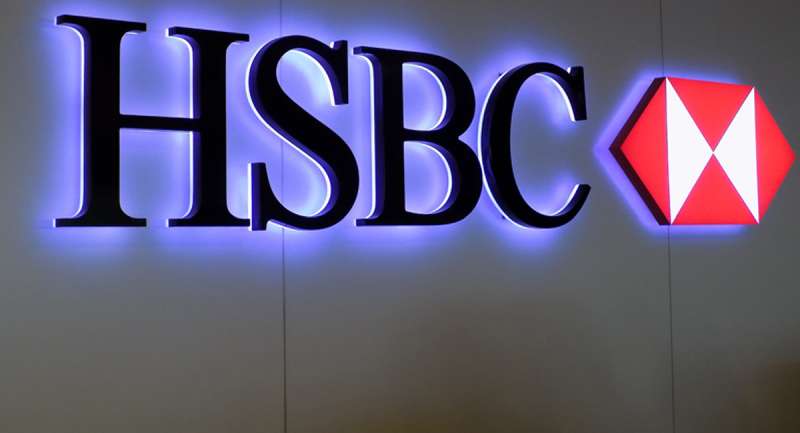
The HSBC logo is one of the most recognized symbols in global banking. Built around a bold red hexagon divided into four triangles, it communicates strength, reach, and reliability without a single word. The mark has represented HSBC Holdings plc across dozens of markets since its formal adoption in 1983. Few financial institutions carry a symbol this geometrically deliberate, or this consistent across six decades of international expansion.
Among bank logos, HSBC’s stands out for its restraint. No gradients, no abstract swooshes. Just geometry and red ink doing all the work.
What is the HSBC Logo?
The HSBC logo is a red and white hexagonal mark made up of four overlapping triangles, forming a stylized “X” pattern. Adopted in 1983 and designed based on a traditional Scottish flag motif, it pairs with a custom sans-serif wordmark. The symbol represents the bank’s global reach and cross-border connectivity.
- Design Type: Combination mark (abstract symbol + wordmark)
- Primary Elements: Red hexagon divided into four triangles, uppercase sans-serif logotype
- Official Introduction Date: 1983 (unified global identity)
- Designer/Agency: Concept attributed to Henry Steward Goodwin; modernized with Interbrand’s involvement
- Trademark Status: Registered trademark of HSBC Holdings plc globally
- Color Palette:
- HSBC Red: #DB0011
- White: #FFFFFF
- Black (wordmark): #000000
- Usage Context: Branch signage, digital platforms, credit cards, marketing materials, corporate communications, merchandise
How Has the HSBC Logo Evolved Over Time?
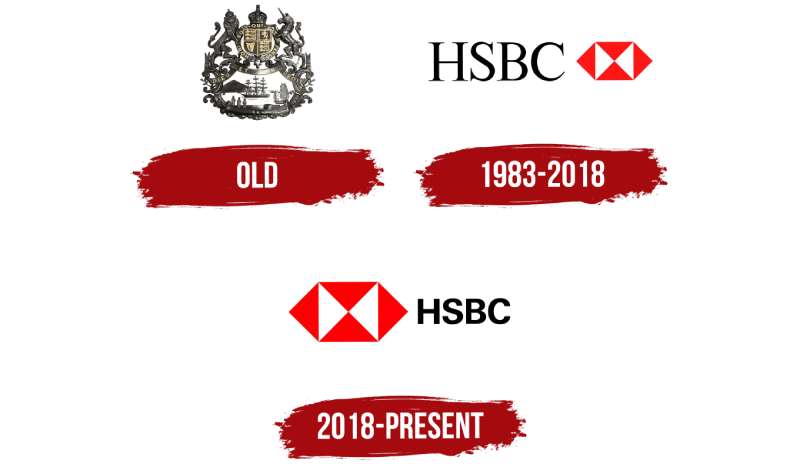
The HSBC identity has gone through several distinct phases, moving from separate regional marks to a single unified global symbol. The hexagon has remained constant since 1983, though its proportions and the accompanying wordmark have been refined multiple times.
The clearest shift came in 2018, when HSBC modernized the wordmark for digital environments. No dramatic overhaul. Just tightening what already worked.
Original Hongkong and Shanghai Banking Corporation Mark (Pre-1983)
- Years Active: 1865–1983
- Design Description: Various regional marks used across different subsidiary banks with no unified visual identity
- Color Scheme: Varied by region and subsidiary
- Designer: Not centrally attributed
- Context: HSBC operated as a collection of regional banks. Each carried its own branding.
- Key Changes from Previous: N/A (founding identity)
- Cultural Significance: Reflected the bank’s fragmented, empire-era expansion model across Asia and beyond
Unified Hexagon Mark (1983–1999)
- Years Active: 1983–1999
- Design Description: Red hexagonal symbol with four white triangles, paired with “HSBC” in a serif wordmark
- Color Scheme: Red and white
- Designer: Concept attributed to Henry Steward Goodwin; based on the Saint Andrew’s Cross flag
- Context: Introduced to create a single recognizable identity across all HSBC subsidiaries as the group went global
- Key Changes from Previous: First unified group-wide identity replacing fragmented regional marks
- Cultural Significance: Marked HSBC’s transition into a coordinated global banking group
Refined Identity with Sans-Serif Wordmark (1999–2018)
- Years Active: 1999–2018
- Design Description: Hexagon symbol retained; serif wordmark replaced with a cleaner sans-serif version
- Color Scheme: Red (#DB0011) and white, black wordmark
- Designer: Interbrand involved in brand consultancy during this period
- Context: Driven by HSBC’s push into digital banking and the “The World’s Local Bank” global campaign
- Key Changes from Previous: Typography modernized; symbol proportions slightly refined
- Cultural Significance: Supported one of the largest global banking campaigns ever run
Current Digital-Optimized Identity (2018–Present)
- Years Active: 2018–present
- Design Description: Refined hexagon with updated wordmark spacing and improved digital rendering
- Color Scheme: HSBC Red #DB0011, White #FFFFFF
- Designer: Internal brand team with external agency input
- Context: Digital-first banking environment requiring crisp rendering at small pixel sizes
- Key Changes from Previous: Tighter kerning on wordmark; improved scalability for app icons and digital displays
- Cultural Significance: Reflects the shift toward mobile-first brand presentation across financial services
What Do the Design Elements of the HSBC Logo Mean?
The hexagon carries real meaning. Its four triangles reference the Saint Andrew’s Cross, the flag of Scotland, which connects directly to HSBC’s Scottish co-founder, Sir Thomas Sutherland.
The shape itself suggests structure, strength, and precision.
Red signals confidence and authority. White signals clarity and trust. Together they form a palette that reads clearly in any context, from a branch fascia in Hong Kong to a smartphone app icon in London.
The geometry is deliberate. This is not a logo built on softness or approachability. It’s designed to look like it means business.
Why Did HSBC Choose These Specific Colors?
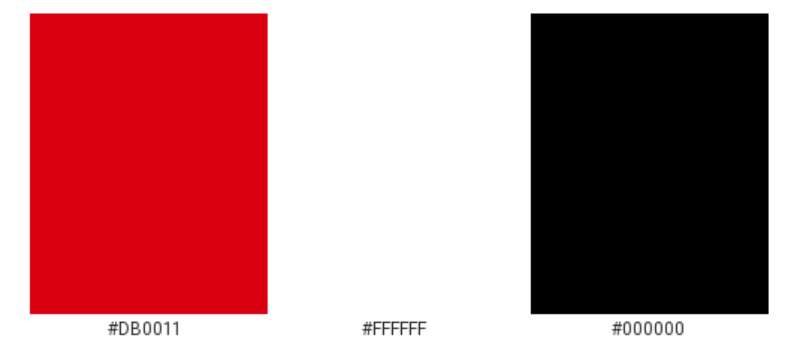
HSBC Red (#DB0011) is the dominant color. In color psychology, red communicates urgency, confidence, and power.
For a bank, it says: we are here, we are stable, and we are not going anywhere.
Red also carries deep cultural significance in Hong Kong and broader Chinese culture, where it represents good fortune and prosperity. For a bank founded in Hong Kong in 1865, that connection is not accidental.
White creates the internal contrast within the hexagon. It adds visual clarity and prevents the symbol from reading as a heavy, filled-in block.
The combination of red and white also appears across the flags of several countries where HSBC operates, including the UK, Canada, and Switzerland.
Interestingly, HSBC doesn’t use standard Pantone 485 (the typical corporate red) used by many competitors. Their specific red sits slightly darker, giving it more weight on screen.
What Typography Style Is Used in the HSBC Logo?
The current wordmark uses a custom sans-serif font with even stroke weights and open letterforms.
It’s not particularly distinctive on its own, which is intentional. The typography is meant to support the hexagon, not compete with it.
The font prioritizes legibility at small sizes. This matters when you’re rendering a brand name on an ATM screen, a credit card emboss, or a mobile app header.
Earlier versions used a serif wordmark, which felt more formal and institutional. The move to sans-serif aligned HSBC with the broader shift in financial services toward accessible typography.
The leading and tracking in the wordmark have been tightened over the years to feel more contemporary without losing readability.
What Are the Hidden Meanings in the HSBC Logo?
The four-triangle composition inside the hexagon mirrors the Saint Andrew’s Cross (the Scottish Saltire), a direct nod to HSBC’s Scottish co-founder and the bank’s origins.
Some designers read the overlapping triangles as two arrows pointing inward, suggesting convergence or the meeting of East and West.
That interpretation fits HSBC’s historical identity as the bridge between Asian and Western financial markets.
There’s no confirmed “hidden message” in the traditional sense. The emphasis is on geometric clarity, not subliminal tricks. What you see is what HSBC intended: structure, symmetry, and strength.
How Does the HSBC Logo Compare to Competitor Logos?
Among major global banks, HSBC’s mark is unusual for relying entirely on geometry with no figurative imagery.
Most competitors use wordmarks, shields, or abstract swooshes. HSBC’s hexagon is genuinely distinctive in a sector that often plays it safe.
The broader bank logo landscape skews heavily toward blue. HSBC’s red immediately separates it from Barclays (blue eagle), Deutsche Bank (blue slash), and BNP Paribas (green/red star). That color differentiation alone makes HSBC more recognizable in multi-brand environments like airport terminals or international business districts.
The Wells Fargo logo uses a stagecoach, the JP Morgan Chase logo uses an abstract octagon, and the Bank of America logo uses a flag-inspired mark. All figurative or semi-figurative. HSBC’s pure geometric approach is actually closer to what you’d expect from a design-forward tech company than a 160-year-old bank.
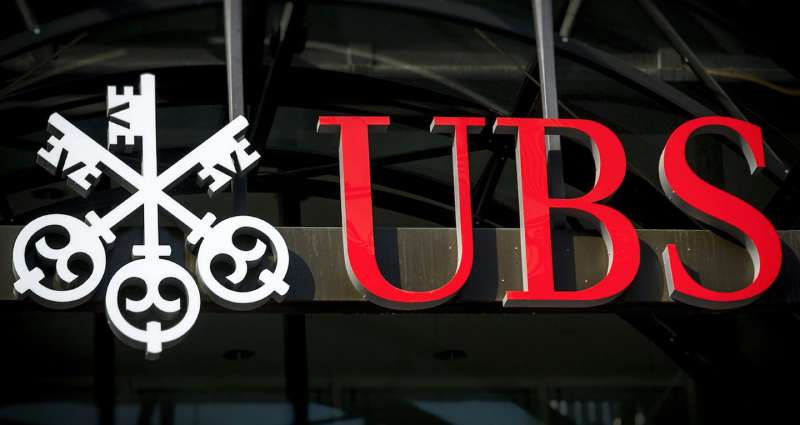
The UBS logo offers the closest parallel in terms of geometric restraint, though it relies on three overlapping keys rather than a single unified shape. HSBC’s hexagon reads more immediately at small sizes.
What Are the Technical Specifications of the HSBC Logo?
Official Color Codes
- Primary Color: HSBC Red
- Hex: #DB0011
- RGB: (219, 0, 17)
- CMYK: (0, 100, 92, 14)
- Pantone: 485 C (approximate; HSBC uses a proprietary variant)
- Secondary Color: White
- Hex: #FFFFFF
- RGB: (255, 255, 255)
- CMYK: (0, 0, 0, 0)
- Wordmark Color: Black
The HSBC logo is one of the most recognized symbols in global banking. Built around a bold red hexagon divided into four triangles, it communicates strength, reach, and reliability without a single word. The mark has represented HSBC Holdings plc across dozens of markets since its formal adoption in 1983. Few financial institutions carry a symbol this geometrically deliberate, or this consistent across six decades of international expansion.
Among bank logos, HSBC’s stands out for its restraint. No gradients, no abstract swooshes. Just geometry and red ink doing all the work.
How Does the HSBC Logo Compare to Competitor Logos?
Among major global banks, HSBC’s mark is unusual for relying entirely on geometry with no figurative imagery.
Most competitors use wordmarks, shields, or abstract swooshes. HSBC’s hexagon is genuinely distinctive in a sector that often plays it safe.
The broader bank logo landscape skews heavily toward blue. HSBC’s red immediately separates it from Barclays (blue eagle), Deutsche Bank (blue slash), and BNP Paribas (green/red star). That color differentiation alone makes HSBC more recognizable in multi-brand environments like airport terminals or international business districts.
The Wells Fargo logo uses a stagecoach, the JP Morgan Chase logo uses an abstract octagon, and the Bank of America logo uses a flag-inspired mark. All figurative or semi-figurative. HSBC’s pure geometric approach is actually closer to what you’d expect from a design-forward tech company than a 160-year-old bank.
The UBS logo offers the closest parallel in terms of geometric restraint, though it relies on three overlapping keys rather than a single unified shape. HSBC’s hexagon reads more immediately at small sizes.
What Are the Technical Specifications of the HSBC Logo?
Official Color Codes
- Primary Color: HSBC Red
- Hex: #DB0011
- RGB: (219, 0, 17)
- CMYK: (0, 100, 92, 14)
- Pantone: 485 C (approximate; HSBC uses a proprietary variant)
- Secondary Color: White
- Hex: #FFFFFF
- RGB: (255, 255, 255)
- CMYK: (0, 0, 0, 0)
- Wordmark Color: Black
- Hex: #000000
- RGB: (0, 0, 0)
- CMYK: (0, 0, 0, 100)
Dimensions and Proportions
- Aspect Ratio: The hexagon symbol is approximately square in its bounding box; the full combination mark runs roughly 4:1 width to height
- Minimum Size Requirements: Symbol alone: minimum 16px for digital; combination mark: minimum 80px wide for screen
- Clear Space: Minimum clear space equal to the height of the “H” in the wordmark on all sides
- File Formats Available: Vector graphics (SVG, EPS, AI) for print; PNG with transparency for digital; JPEG for document use
- Print Resolution: Minimum 300 DPI for all print applications
What Cultural Impact Has the HSBC Logo Had?
HSBC’s hexagon has become shorthand for international finance. It appears on buildings in over 60 countries, making it one of the most geographically distributed brand marks in banking history.
The “World’s Local Bank” campaign in the early 2000s used the logo as the anchor for an advertising strategy that played on cultural differences across markets.
Those airport ads, where the same image was labeled differently depending on cultural context, made the hexagon synonymous with global perspective and local awareness.
The red hexagon also carries weight in Asia specifically. In Hong Kong, the HSBC Main Building on Queensway is as much a landmark as the logo itself. The symbol appears on local currency notes issued by HSBC, which is genuinely rare for a commercial bank.
Among red logos globally, HSBC’s sits alongside Coca-Cola and YouTube as one of the most recognizable. That’s not a small claim for a financial institution.
How Does the HSBC Logo Fit Into the Overall Brand Identity?
The logo doesn’t work alone. It sits at the center of a broader identity system that includes the red color, the custom typography, specific color palette applications, and detailed brand guidelines governing how the mark appears across every touchpoint.
HSBC’s brand system uses the hexagon as a structural motif beyond the logo itself.
Hexagonal shapes appear in branch interior design, marketing layouts, and digital UI elements. The symbol isn’t just a logo; it’s a brand style anchor that shapes the entire visual language.
The visual hierarchy in HSBC’s communications always puts the hexagon first. Typography, photography, and layout all play supporting roles.
The graphic design principles behind the identity lean heavily on symmetry and balance. The hexagon is perfectly symmetrical on all axes. For a bank, symmetry communicates stability.
How Should the HSBC Logo Be Used?
Official Usage Guidelines
- Do: Use approved files downloaded directly from HSBC’s official brand portal
- Do: Maintain minimum clear space around the mark at all times
- Do: Use the hexagon symbol and wordmark together in most contexts
- Do: Reproduce the logo in full red/white on dark backgrounds, or in black/white where color printing is unavailable
- Don’t: Alter the proportions, colors, or orientation of the mark
- Don’t: Place the logo on visually busy backgrounds that reduce legibility
- Don’t: Recreate the logo from scratch using generic hexagon shapes
- Don’t: Use the logo in any context that implies HSBC endorsement without authorization
Where to Access Official Files
Official logo files are available through HSBC’s brand portal, accessible to authorized partners, agencies, and licensed vendors. The general public cannot download official vector files directly. For editorial and journalistic use, HSBC’s press office provides approved assets upon request.
Third-party logo repositories often carry outdated versions. Always verify you’re using the current mark, especially post-2018 when the wordmark was updated.
Trademark and Licensing
The HSBC hexagon and wordmark are registered trademarks of HSBC Holdings plc in most jurisdictions globally. Unauthorized commercial use is prohibited without a formal licensing agreement.
Font licensing for HSBC’s custom typeface is strictly internal. If you’re building materials that reference HSBC, use their official approved templates or request assets through proper channels.
Conclusion
The HSBC logo is a case study in how geometric simplicity can carry serious brand weight across six decades and 60+ countries.
Four triangles inside a red hexagon. That’s it. And yet it communicates financial authority, cross-cultural connectivity, and institutional stability better than most logos that try far harder.
The visual identity system behind it – the pixel-perfect scalability, the deliberate color theory choices, the typeface built for legibility over personality – shows what happens when corporate branding is treated as a long-term asset rather than a marketing afterthought.
Among global red logos, few have achieved this level of recognition with this little visual complexity.

Renowned for his expertise in logo design and visual branding, Bogdan has developed a multitude of logos for various clients.
His skills extend to creating posters, vector illustrations, business cards, and brochures. Additionally, Bogdan's UI kits were featured on marketplaces like Visual Hierarchy and UI8.
He also wrote in the past years on sites like Design Your Way, WebDesignerDepot, WPDean, Designmodo, Speckyboy, Slider Revolution, and more.
- Canva vs PowerPoint: Which Is Better for Presentations? - 22 September 2026
- How to Install Fonts on Mac (Step-by-Step Guide) - 20 September 2026
- From Mockup to Code: How AI-Augmented Development Speeds Up the Design Handoff - 19 September 2026

Bogdan Sandu is a seasoned designer who has been designing websites since 2008. Renowned for his expertise in logo design and visual branding, Bogdan has developed a multitude of logos for various clients. His skills extend to creating posters, vector illustrations, business cards, and brochures. Additionally, Bogdan's UI kits were featured on marketplaces like Visual Hierarchy and UI8. He also wrote in the past years on sites like Design Your Way, WebDesignerDepot, WPDean, Designmodo, Speckyboy, Slider Revolution, and more.
You Might Also Like