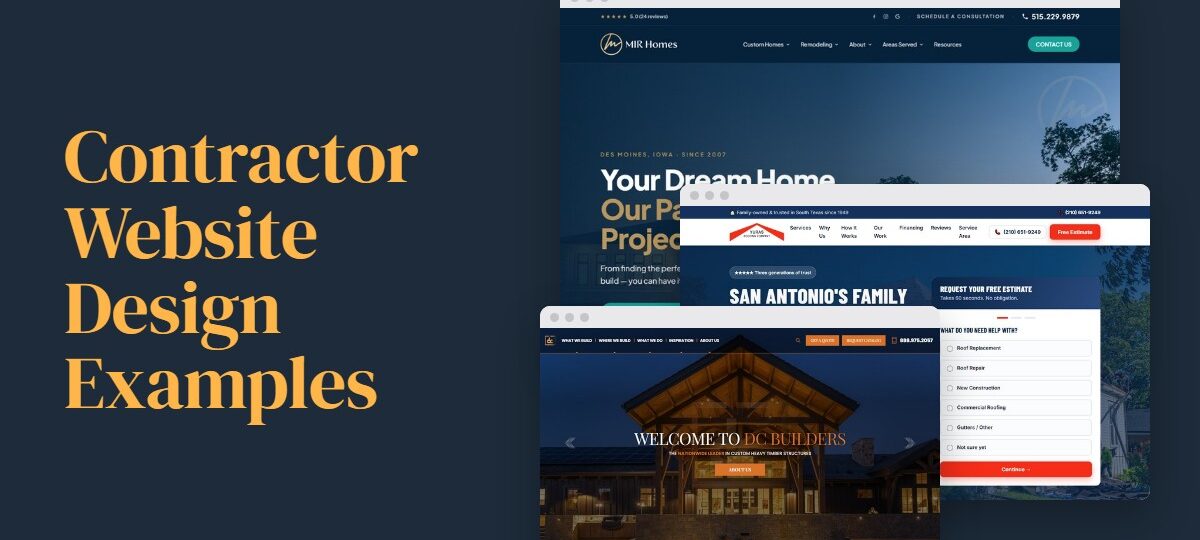
Colorlib’s 2026 audit of 27 general contractor sites found only 14 with a tappable phone number. The other 13 left visitors to copy the digits by hand.
That kind of gap runs through contractor web design. Roofers, plumbers, remodelers and commercial builders all arrange the first screen differently, but the sites that win calls and quote requests tend to show a tappable phone number, a stated license, a named service area and a short form.
What Do the Best Contractor Website Examples Have in Common?
A visitor landing on a contractor site wants to know what the contractor does and whether they cover the area. Whether they can be trusted comes right behind. Freshy Sites uses that test in its 2026 roundup of 50 contractor sites.
Real photos count for more than a polished design. Nanoglobals notes that homeowners pick the contractor who feels least likely to disappear mid-project, and its 2026 general contractor list favors real project photos over stock imagery.
The rest of Colorlib’s counts for those 27 sites are just as thin. Only 5 of 27 state a license or insurance credential, and 8 of 27 show a phone number above the fold. A tappable number turns up somewhere on the page for 14 of 27. Enquiry forms are rarer, with 7 of 27 putting one on the homepage and none placing it above the fold.
Put Freshy Sites’ questions next to Colorlib’s counts and the gap is hard to miss. Trust and location are what visitors check first, and most of the sampled sites leave out the license while fewer than half name a service area.
A site that names its towns and has a tappable number is already ahead of most of that sample, and a stated license puts it further ahead.
What Belongs on the First Screen of a Contractor Homepage?
The trade, the service area, a phone number and one primary call to action. Everything else gets in the way of the next step.
Header and phone number placement
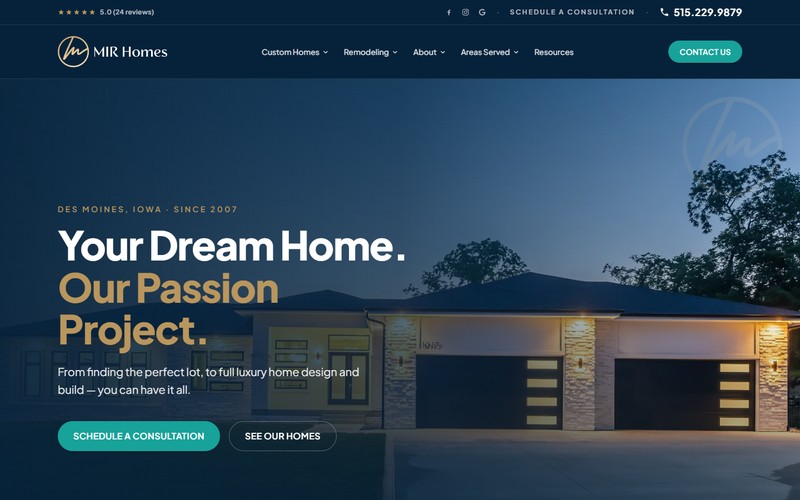
Most sites in Colorlib’s sample hide the number or leave it untappable, which makes the exceptions worth a look. West Village GC puts its phone number in the main navigation. MIR Homes shows its number twice above the fold, and Allstate General Contractors names three towns while keeping the phone above the fold too.
A sticky header keeps the number in reach once the visitor scrolls past the hero. On a phone, the number should be a tappable link, not plain text.
Hero section and call to action
Keep the hero to one message and one button.
It works best when it follows a clear visual hierarchy. The headline names the trade, and the call to action is the strongest element after it.
Buttons placed over project photos need enough contrast against the image to stay readable on a phone in daylight.
C2 Construction goes action-first with a “Hire Us” call to action. Keen Building Company takes a different route and sells its estimating technology before it asks for the form.
WebFX singles out Tyler Mitchell Construction for its call to action buttons and West Village GC for a homepage video that walks through its services. Pick one primary action. A second button of equal weight splits attention, and I’d cut it.
Quote request forms and click-to-call buttons
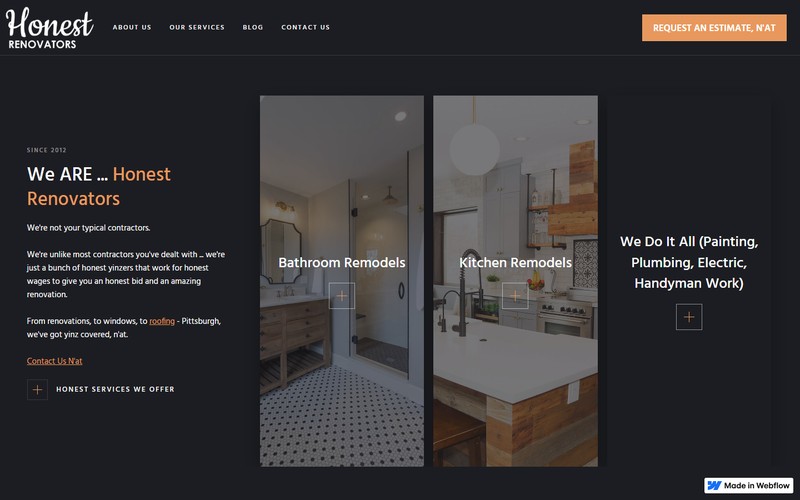
Form length in the examples runs from two fields to six required ones. Letter Four and Honest Renovators ask for just two fields, and Scott Simpson Design + Build asks for three. Keen Building Company has five required fields, Evans Construction six.
Published tests don’t agree on whether fewer fields always win. Venture Harbour’s review of five form-length tests describes cases where cutting fields lifted conversions and others where cutting them lowered conversions, because motivated visitors will give more detail when the offer calls for it.
A quote request fits the second case. A kitchen remodel cannot be priced from a name and an email, so one or two scope questions (project type, ZIP code) earn their place.
Click-to-call covers everyone else. Construction Placements notes that most contractor traffic now arrives on phones, often at odd hours. That favors a tappable number next to a short form, since the visitor picks whichever fits the hour.
How Do Contractor Websites Show Trust?
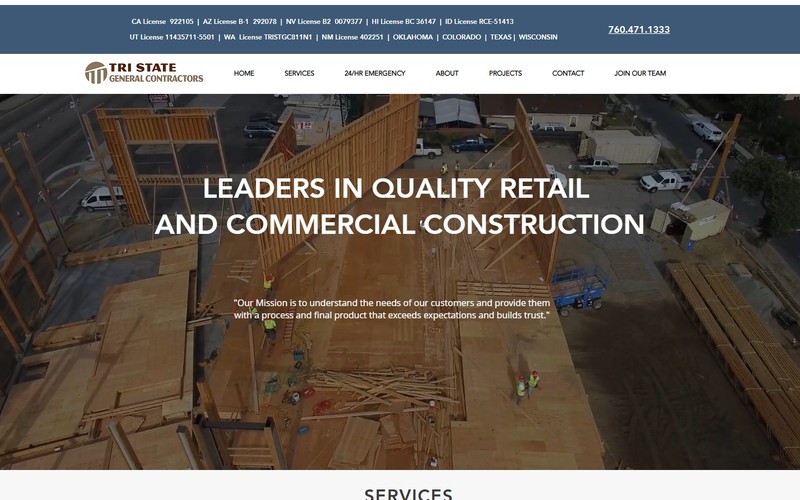
With proof a visitor can check, placed near the point where they decide. That means a license number and insurance details, plus reviews that link to their source and past work with names attached. Claims without proof read as marketing.
NOVO Construction publishes its full license number, Tri-State General Contractors makes state license numbers its headline, and Letter Four names its founders’ licenses. Tuckman-Barbee Construction shows repeat institutional clients, which says more than a slogan would. Schimenti Construction puts employee ownership in its navigation.
The license line is also a legal matter in some states. California’s contractor licensing board requires the license number in all forms of advertising, websites included, with a civil penalty of $100 to $1,000 for a first offense. Other states set their own rules, so check the state board before copying an example.
Google runs a similar check before ads appear. As of November 2026, Google’s Local Services Ads screening can include license and insurance verification, depending on business category and country. Showing the same credentials on the site keeps the listing and the page consistent.
Then there are reviews. BrightLocal’s 2026 Local Consumer Review Survey reports that 97% of consumers read reviews for local businesses, and that Google and Facebook are the sources they use most for local recommendations.
So embed or link the platforms where your reviews actually live (Google Business Profile, Yelp, Angi, Houzz) and name the source beside each quote. A Better Business Bureau badge helps only when the business is accredited and the badge links to its profile.
Star ratings and badges that link nowhere are the worst version of this. They look like proof, and nothing about them can be checked.
How Should a Contractor Portfolio Be Presented?
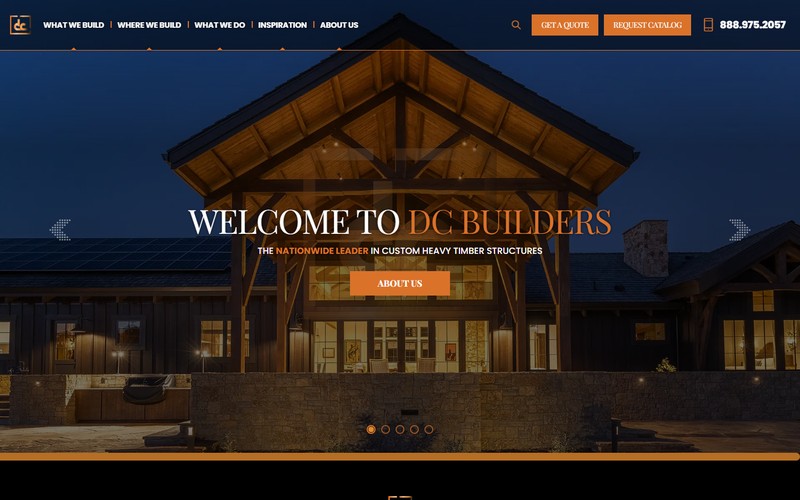
By project, with real photos, a place and a scope, grouped the way a buyer shops. Construction Placements argues that skeptical buyers in 2026 trust visible work over polished claims.
Scott Simpson Design + Build splits its portfolio by architectural style, while DC Builders organizes its menu by building type. Both work because the visitor can jump straight to the kind of project they want priced.
Each project page should give the scope and trade, the town (not just the state), before and after photos, a timeline and one line from the client.
Galleries built on a consistent grid system let wide before and after pairs sit beside vertical shots without ragged edges. Houzz can hold the same projects with reviews attached, so link to the profile from the site.
Two sampled sites show what goes wrong. Blue Divide leads with the portfolio and has no phone or form on the first screen. KC Remodel & Repair has no phone, portfolio or form.
Large galleries also load slowly on phones, so compress the photos before upload.
How Do Contractor Examples Handle Service Areas and Local Pages?
The better ones name their towns on key pages and add an Areas Served menu. They also build dedicated city pages with local content, and they keep listings and markup consistent with the site. Most sampled sites do less than that.
City and service area pages
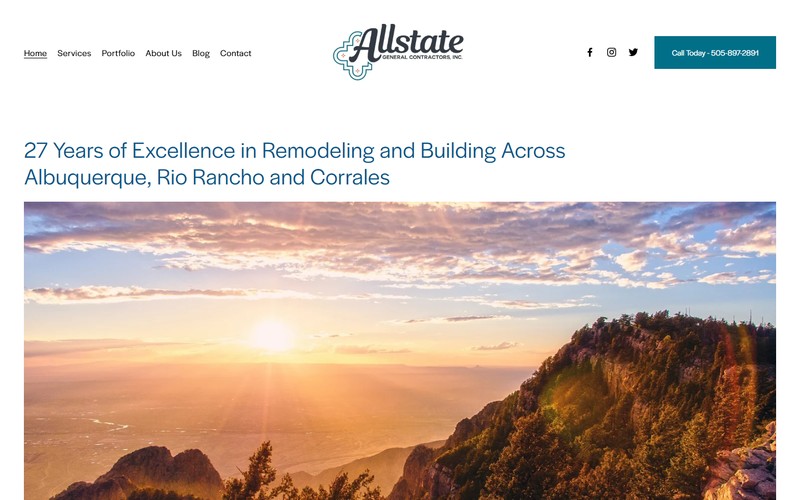
Allstate General Contractors names three towns on a page that also shows its phone above the fold. MIR Homes runs an Areas Served menu, and West Village GC publishes a local cost and insurance blog.
City pages need to differ in substance. Construction Placements says a general contractor serving five suburbs needs a real page for each, with local code references, neighborhood-specific examples and housing styles.
Google has a name for the failure. Its spam policies define doorway abuse as pages created to rank for specific, similar queries that lead users to intermediate pages less useful than the final destination. Search Engine Land describes location pages built only to rank a city plus a service as a typical doorway example.
A page that swaps only the town name fits that description.
Structured data and listings
Markup tells Google what the page already says. Google’s LocalBusiness structured data documentation covers business hours and departments, among other details.
For contractors, a trade subtype fits better than the generic type. Schema.org defines HomeAndConstructionBusiness as a LocalBusiness that provides services around homes and buildings, with subtypes that include Electrician, GeneralContractor, HVACBusiness, HousePainter, Plumber and RoofingContractor.
The Google Business Profile and any Local Services Ads campaign should name the same services and towns as the landing page. Name, address and phone need to read identically across the site, the markup and the listing.
Contractor Website Design Examples by Trade
The trade decides what the first screen sells. Roofers lead with an inspection and plumbers with fast response, remodelers show finished projects, and commercial builders put credentials up front.
Roofing and exterior contractors
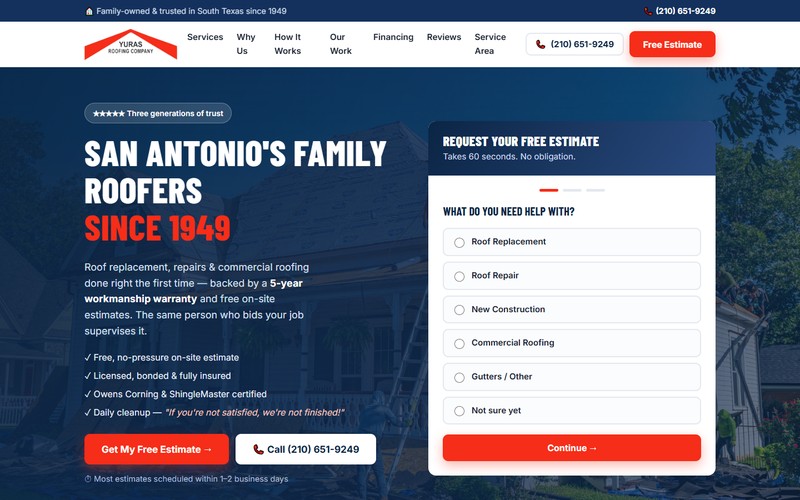
Yuras Roofing Company, built by Krishaweb, opens with a clear header photo and a line stating its expertise. A homeowner can place the company before reading anything else.
WebFX’s October 2026 roofing roundup says roofing sites should show how to book a free inspection, and it singles out D&L Roofing for readability. It also flags Philadelphia Quality Roofing for scroll animation, which looks great in a showcase and can cost speed on a mid-range phone (more on that below).
Hook Agency’s roofing and contractor roundups are worth scanning for exterior layouts. They include Secured Roofing & Restoration, Northface Construction, Puetz Construction and Stormgrade.
Plumbing, HVAC and electrical contractors
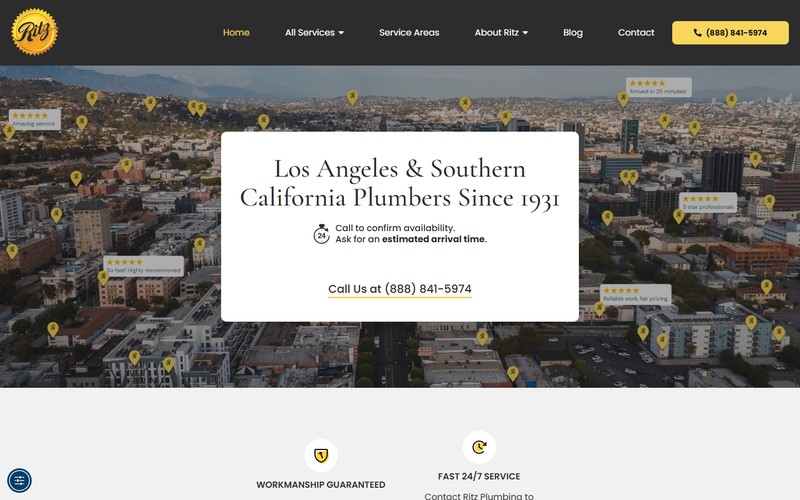
Colorlib’s audit of 18 plumbing sites found a tappable phone number above the fold on 16 of them. The number is a given in this trade, so the differences sit elsewhere.
Edwards Plumbing publishes a license number, runs an Available 24/7 strip and lists a Cities We Serve menu. Jimmy Joe’s Plumbing adds an “Is this an emergency?” field to its form, so urgent jobs get sorted before anyone calls back.
Ritz Plumbing shows a hero map of review pins, adds an Emergency Plumber menu item and repeats its number before the first scroll.
Parklane Plumbing goes the other way, with no clickable number on its opening screen and no form on the homepage. A visitor with a leak has nothing to act on.
HVAC sites lean on booking buttons. In Colorlib’s 30-site HVAC audit, twenty have a Book Now button and only eight have a booking system behind it.
A button that opens a plain contact form promises more than it delivers. Circle Plumbing and Heating makes a smaller version of the same slip, with the number in the headline but not set up as a link.
The HVAC set includes Squarespace builds (Paragon Mechanical, Stott HVAC Systems) and a WordPress build (Smock HVAC). For electricians, Colorlib’s review points to Bitz Electrical as a site that puts a form in the hero.
Remodelers and general contractors
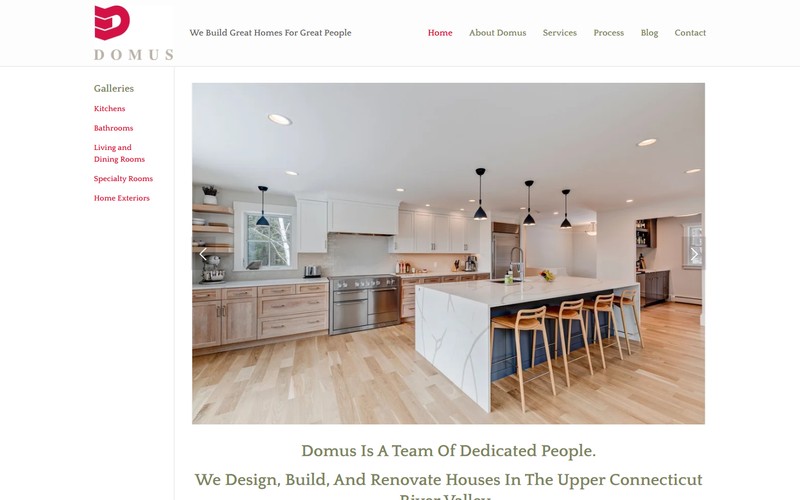
Remodelers sell scope and price comfort more than speed, and the examples handle price in very different ways.
Good remodeling website design needs to help homeowners picture the finished project before they request an estimate. That means showing real kitchen and bathroom transformations, organizing galleries by project type, and making it easy to understand the contractor’s process. Clear pricing expectations and a visible consultation button can then turn that interest into a qualified enquiry.
| Site | Approach on the page |
|---|---|
| Domus Custom Builders | States there is no average price |
| Castle Homes | Guaranteed pricing, with homes for sale |
| Southtide Construction | Named house plans, phone number above the fold |
| Beasley Construction & Associates | Sells available homes and lots |
| Never Stop Building | Positions around one specific craft |
Domus takes the boldest line. Saying there is no average price filters out bargain hunters and treats every job as its own estimate, which suits custom work.
Castle Homes and Beasley sell inventory, so a fixed price is possible for them. A remodeler quoting from scope should copy Domus, not Castle.
Commercial builders

Commercial sites talk to procurement teams. In Colorlib’s audit, PCL Construction reads like a newsroom, with no phone number, form or service list on the first screen. Siena Construction leads with a procurement-focused hero and also skips the phone, form and portfolio.
Grunley Construction adds a subcontractor menu item, which serves a second audience. Pryor Construction shows little more than a name and a number. Vitruvius Built, a luxury residential firm rather than a commercial one, takes a similar referral-led approach.
That pattern fits how large projects get bought, through referrals, architects and bid lists. A mid-size commercial builder still needs a visible contact route, since it does not have PCL’s name.
Which Platforms Power the Best Contractor Websites?
WordPress, Squarespace, Wix and Webflow cover most examples worth studying. In Colorlib’s 2026 audit of 27 general contractor sites, 9 ran on WordPress, 8 on Squarespace, 4 on Wix and 4 on Webflow (platform was confirmed for 25 of the 27).
Colorlib notes the list was ordered by platform as it was sourced, so the split reflects how the list was assembled. Read it as variety, not market share.
| Platform | Best for | Lead capture options | Main limit |
|---|---|---|---|
| WordPress | Custom service and city page templates | Form plugins, Jobber plugin, CallRail plugin | Updates and security upkeep |
| Squarespace | Small crews that want a tidy build fast | Built-in forms, booking tools through embeds | Custom scripts depend on the plan tier |
| Wix | Owners who edit the site themselves | Built-in forms, Jobber app | Call tracking needs a Premium plan |
| Webflow | Design-led firms with a designer on call | Native forms | Steeper learning curve; the free Starter plan allows only 50 form submissions in total |
Pros and cons by platform
WordPress gives you full control over page templates and has a plugin for almost every lead tool. The cost is that updates and security land on you.
Squarespace has clean templates and builds quickly. Check that your plan allows site-wide code injection before you plan any tracking scripts.
Wix is easy to edit without help. CallRail’s Wix integration is only available on Premium plans and cannot track form submissions.
Webflow offers precise layout control and tidy output. Paid site plans include unlimited form submissions (only the free Starter plan is capped, at 50 in total), and most owners need a designer for changes.
Booking tools that plug in
Jobber request forms can carry an optional booking section, and they embed through the Jobber WordPress plugin or the Wix app. Jobber can also show a Book Online button on a connected Google Business Profile.
Housecall Pro offers Online Booking on all plans, and it can sit on a website, a Facebook page or a Google listing. If you already run one of these tools, that usually settles the platform question.
Limits that show up after launch
Patchstack’s State of WordPress Security in 2026 reports that 46% of vulnerabilities were not fixed in time for public disclosure. That does not make WordPress a bad pick. It means someone needs to own updates, a cost hosted builders mostly absorb.
Call tracking has its own trap. CallRail is not compatible with GoDaddy sites because of their use of iframes. Check this before you sign with a host or a builder.
How Do Mobile Speed and Technical Setup Show Up in Strong Contractor Sites?
Strong sites pass Google’s Core Web Vitals on phones. According to Google’s web.dev, that means Largest Contentful Paint within 2.5 seconds and Interaction to Next Paint at 200 milliseconds or less. Cumulative Layout Shift has to stay at 0.1 or less. All of it is measured at the 75th percentile of page loads.
INP became a stable Core Web Vital in 2024 and replaced First Input Delay. Speed advice that still talks about FID is out of date.
Lab data and field data in PageSpeed Insights
PageSpeed Insights reports lab data from a simulated Lighthouse load. It also reports field data from the Chrome User Experience Report, which reflects real visits to the URL over a past period.
The two can disagree. Trust field data when it exists, and use lab data to test a fix before it ships.
Tap targets and readable text
WCAG 2.2, published by the W3C in October 2023, sets a Level AA minimum of 24 by 24 CSS pixels for targets under success criterion 2.5.8, with exceptions for spacing and inline links. The stricter AAA criterion asks for 44 by 44.
A call button is the most important target on a contractor site, so aim for the larger size. Text matters too, and a guide to fonts for accessibility helps when you pick a body face for tired eyes on a small screen.
What slows contractor sites down
- Project galleries full of full-size photos. Resize and compress them, and load below-the-fold images lazily.
- Autoplay hero video costs far more on mobile data than a still image with a play button.
- Chat and review widgets each add scripts, so keep the one that earns leads.
- Tag manager, call tracking and ad pixels add up quickly once they’re stacked.
When Does Copying a Contractor Website Example Not Work?
Copying fails when the example’s proof, scale or market does not match yours. A layout only carries its trust signals if you have the same ones to show.
Ritz Plumbing’s map of review pins works because the reviews exist. A new company with a handful of ratings ends up with a thin block.
Licensing is local, too. FD Plumbing names the Gas Safe register, which is a UK scheme, so a US contractor needs the state or local license line instead.
Castle Homes can guarantee prices on homes it sells. A remodeler quoting from scope cannot, so that kind of pricing claim only works if you control the price.
Agency builds need agency budgets as well. Custom work like the Hook Agency designs may rely on development hours a small crew will not pay for.
What the audits do not show
Colorlib judged live pages in a 1280 by 860 browser window and identified platforms from the markup. So the above-the-fold counts describe a desktop screen, and none of the audits report conversion rates.
An example proves a design exists, not that it brings jobs. Treat each pattern as a hypothesis and test it on your own traffic.
How to Turn Contractor Website Examples Into Your Own Design
Start with three local competitors and copy only the patterns your own proof can support. Measure results before you change anything else.
- Audit three competitors in your service area on a phone. Note the first-screen phone number, whether it is tappable, the license line, the service area and where the form sits.
- Choose a platform and a page list. A workable start is the homepage, one page per core service, a few real area pages, projects, reviews and a quote page.
- Write the first screen and the form. Give it one main action, a tappable number, a license line if you have a number to show, and a form short enough to finish with a thumb. If you run Jobber or Housecall Pro, use its request or booking form so jobs land in your system.
- Set up measurement before launch. In Google Analytics, go to Admin, then Data display, then Events, and mark your form submission and call click events as key events (the Editor role is required, per Google Analytics Help). Then install the CallRail snippet. CallRail stores the visitor’s source in a cookie, so returning visitors keep seeing the same tracking number.
- Test on a real phone. Tap the number, submit the form and confirm the email and CRM entry arrive. Test dynamic number insertion as a first-time visitor.
- Run PageSpeed Insights on the homepage and your top service page. Compare lab and field data, then fix the largest hero image first, since it usually drives Largest Contentful Paint.
Tracking goes in before launch, not after the first slow month. The first weeks of data become the baseline that every later change gets compared against.
Contractor Website Design FAQ
How much does a contractor website cost to build?
Platform fees, custom design hours, copywriting and project photography all move the number. A template on a hosted builder costs a monthly plan. A custom agency build costs far more, and photography and written content are the budget lines owners skip and regret.
Do I still need my own website if I have a Google Business Profile, Angi or Yelp listing?
Yes. Listings rent you attention on someone else’s terms, while your own site holds your service pages, project proof and booking form. Your Google Business Profile can link to it, so the two work together.
Should a contractor show prices on the website?
Only if you can stand behind them. Castle Homes guarantees pricing on homes it sells, while Domus Custom Builders states there is no average price. Custom work usually fits a starting range with scope notes better than a fixed number.
How many pages does a contractor website need?
A small crew can launch with a homepage, one page per core service, a projects page, reviews and a contact page. Add more only when each new page has something specific to say. Padding the site with thin pages helps no one.
Does a contractor website need a blog?
No. A blog earns its upkeep when it answers questions customers actually ask or documents finished jobs. A blog with three posts from 2022 reads as neglect, so skip it if nobody will maintain it.
Is video worth adding to a contractor website?
Short project clips and site walkthroughs can show craft better than photos. Keep them off autoplay and load them on tap, so the page still passes speed checks on a phone.
Which colors work best for a contractor website?
Pick your brand colors, then test whether the phone number and main button stand out from the background. Legible contrast matters more than any specific hue, especially on a phone in daylight.
Can a contractor site use illustrations instead of photos?
For icons, process diagrams and service labels, yes. For proof of work, no. Visitors want to see real projects and real crews, and an illustration cannot show a finished kitchen or a clean roof line.
What a Live Contractor Website Costs to Keep Current
A live contractor website carries recurring costs in platform or hosting fees and call tracking subscriptions. It also needs regular attention, and the order matters.
After each job, add the finished project and any new reviews. Once a month, test the phone number, form and call tracking. Whenever a new plugin or widget goes on, rerun PageSpeed Insights.
Proof ages fastest, a broken lead path loses the most per day, and speed drifts slowly. Field data in PageSpeed Insights covers a past period, so a slow addition shows up in lab data first, before field data catches up.
The trade-off is control. Hosted builders remove most security upkeep but limit custom scripts, so the lighter workload comes with fewer options.
This position was verified in November 2026. It holds until platform plans or Core Web Vitals thresholds change.

Renowned for his expertise in logo design and visual branding, Bogdan has developed a multitude of logos for various clients.
His skills extend to creating posters, vector illustrations, business cards, and brochures. Additionally, Bogdan's UI kits were featured on marketplaces like Visual Hierarchy and UI8.
He also wrote in the past years on sites like Design Your Way, WebDesignerDepot, WPDean, Designmodo, Speckyboy, Slider Revolution, and more.
- The BMW Logo History, Colors, Font, and Meaning - 14 November 2026
- How to Design an AI Brand That Doesn’t Look Like Every Other AI Brand - 14 November 2026
- Why Your Website Is Slow and What to Fix Before a Redesign - 13 November 2026

Bogdan Sandu is a seasoned designer who has been designing websites since 2008. Renowned for his expertise in logo design and visual branding, Bogdan has developed a multitude of logos for various clients. His skills extend to creating posters, vector illustrations, business cards, and brochures. Additionally, Bogdan's UI kits were featured on marketplaces like Visual Hierarchy and UI8. He also wrote in the past years on sites like Design Your Way, WebDesignerDepot, WPDean, Designmodo, Speckyboy, Slider Revolution, and more.
You Might Also Like