The Phoenix Suns logo represents one of basketball’s most recognizable brand identities. Since 1968, this emblem has evolved through multiple iterations while maintaining its core symbolism of a basketball radiating solar energy.
The franchise joined the NBA as an expansion team that year, with Stan Fabe creating the original design for just $200. Over five decades, the team has refined this visual identity four times, each version reflecting different eras of professional basketball design while staying true to the desert franchise’s sunny heritage.
What is the Phoenix Suns Logo?

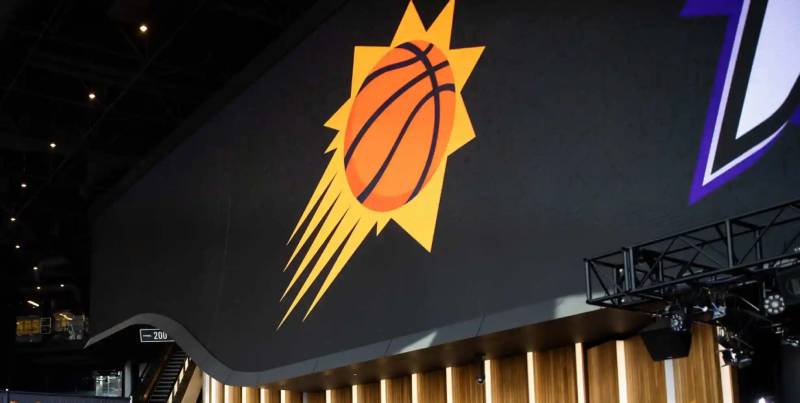
The Phoenix Suns logo features a basketball positioned at the center of a sunburst with radiating spikes, enclosed in a black badge. Introduced in its current form in 2013, the design uses purple, orange, yellow, and black colors to symbolize the Arizona sun’s intensity and the team’s competitive energy.
Design Type: Combination mark (icon with wordmark)
Primary Elements:
- Basketball with detailed seams
- Radiating sunburst spikes
- Black badge-shaped container
- “PHOENIX SUNS” wordmark in gray
Official Introduction Date: Current version launched for the 2013-2014 season
Original Designer: Stan Fabe (1968 original logo)
Rebranding Designer: Tom O’Grady (1992 “Streaking Sun” redesign)
Trademark Status: Registered trademark of Phoenix Suns LLC
Color Palette:
- Purple: #1D1160 (Pantone PMS 275 C)
- Orange: #E56020 (Pantone PMS 159 C)
- Yellow: #F9AD1B (Pantone PMS 137 C)
- Dark Orange: #B95915 (Pantone PMS 1675 C)
- Black: #000000 (Pantone PMS Process Black C)
- Gray: #63727A (Pantone PMS 431 C)
Usage Context: Jerseys, court design, merchandise, marketing materials, digital platforms, official team communications
How Has the Phoenix Suns Logo Evolved Over Time?
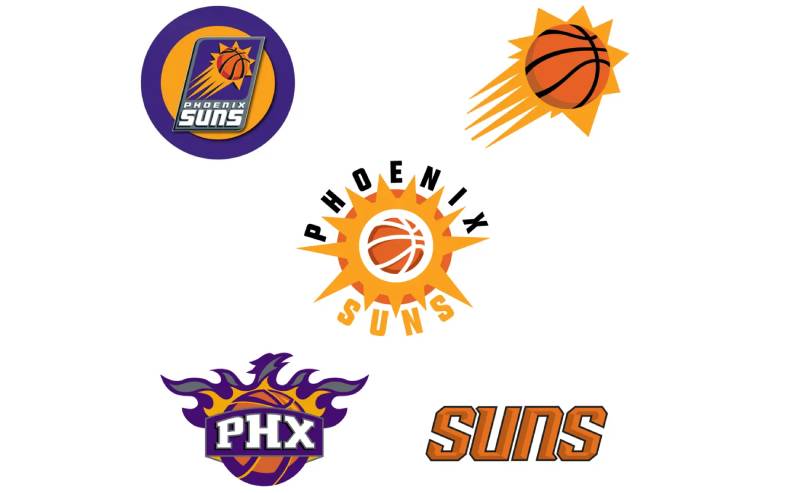
The Phoenix Suns have redesigned their primary logo four times since 1968. Each version maintained the basketball-as-sun concept while adapting to contemporary design trends.
The franchise has consistently used variations of purple and orange throughout its history. These colors became synonymous with Phoenix basketball culture.
Original Phoenix Suns Logo (1968-1992)
Years Active: 1968-1992
Design Description: A sunburst basketball with flame-like spikes extending to the right, contained within a red rectangular frame
Color Scheme: Gold basketball with white border, red frame, purple and white text
Designer: Stan Fabe, a Tucson-based commercial printer
Context: Created for the NBA expansion franchise’s debut season. Fabe won just $200 for the design that would become one of basketball’s most enduring emblems.
Key Features: The wordmark “PHOENIX” appeared above the sun graphic, while “SUNS” sat below. The lowercase “n” in both words created a distinctive typographic signature.
Cultural Significance: This logo represented the franchise during its first NBA Finals appearance in 1976 and the early success with Dick Van Arsdale and Paul Westphal.
Streaking Sun Logo (1992-2000)
Years Active: 1992-2000
Design Description: A dynamic sunburst with horizontal motion blur effect, featuring gradient transitions from yellow to orange to red
Color Scheme: Purple badge background, gradient sun (yellow to orange to red), smaller wordmark beneath
Designer: Tom O’Grady, NBA’s first Creative Director and founder of Gameplan Creative
Context: Introduced alongside the team’s move to America West Arena. This redesign coincided with Charles Barkley’s arrival and represented a revolutionary approach to sports branding.
Key Changes from Previous: Introduced gradient technology (new to sports logos), added purple as dominant color, modernized typography, created horizontal movement
Cultural Significance: This era marked the team’s 1993 NBA Finals run. O’Grady’s design was among the first to use Adobe Photoshop and digital gradient techniques in professional sports branding.
The design broke traditional sports logo design principles by embracing computer-generated effects. It influenced an entire generation of team identity work across leagues.
Refined Streaking Sun (2000-2013)
Years Active: 2000-2013
Design Description: Enhanced version of the 1992 logo with added dimensional effects, shadows, and refined color transitions
Color Scheme: Purple badge with gray and black outline, gradient orange basketball with black seams, shadow effects on lettering
Designer: In-house refinement of O’Grady’s original concept
Context: Updated to take advantage of improved printing and digital display technologies. The Steve Nash era brought this logo international recognition.
Key Changes from Previous: Added dimensional shadows to text, refined basketball detail, introduced gray accent color, enhanced gradient smoothness
Cultural Significance: This logo represented the “Seven Seconds or Less” offense under Mike D’Antoni. The team achieved franchise-record win totals during this period.
Current Phoenix Suns Logo (2013-Present)
Years Active: 2013-Present
Design Description: Simplified sunburst basketball on black badge with straightforward color blocking
Color Scheme: Black badge, bright orange basketball, yellow sunburst rays, gray wordmark
Designer: Phoenix Suns creative team
Context: Launched during a rebuilding phase, this design returned to simplified, bold aesthetics influenced by minimalist design trends
Key Changes from Previous: Eliminated gradients, simplified color palette, strengthened contrast, added black badge shape, made basketball more prominent
Cultural Significance: This logo represents the modern era including the 2021 NBA Finals appearance with Chris Paul, Devin Booker, and Deandre Ayton.
What Do the Design Elements of the Phoenix Suns Logo Mean?
The sunburst basketball symbolizes Phoenix’s nickname as the “Valley of the Sun” while representing athletic excellence. The radiating spikes suggest explosive energy and the team’s aggressive playing style, creating immediate visual recognition across basketball culture.
The design connects Arizona’s desert climate with competitive intensity. Phoenix experiences over 300 sunny days annually, making the sun an obvious regional identifier.
The basketball at the center grounds the logo in its sport. The detailed seams add realism while the sunburst transformation elevates it beyond generic sports imagery.
Why Did Phoenix Suns Choose These Specific Colors?
Purple (#1D1160)
This deep shade represents royalty, ambition, and power. In color psychology, purple conveys luxury and prestige.
The Suns were among the first NBA franchises to adopt purple as a primary color. This choice distinguished them from red and blue-dominated competitors.
Orange (#E56020)
The dominant orange captures Arizona’s intense desert sunsets and relentless heat. This vibrant hue communicates energy, enthusiasm, and warmth.
Orange creates immediate visual impact and high visibility on courts and television broadcasts. The color suggests movement and excitement.
Yellow (#F9AD1B)
Bright yellow represents sunshine, optimism, and the team’s namesake. This accent color adds brightness and positive energy to the overall palette.
The yellow-to-orange transition creates depth in the sunburst effect. This gradient adds dimension to what could be a flat design.
Black (#000000)
Black provides grounding contrast and modern sophistication. It makes the bright colors pop while adding contemporary edge to the design.
The black badge shape creates clear boundaries and improves legibility across applications. This neutral anchor prevents the warm colors from overwhelming viewers.
What Typography Style Is Used in the Phoenix Suns Logo?
The Phoenix Suns wordmark uses NBA Suns, a custom sharp serif font designed specifically for team branding. The typography features clean lines with subtle serifs that suggest both tradition and modernity.
The gray color choice for text ensures readability against the black badge. The letterforms maintain consistent weight distribution for balance.
This custom typeface appears on jerseys, player names, numbers, and all official merchandise. The design team prioritized versatility across print and digital applications.
What Are the Hidden Meanings in the Phoenix Suns Logo?
The spikes radiating from the basketball create subliminal flame imagery, connecting to the phoenix mythological bird that rises from fire. This subtle reference reinforces the team name without literal bird imagery.
The basketball’s central position suggests the sun at noon, representing peak performance and intensity. The symmetrical spike arrangement creates visual stability while implying explosive outward energy.
Designer Tom O’Grady intended the streaking effect (in earlier versions) to suggest forward momentum and unstoppable progress. The current simplified version maintains this directional energy through spike alignment.
Some fans note the spikes create a star-like pattern, suggesting championship aspirations. The black badge frames this symbolism like a badge of honor.
How Does the Phoenix Suns Logo Compare to Competitor Logos?
The Phoenix Suns logo occupies unique territory among NBA logos by combining literal representation with abstract energy. While the Los Angeles Lakers logo emphasizes purple and gold minimalism, and the Chicago Bulls logo relies on aggressive animal imagery, the Suns integrate their natural environment directly into sports symbolism.
Compared to Division Rivals:
The Golden State Warriors logo uses bridge iconography for regional identity. The Los Angeles Clippers logo features nautical themes. The Sacramento Kings logo employs royal imagery.
The Suns stand apart by making weather itself the central brand element. This approach feels less forced than animal mascots or geographic landmarks.
Color Differentiation:
Few NBA teams combine purple logos with orange logos effectively. The Utah Jazz logo also features purple but pairs it with yellow and green. The New York Knicks logo uses orange but with blue instead of purple.
This specific purple-orange combination creates instant Suns recognition. The warm color palette distinguishes them from cooler blue-dominated franchises like the Dallas Mavericks logo or Memphis Grizzlies logo.
Design Approach:
Eastern Conference teams like the Boston Celtics logo and Brooklyn Nets logo favor traditional, heritage-focused designs. Western teams like the Suns, Portland Trail Blazers logo, and Denver Nuggets logo embrace bolder, more abstract concepts.
The Suns logo’s geometric sunburst pattern shares design DNA with the Trail Blazers’ pinwheel. Both transform simple shapes into dynamic sports symbols.
What Are the Technical Specifications of the Phoenix Suns Logo?
Official Color Codes:
Primary Purple:
Primary Orange:
- Pantone: PMS 159 C
- Hex: #E56020
- RGB: (229, 95, 32)
- CMYK: (0, 75, 100, 5)
Accent Yellow:
- Pantone: PMS 137 C
- Hex: #F9AD1B
- RGB: (249, 160, 27)
- CMYK: (0, 43, 100, 0)
Dark Orange:
- Pantone: PMS 1675 C
- Hex: #B95915
- RGB: (185, 89, 21)
- CMYK: (0, 67, 100, 28)
Black:
- Pantone: PMS Process Black C
- Hex: #000000
- RGB: (6, 25, 34)
- CMYK: (30, 0, 0, 100)
Gray:
- Pantone: PMS 431 C
- Hex: #63727A
- RGB: (99, 113, 122)
- CMYK: (15, 0, 0, 65)
Light Gray:
- Pantone: PMS COOL GRAY 5 C
- Hex: #BEC0C2
- RGB: (190, 192, 194)
- CMYK: (0, 0, 0, 29)
Dimensions and Proportions:
The logo maintains a roughly 1:1 aspect ratio for primary applications. The sunburst extends beyond the basketball circle at consistent angles.
Minimum Size Requirements:
Digital applications require minimum 32px height for clear visibility. Print applications need minimum 0.5 inch height to maintain detail in basketball seams and spike definition.
Clear Space Specifications:
Maintain clear space equal to the height of the “S” in “SUNS” on all sides. This prevents visual crowding when used alongside other design elements.
Official Usage Guidelines:
The logo should not be recolored, rotated, distorted, or modified. Always use official files from team resources. Maintain proper DPI (300 for print, 72 for web).
What Cultural Impact Has the Phoenix Suns Logo Had?
The Phoenix Suns logo influenced sports branding by pioneering digital gradient techniques in the 1990s. Tom O’Grady’s 1992 redesign demonstrated how computer-generated effects could create modern, dynamic team identities.
This approach spread across professional sports. Teams recognized that technology enabled fresh visual directions beyond traditional illustrated mascots.
The purple and orange combination became deeply embedded in Phoenix culture. Local businesses, schools, and organizations adopted similar palettes to connect with regional pride.
The logo appears in streetwear collaborations, vintage jersey collections, and contemporary fashion. The 1990s “Streaking Sun” era particularly resonates with collectors seeking authentic period pieces.
How Does the Phoenix Suns Logo Fit Into the Overall Brand Identity?
The logo serves as the cornerstone of a comprehensive brand system that includes court design, uniform variations, and marketing materials. The sunburst appears across multiple touchpoints reinforcing consistent visual recognition.
The team’s “Valley” alternate branding expands on desert themes while maintaining core color relationships. These variations allow fresh expressions without abandoning established equity.
Brand guidelines specify precise color usage, typography elements, and spacing requirements. This ensures unity across partnerships, merchandise, and digital platforms.
The Suns maintain visual hierarchy by making the primary logo most prominent. Secondary marks and alternate logos support specific applications without competing for attention.
How Should the Phoenix Suns Logo Be Used?
Official Usage Do’s:
- Always use approved logo files from official sources
- Maintain proper proportions and clear space
- Apply correct color specifications for each medium
- Use appropriate file formats (vector graphics for print, PNG for web)
- Follow print design standards for physical materials
Official Usage Don’ts:
- Don’t alter colors or apply custom color schemes
- Don’t rotate, skew, or distort the logo proportions
- Don’t add effects like shadows, glows, or outlines
- Don’t use low-resolution files that appear pixelated
- Don’t place the logo on busy backgrounds that reduce visibility
Where to Access Official Logos:
The Phoenix Suns provide official logo files through their media relations department. Approved partners receive access to complete brand asset libraries.
Licensing Information:
The Phoenix Suns logo is a registered trademark. Commercial use requires licensing agreements through NBA Properties. Editorial and news coverage typically falls under fair use provisions.
Fan-created content for personal use generally receives more flexibility. Commercial merchandise or business applications need explicit permission.
Trademark Protection Details:
Phoenix Suns LLC owns all trademark rights. The NBA maintains additional trademark interests as the league governing body. Unauthorized commercial use may result in legal action.
FAQ About the Phoenix Suns Logo
When was the Phoenix Suns logo created?
The original Phoenix Suns logo debuted in 1968 when the franchise joined the NBA as an expansion team. Stan Fabe designed this first version for $200. The current logo iteration launched for the 2013-2014 season, representing the fourth major redesign in franchise history.
Who designed the Phoenix Suns logo?
Stan Fabe, a Tucson commercial printer, designed the original 1968 Phoenix Suns logo. Tom O’Grady, the NBA’s first Creative Director, created the revolutionary 1992 “Streaking Sun” redesign. The Phoenix Suns internal creative team developed the current 2013 version, simplifying earlier concepts into a bold, contemporary mark.
What do the colors in the Phoenix Suns logo mean?
Purple represents ambition and royalty, distinguishing the Suns among NBA franchises. Orange captures Arizona’s intense desert sun and team energy. Yellow adds brightness and optimism. Black provides modern sophistication and strong contrast. Together, these colors create the distinctive Phoenix identity recognized worldwide.
How many times has the Phoenix Suns logo been redesigned?
The Phoenix Suns have redesigned their primary logo four times: 1968 (original), 1992 (Streaking Sun), 2000 (refined gradient), and 2013 (current simplified version). Each iteration maintained the basketball-as-sun concept while adapting to contemporary design trends and technological capabilities in sports branding.
Where can I download the official Phoenix Suns logo?
Official Phoenix Suns logos are available through the team’s media relations department for approved editorial and commercial use. PNG and vector graphics formats exist for different applications. The NBA also provides logo resources through their official channels for licensed partners and media outlets.
Is the Phoenix Suns logo trademarked?
Yes, the Phoenix Suns logo is a registered trademark owned by Phoenix Suns LLC and protected under NBA Properties. The design cannot be used commercially without proper licensing. Editorial and news organizations typically operate under fair use guidelines, but commercial applications require explicit permission.
What font is used in the Phoenix Suns logo?
The Phoenix Suns logo uses NBA Suns, a custom serif font created specifically for team branding. This typeface appears on jerseys, merchandise, and all official communications. The sharp, clean letterforms balance traditional and modern design characteristics for versatile application across media.
Why did Phoenix Suns choose a sunburst for their logo?
The Phoenix Suns chose a sunburst to represent the city’s nickname “Valley of the Sun” and Arizona’s famous sunny weather. Phoenix experiences over 300 sunny days annually. The sun symbolizes energy, warmth, and intensity while creating immediate geographic association. The basketball integration makes the sports connection explicit.
Conclusion
The Phoenix Suns logo represents over five decades of basketball tradition combined with innovative design evolution. From Stan Fabe’s original $200 creation to Tom O’Grady’s gradient revolution to today’s simplified sunburst, this emblem demonstrates how sports branding adapts while preserving core identity.
The distinctive purple and orange color palette, sunburst basketball symbolism, and connection to Arizona’s desert climate create immediate recognition. As the franchise continues competing for championships, this visual identity remains one of professional basketball’s most recognizable marks.
The logo’s journey from hand-drawn illustration to computer-generated gradients to modern minimalism mirrors broader trends in sports design. Yet through each iteration, the Suns maintained their essential character, proving that strong brand foundations allow creative evolution without losing authenticity.

Renowned for his expertise in logo design and visual branding, Bogdan has developed a multitude of logos for various clients.
His skills extend to creating posters, vector illustrations, business cards, and brochures. Additionally, Bogdan's UI kits were featured on marketplaces like Visual Hierarchy and UI8.
He also wrote in the past years on sites like Design Your Way, WebDesignerDepot, WPDean, Designmodo, Speckyboy, Slider Revolution, and more.
- The Windsurf Logo History, Colors, Font, And Meaning - 10 October 2026
- How to Remove Background From Product Photos (No Photoshop) - 10 October 2026
- How Designers can Build a Stronger Online Creative Identity - 9 October 2026

Bogdan Sandu is a seasoned designer who has been designing websites since 2008. Renowned for his expertise in logo design and visual branding, Bogdan has developed a multitude of logos for various clients. His skills extend to creating posters, vector illustrations, business cards, and brochures. Additionally, Bogdan's UI kits were featured on marketplaces like Visual Hierarchy and UI8. He also wrote in the past years on sites like Design Your Way, WebDesignerDepot, WPDean, Designmodo, Speckyboy, Slider Revolution, and more.
You Might Also Like