The Boston Celtics logo represents one of the NBA’s most successful franchises, featuring Lucky the Leprechaun spinning a basketball on his finger while leaning on a cane. Designed originally by Zang Auerbach in the early 1950s, this mascot-based emblem has become a defining symbol of professional basketball branding.
Founded in 1946 as one of the original NBA teams, the Celtics have maintained strong Irish heritage in their visual identity across six major logo iterations. The current full-color version, introduced in 1996 for the franchise’s 50th anniversary, combines green, gold, brown, black, and white in a circular composition that balances tradition with modern athletic branding.
What is the Boston Celtics Logo?
The Boston Celtics logo is a mascot-based emblem featuring Lucky the Leprechaun spinning a basketball while leaning on a shillelagh, set within a green circular frame with white lettering. Introduced by Zang Auerbach in the early 1950s, the design incorporates Irish symbolism through shamrock details and traditional leprechaun imagery.
Design Type: Mascot-based combination mark with circular wordmark frame
Primary Elements:
- Lucky the Leprechaun character
- Basketball balanced on raised finger
- Traditional Irish shillelagh (walking stick)
- Circular green frame with “BOSTON CELTICS” wordmark
- Shamrock details on vest, bow tie, and hat
- Pipe detail (present in most versions)
Official Introduction Date: Early 1950s (original leprechaun version), 1996 (current full-color version)
Designer: Zang Auerbach, brother of legendary coach Red Auerbach
Trademark Status: Registered trademark of Boston Basketball Partners LLC
Color Palette:
- Celtics Green: #007A33 (Pantone PMS 356 C)
- Celtics Gold: #BA9653 (Pantone PMS 874 C)
- Celtics Brown: #963821 (Pantone PMS 174 C)
- White: #FFFFFF
- Black: #000000 (Pantone PMS Black 6 C)
Usage Context: Team uniforms, court markings, merchandise, digital platforms, marketing materials, championship banners, and fan apparel. The logo appears on everything from jerseys to TD Garden’s parquet floor.
How Has the Boston Celtics Logo Evolved Over Time?
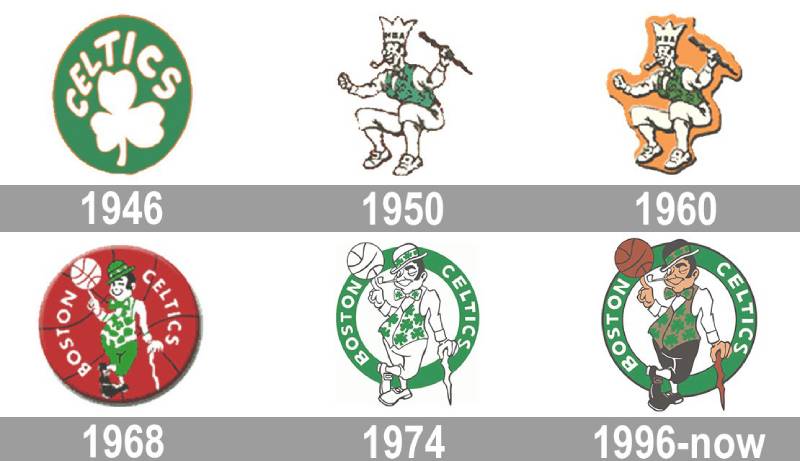
The Boston Celtics emblem has transformed from a simple shamrock to a detailed leprechaun character through six distinct versions spanning nearly eight decades. Each redesign reflected both the team’s championship success and shifts in sports branding standards while maintaining consistent Irish cultural references.
Original Boston Celtics Logo (1946-1950)
Years Active: 1946-1950
Design Description: Simple circular badge with white shamrock centered inside a green circle, arched “CELTICS” wordmark above in rounded sans-serif lettering
Color Scheme: Green, white, and thin gold outline
Designer: Unknown
Context: Created during the team’s founding as one of the original NBA franchises, chosen by Boston Garden owner Walter Brown to honor the city’s Irish population
Key Features: Minimalist approach typical of 1940s sports branding, direct reference to Original Celtics team from New York (1914-1930)
Cultural Significance: Established immediate connection to Boston’s Irish-American community and basketball heritage
First Leprechaun Logo (1950-1968)
Years Active: 1950-1968
Design Description: Jumping leprechaun character wearing crown-hat with “NBA” lettering, holding oak cane and smoking pipe
Color Scheme: Initially green and white (1950-1961), orange/gold background added (1961-1968)
Designer: Zang Auerbach
Context: Introduced as team gained popularity under coach Red Auerbach, coinciding with Bill Russell era and championship dominance
Key Changes from Previous: Replaced static shamrock with animated character, added personality and movement to brand identity
Cultural Significance: Personified the team’s Irish heritage through folklore character, created memorable mascot during eight consecutive championship run (1959-1966)
Standing Leprechaun on Red Basketball (1968-1976)
Years Active: 1968-1976
Design Description: Leprechaun spinning basketball on finger while leaning on cane, winking and smiling with pipe, placed on red basketball background with “BOSTON CELTICS” wordmark circling the perimeter
Color Scheme: Green, white, black leprechaun on red/orange basketball background
Designer: Refinement of Zang Auerbach’s original concept
Context: Redesigned during transition period after eight consecutive championships, crown replaced with Irish derby hat
Key Changes from Previous: Static pose replaced jumping action, added basketball-spinning gesture showing athletic skill, three-dimensional basketball background
Cultural Significance: Became the foundational template for all future versions, introduced the iconic pose still used today
Green Circle Version (1976-1996)
Years Active: 1976-1996
Design Description: Leprechaun spinning basketball, leaning on cane with same pose, placed within green circular frame replacing red basketball background
Color Scheme: Green, white, and black only
Designer: In-house refinement
Context: Debuted during Larry Bird era championships (1981, 1984, 1986), became synonymous with 1980s Celtics dominance
Key Changes from Previous: Eliminated red basketball background, introduced clean green circle with white wordmark, refined leprechaun’s facial features and clothing details for sharper reproduction
Cultural Significance: Most recognized version among fans, associated with Bird-McHale-Parish dynasty and Celtics-Lakers rivalry, used during franchise’s peak popularity
Full-Color 50th Anniversary Version (1996-Present)
Years Active: 1996-Present
Design Description: Same leprechaun pose with detailed full-color treatment including skin tones, shaded clothing, and natural color palette
Color Scheme: Celtics green, gold, brown, black, white, with tan skin tones
Designer: Updated by Celtics design team
Context: Introduced to celebrate franchise’s 50th anniversary, marked transition to modern digital-era branding standards
Key Changes from Previous: Added skin tone to face and hands, gold accents on vest/bow tie/hat, brown shading on basketball and shillelagh, black pants and shoes, increased detail and depth
Cultural Significance: Current version reflects both tradition and contemporary athletic branding, maintains historical elements while meeting modern reproduction standards across digital and print platforms
Alternate Shamrock Logo (1998-Present)
Years Active: 1998-Present (secondary logo)
Design Description: White shamrock with “CELTICS” wordmark above, enclosed in green circle, based on 1946 original design
Color Scheme: Green and white (also black and white version)
Context: Reintroduced as secondary mark for cleaner applications where detailed leprechaun doesn’t reproduce well
Usage: Appears on warmup jackets, alternate jerseys, minimalist merchandise, and simplified branding applications
What Do the Design Elements of the Boston Celtics Logo Mean?
The leprechaun character embodies Irish folklore traditions while the basketball-spinning gesture represents athletic excellence and showmanship. Shamrock details reference both Boston’s Irish heritage and traditional symbols of luck, fortune, and Celtic pride that resonate throughout the franchise’s championship history.
The character’s confident pose with one eye winking suggests playful competitiveness. His cane (shillelagh) connects to Irish cultural artifacts while serving as a visual anchor for the composition’s balance.
The circular frame creates unity while the wordmark placement follows principles of alignment that ensure readability at any size. The basketball positioned above establishes a clear focal point that draws attention upward through the composition.
Why Did Boston Celtics Choose These Specific Colors?
Celtics Green (#007A33) serves as the primary brand color representing growth, vitality, and Irish heritage. In color psychology, green evokes balance and renewal while differentiating the Celtics from red and blue-dominated NBA branding.
The shade was chosen by Zang Auerbach to honor Boston’s Irish population.
Gold accents (#BA9653) add warmth and suggest championship excellence, appearing on the vest, bow tie, and hat to create contrast against green elements. Brown tones (#963821) provide natural depth for the basketball and cane, grounding the character with earthy authenticity.
Black and white create sharp definition, with black outlines ensuring visibility across backgrounds and white elements providing breathing room. This color palette balances tradition with modern athletic branding requirements.
What Typography Style Is Used in the Boston Celtics Logo?
The “BOSTON CELTICS” wordmark uses a custom sans-serif font with bold, blocky letterforms that prioritize legibility from arena distances. The typography features consistent stroke width and tight tracking to maximize readability.
Capital letters follow a circular baseline grid that mirrors the logo’s shape, creating rhythm through repeated curves. The typeface conveys strength and durability, matching the franchise’s enduring success.
While appearing similar to block athletic fonts, the lettering was hand-drawn specifically for the Celtics brand, ensuring unique character shapes that can’t be replicated exactly.
What Are the Hidden Meanings in the Boston Celtics Logo?
The winking eye creates personal connection with fans while suggesting confidence and insider knowledge. The pipe, present in most versions, references traditional Irish culture and leisure, though sometimes removed in certain applications for contemporary sensibilities.
Three shamrocks appear on the vest, representing the triple-leaf clover’s symbolic meaning of faith, hope, and love in Irish tradition. The upward-pointing finger with basketball suggests aspirational excellence and upward movement through competitive ranks.
The crossed-foot stance adds personality while maintaining symmetry in the overall composition. Designer intent focused on creating approachable yet competitive character that embodied both Boston’s cultural identity and basketball prowess, avoiding intimidation while projecting championship confidence.
How Does the Boston Celtics Logo Compare to Competitor Logos?
The Boston Celtics stand alone among NBA logos with a fully-illustrated character-based design, while most competitors use abstract symbols or simplified mascots. The leprechaun’s detailed rendering contrasts sharply with the minimalist approaches of the Golden State Warriors logo or Miami Heat logo.
Eastern Conference rivals like the New York Knicks logo use geometric simplicity, while the Philadelphia 76ers logo employs patriotic symbolism.
The Celtics share character-based approaches with the Chicago Bulls logo, though the Bulls’ aggressive animal contrasts with Lucky’s playful persona. The Los Angeles Lakers logo uses simple wordmark styling, while the Milwaukee Bucks logo features wildlife imagery.
Among green logos in sports, the Celtics’ shade and shamrock details distinguish them from teams like the Milwaukee Bucks who use green differently. The combination of character illustration with cultural symbolism creates unique positioning that few sports brands attempt with such complexity.
What Are the Technical Specifications of the Boston Celtics Logo?
Official Color Codes:
Primary Color: Celtics Green
Secondary Color: Celtics Gold
- Hex: #BA9653
- RGB: (139, 111, 78)
- CMYK: (30, 40, 80, 0)
- Pantone: PMS 874 C
Tertiary Color: Celtics Brown
- Hex: #963821
- RGB: (150, 56, 33)
- CMYK: (40, 95, 100, 0)
- Pantone: PMS 174 C
Supporting Color: White
- Hex: #FFFFFF
- RGB: (255, 255, 255)
- CMYK: (0, 0, 0, 0)
Supporting Color: Black
- Hex: #000000
- RGB: (0, 0, 0)
- CMYK: (0, 0, 0, 100)
- Pantone: PMS Black 6 C
Dimensions and Proportions:
The logo maintains a circular aspect ratio with leprechaun figure occupying approximately 65% of interior space. Minimum reproduction size is 0.5 inches diameter for print applications to maintain detail clarity.
DPI requirements follow standard 300 DPI for print design and 72 DPI for web design applications.
Clear space specifications require minimum buffer of 10% of logo diameter on all sides to prevent visual crowding. When used alongside other elements, maintain proximity spacing that doesn’t compromise the mark’s readability.
The design works as both vector graphics for scalability and bitmap formats like JPEG for specific applications, though vector formats are preferred for professional reproduction.
What Cultural Impact Has the Boston Celtics Logo Had?
Lucky the Leprechaun has transcended sports branding to become a cultural icon representing Boston’s Irish heritage and basketball excellence globally. The mascot appears in popular media, merchandise collections, and casual conversation as shorthand for NBA championship tradition and Celtic pride.
The logo’s longevity (over 70 years) demonstrates rare brand consistency in professional sports. It influenced subsequent NBA mascot designs while maintaining distinctiveness that newer teams struggle to replicate.
Its recognition extends beyond basketball fans, appearing in fashion collaborations, art installations, and cultural references. The green and white color scheme has become synonymous with Boston sports identity alongside the Red Sox and Bruins.
The leprechaun character helped normalize cultural mascots in American sports while celebrating specific ethnic heritage, paving the way for other culturally-specific team identities. Its playful approach to competition influenced how sports brands communicate personality through visual identity.
How Does the Boston Celtics Logo Fit Into the Overall Brand Identity?
The leprechaun serves as the cornerstone of comprehensive brand architecture that includes alternate shamrock marks, championship banner designs, and court floor patterns. The TD Garden’s famous parquet flooring creates texture that complements the logo’s detailed illustration through shared emphasis on craftsmanship.
Brand guidelines specify Lucky’s usage across jerseys, marketing materials, digital platforms, and packaging design for licensed products. The visual hierarchy places the primary logo at the top, followed by shamrock alternates and wordmarks.
The franchise maintains brand style guide consistency through approved color specifications, spacing rules, and reproduction standards. This ensures repetition of core elements across touchpoints from arena signage to social media graphics.
Special edition uniforms incorporate logo elements while exploring variety through alternative colorways and placements. City Edition jerseys have featured shamrock details, leprechaun silhouettes, and championship references that extend the logo’s design language while allowing creative emphasis on specific seasons or achievements.
How Should the Boston Celtics Logo Be Used?
Official Usage Guidelines:
DO maintain proper clear space around logo in all applications. DO use approved color specifications from official print color profile documents.
DO scale proportionally to avoid distortion. DO place on backgrounds that provide sufficient contrast for visibility.
DON’T alter colors, rotate, or distort logo proportions. DON’T add effects like drop shadows, outlines, or gradients.
DON’T place logo over busy backgrounds that compromise legibility. DON’T separate wordmark from leprechaun character.
Official Logo Access:
The Boston Celtics official website provides approved logo files for media use. Licensed partners receive vector graphics through official channels with proper documentation.
For commercial use, contact Boston Basketball Partners LLC for licensing agreements and approved file formats. Educational and editorial use follows fair use guidelines with proper attribution.
Licensing Information:
The Boston Celtics logo is a registered trademark protected under U.S. trademark law. Commercial reproduction requires licensing agreements through the Celtics organization or NBA Properties.
Licensed merchandise manufacturers receive access to approved artwork files with specific usage parameters. Unauthorized commercial use faces legal action for trademark infringement.
Trademark Protection:
Boston Basketball Partners LLC actively defends trademark rights for the leprechaun design and associated wordmarks. The green color, character design, and overall composition receive protection under intellectual property law.
Registration extends across multiple trademark classes covering apparel, entertainment services, and digital media. The franchise monitors unauthorized use and pursues enforcement actions when necessary to maintain brand integrity.
FAQ About the Boston Celtics Logo
When was the Boston Celtics logo created?
The original shamrock logo was created in 1946 when the team was founded. The iconic Lucky the Leprechaun character was introduced in the early 1950s by Zang Auerbach, brother of legendary coach Red Auerbach. The current full-color version debuted in 1996 during the franchise’s 50th anniversary celebration, adding skin tones and gold, brown, and black details to the previous green-and-white design.
Who designed the Boston Celtics logo?
Zang Auerbach designed the Lucky the Leprechaun logo in the early 1950s. Zang was the brother of Red Auerbach, who served as the team’s head coach during their championship dynasty years. The original 1946 shamrock logo’s designer remains unknown. The 1996 full-color update was executed by the Celtics’ in-house design team to commemorate the team’s 50th anniversary.
What do the colors in the Boston Celtics logo mean?
Celtics green represents Irish heritage, growth, and renewal while distinguishing the team from red and blue-dominated NBA branding. Gold accents symbolize championship excellence and prestige. Brown tones provide natural authenticity for the basketball and cane elements. Black creates definition and ensures visibility, while white offers contrast and breathing room. Together, these colors balance tradition with athletic performance values in professional basketball.
How many times has the Boston Celtics logo been redesigned?
The Boston Celtics logo has undergone six major redesigns since 1946. The progression includes the original shamrock (1946-1950), first jumping leprechaun (1950-1968), standing leprechaun on red basketball (1968-1976), green circle version (1976-1996), full-color 50th anniversary edition (1996-present), and reintroduced shamrock alternate (1998-present). Each version maintained core Irish symbolism while adapting to branding standards of its era.
Where can I download the official Boston Celtics logo?
Official Boston Celtics logo files for media and editorial use are available through the team’s official website media resources section. Licensed commercial partners receive approved artwork through NBA Properties or direct team licensing agreements. Unauthorized commercial use violates trademark protections. For commercial licensing inquiries, contact Boston Basketball Partners LLC through their official channels. High-resolution files require proper authorization based on intended usage.
Is the Boston Celtics logo trademarked?
Yes, the Boston Celtics logo is a registered trademark owned and protected by Boston Basketball Partners LLC. The leprechaun character, wordmarks, color combinations, and overall design composition receive trademark protection under U.S. intellectual property law. Commercial reproduction requires licensing agreements. The franchise actively enforces trademark rights and pursues legal action against unauthorized commercial use. Registration covers multiple classes including apparel, entertainment services, and digital media applications.
What font is used in the Boston Celtics logo?
The “BOSTON CELTICS” wordmark uses a custom hand-drawn sans-serif typeface created specifically for the team rather than a standard commercial font. The lettering features bold, blocky letterforms with consistent stroke width optimized for arena visibility and reproduction across various media. While similar to athletic block fonts, the exact typeface cannot be replicated because it was designed uniquely for the Celtics brand identity without public distribution.
Why did Boston Celtics choose a leprechaun for their logo?
The leprechaun symbolizes Boston’s large Irish-American population and pays homage to the city’s strong Celtic heritage. Team founder Walter Brown chose the “Celtics” name in 1946 to honor Boston’s Irish community and reference the Original Celtics, a successful team from the 1920s. Zang Auerbach designed Lucky the Leprechaun in the early 1950s to personify this heritage through a recognizable character from Irish folklore, adding personality and cultural connection to the brand.
Conclusion
The Boston Celtics logo represents athletic branding excellence through its character-driven design featuring Lucky the Leprechaun. Created by Zang Auerbach in the early 1950s and refined through six iterations, this mascot-based emblem balances Irish cultural symbolism with championship tradition across professional basketball’s most successful franchise.
Key attributes include the detailed leprechaun character spinning a basketball, circular green frame with white wordmark, and full-color palette introduced in 1996. The design demonstrates rare longevity and consistency while adapting to modern reproduction standards.
Within NBA branding, the Celtics logo stands apart through its illustrated character approach and cultural specificity. Its influence extends beyond sports into popular culture, representing both Boston identity and basketball excellence globally. The mark’s detailed craftsmanship and symbolic depth establish it as one of professional sports’ most recognizable and enduring visual identities.
As the Celtics continue adding championships to their legacy, Lucky the Leprechaun remains the franchise’s visual ambassador, connecting past dynasties with future generations of fans.
If you liked this article about the Boston Celtics logo, you should check out this article about the Portland Trail Blazers logo.
There are also similar articles discussing the San Antonio Spurs logo, the New Orleans Pelicans logo, the Philadelphia 76ers logo, and the Indiana Pacers logo.
And let’s not forget about articles on the Los Angeles Clippers logo, the Oklahoma City Thunder logo, the Phoenix Suns logo, and the Charlotte Hornets logo.

Renowned for his expertise in logo design and visual branding, Bogdan has developed a multitude of logos for various clients.
His skills extend to creating posters, vector illustrations, business cards, and brochures. Additionally, Bogdan's UI kits were featured on marketplaces like Visual Hierarchy and UI8.
He also wrote in the past years on sites like Design Your Way, WebDesignerDepot, WPDean, Designmodo, Speckyboy, Slider Revolution, and more.
- The Cursor Logo History, Colors, Font, And Meaning - 24 September 2026
- Top 7 Web Design Subscription Services That Replace Full-Time Hires - 24 September 2026
- Canva vs PowerPoint: Which Is Better for Presentations? - 22 September 2026

Bogdan Sandu is a seasoned designer who has been designing websites since 2008. Renowned for his expertise in logo design and visual branding, Bogdan has developed a multitude of logos for various clients. His skills extend to creating posters, vector illustrations, business cards, and brochures. Additionally, Bogdan's UI kits were featured on marketplaces like Visual Hierarchy and UI8. He also wrote in the past years on sites like Design Your Way, WebDesignerDepot, WPDean, Designmodo, Speckyboy, Slider Revolution, and more.
You Might Also Like