The Dropbox logo is one of the most recognized symbols in cloud computing. It stands for simplicity, file storage, and digital collaboration. And honestly, for something that started as a quick sketch by an MIT student, it’s aged pretty well.
Drew Houston and Arash Ferdowsi founded Dropbox in 2007. The company launched publicly in 2008 at TechCrunch Disrupt. Since then, the logo has gone through about five distinct versions, each one stripping away detail and moving toward something cleaner. The current mark, introduced in 2017 through a collaboration with design agency Collins, features five flat diamond shapes arranged to suggest an open box. It replaced the more literal 3D box icon that had been around since the beginning.
Today, the Dropbox logo sits at the intersection of tech branding and minimalist design. It communicates trust, openness, and creative collaboration without saying a word. Your mileage may vary on whether the 2017 rebrand was a hit. But there’s no denying it made people talk.
What Is the Dropbox Logo?
The Dropbox logo is a combination mark featuring an abstract open-box glyph made of five diamond shapes alongside a lowercase wordmark set in Sharp Grotesk. It was redesigned in October 2017 by Collins and the Dropbox Brand Studio. The symbol represents openness, collaboration, and secure file storage.
Design Type: Combination mark (abstract icon plus wordmark)
Primary Elements: The glyph consists of five flat rhombus (diamond) shapes arranged to form an abstracted open box. A sixth diamond appears in the negative space between the four outer shapes, which is a nice little detail most people miss. The wordmark sits to the right of the glyph.
Official Introduction Date: The original logo launched in 2008. The current version debuted in October 2017.
Designer/Agency: The original 2008 logo was created by Jon Ying, a friend of co-founder Drew Houston. The 2017 redesign was handled by Collins (New York-based design studio) working alongside the Dropbox in-house Brand Studio, with support from studios Instrument, XXIX, Sharp Type, and Animade.
Trademark Status: The Dropbox name and logo are registered trademarks owned by Dropbox, Inc. All brand materials fall under their Terms of Service and official branding guidelines. Third parties need written approval from brand@dropbox.com for commercial use.
Color Palette:
- Dropbox Blue: #0061FE
- Graphite (wordmark): #1E1919
- Coconut (background): #F7F5F2
Usage Context: The logo appears across the Dropbox desktop app, mobile apps, website, marketing campaigns, product packaging, partnership materials, and merchandise. The glyph can be used independently as an app icon, while the full combination mark is used for high-level branding.
How Has the Dropbox Logo Evolved Over Time?
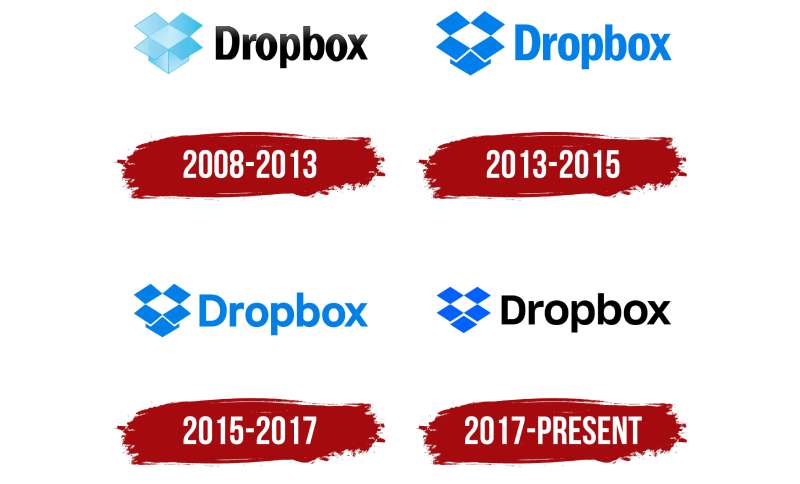
The Dropbox logo has been redesigned four times since 2008. Each version moved further away from the original realistic box illustration toward a more abstract, geometric mark.
The early versions used shading and gradient effects. Later ones went flat. The 2017 overhaul was the most dramatic shift, turning the entire brand identity upside down with new colors, a new typeface, and an abstract icon that barely resembles a box anymore.
Original Dropbox Logo (2008-2013)
Years Active: 2008 to 2013
Design Description: A detailed, three-dimensional open box rendered with gradient blue shading, placed to the left of a solid black wordmark in title case. The box had visible depth, with lid flaps open to show the interior. It looked like something you might find in an early macOS interface.
Color Scheme: Gradient blue (light to dark) for the box icon, black for the wordmark text.
Designer: Jon Ying, a friend of co-founder Drew Houston. Drew himself created the very first logotype in 2007 using Adobe Photoshop before the official version was finalized.
Context: Dropbox had just launched at TechCrunch Disrupt. The company needed something that immediately communicated “storage” and “files” to early adopters. A literal open box did exactly that. The 3D look was common in tech branding at the time, when skeuomorphism was still the default approach.
Cultural Significance: It established the open box as the core brand symbol. Even though the design has changed dramatically, every version since has kept some reference to this original concept.
Refined Dropbox Logo (2013-2015)
Years Active: 2013 to 2015
Design Description: The box became flatter and more geometric. Gone were the detailed 3D gradients. The icon shifted to a simplified, two-dimensional open box outline with flat rhomboid shapes. The wordmark switched from black to the same blue as the icon.
Color Scheme: Solid, intense blue for both icon and text. No more gradient.
Key Changes from Previous: Dropped the 3D shading entirely. The box became abstract rather than realistic. The wordmark color changed from black to blue, creating a more unified look.
Context: This was the era when flat design was taking over everything. Apple had just released iOS 7 with its flat interface, and the whole tech industry was racing to strip away skeuomorphic details. Dropbox followed suit. The redesign also signaled the company’s growing maturity, moving away from startup vibes toward something more polished.
Cultural Significance: It positioned Dropbox alongside other tech brands that were embracing flat design. The blue-on-blue wordmark and icon pairing gave the brand a more cohesive identity across platforms.
Subtle Refresh (2015-2017)
Years Active: 2015 to 2017
Design Description: The glyph got slightly smaller while the lettering was enlarged. The font changed to a sans-serif with rounder letterforms and more open spacing. Look at the “D,” “o,” “p,” and “b” in this version. The counter spaces (the holes inside letters) became noticeably wider.
Color Scheme: The blue shifted one shade lighter compared to the 2013 version.
Key Changes from Previous: More rounded typography, lighter blue tone, adjusted proportions between icon and wordmark. Subtle stuff, but it made a difference in how the brand felt at smaller sizes.
Context: Dropbox was growing fast and needed a logo that worked better across a wider range of screen sizes and contexts. The rounder letterforms improved readability on mobile, and the lighter blue felt more approachable. This was refinement, not revolution.
Cultural Significance: It showed that even small typographic adjustments can refresh a brand without confusing existing users. Most people probably didn’t even notice the change, which is actually the point of a good subtle update.
Current Dropbox Logo (2017-Present)
Years Active: 2017 to present
Design Description: Five flat diamond shapes arranged to suggest an open box, but much more abstract than any previous version. One diamond sits at the bottom, two on each upper row, and a white diamond appears in the negative space between them. The wordmark switched to Sharp Grotesk in black, placed beside the blue glyph.
Color Scheme: Dropbox Blue (#0061FE) for the glyph, Graphite (#1E1919) for the wordmark. The brand also introduced an expanded color palette with bold, contrasting combinations for marketing materials.
Designer: Collins design studio in collaboration with Dropbox Brand Studio, along with Instrument, XXIX, Sharp Type, and Animade.
Key Changes from Previous: The biggest visual overhaul in the company’s history. The icon became fully abstract. The wordmark font changed to Sharp Grotesk. The color palette expanded dramatically to include unexpected pairings beyond just blue. The entire brand identity shifted from “file storage company” to “creative collaboration platform.”
Context: Dropbox wanted to reposition itself. The company was no longer just a place to store files. They were pushing Dropbox Paper, team collaboration features, and creative tools. The old blue box made people think of cardboard boxes and shipping. The new abstract mark was meant to say “open platform” and “creative workspace” instead.
Cultural Significance: The rebrand generated massive online discussion. Not all of it was positive. Many designers criticized the bold color combinations as clashing and hard to look at. But that was partly the point. The brand wanted to provoke a reaction and position itself as something different from the safe, blue-and-white tech aesthetic that every tech company seemed to share.
What Do the Design Elements of the Dropbox Logo Mean?
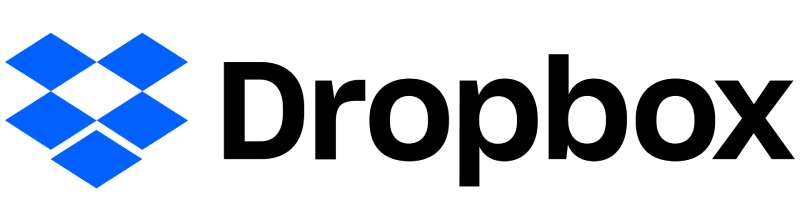
Every piece of the Dropbox logo carries a specific intention. The five diamond shapes represent an open, welcoming space for digital content.
The negative space between them creates a hidden sixth diamond shape. That’s not accidental. It represents the user, the person at the center of the platform.
The overall geometric structure suggests order and security. The openness of the box shape signals accessibility and collaboration.
Why Did Dropbox Choose These Specific Colors?
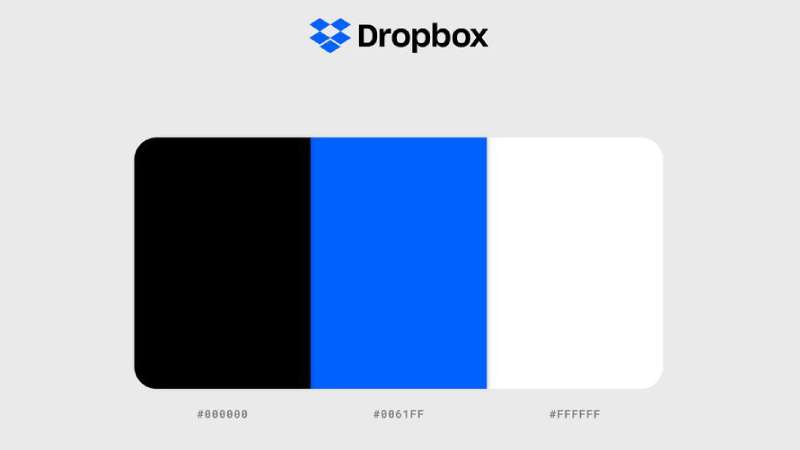
Dropbox Blue (#0061FE): This is a bright, confident shade of blue. Not the muted corporate blue you see in banking. It sits closer to what’s sometimes called “Brandeis blue.” In color psychology, blue signals trust, reliability, and security. For a company handling people’s private files, that’s not a random choice. The saturation level is high enough to feel energetic and modern rather than stuffy.
Graphite (#1E1919): The wordmark uses this near-black shade instead of pure black (#000000). It’s warmer and less harsh. It adds a touch of sophistication without the starkness that pure black creates on screen. The decision supports readability and feels more human.
Coconut (#F7F5F2): This off-white background color appears throughout Dropbox’s brand materials. It softens the overall presentation compared to using pure white. The warmth in this hue makes the brand feel more inviting and less clinical.
During the 2017 rebrand, Dropbox also introduced a wild expanded palette with bold pinks, purples, greens, and oranges. These were meant for marketing campaigns where the brand could “dial up” expressiveness. In the product itself, they kept things toned down so users could focus on their work.
What Typography Style Is Used in the Dropbox Logo?
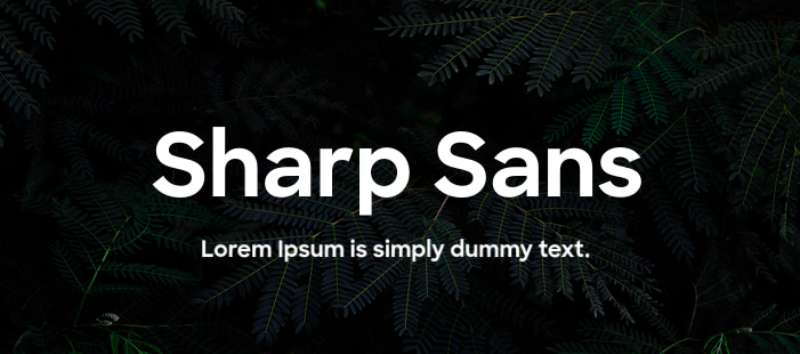
The current wordmark uses Sharp Grotesk, designed by Sharp Type foundry. It was influenced by hand-drawn poster lettering and the work of Swiss designer Adrian Frutiger.
Sharp Grotesk offers 259 fonts across various weights and widths. That range gives Dropbox the flexibility to use different typographic voices for different contexts. Most brand communications use three primary weights: Book 22, Medium 22, and Semibold 22 in roman.
Previous logo versions used a sans-serif font similar to Neue Helvetica. The switch to Sharp Grotesk was a deliberate move away from that safe, corporate feel toward something with more personality. The text is always set flush left with a ragged right edge, never centered.
What Are the Hidden Meanings in the Dropbox Logo?
The most talked-about hidden detail is the sixth diamond formed by white space between the four outer diamonds. This negative-space shape represents the collaborative center of the platform, the point where different people and their files come together.
The open-top structure of the icon suggests that the “box” is never closed. Your content is always accessible, always ready to be shared. The equal sizing of all five visible diamonds implies balance and equal access across the platform.
VP of Design Nicholas Jitkoff described the new logo as a shift from “a literal box” to “a collection of surfaces,” showing that Dropbox is an open platform rather than just a storage container.
How Does the Dropbox Logo Compare to Competitor Logos?
Cloud storage brands tend to share similar visual language. Blue is everywhere. Clean, geometric shapes dominate. But each company has carved out a slightly different visual space.
Google Drive uses a simplified triangular shape made from three colored segments (red, yellow, green, blue), tying it visually to the broader Google brand. Microsoft OneDrive features two blue clouds, leaning into the literal “cloud storage” metaphor. Apple iCloud goes with a clean cloud outline against a blue gradient background.
Box, Dropbox’s closest competitor by name and function, uses a simple green diamond shape. The visual similarity between Box and Dropbox’s glyph has been noted by designers more than once.
Where Dropbox stands apart is in its willingness to break the mold with the 2017 rebrand. While competitors stuck with safe, predictable color schemes, Dropbox went bold. The expanded palette with clashing colors, the abstract icon, the expressive typography. It was a gamble. Whether you think it paid off depends on how you feel about brands taking risks with their visual identity.
Among other blue logos in tech, Dropbox sits in a middle ground. It’s not as conservative as IBM’s logo or as playful as the Zoom logo. It occupies a space that says “we’re professional, but we’re also creative.”
What Are the Technical Specifications of the Dropbox Logo?
Official Color Codes
Primary Color – Dropbox Blue
Secondary Color – Graphite
- Hex: #1E1919
- RGB: (30, 25, 25)
- CMYK: (0, 17, 17, 88)
Background Color – Coconut
- Hex: #F7F5F2
- RGB: (247, 245, 242)
- CMYK: (0, 1, 2, 3)
Dimensions and Proportions
The Dropbox logo has two main components: the glyph and the wordmark. Official guidelines require specific spacing between these two elements. The glyph and wordmark must always appear together in the full logo lockup for high-level branding applications.
The glyph can be used separately as an app icon or when paired with additional layout elements (Dropbox calls this the “Tab” format, where the glyph sits within a colored plane). Clear space around the logo should be maintained to keep it legible and uncluttered.
According to Dropbox’s brand guidelines, the two-color version (blue glyph, black or white wordmark) should be used in most situations. The glyph color may change for special circumstances, but the wordmark stays either white or black. Corner placement or centered positioning is preferred for compositions.
What Cultural Impact Has the Dropbox Logo Had?
The 2017 Dropbox rebrand became one of the most discussed identity changes in tech branding that year. Designers were split. Some praised the boldness. Others thought the clashing color combinations looked like a design error.
But here’s the thing. People were talking about a file storage company’s visual identity. That alone is a win for brand awareness.
The rebrand pushed a conversation about whether tech companies should play it safe with predictable blue-and-white palettes, or take risks to stand out. The contrast between the old “safe” Dropbox and the new “bold” Dropbox became a case study in design schools and branding agencies.
The hidden diamond in the negative space also became a talking point. People love finding hidden details in logos, and this one delivered.
How Does the Dropbox Logo Fit Into the Overall Brand Identity?
The logo is just one piece of a larger system. Dropbox built an entire visual identity around it, including the Sharp Grotesk type family, a system of colored “planes” used in layouts, an illustration style featuring hand-drawn graphite sketches, and a flexible color system that can shift from subdued to loud depending on context.
The glyph works as a layout tool, too. When used in the “Tab” format, it sits within a colored plane and acts as the anchor point for the entire composition. Everything else on the page organizes around it.
This modular approach lets Dropbox maintain unity across wildly different applications. A product interface stays clean and focused. A marketing campaign can go loud with bold colors and expressive type. The brand style guide gives teams rules to follow while still leaving room for creativity. At least, that’s the idea.
How Should the Dropbox Logo Be Used?
Official Usage Do’s
- Use the two-color logo (blue glyph, black or white wordmark) in most situations
- Maintain proper spacing between the glyph and wordmark
- Place the logo in corner positions or centered within a composition
- Use official logo files from Dropbox’s brand resource page
- Keep clear space around the logo to avoid visual clutter
Official Usage Don’ts
- Don’t rotate or deconstruct the glyph
- Don’t stretch, distort, or fill in the glyph
- Don’t apply gradients to the logo
- Don’t outline the glyph or wordmark
- Don’t use non-system color pairings
- Don’t use center lockups (glyph stacked above wordmark) unless specifically approved
- Don’t color the logotype (wordmark stays black or white only)
- Don’t incorporate the Dropbox logo into your own logo
- Don’t use “Dropbox” or similar terms in product or domain names without permission
Where to Access Official Logos
Official brand assets are available through the Dropbox brand guidelines site at brand.dropbox.com. Developers using the Dropbox API can access approved logo files through the Developer Brand Guidelines. For any other commercial use, reach out to brand@dropbox.com.
Trademark Protection
The Dropbox name, logo, and all associated brand materials are intellectual property owned by Dropbox, Inc. Using them requires compliance with the Dropbox Terms of Service and branding guidelines. Third-party merchandise featuring the Dropbox logo is generally not permitted without explicit written approval. The word “Dropbox” should always be used as a proper adjective (capitalized) and never as a noun or verb.
FAQ on The Dropbox Logo
What does the Dropbox logo represent?
The Dropbox logo features five diamond shapes forming an abstract open box. It represents cloud storage, file sharing, and collaboration. A hidden sixth diamond appears in the negative space, symbolizing the user at the center of the platform.
Who designed the current Dropbox logo?
The current logo was created in October 2017 by Collins, a New York design studio, working with the Dropbox Brand Studio. Sharp Type, Instrument, XXIX, and Animade also contributed. The original 2008 version was designed by Jon Ying.
What font does Dropbox use in its logo?
Dropbox uses Sharp Grotesk, a sans-serif typeface created by Sharp Type foundry. It offers 259 fonts across different weights. Previous versions used a font similar to Neue Helvetica. The switch happened during the 2017 rebrand.
What are the official Dropbox logo colors?
The primary color is Dropbox Blue (#0061FE). The wordmark uses Graphite (#1E1919), a warm near-black. Coconut (#F7F5F2) serves as the background tone. The 2017 rebrand also added bold accent colors for marketing use.
How many times has the Dropbox logo changed?
The logo has gone through four major redesigns since 2008. It started as a detailed 3D box with gradient shading. Each update simplified the design further. The 2017 version was the most dramatic change in Dropbox brand identity history.
Can I use the Dropbox logo for my project?
Dropbox allows limited use under strict brand guidelines. You can link to their site using the logo. Commercial use, merchandise, or incorporating it into your own logo requires written approval from brand@dropbox.com.
Why did Dropbox change its logo in 2017?
Dropbox wanted to reposition from a file storage service to a creative collaboration platform. The old blue box felt too literal. The abstract diamond icon and expanded color palette signaled a shift toward creative professionals and team workflows.
Where can I download the official Dropbox logo?
Official logo files are available at brand.dropbox.com. Developers using the Dropbox API can access approved assets through the Developer Brand Guidelines page. All downloads must follow the company’s usage rules and trademark policies.
What is the hidden meaning in the Dropbox logo?
The four outer diamonds create a fifth diamond shape through negative space. This hidden shape represents collaboration and connection. The open-top structure suggests files are always accessible, never locked away.
How does the Dropbox logo compare to Google Drive and OneDrive?
Google Drive uses a multicolored triangle tied to its parent brand. OneDrive features two blue cloud shapes. Dropbox stands out with its abstract diamond glyph and bolder color system. All three use blue as a primary color to signal trust.
Conclusion
The Dropbox Logo tells a clear story about how a SaaS company can grow beyond its original purpose through smart visual identity choices. From a 3D open box to five abstract diamonds, each redesign tracked the company’s shift from file synchronization tool to creative workspace.
Drew Houston and Arash Ferdowsi built something that started in a dorm at MIT. The branding followed that same arc, getting sharper and more confident with each iteration.
Whether you’re studying logo design principles or planning your own brand refresh, there’s a lot to pull from how Dropbox handled its visual evolution. The lesson is simple. Don’t be afraid to break what’s working if your business has outgrown it.

Renowned for his expertise in logo design and visual branding, Bogdan has developed a multitude of logos for various clients.
His skills extend to creating posters, vector illustrations, business cards, and brochures. Additionally, Bogdan's UI kits were featured on marketplaces like Visual Hierarchy and UI8.
He also wrote in the past years on sites like Design Your Way, WebDesignerDepot, WPDean, Designmodo, Speckyboy, Slider Revolution, and more.
- The Cursor Logo History, Colors, Font, And Meaning - 24 September 2026
- Top 7 Web Design Subscription Services That Replace Full-Time Hires - 24 September 2026
- Canva vs PowerPoint: Which Is Better for Presentations? - 22 September 2026

Bogdan Sandu is a seasoned designer who has been designing websites since 2008. Renowned for his expertise in logo design and visual branding, Bogdan has developed a multitude of logos for various clients. His skills extend to creating posters, vector illustrations, business cards, and brochures. Additionally, Bogdan's UI kits were featured on marketplaces like Visual Hierarchy and UI8. He also wrote in the past years on sites like Design Your Way, WebDesignerDepot, WPDean, Designmodo, Speckyboy, Slider Revolution, and more.
You Might Also Like