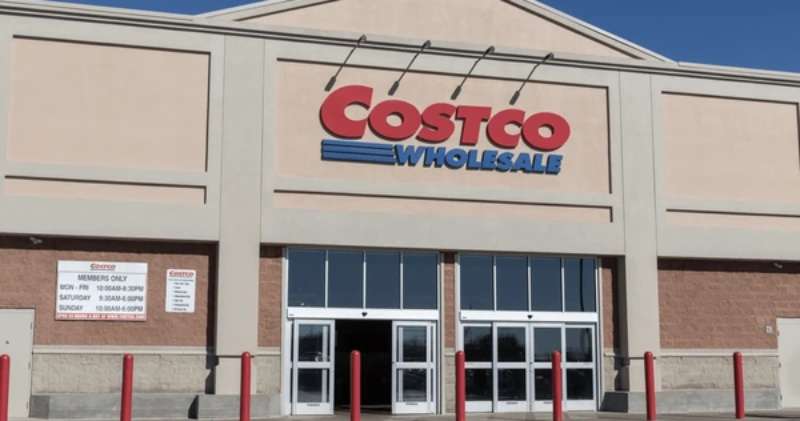
The Costco logo is a wordmark-based corporate identity representing one of the largest membership warehouse retailers in the world. It uses a bold, two-color typographic treatment that has become immediately recognizable across North America and beyond. Costco Wholesale Corporation has kept its visual identity deliberately simple, a choice that reflects the brand’s no-frills, value-driven retail model.
In the broader context of grocery and warehouse store branding, Costco’s mark stands out for its consistency and restraint. While competitors have cycled through multiple redesigns, Costco has held onto a stable visual identity for decades, making it one of the more recognizable retail marks in the Fortune 500.
The current logo is a pure wordmark. No icon, no emblem. Just the word “Costco” set in a custom-modified sans-serif style with red and blue coloring. The brand was founded in 1983 following the merger of Price Club and Costco. The logo has gone through roughly three distinct iterations since then.
What is the Costco Logo?
The Costco logo is a bold red-and-blue wordmark introduced in its current form in 1997. It uses a modified sans-serif typeface, features no standalone icon or symbol, and is trademarked by Costco Wholesale Corporation. The design communicates scale, reliability, and straightforward value.
- Design Type: Wordmark (text-only logotype)
- Primary Elements: Custom-modified sans-serif lettering split between red (“Cost”) and blue (“co”)
- Official Introduction Date: 1997 (current version); earlier versions date to 1983
- Designer/Agency: Developed internally; no single external agency is publicly credited
- Trademark Status: Registered trademark of Costco Wholesale Corporation (USPTO)
- Color Palette:
- Red: approximately #E31837
- Blue: approximately #003DA5
- Usage Context: Storefront signage, membership cards, e-commerce platform, packaging, marketing materials, uniforms, and digital platforms
How Has the Costco Logo Evolved Over Time?
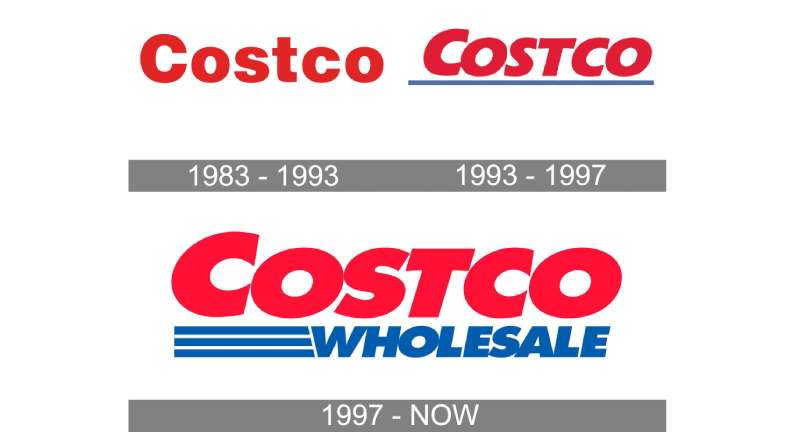
The Costco visual identity has gone through three main phases since 1983, shifting from a more complex early design to the clean, confident wordmark used today. Each change tracked closely with the company’s growth from a regional warehouse club to a global retail force.
Original Price Club / Early Costco Logo (1976-1993)
- Years Active: 1976-1993
- Design Description: The pre-merger Price Club used a simple typographic mark. Early Costco branding from 1983 featured blockier lettering with less typographic refinement.
- Color Scheme: Red and blue, though with less precise color standardization
- Designer: Not publicly credited
- Context: Costco was founded in Seattle in 1983 by James Sinegal and Jeffrey Brotman. The logo needed to signal a warehouse-scale, no-frills operation to a membership-based audience.
- Key Changes from Previous: N/A (first version)
- Cultural Significance: Reflected the utilitarian, industrial character of early warehouse retail. Function over form, essentially.
Post-Merger Transition Logo (1993-1997)
- Years Active: 1993-1997
- Design Description: After the 1993 merger of Costco and Price Club, the brand briefly operated as “Price Costco.” The logo during this period reflected the combined entity name with similar typographic styling.
- Color Scheme: Red and blue retained
- Designer: Not publicly credited
- Context: The merger created the largest membership warehouse operator in the U.S. at the time. The identity was transitional by design.
- Key Changes from Previous: Name change to “Price Costco” reflected in the wordmark
- Cultural Significance: Represented a major consolidation in the warehouse club industry, though the design itself remained unremarkable during this period.
Current Costco Wholesale Logo (1997-Present)
- Years Active: 1997-present
- Design Description: Clean, bold wordmark reading “Costco” with “Cost” in red and “co” in blue. The letterforms are tight, evenly spaced, and set in a modified sans-serif style. “Wholesale” sometimes appears as a smaller secondary line beneath.
- Color Scheme: Red (#E31837) and blue (#003DA5)
- Designer: Internal brand team; no external agency officially credited
- Context: The company rebranded fully as “Costco Wholesale Corporation” in 1997, dropping “Price” from the name entirely. The logo was updated to match.
- Key Changes from Previous: Simplified name, tighter letterforms, more consistent color application
- Cultural Significance: The logo became a shorthand for bulk value shopping. It’s now one of the most recognizable retail marks in North America.
What Do the Design Elements of the Costco Logo Mean?
The Costco logo communicates trust and scale through extremely minimal means. The two-color wordmark relies entirely on typography and color to carry the brand message, with no supporting graphic elements needed.
The split between red and blue isn’t arbitrary. It creates a subtle visual rhythm within a single word, drawing the eye across the full name while giving each half a distinct weight.
The bold letterforms signal strength and reliability. The lack of any icon or emblem reinforces the idea that Costco doesn’t need decoration. The name itself is the brand.
Why Did Costco Choose These Specific Colors?
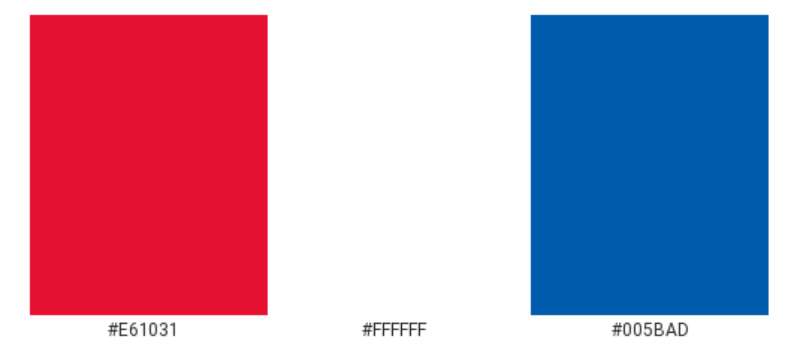
Red (“Cost”):
- Color Name: Costco Red
- Approximate Code: Hex #E31837, Pantone 186 C
- Symbolic Meaning: Energy, urgency, value
- Psychological Impact: Triggers attention and is strongly associated with deals and retail action
- Brand Connection: Red is one of the most common colors in retail brand identities precisely because of its high visibility
Blue (“co”):
- Color Name: Costco Blue
- Approximate Code: Hex #003DA5, Pantone 286 C
- Symbolic Meaning: Trust, dependability, stability
- Psychological Impact: Counters the urgency of red with a sense of calm authority. Together, they balance each other out.
- Brand Connection: Blue in brand identities is consistently linked to reliability, which fits a membership model built on long-term customer trust
What Typography Style Is Used in the Costco Logo?
The Costco wordmark uses a custom-modified sans-serif typeface. It doesn’t map cleanly to any publicly available font, though it shares structural similarities with bold grotesque styles.
The letterforms are wide, consistent in stroke weight, and set with tight spacing. There’s no italic, no script, no decorative detail. Just clean, readable type.
Readability at large scale was clearly a priority. The logo appears on massive warehouse signage, and the letterforms hold up well at any size. That said, the typography hasn’t changed significantly since 1997, which is actually a strength. Consistency over decades builds recognition.
What Are the Hidden Meanings in the Costco Logo?
There aren’t really any hidden messages here, and that’s intentional. Costco has never been a brand that plays visual games.
The one subtle element worth noting is the color split itself. “Cost” in red and “co” in blue creates a quiet word-within-a-word effect. Some read it as an implicit nod to “cost” as the core brand promise, with the blue “co” serving as a company identifier. Whether the designers intended this is unclear.
No official designer statements have been published about subliminal intent. The logo appears to be exactly what it looks like: a confident, clean wordmark built for recognition at scale.
How Does the Costco Logo Compare to Competitor Logos?
Costco’s wordmark is among the simplest in the warehouse retail category. Compared to Sam’s Club and BJ’s Wholesale Club, it uses fewer graphic elements and relies more heavily on typographic weight and color contrast to establish presence.
Sam’s Club has moved toward a more geometric, icon-driven identity in recent years. BJ’s uses a full combination mark with a starburst-style element. Costco has done neither.
Looking at broader grocery and retail store branding, chains like Walmart and Target use recognizable standalone icons alongside their wordmarks. Costco skips the icon entirely.
That restraint is actually competitive. In a category full of visual noise, a clean two-color wordmark stands out by doing less. Compare it to something like the Kroger logo or the Albertsons logo, both of which use more decorative elements, and Costco’s stripped-back approach feels notably direct.
The Trader Joe’s logo and the Whole Foods Market logo go in a completely different direction, leaning into organic and artisanal visual cues. Costco has no interest in that territory. Its logo says bulk, value, and membership. Nothing more.
What Are the Technical Specifications of the Costco Logo?
Official Color Codes:
- Primary Color: Costco Red
- Hex: #E31837
- RGB: (227, 24, 55)
- CMYK: (0, 89, 76, 11)
- Pantone: 186 C
- Secondary Color: Costco Blue
- Hex: #003DA5
- RGB: (0, 61, 165)
- CMYK: (100, 63, 0, 35)
- Pantone: 286 C
- Neutral: White
- Hex: #FFFFFF
- Used as background in most standard applications
Dimensions and Proportions:
- Aspect Ratio: Approximately 4:1 (width to height) for the standard wordmark
- Minimum Size: Costco does not publicly publish exact minimum size specs, but standard brand practice recommends no smaller than 1 inch wide in print
- Clear Space: Standard practice requires clear space equal to the cap height of the wordmark on all sides
- File Formats Used: The logo is distributed as vector graphics (EPS, SVG) for print applications and PNG with transparent backgrounds for digital use. JPEG versions are used for certain web applications where transparency isn’t needed.
- Resolution: Print applications require a minimum of 300 DPI. Anything below that and the letterforms start to soften at the edges, which matters more than people think on large signage.
What Cultural Impact Has the Costco Logo Had?
The Costco logo has become a symbol of a very specific kind of consumer culture: bulk buying, membership loyalty, and the idea that more is better when the price is right. It shows up in memes, pop culture references, and countless social media posts about hauls and deals.
The red and blue wordmark is now inseparable from the experience of the brand itself. Hot dogs for $1.50. Oversized muffins. Pallets of paper towels. The logo carries all of that context automatically.
It’s also become a marker of a certain middle-class American suburban identity, referenced in everything from comedy sketches to personal finance content. That kind of cultural embedding is rare and genuinely difficult to manufacture through design alone.
The logo’s consistency across decades has helped. Brand recognition compounds over time, and Costco has not disrupted that accumulation with unnecessary redesigns. Compared to the frequent identity refreshes seen across the retail sector, Costco’s stability reads as confidence.
How Does the Costco Logo Fit Into the Overall Brand Identity?
The logo is the anchor of a deliberately minimal brand system. Costco’s overall visual identity, from store interiors to packaging to the Kirkland Signature private label, follows the same logic as the logo: functional, direct, no decorative excess.
The Kirkland Signature sub-brand uses its own mark but inherits the same color family and typographic straightforwardness. The membership card, the website, the warehouse signage, all of it reinforces the same message the logo communicates.
Understanding how the logo connects to broader brand guidelines and a cohesive brand style guide helps explain why Costco’s identity feels so unified across touchpoints. Everything defers to the same principles: clarity, consistency, and scale.
The function of a logo within a brand system is to act as a recognition anchor. Costco’s wordmark does this without relying on a symbol or mascot, which means the typography and color have to do all the work. They do it well.
How Should the Costco Logo Be Used?
Official Usage Guidelines:
- Do: Use the logo on a white or light neutral background for maximum contrast and legibility
- Do: Maintain the red/blue color split exactly as specified; do not swap, recolor, or apply gradients
- Do: Preserve clear space around the mark to prevent visual crowding
- Do: Use official file formats (vector for print, PNG for digital) provided through Costco’s official media channels
- Don’t: Stretch, distort, rotate, or alter the proportions of the wordmark
- Don’t: Place the logo over busy backgrounds, dark backgrounds (without an approved reversed version), or photographic images that reduce legibility
- Don’t: Add drop shadows, outlines, or decorative effects to the mark
- Don’t: Use the logo to imply endorsement, partnership, or affiliation without express written permission from Costco Wholesale Corporation
Where to Access the Official Logo:
- Official press and media assets are available through Costco’s corporate newsroom and investor relations pages
- Third-party uses (editorial, journalistic) fall under standard fair use provisions, but commercial use requires explicit licensing
Licensing and Trademark Protection:
- The Costco wordmark is a federally registered trademark in the United States (USPTO) and in multiple international jurisdictions
- Unauthorized commercial reproduction or modification of the logo is a trademark violation
- Requests for licensing or partnership use of the logo should be directed to Costco’s legal and brand affairs teams through official corporate contact channels
FAQ on The Costco Logo
What does the Costco logo look like?
It’s a clean wordmark with no icon or symbol.
“Cost” appears in red, “co” in blue. Bold, modified sans-serif letterforms. No gradients, no embellishments. Just the name, set with tight spacing on a white background.
What font does the Costco logo use?
Costco uses a custom-modified sans-serif typeface. It doesn’t match any publicly available font exactly.
The letterforms share structural traits with bold grotesque styles. Wide, even stroke weight, no decorative detail. Built for legibility at warehouse-signage scale.
What colors are used in the Costco logo?
Two colors: red (approximately Pantone 186 C, Hex #E31837) and blue (approximately Pantone 286 C, Hex #003DA5).
Red covers “Cost,” blue covers “co.” The combination follows standard color theory for retail branding, pairing urgency with trust.
When was the current Costco logo introduced?
The current version dates to 1997, when the company rebranded fully as Costco Wholesale Corporation after dropping “Price” from the name.
That’s nearly 30 years with the same core wordmark. Very few retailers in the Fortune 500 can claim that kind of visual consistency.
Has the Costco logo ever changed?
Yes, three times. The original 1983 mark, a transitional “Price Costco” version after the 1993 merger, then the current 1997 wordmark.
Each change tracked a corporate shift. The design itself grew simpler with each iteration, which is a pattern worth noticing in the broader history of retail graphic design.
Who designed the Costco logo?
No external agency has been publicly credited. The wordmark was developed internally by Costco’s brand team.
That’s actually common for large retailers. Many major corporate visual identities are handled in-house, especially when the design brief is as straightforward as Costco’s.
What is the meaning behind the Costco logo colors?
Red signals value, urgency, and action. Blue communicates reliability and trust. Together they reflect standard color psychology principles applied to a membership retail model.
The split also creates a subtle visual rhythm. Your eye moves across the full word, which keeps the name readable at a glance.
How does the Costco logo compare to Sam’s Club and BJ’s?
Sam’s Club now uses a geometric icon alongside its wordmark. BJ’s uses a combination mark with a starburst element. Costco uses neither.
The Costco wordmark is the most minimal of the three. In warehouse retail branding, that restraint is a differentiator, not a gap.
Is the Costco logo trademarked?
Yes. The Costco wordmark is a federally registered trademark in the U.S. (USPTO) and protected in multiple international markets.
Commercial use without permission is a trademark violation. Editorial and journalistic use generally falls under fair use, but licensing requests go through Costco’s corporate legal team.
Where can I download the official Costco logo?
Official assets are available through Costco’s corporate newsroom and investor relations pages.
For print, you need the vector version (EPS or SVG). For digital use, a PNG with a transparent background is standard. Avoid bitmap versions for anything that requires scaling, since they degrade fast.
Conclusion
The Costco logo is a case study in what happens when a brand commits to a design and just… sticks with it.
The red and blue wordmark, unchanged since 1997, has built the kind of membership warehouse brand recognition that most corporate visual identities spend decades chasing.
No mascot, no icon, no redesign every five years. Just a clean sans-serif typographic treatment that works equally well on a warehouse sign, a membership card, and a product page.
That consistency is the real story behind Costco’s wholesale brand identity. The logo doesn’t try to do too much, and that’s exactly why it works.

Renowned for his expertise in logo design and visual branding, Bogdan has developed a multitude of logos for various clients.
His skills extend to creating posters, vector illustrations, business cards, and brochures. Additionally, Bogdan's UI kits were featured on marketplaces like Visual Hierarchy and UI8.
He also wrote in the past years on sites like Design Your Way, WebDesignerDepot, WPDean, Designmodo, Speckyboy, Slider Revolution, and more.
- The Windsurf Logo History, Colors, Font, And Meaning - 10 October 2026
- How to Remove Background From Product Photos (No Photoshop) - 10 October 2026
- How Designers can Build a Stronger Online Creative Identity - 9 October 2026

Bogdan Sandu is a seasoned designer who has been designing websites since 2008. Renowned for his expertise in logo design and visual branding, Bogdan has developed a multitude of logos for various clients. His skills extend to creating posters, vector illustrations, business cards, and brochures. Additionally, Bogdan's UI kits were featured on marketplaces like Visual Hierarchy and UI8. He also wrote in the past years on sites like Design Your Way, WebDesignerDepot, WPDean, Designmodo, Speckyboy, Slider Revolution, and more.
You Might Also Like