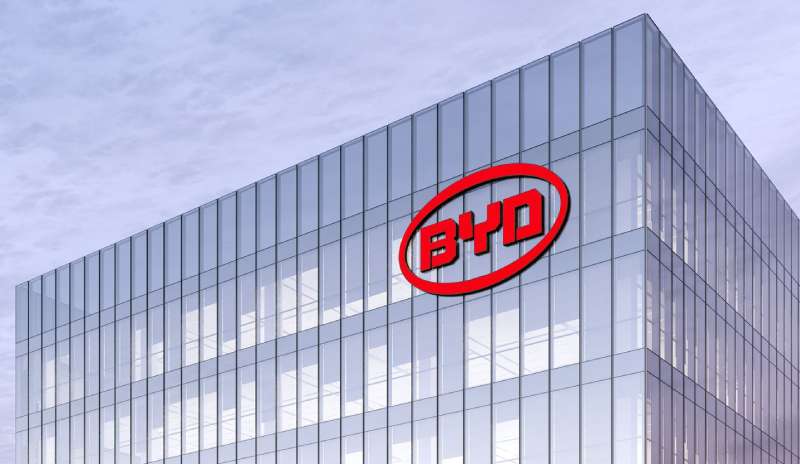
The BYD Logo represents one of the most significant brand transformations in the Chinese automotive industry. This emblem belongs to BYD Company Limited, a Shenzhen-based manufacturer that started as a battery producer before becoming the world’s largest electric vehicle maker.
BYD stands for “Build Your Dreams.” Wang Chuanfu founded the company in February 1995. The original characters had no meaning together. Wang simply picked letters that weren’t already taken.
The brand has gone through approximately four major logo versions since its founding. The current wordmark, introduced in 2022, represents a complete departure from the oval-framed designs that defined the company for decades. This shift mirrors BYD’s rise from regional battery manufacturer to global EV leader.
What is the BYD Logo?
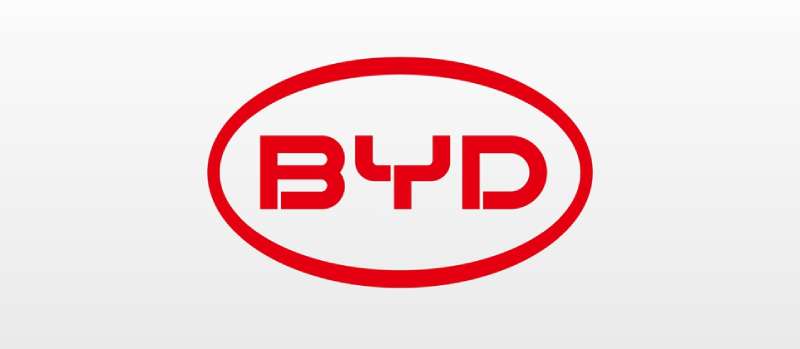
The BYD Logo is a red wordmark featuring three custom-designed letters arranged horizontally. Officially introduced on February 17, 2022, in Shenzhen, the current version removed all framing elements. The design uses a geometric sans-serif typeface with distinctive gaps within each character.
Design Type: Wordmark (lettermark)
Primary Elements:
- Three uppercase letters: B, Y, D
- Custom geometric typography with internal splits
- No frame or enclosure in current version
- Rounded corners replacing previous sharp angles
Official Introduction Date: February 17, 2022 (current version)
Designer/Agency: BYD’s in-house design team. The company hasn’t publicly credited external agencies.
Trademark Status: Registered trademark of BYD Company Limited
Color Palette:
- Primary Red: #E91B21
- White background for standard applications
- Silver/Chrome for vehicle badges
Usage Context: Vehicle grilles, steering wheels, key fobs, dealership signage, digital platforms, marketing materials, and corporate communications
How Has the BYD Logo Evolved Over Time?
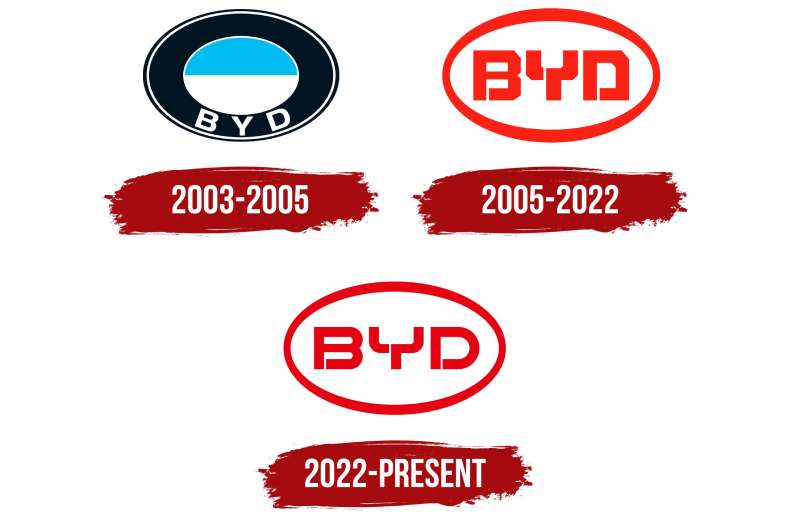
BYD’s logo history spans nearly three decades with four distinct phases. Each redesign coincided with major shifts in the company’s business strategy.
The evolution moved from a complex dual-oval emblem to today’s clean wordmark.
Original BYD Logo (1995-2007)
Years Active: 1995-2007
Design Description: Two concentric ovals. The larger outer oval was black with white and black border lines. A smaller central oval sat divided into two zones. Blue on top, white on the bottom. The “BYD” letters appeared at the base in white sans-serif type.
Color Scheme: Black, white, light blue
Designer: Unknown (internal)
Context: Created when BYD was purely a battery manufacturer. The blue and white symbolized sky and clouds, representing clarity and professional approach.
Key Changes from Previous: This was the original. No predecessor.
Cultural Significance: The design drew criticism for resembling the BMW roundel. This similarity prompted the 2007 redesign.
Red Oval BYD Logo (2007-2021)
Years Active: 2007-2021
Design Description: Bright red oval frame containing bold red letters on white. The lettering featured straight lines, sharp angles, and diagonal cuts at corners. Each letter had an open design with visible internal gaps.
Color Scheme: Red and white
Designer: BYD internal team
Context: Introduced after the BMW similarity controversy. Ironically, critics noted the new design resembled the Kia emblem. This version launched as BYD entered automotive manufacturing.
Key Changes from Previous: Complete color shift from black/blue to red/white. Removed the dual-oval structure. Added angular, futuristic letterforms.
Cultural Significance: This logo accompanied BYD’s transformation into an automaker. It appeared on the company’s first cars and electric buses.
Refined Oval BYD Logo (2021)
Years Active: January 2021 – February 2022
Design Description: Thinner lines throughout. More internal space within the oval medallion. Darker shade of red replacing the bright crimson.
Color Scheme: Dark red (closer to crimson) and white
Designer: BYD internal team
Context: A transitional design. BYD was preparing for global expansion and needed a more sophisticated image.
Key Changes from Previous: Lightened visual weight. Darkened color tone. Smoothed some angular elements.
Cultural Significance: Brief but meaningful. Showed BYD moving toward maturity as a global brand.
Current BYD Wordmark (2022-Present)
Years Active: February 2022-present
Design Description: Standalone wordmark with no oval frame. Three letters with rounded corners, subtle internal gaps, and thicker strokes than the 2021 version. Taller, narrower proportions.
Color Scheme: Deep red and white
Designer: BYD Group internal team
Context: Released alongside BYD’s “Innovating for a Better Life” brand mission. Reflects the company’s position as a technology-forward automaker rather than just a car company.
Key Changes from Previous: Removed oval frame entirely. Eliminated vertical bars from “B” and “D” letters. Softened all corners. Thickened letter strokes.
Cultural Significance: Represents BYD’s confidence as a global leader. The minimalist approach signals modernity and aligns with current design trends.
What Do the Design Elements of the BYD Logo Mean?
Every part of the BYD logo carries meaning tied to the company’s identity and mission.
The rounded letterforms replaced sharp angles to communicate friendliness and approachability.
Internal gaps within each letter suggest innovation and openness.
Why Did BYD Choose These Specific Colors?
Red
Red carries significant cultural weight in China. It represents energy, passion, and good fortune.
From a color psychology standpoint, red grabs attention instantly. It signals power and excitement. For an automaker competing against established brands, this color choice makes sense.
The shift from bright red to deeper crimson in recent versions adds sophistication. It’s less aggressive, more premium.
White
- Hex Code: #FFFFFF
- RGB: (255, 255, 255)
- CMYK: (0, 0, 0, 0)
White provides contrast and readability. It also suggests cleanliness and technology.
For an electric vehicle company, white reinforces the clean energy message.
What Typography Style Is Used in the BYD Logo?
BYD uses a custom-designed typeface. You won’t find it in any font library.
The letters are geometric sans-serif. Even, smooth, strict.
Some observers note similarities to Bitsumishi Pro Medium for the “B” and “Y” characters. The “D” resembles glyphs from Cassandra Plus Black by Wiescher-Design.
But here’s the thing. The BYD characters have small gaps between parts that make them unique. This isn’t a modified existing font. It’s original work.
Understanding how typefaces affect perception helps explain this choice. Geometric sans-serifs communicate modernity, efficiency, and technological advancement. Perfect for an EV company.
What Are the Hidden Meanings in the BYD Logo?
The gaps within each letter represent openness to innovation. At least that’s the official line.
The rounded shapes in the current version communicate safety. Sharp edges feel aggressive. Curves feel protective.
BYD stated their 2022 redesign represents “closeness and openness” along with “a blend of technology and human relations.” This connects to their “People First” philosophy.
The removal of the oval frame? That signals breaking free from constraints. BYD isn’t contained by traditional automotive industry boundaries anymore.
How Does the BYD Logo Compare to Competitor Logos?
BYD’s wordmark stands apart from most automotive emblems.
Most automakers use symbolic badges, shields, or abstract marks. Think about it. BMW has the roundel. Mercedes has the three-pointed star. Tesla has the stylized T.
BYD went with pure letterforms.
This approach aligns more with tech companies than traditional automakers. And maybe that’s the point. BYD wants to be seen as a technology company that happens to make cars.
Among Chinese EV brands, NIO uses a more abstract approach. XPeng employs a similar wordmark strategy but with different styling. Geely maintains a traditional emblem.
The simplified BYD wordmark shares DNA with Kia’s redesign that happened around the same time. Both companies removed framing elements and modernized their typography.
What Are the Technical Specifications of the BYD Logo?
Official Color Codes:
Primary Color (Red)
- Hex: #E91B21
- RGB: (233, 27, 33)
- CMYK: (0, 88, 86, 9)
- Pantone: PMS 485 C (approximate)
Secondary Color (Dark Gray, for alternate applications)
- Hex: #4C4C4C
- RGB: (76, 76, 76)
- CMYK: (0, 0, 0, 70)
Background (White)
- Hex: #FFFFFF
- RGB: (255, 255, 255)
- CMYK: (0, 0, 0, 0)
Dimensions and Proportions:
BYD maintains strict guidelines for logo reproduction. The current wordmark uses a horizontal arrangement with specific spacing between letters.
Clear space requirements demand adequate breathing room around the mark. The company recommends using the height of the “B” as a minimum margin on all sides.
For vector format files, BYD provides SVG and AI formats through official channels.
Vehicle badges use chrome or silver finishes on black backgrounds. Digital applications typically use red on white.
What Cultural Impact Has the BYD Logo Had?
The BYD emblem has become a symbol of Chinese manufacturing capability on the global stage.
When Warren Buffett invested in BYD in 2008, few outside China recognized the brand. Now it’s becoming familiar in Europe, Latin America, and beyond.
The logo appears on electric buses in Los Angeles, London, and dozens of other major cities. That’s significant visibility.
For many consumers, BYD represents affordable electric mobility. The logo carries that association now.
How Does the BYD Logo Fit Into the Overall Brand Identity?
BYD operates multiple sub-brands, each with distinct visual identities.
The main BYD badge covers their mass-market vehicles. But premium models use different marks entirely.
Dynasty series vehicles (Tang, Han, Qin, Yuan, Song) feature Chinese characters representing ancient royal families. These badges appear alongside the BYD wordmark.
Yangwang, their ultra-premium brand, has its own unique emblem.
Denza, the joint venture with Mercedes, maintains separate branding.
The BYD wordmark serves as a corporate umbrella. It appears on buildings, documents, and marketing materials. But the vehicle badges can vary dramatically based on model line.
This multi-brand strategy requires careful brand guidelines to maintain coherence. BYD has developed visual hierarchy rules that determine when and how each mark appears.
How Should the BYD Logo Be Used?
Official Usage Guidelines:
Do:
- Maintain minimum clear space around the logo
- Use official color codes for accurate reproduction
- Scale proportionally without distortion
- Use high-resolution files for print applications
Don’t:
- Alter the proportions or spacing of letters
- Change the official colors
- Add effects like shadows or gradients
- Place the logo on busy or conflicting backgrounds
- Rotate or skew the wordmark
Where to Access Official Logos:
BYD provides official logo assets through their media center and press resources. Regional websites may have localized versions.
Licensing Information:
The BYD logo is a registered trademark. Commercial use requires explicit permission from BYD Company Limited. Editorial and informational use follows standard fair use guidelines.
Trademark Protection:
BYD actively protects its trademarks globally. The company has registered the wordmark and various logo iterations in multiple jurisdictions as it expands internationally.
FAQ on The BYD Logo
What Does BYD Stand For?
BYD stands for “Build Your Dreams.” Wang Chuanfu founded the company in Shenzhen, China in 1995.
The original three characters meant nothing together. Wang picked them because the name wasn’t taken.
The slogan appeared on vehicles starting in 2008 at the North American International Auto Show.
When Was the Current BYD Logo Introduced?
BYD unveiled its current wordmark on February 17, 2022, in Shenzhen. This version removed the oval frame entirely.
The company refined the design to align with its “Innovating for a Better Life” brand mission.
Previous versions date back to 1995 when BYD Company Limited first launched as a battery manufacturer.
Why Did BYD Change Its Logo Design?
BYD’s original 1995 emblem drew criticism for resembling the BMW roundel. The company redesigned it in 2007.
The 2022 update signaled BYD’s evolution from regional automaker to global electric vehicle leader.
Removing the oval frame created a cleaner, more modern look suited to digital platforms.
What Do the Colors in the BYD Logo Represent?
Red symbolizes energy, passion, and good fortune. It’s culturally significant in China.
The original 1995 logo used black and blue. Blue represented sky and professional approach.
White provides clean backgrounds and reinforces BYD’s new energy vehicle identity. The color combination creates strong visibility.
Who Designed the BYD Logo?
BYD’s in-house design team created all logo versions. The company hasn’t credited external agencies.
Wang Chuanfu founded BYD in 1995. The brand identity evolved alongside the company’s growth.
Recent refinements align with BYD Auto’s position as the world’s largest plug-in electric vehicle manufacturer.
What Font Does the BYD Logo Use?
BYD uses a custom-designed geometric typeface. You won’t find it in standard font libraries.
The letters show similarities to Bitsumishi Pro Medium. The “D” resembles glyphs from Cassandra Plus Black.
Each character features internal gaps that make the design unique to the BYD brand identity.
Why Does the BYD Logo Look Similar to Other Car Logos?
The 1995 version resembled BMW’s emblem. BYD changed it in December 2005.
The 2007 red oval then drew comparisons to Kia’s symbol. Ironically, avoiding one similarity created another.
The current frameless wordmark eliminates these issues entirely.
Where Can I Download the Official BYD Logo?
BYD provides official assets through their media center. Regional websites offer localized versions.
The logo is available in SVG and other formats. Always use high resolution files for print applications.
Commercial use requires permission from BYD Company Limited. Editorial use follows fair use guidelines.
What Are the BYD Logo Color Codes?
Primary red uses hex code #E91B21. The RGB values are (233, 27, 33).
CMYK runs (0, 88, 86, 9). Pantone approximation is PMS 485 C.
Vehicle badges use chrome or silver finishes. Digital applications typically show red on white backgrounds.
How Many Times Has the BYD Logo Changed?
BYD has had four major logo versions since 1995. The brand underwent changes in 2007, 2021, and 2022.
Each redesign matched company milestones. The shift from battery maker to automaker prompted the biggest change.
The evolution reflects BYD’s growth from a small Shenzhen factory to a global new energy vehicles leader.
Conclusion
The BYD Logo tells a story of transformation. From battery startup to global EV powerhouse, every redesign marked a turning point for the Shenzhen-based company.
Wang Chuanfu’s Build Your Dreams brand now competes with Tesla and established automakers worldwide.
The 2022 wordmark stripped away the oval frame. What remains is pure, confident typography in deep red.
Strong logo design principles guided this evolution. The emblem joins other red logos that command attention through bold color choices and clean design elements.
BYD’s visual identity now matches its ambition.

Renowned for his expertise in logo design and visual branding, Bogdan has developed a multitude of logos for various clients.
His skills extend to creating posters, vector illustrations, business cards, and brochures. Additionally, Bogdan's UI kits were featured on marketplaces like Visual Hierarchy and UI8.
He also wrote in the past years on sites like Design Your Way, WebDesignerDepot, WPDean, Designmodo, Speckyboy, Slider Revolution, and more.
- The Windsurf Logo History, Colors, Font, And Meaning - 10 October 2026
- How to Remove Background From Product Photos (No Photoshop) - 10 October 2026
- How Designers can Build a Stronger Online Creative Identity - 9 October 2026

Bogdan Sandu is a seasoned designer who has been designing websites since 2008. Renowned for his expertise in logo design and visual branding, Bogdan has developed a multitude of logos for various clients. His skills extend to creating posters, vector illustrations, business cards, and brochures. Additionally, Bogdan's UI kits were featured on marketplaces like Visual Hierarchy and UI8. He also wrote in the past years on sites like Design Your Way, WebDesignerDepot, WPDean, Designmodo, Speckyboy, Slider Revolution, and more.
You Might Also Like