


Wire staples through the fold suit booklets of 8 to about 64 pages. Thicker catalogs and manuals, and paperbacks that need a printed title, belong on a glued, milled spine (AlphaGraphics, 2026).
Staples cost less per copy, and the booklet opens flat. The glued spine gives you a surface for a title and holds up better when the thing gets handled a lot.
Quoted minimums for perfect binding range from 28 to 48 pages. The spread exists because the real limit is thickness, not page count. Sheridan (2017) says the spine typically needs to be at least 1/8 inch thick.
Saddle Stitch vs Perfect Binding at a Glance
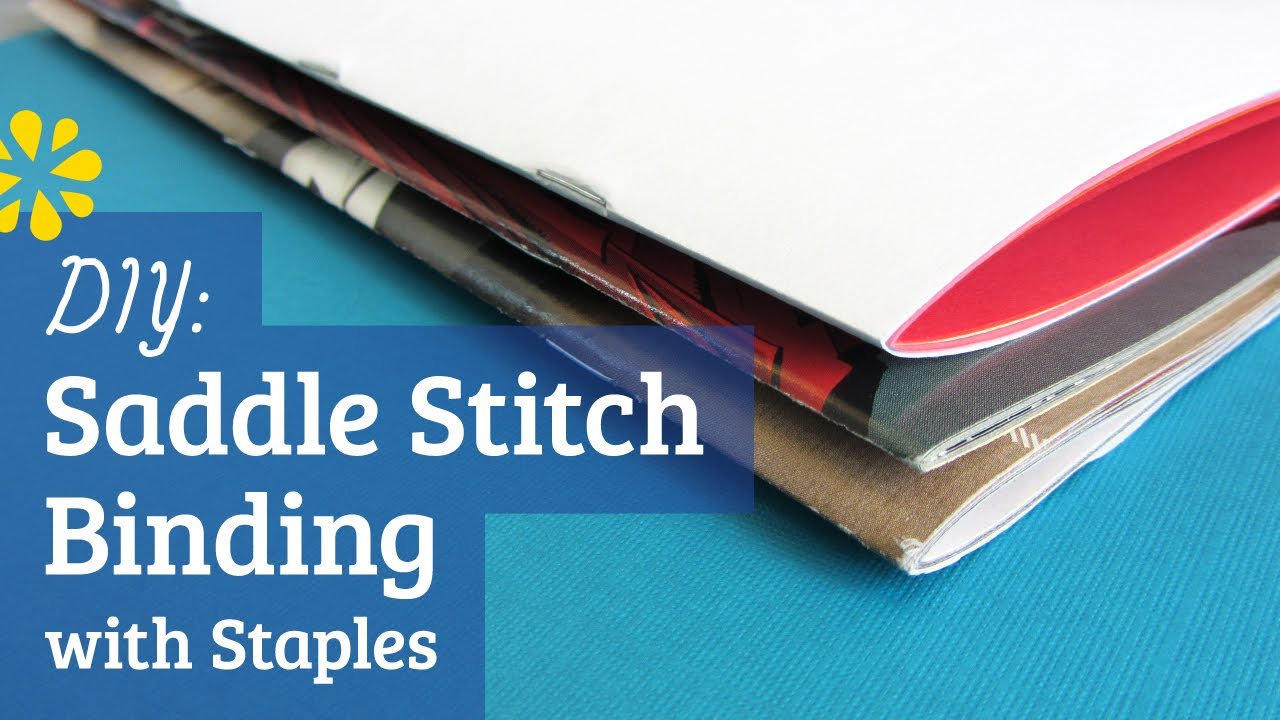
A saddle stitcher gathers folded sheets, nests them inside each other and drives wire staples through the fold. One inline pass, no adhesive, no curing.
Perfect binding has more going on. The binder collects signatures into a text block and mills the spine edge, then applies hot melt adhesive right before the cover wraps on. Standard jobs use EVA. PUR costs more and flexes better, which helps the book open and resist page pull.
In practice page count picks the method and budget breaks ties. Anything thin gets stapled, and thick jobs usually need glue.
| Attribute | Saddle stitch | Perfect binding |
|---|---|---|
| Fastening | Wire staples through the fold | EVA or PUR hot melt adhesive |
| Spine | Folded edge, nothing to print on | Squared spine that carries a title |
| Page count | Multiples of four, up to about 64 | Roughly 28 to 48 minimum, no firm ceiling |
| Opens flat | Yes, at every spread | No, and EVA is the stiffer of the two glues |
| Cost per copy | Lower | Higher |
AlphaGraphics (2026) warns that a glued spine on a thin brochure looks overbuilt for what it is. I’d agree. Nobody needs a milled spine on a 16-page handout.
How Many Pages Does Each Binding Method Take?
Stapled booklets run from 8 to about 64 pages, always in multiples of four. Glued books have a floor instead of a ceiling. Printers set that floor anywhere between 28 and 48 pages depending on the paper, and above it there is no practical limit.
AlphaGraphics (2026) lists saddle stitch at 8 to 64 pages, divisible by four, and perfect binding at 28 to 300+ pages. Sheridan (2017) says magazines past 100 pages are better perfect bound. And if the whole booklet runs on cover-weight paper, the stitch ceiling drops by about 30%, to roughly 44 pages (AlphaGraphics, 2026).
Why Saddle Stitch Page Counts Run in Fours
Every folded sheet carries four pages, so the count steps 8, 12, 16, 20. A 22-page file ends up with two blank pages, which is why so many booklets close on a notes page.
The ceiling comes from bulk, not a fixed number. As nested sheets pile up, the inner ones push out past the outer ones at the fore edge (creep) and the staples struggle to get through the stack.
Weight alone does not predict bulk, so it pays to know how paper weight differs from thickness before picking a stock. A 48-page job on 80 lb text stitches fine. The same 48 pages on 100 lb cover can be too thick for clean stapling (AlphaGraphics, 2026).
Why Perfect Binding Has a Minimum
Printers don’t agree on the minimum, and 4OVER4 doesn’t even agree with itself. Its binding-types guide says 28 pages, the same as AlphaGraphics (2026), though some printers ask for 32. Its comparison guide (2026) says about 40 on ordinary text stock. A 4OVER4 FAQ entry says about 48, which is also the number in Nahan’s printing guide.
The numbers differ because the limit is physical thickness. Sheridan (2017) puts the typical floor at a spine of 1/8 inch and tells buyers to use the paper’s pages-per-inch rating to work out the page count.
Stock choice moves the line, and the gap between coated and uncoated sheets is part of it. Heavy coated text reaches a workable spine in fewer pages, while thin paper needs more (4OVER4, 2026).
Here is the math using KDP’s published thickness values of 0.002252 inch per page on white paper and 0.0025 on cream. A 1/8 inch spine takes about 56 pages on white and 50 on cream, which lands near the 48-page advice and well above the 28-page floor.
That is arithmetic on two sources, not a figure either one prints. KDP itself accepts paperbacks from 24 pages (KDP help pages, as of October 2026), so the minimum is the printer’s rule and not a physical constant. Ask for theirs.
What to Choose Between 28 and 64 Pages
Both bindings work in the overlap, so use decides.
Stitch it when the piece gets read once and recycled, or when the reader needs it open flat. Putting the savings into better paper is a fine reason too.
Go with glue if the piece will sit in a rack or on a shelf where the spine title does the selling, or if people will keep it and refer back to it for months. A heavy interior stock can push the stitched version past its limit, and a count close to 64 that is still growing means you will probably cross it anyway.
For event handouts, 4OVER4 (2026) says to stitch the booklet and put the money into better paper.
Spine Structure and How to Calculate Perfect Bound Spine Width
A stitched spine is only the fold, so there is nothing to print a title on. Perfect bound spines are squared and glued and do print, and the width is the page count times the thickness of one page.
Printers write the formula two ways. The results match.
- Get the confirmed caliper for the exact stock from your printer.
- Divide the page count by two to get sheets, then multiply by the sheet caliper.
- Or multiply the page count by the per-page thickness, which is half the caliper.
- Build the cover as one flat spread: back, spine, front.
At 0.004 inch per sheet, a 96-page book has 48 sheets and a 0.192 inch spine (4OVER4, 2026). KDP’s white paper factor of 0.002252 inch per page equals a sheet of about 0.0045 inch, which puts the same 96 pages near 0.216 inch.
Caliper is how thick a single sheet is, and it varies by mill and by coating. Use the printer’s number, not a chart. Nahan has its account managers calculate spine thickness and builds the cover file as a two-page spread around it.
The finished trim size never enters the calculation. KDP’s formula has no trim term, so a 5.5 x 8.5 book and an 8.5 x 11 book with the same pages and paper share a spine width.
Being able to bind a book and being able to print on its spine are two different thresholds. KDP rejects covers with spine text on books under 79 pages (as of October 2026), even though it binds them from 24.
Which Binding Costs Less, and Where Does the Gap Close?
Saddle stitch costs less wherever both methods work. Binding stays a minor line on the invoice (Sheridan, 2017), so page count and paper move the total more than staples or glue do.
- Sheridan (2017) priced a 64-page book plus cover at 5,000 copies. It came to $117.00 saddle stitched and $285.75 perfect bound.
- At 250 copies, AlphaGraphics (2026) puts saddle stitched booklets at $0.50 to $3.00 each and perfect bound ones at $3.00 to $9.00 (US averages, pricing varies by location).
- 4OVER4 (2026) starting prices are $240.55 for 25 saddle stitch booklets and $375.05 for 10 perfect bound books.
Do not divide that last pair into a per-copy comparison. The minimum quantities differ, so the two numbers describe different orders.
Sheridan splits binding cost into a make-ready charge and a per-1,000 running charge. Volume dilutes the first and does not touch the second, so the gap never fully closes.
That also explains why sources disagree. AlphaGraphics (2026) says perfect binding gets more economical above 100 copies as setup spreads out, yet Sheridan’s 5,000-copy example still lands at about 2.4 times the stitched price. Read “more economical” as “less painful per copy,” not “cheaper.”
More pages raise both the make-ready and the running charge (Sheridan, 2017). Cover stock matters too. A self cover prints on the interior paper and a plus cover on a separate heavier sheet, and perfect bound books almost always use the second (4OVER4, 2026). Heavier interior paper adds cost and also moves the page limits. Make-ready is fixed, so short runs feel it most.
On a short run of a thin booklet, stitching is the clear call. On a long run of a thick book, the glue premium is small next to printing and paper, so choose on use.
Durability and Lay-Flat Behavior Compared
Perfect binding wears better under repeated handling and carries more pages. Staples are the weak point of a stitched booklet, since they loosen with use, though it does open flatter at the fold.
The adhesive decides how far the perfect bound advantage goes. PUR beats EVA on flexibility and lay-flat, and it does better on coated stock (Hotmelt.com, 2026).
Saddle Stitch Under Repeated Handling
A stitched booklet opens flat because every sheet hinges on the fold. The staples holding it together are also the first part to give, and AlphaGraphics (2026) notes they loosen over time with heavy use.
Booklets that get read once and recycled are fine. The ones that get passed around or filed will start to loosen.
Cover stock matters too. Duplo (2023) says a booklet whose cover and interior share one stock tends to hold up less well.
EVA vs PUR in Perfect Binding
Ask which glue your printer runs.
| Property | EVA | PUR |
|---|---|---|
| Flexibility and lay-flat | Moderate, stiffer spine | High, opens flatter |
| Coated stock | Fair | Excellent |
| Heat | Can be reheated and softens | Does not remelt once cured |
| Cure and cost | Fast to handle, lower cost | Slower to cure, higher cost, special equipment |
EVA stays the standard for manuals and catalogs on uncoated paper. PUR earns its premium on coated stock and thick books, and on digital prints too (Hotmelt.com, 2026).
Strength claims for PUR do not agree. Printivity says its bond runs as much as 50% above EVA, while a commercial printer interviewed by PrintWeek India (2013) reported more than 2.5 times the page pull.
The gap comes from measurement. Fogra notes that page pull test parameters were unspecified and test devices measured differently, which led to ISO 19594, in force since 2017.
Use the wrong adhesive or apply it badly and you get page pullout and spine cracking (Hotmelt.com, 2026). EVA on heavily coated stock is the weak pairing. PUR needs a day or more to reach full cure (Mid-State Litho, 2026), so rush jobs favor EVA.
How to Set Up Files for Each Binding Method
Stitched files have to deal with creep at the outer edge. Perfect bound files need a protected gutter and a cover built as one spread. Either way, ask the printer first whether it wants single pages or imposed spreads.
Saddle Stitch: Creep and Outer Margin
Creep is the outward drift of inner sheets, which the final trim cuts flush, so inner pages end up with a narrower outer margin than outer ones. On short booklets it barely shows. On thick ones or bulky stock it does (Printivity).
InDesign’s Print Booklet command applies creep for the 2-up Saddle Stitch and 2-up Perfect Bound types (Adobe help, updated June 2026). It divides your creep value by the number of sheets minus one, so a 16-page booklet (4 sheets) with 24 points of creep shifts each sheet by 8 points.
Check before you use it. Printers that impose in-house, such as 4OVER4 and KDP, ask for single pages, so pre-applying creep in your own file risks doubling the correction.
Keep live text inside a safe zone set back from the outer edge, and give folios extra room on thicker jobs.
Perfect Binding: Gutter, Crossover and Cover Spread
KDP’s minimum gutter grows with page count, from 0.375 inch at 24 to 150 pages to 0.875 inch at 701 to 828 pages (KDP, as of October 2026). A thicker block opens less, so the inside margin has to give more.
For images that span the spread in the 2-up Perfect Bound type, use Bleed Between Pages (Adobe). Space Between Pages applies to perfect bound spreads and not to saddle stitch (Adobe). Inside covers need a knockout across the spine plus an allowance into each hinge score (Nahan).
Cover art that runs to the edge needs bleed, and the spine needs a tolerance because every book varies slightly when bound (KDP, as of October 2026).
Work through it in this order.
- Confirm page count and paper with the printer.
- Ask who applies creep and whether to send single pages or spreads.
- Set trim and bleed on every page.
- Widen the gutter for perfect binding, or hold the outer margin for saddle stitch.
- Build the cover from the printer’s confirmed spine width.
- Export, then check the proof for creep and spine alignment.
Which Binding Fits Catalogs, Magazines, Manuals and Paperbacks?
Catalogs and magazines split by page count and paper. Manuals depend on where they get used. Paperbacks are perfect bound, and that is the end of that.
Catalogs
Light catalogs get staples and heavy ones get glue, with a wide middle band where use decides.
Duplo (2023) puts saddle stitch at under 100 pages for catalogs and brochures, well above the 64-page ceiling other printers quote on text stock. The stitcher and the paper both set the limit, so treat 64 as a planning number and confirm the machine’s.
On adhesive, EVA covers most catalogs on uncoated paper and PUR covers premium catalogs on coated stock (Hotmelt.com, 2026).
Magazines
Thin issues get staples. AlphaGraphics (2026) lists newsletters and magazines among saddle stitch work. Thick issues go perfect bound, for the printed spine and the shelf, and magazines on coated pages lean toward PUR (Mid-State Litho, 2026).
Manuals
Ask where the manual lives.
One that sits on a shelf or rack is perfect bound, with EVA common (Hotmelt.com, 2026). One that stays on a bench or desk is better off with coil or Wire-O, because training manuals and workbooks that must lie flat suit coil (AlphaGraphics, 2026).
Paperbacks
Perfect binding is the paperback method, and the page ceiling is a big reason. KDP’s range for a 5.5 x 8.5 inch black ink paperback on white paper tops out at 828 pages (KDP, as of October 2026).
Saddle stitch stops far short of that.
When Neither Binding Fits
Neither method fits when the reader needs the book open flat, when the book has to survive daily handling, or when the job sits where staples and glue both struggle. Coil, Wire-O, Smyth sewn and case binding cover those situations.
| Method | Opens flat | Spine title | Fits |
|---|---|---|---|
| Coil | Yes, folds back on itself | No | Workbooks, SOPs, pitch decks |
| Wire-O | Yes, folds back on itself | No | Proposals, planners |
| Smyth sewn | Yes, drapes open | Yes, in a glued or case cover | Cookbooks, art books, sheet music |
| Case bound | Only with sewn construction | Yes | Hardcovers |
The wider field of binding types used in print design goes beyond these four, but they cover most of the cases where saddle stitch and perfect binding fail.
Coil and Wire-O for Books That Stay Open
Coil has real downsides. It snags in bags and carries no spine title. It also reads as informal, and pages can tear if the punched holes are stressed (AlphaGraphics, 2026).
That same source lists sales presentations and pitch decks among coil’s uses, which is why spiral binding for presentation decks and workshop handouts is so common.
Wire-O trades a higher price for a cleaner double-loop look.
Smyth Sewn and Case Binding for Long Life
Smyth sewn stitches signatures with thread before the cover goes on, which is why the block drapes open and survives heavy use. The catch is the schedule. One specialty printer sends the work to a specialty bindery and quotes weeks of lead time and a minimum run (Acutrack).
Smyth sewn blocks can take a perfect bound or a case cover, and the same printer recommends the case. Another printer, Qin Printing, warns that PUR-glued case binding does not lie flat and costs more than sewn and glued.
Square-Back Saddle Stitch for a Thicker Look
Duplo (2023) says its DBM-700 bookletmaker, with an optional square back module, produces stitched booklets with a square-back finish, in-line and on demand.
It is still a stitched book, so the machine’s capacity caps the page count. Ask whether the squared spine can carry printed text before you count on it.
Saddle Stitch vs Perfect Binding FAQ
How many staples does a saddle stitched booklet use?
Two to four, depending on the format. AlphaGraphics (2026) puts two staples on standard sizes and three on legal-length documents, and Duplo (2023) cites 2 to 4 stitches, so the count follows trim height.
How long does each binding method take to produce?
Saddle stitch ships fastest, in 2 to 3 business days at a typical print shop, against 5 to 7 for perfect binding (AlphaGraphics, 2026).
The gap comes from adhesive curing before the three-side trim. PUR needs the longest cure.
Does digital or offset printing change the binding choice?
No, either printing method works with any binding (AlphaGraphics, 2026). The details shift, though.
Duplo (2023) says covers on digitally printed perfect bound books need creasing to prevent toner cracking, and Hotmelt.com (2026) recommends PUR for digitally printed books.
Is perfect binding the same as paperback binding?

Yes, in practice. Perfect binding is the method used for paperback books (AlphaGraphics, 2026), and Duplo (2023) describes it as gluing the book block to a soft cover.
Why is it called saddle stitch?
The name comes from the equipment. Printivity (2026) describes folded sheets draped over a saddle-shaped piece of machinery while a stitching head drives staples through the fold.
Print shops call stapling stitching, which completes the term.
What to Confirm With the Printer Before Approving the Job
A saddle stitch vs perfect binding choice only holds once the printer confirms a few things in writing. Paper caliper and page count come first, because they fix the spine and rule out a method. Then comes who applies creep and how the files get imposed, which decides what you send. After that, the adhesive and its page pull result, since those set durability.
Price comes after all of that. On Sheridan’s 5,000-copy example (2017), the perfect binding premium totals $168.75, about 3.4 cents per copy.
The sequence was verified in October 2026 and changes if the printer adds equipment, such as a PUR line or a square back module (Duplo, 2023).
With those answers in writing, setting up a print-ready file is the next job.

Renowned for his expertise in logo design and visual branding, Bogdan has developed a multitude of logos for various clients.
His skills extend to creating posters, vector illustrations, business cards, and brochures. Additionally, Bogdan's UI kits were featured on marketplaces like Visual Hierarchy and UI8.
He also wrote in the past years on sites like Design Your Way, WebDesignerDepot, WPDean, Designmodo, Speckyboy, Slider Revolution, and more.
- The Windsurf Logo History, Colors, Font, And Meaning - 10 October 2026
- How to Remove Background From Product Photos (No Photoshop) - 10 October 2026
- How Designers can Build a Stronger Online Creative Identity - 9 October 2026

Bogdan Sandu is a seasoned designer who has been designing websites since 2008. Renowned for his expertise in logo design and visual branding, Bogdan has developed a multitude of logos for various clients. His skills extend to creating posters, vector illustrations, business cards, and brochures. Additionally, Bogdan's UI kits were featured on marketplaces like Visual Hierarchy and UI8. He also wrote in the past years on sites like Design Your Way, WebDesignerDepot, WPDean, Designmodo, Speckyboy, Slider Revolution, and more.
You Might Also Like


