


Embossing presses a design up into the material, and engraving cuts it away and leaves a recess. Cardstock and leather take embossing well, and so do bold designs repeated in volume. Metal and glass suit engraving, wood does too, and so does anything fine or variable.
The names cause trouble. Traditional engraved stationery has a raised surface, because the engraving is cut into the printing die and press pressure pushes the inked paper up, leaving an indentation on the back (Print magazine’s glossary of engraving terms).
What Is the Difference Between Embossing and Engraving?
Push a design up from behind and the surface rises into a relief. That’s embossing. Cut into the face and take material out, and what’s left is a recessed mark. That’s engraving.
Displacing versus removing. Tooling, cost, material fit and wear all follow from it.
Because embossing is worked from behind, the reverse of the sheet carries a matching recess. Engraved pieces keep a flat back, since the cut only happens on the face.
| Attribute | Embossing | Engraving |
|---|---|---|
| Mechanism | Pushes material up into a relief | Cuts material away |
| Tooling | Male and female die set, or a heated die | Burin, rotary cutter, diamond-drag tool, laser |
| Typical materials | Paper, cardstock, leather, thin sheet metal | Metal, wood, glass, acrylic, plastic |
| Reverse side | Matching recess | Flat |
| Setup | Custom die for each design | Per-piece cutting time, no die |
Two cases blur the line. Die-stamped “engraved” stationery has a raised surface, and laser engraving on leather burns off the top layer instead of cutting a groove.
How Embossing Works
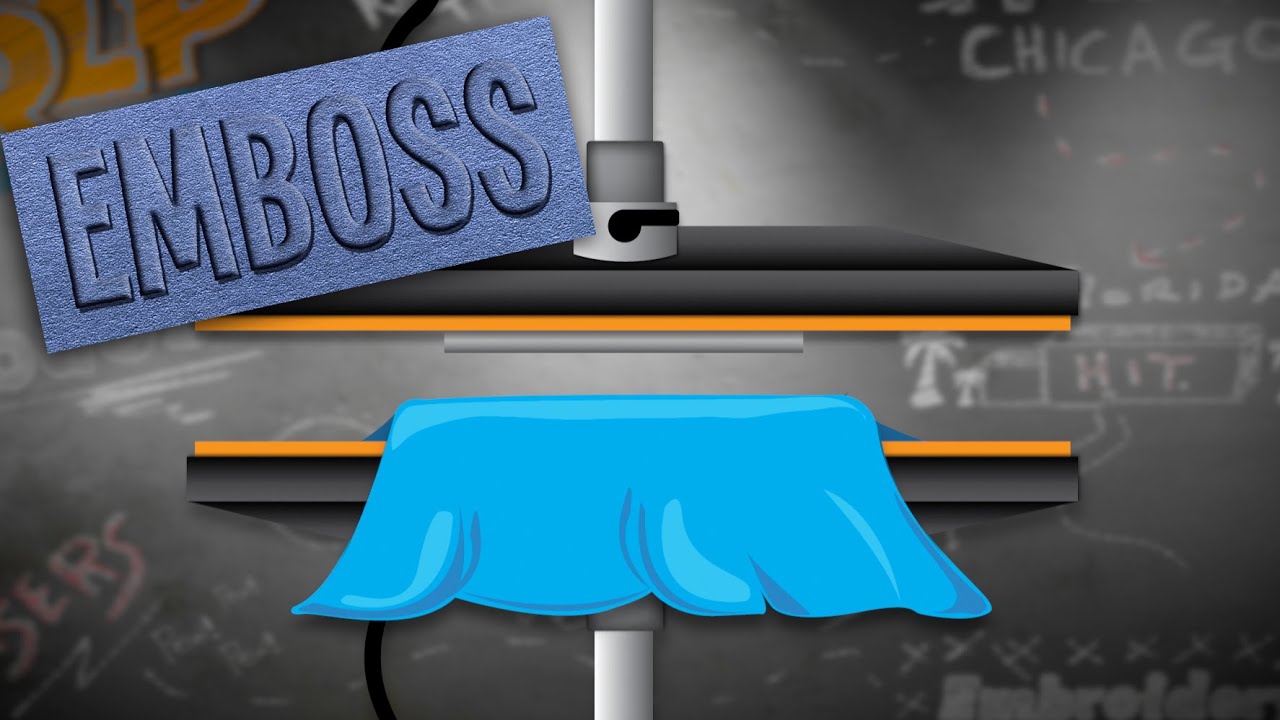
The sheet goes between a male die and a female die, and pressure forces the material into the shape of the pattern. Leather and foil jobs add heat. Since the design lives in the die, new artwork means a new die.
- Prepare vector artwork, since embossing dies are typically cut from vector files (Made Good Designs).
- Make the die pair. The male die carries the pattern in relief and the female die carries it recessed, usually in hardened tool steel, brass or copper (Prolean).
- Mount the dies in a press and align the sheet. Registered embossing lines the relief up with printed artwork.
- Press the sheet so the material is forced into the female die, with heat added for leather and foil jobs.
- Release and inspect. The face shows the raised design and the reverse shows the matching recess.
Blind, foil and combination embossing
Blind embossing skips ink and foil entirely, so all you see is light and shadow across the relief. Add foil or ink to the raised area and it turns into foil or combination embossing. Registered embossing is the variant where the relief has to land exactly on printed artwork.
How thin a line can be depends on the stock. Jukebox Print’s guidelines say fine detail can be as small as 1 pt on soft uncoated stock 16 pt or thinner, while coated and thicker uncoated stocks are more rigid and need larger details (as of 2026).
Foil adds a heated transfer step to the relief, which is the same process used in standalone foil stamping.
Specialist printers like Baddeley Brothers offer both blind embossing and foil embossing across premium stationery and business card applications.
Hot stamping on leather
Leather gets embossed with a heated metal die, and foil sits between the die and the hide when the job needs color.
Orvis uses the embossing process to personalize its leather gifts.
Temperature is fussier than you’d think. One monogramming workshop reports that gold foil smudges when the type runs too hot, while black foil tolerates much higher temperatures (Marylebone Journal).
How Engraving Works
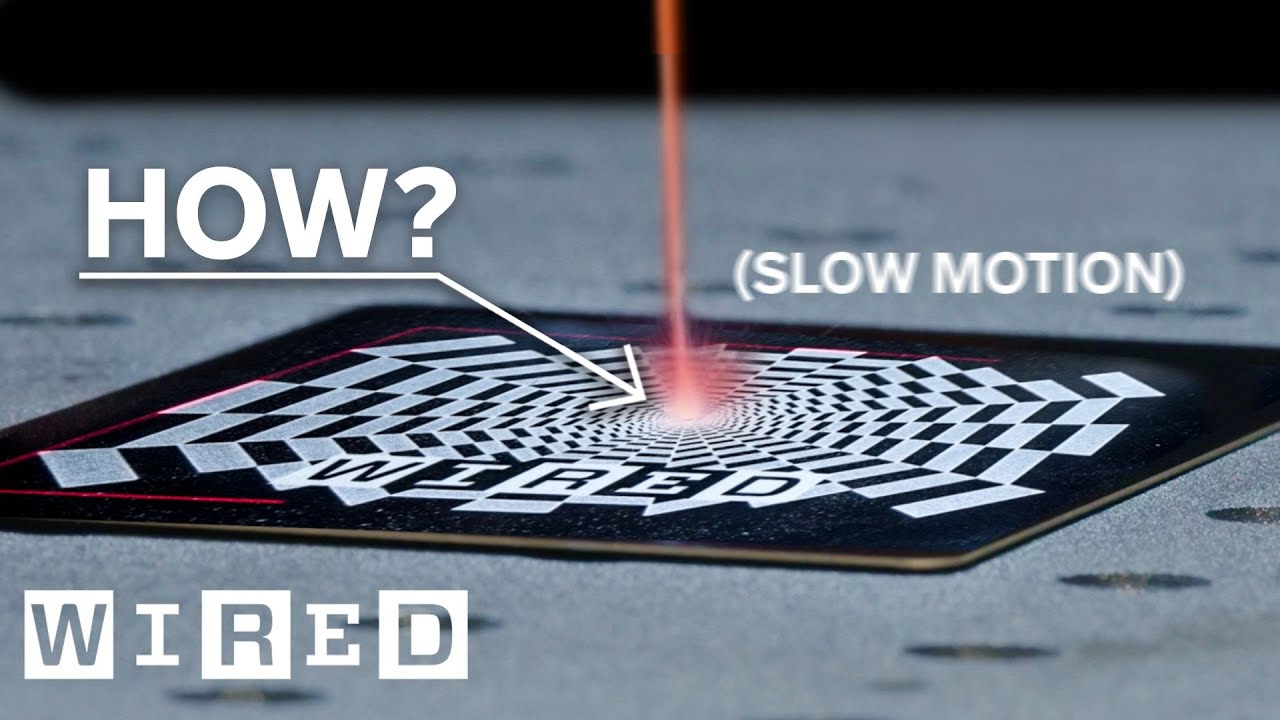
The material gets cut out and the mark stays for good. A burin by hand, a rotary or CNC cutter, a diamond-drag tool and a laser cover nearly all of it.
No die is involved. Machine engraving runs from a digital file, so a single custom piece needs no tooling.
Hand engraving with a burin
An engraver pushes a hardened steel burin (also called a graver) through the metal by hand and cuts a fine furrow. Silver, nickel, steel, brass, gold and titanium all take it.
Tool shape decides the cut. Ring gravers handle inscriptions inside rings. Flat gravers fill in letters and clear background, and knife gravers cut lines and very deep grooves.
Depth and line weight change with the hand, which suits personalized jewelry and decorative work. Volume work is a poor fit.
Rotary and CNC engraving
A spinning carbide or diamond bit removes material in rotary cutting. It can go deep or cut a letter out completely, and it leaves chips to clear (JPPlus). Diamond-drag works another way, with a non-rotating diamond tip that only scratches soft metals such as aluminum, brass, silver, pewter and gold.
CNC engraving is simply either method driven by a computer, with the spindle following a digital design.
Cutter width caps how fine a stroke can get, so small lettering has to be chosen with that in mind. Checking typefaces that engrave cleanly before artwork goes to the shop saves a rejected proof.
Laser engraving: CO2 versus fiber
Fiber lasers emit near 1064 nm, and CO2 lasers emit at 10.6 microns, about ten times longer (Inkcups).
Metal absorbs the shorter wavelength. Wood, acrylic, leather, paper and stone absorb the longer one.
A CO2 laser marks bare metal only with a coating, and it burns the anodizing off treated aluminum (VCU Workshop guide, University of Arizona CATalyst lab). On glass, the beam fractures the surface instead of removing material (Epilog).
Line work runs from vector files and photos run as raster images, so logos and lettering should be built as vector graphics.
Put simply, a CO2 machine covers the most materials, while a fiber machine covers bare metal and very little else (Thunder Laser).
Why Does Engraved Stationery Have a Raised Surface?
Nothing gets cut into the paper. The cutting happens on the printing die, which holds ink in its recesses, and press pressure forces the sheet down into them so the inked image gets pushed up from the surface.
Intaglio and die-stamped printing
Die stamping presses the sheet against the inked die at over a ton per square inch, according to Barnard and Westwood.
The die is steel or copper, and steel dies run about half an inch thick (Print magazine’s glossary of engraving terms).
The finished sheet has a raised inked image on the face and an indentation on the back, which printers call a bruise. Every color needs its own die and its own pass through the press.
The Bureau of Engraving and Printing applies intaglio to the portraits, numerals and lettering on US currency. Federal law (31 U.S.C. 5114) requires US currency and bonds to be printed from intaglio plates.
The name comes from the engraver who cuts the die, not from anything done to the paper.
Thermography, letterpress and foil stamping as neighbours
| Process | How the raised look forms | Reverse of the sheet |
|---|---|---|
| Die stamping (intaglio) | Press pressure pushes inked paper up from the die | Indented |
| Thermography | Resin powder melts and swells on wet ink | Flat |
| Blind embossing | Paper pressed between dies, no ink | Matching recess |
Thermography is the cheaper stand-in, sometimes called imitation engraving (PaperSpecs). Turn the sheet over. A flat back gives it away.
Letterpress is a relief printing process. Blind embossing is often added to letterpress or foil stamping jobs to build more complex designs (Pemberly Fox).
Which Materials Suit Embossing and Which Suit Engraving?
Whatever deforms under pressure gets embossed: paper, cardstock, vegetable-tanned leather and thin sheet metal. Whatever holds a cut gets engraved, which covers metal, wood, glass, acrylic, plastic and stone. Leather and sheet metal go either way.
Paper and cardstock
Guides don’t agree on the minimum stock weight for embossing. Made Good Designs recommends 300 gsm as the minimum for clear embossing and debossing in print finishing, while Crafter’s Companion recommends 220 to 280 gsm for embossing with craft dies.
The gap tracks the equipment, since one guide covers commercial print finishing and the other covers hobby die machines. Lightweight paper can puncture or rip under either (Soyang).
Heavier stock gives a deeper impression, while thinner uncoated stock holds finer detail (Jukebox Print, as of 2026). Which weight is right depends on which of the two the design needs.
Weight and thickness are separate measures, since cotton stock can be thick without being heavy (Vistaprint). It pays to understand paper weight versus thickness before choosing a stock for a die.
Leather
Both techniques work on leather, and the marks look different.
PEGAI presses very hot brass characters into its leather padfolios, which leaves a deep indentation and a darker imprint with no pigment. A laser does something else. The beam burns the top layer, so the mark is shallower, starts out black from soot, and lightens with cleaning and use (PEGAI).
Each has a weak spot. Embossing fails on faux leather, which tears or fades (xTool), and on thin leather that can’t take the heat and pressure (Monday Merch). Engraved text is barely visible on dark leather (Hidemont).
Metal
Thin sheet metal can be embossed between a male and female die pair. Soft metals suit diamond-drag engraving, and bare steel and titanium suit fiber laser engraving.
Commercial brass is hard to engrave, so shops buy softer half-hard engraver’s brass (Xometry).
Laser marking and laser engraving are not the same process. Marking changes the metal’s surface without removing material, while engraving removes it (Xometry).
Wood, glass and acrylic
Wood is the most laser-friendly material because it discolors when engraved and cuts deeper than most materials (Epilog). Acrylic comes second in popularity.
Glass behaves differently. The beam fractures the surface and doesn’t remove material, so the mark stays shallow.
Rotary bits handle plastic, wood and acrylic, while diamond-drag tools handle metal and glass (JPPlus). None of these materials is a candidate for embossing.
How Do Raised and Recessed Finishes Compare in Look and Feel?
Embossing reads as texture and engraving reads as line detail. Bold shapes favor embossing, and thin lines and small text favor engraving.
An embossed mark is something you feel under a fingertip. From a distance it reads as texture, with contrast coming from relief instead of color, which suits large, simple logos and strong tactile impact (Yukon Bags).
Engraving feels like a cut line, a smooth surface against crisp recessed edges (MachineMFG). Fine detail, small text and variable names are where it earns its place (Yukon Bags).
Depth is adjustable in both. Die and stock set it in embossing, and cutter pressure or laser passes set it in engraving.
A blind emboss shows best on lightly textured stock and uncomplicated designs (Johnson’s Cards).
Thunder Laser’s view is that embossing looks more premium in branding and packaging, while engraving looks more functional and precise.
How Long Does Each Finish Last, and When Does It Fail?
An engraving lasts as long as the surface it is cut into. An emboss lasts as long as the relief holds its shape, and that depends on whether the material flexes or gets rubbed.
Vendors split on which finish wears better. Identisys ranks embossed metal tags above engraved ones for durability, because nothing printed on the surface can fade from weather, UV or abrasion. Thunder Laser calls engraving significantly more durable than embossing, in a comparison that covers leather, paper and packaging.
The material explains the split. Metal doesn’t flex, so a raised mark survives, while on leather and paper the raised edges catch and flatten with handling (xTool).
Thunder Laser sells engraving lasers and Identisys writes about metal tags, so each comparison reflects its own material.
Wear and flattening in embossing
Thin paper bows and bends under the press (Barnard and Westwood). On materials that flex, the raised edges flatten with handling, which is why xTool rates debossing as the longer-lasting option on handled leather.
Textured paper loses out too, because the press flattens the existing texture inside the image area (Barnard and Westwood).
Irreversibility and contrast limits in engraving
Standard laser engraving is typically a few microns deep and reaches up to 500 microns, while deep engraving reaches a few millimeters (Laserax).
Depth decides how well a mark survives abrasion. It also decides machine time.
Removed material can’t be put back, so a mistake scraps the piece. Contrast is another snag. Brass letters are often paint-filled to stand out (Xometry), and single-ply surfaces with no color layer underneath need diamond-drag to show a mark (JPPlus).
Stainless steel needs care, since deep engraving strips the protective oxide layer and the part then needs painting or plating to prevent rust (Laserax).
Which Costs More, and Where Does the Break-Even Sit?
Embossing costs more up front and less per piece at volume. Engraving needs no die, so it starts cheaper, but each piece takes cutting time.
For embossing, a one-time die or plate charge gets spread over the run, so quantity does most of the price work. Intricate shapes and deep embosses add setup, and custom tooling adds days of lead time.
over4 prices these items per project and publishes no flat die price. An embossed business card also costs more than a flat one because the die adds a production step.
Engraving cost is machine time, and depth multiplies it. A deep mark in steel takes far longer than a shallow mark in wood.
Laserax gives the clearest laser numbers. Most deep-engraving jobs need 100 W, because weaker lasers make cycle times too long. A 100 W fiber laser with a 254 mm lens removes 0.05 to 0.11 cubic millimeters per second in steel, against 0.41 to 0.70 in aluminum, and deep engraving takes minutes to hours per part (Laserax).
Trotec’s fast setting for a 200 micron deep, 5 x 5 mm square in stainless steel runs 32 passes, 112 seconds.
Identisys’s tag comparison puts embossing ahead at scale and engraving ahead on small runs.
No source publishes the quantity where the two cross, because the crossover depends on the die price and the cutting time per piece. Getting a quote for both settles it.
How to Choose Between Embossing and Engraving for a Specific Job
Material, run size and level of detail do most of the deciding.
Decision rule by material, volume and detail
Soft, pressable stock such as cardstock, leather and thin sheet metal points to embossing, and hard or rigid material points to engraving.
Thousands of identical pieces point to embossing. One-offs, or text that changes on every piece, point to engraving.
Bold shapes lean toward embossing, and thin lines and small text lean toward engraving.
Matching the technique to the job
| Job | Better fit | Deciding factor |
|---|---|---|
| Business cards | Embossing | Tactile finish, falling per-card cost |
| Identical metal ID tags | Embossing | Bold marks, no fading |
| Metal tags with unique data | Engraving | No die per design |
| Jewelry and trophies | Engraving | Fine lines on hard metal |
| Luxury boxes | Embossing | Tactile branding |
Luxury boxes and logos are where embossing appears most often in packaging design, while personalization on jewelry and trophies stays with engraving (Thunder Laser).
The obvious choice isn’t always the right one. For wedding invitations, thermography gives a raised look at a lower price than die stamping, but its machines handle only paper of limited thickness (Inside Weddings).
Pros and cons
Embossing
Marks come out bold and readable, the per-piece cost falls as volume rises, and metal tags have no printed layer to fade (Identisys).
Against that, every design needs its own custom die and the artwork is locked once the die is cut. Tooling adds lead time (4over4), and fine detail reproduces poorly.
Engraving
With no die, each piece can carry different text. Fine lines, curves and complex artwork come out well (Identisys), and the mark is cut into the material itself.
The downsides are speed and depth. It’s slower per piece, which makes large runs costly, and the material needs enough depth to take the cut without losing strength (Identisys).
Embossing vs Engraving FAQ
How does embossing differ from debossing?
Debossing presses the design below the surface, while embossing raises it above. One die pair can make either, because swapping the male and female members or inverting the sheet turns an embossment into a debossment (US patent 4112827).
Debossing tends to look more modern and restrained (Made Good Designs).
Is etching the same as engraving?
No. Engraving cuts the metal directly with a burin or cutter, while etching bites the design in with acid.
The terms blur in stationery, where plates are often acid-etched and the product is still sold as engraved (Pemberly Fox).
Can embossing and engraving be combined on one piece?
Yes. Engraved stationery sometimes gets an added embossing run that presses the image edges in the opposite direction to the raised ink, which deepens the relief (The Pleasure of Writing).
Does a laser engraver emboss?
Not directly. A laser burns or removes material, so lasering leather is engraving rather than embossing.
Where it does help embossing is in cutting the metal stamp that presses the leather (xTool).
How do you emboss paper at home?
Run cardstock through a die-cutting machine such as the Sizzix Big Shot with an embossing folder. Misting the cardstock lightly first gives a deeper impression (Sizzix).
Without a machine, dampened printmaking paper pressed over cardboard cutouts with a bone folder also works (University of the Arts London printmaking blog).
Can an engraving be removed or corrected?
On solid gold or silver, yes, but only by removing more metal. A jeweler polishes the surface down past the mark and re-engraves, and deeper cuts take more metal with them (Martin Busch Jewelers).
Tungsten, titanium and ceramic carbide can’t be worked with regular jeweler’s tools, so those engravings stay (Quick Jewelry Repairs).
What to Check Before Approving a Full Production Run
Order a sample on the production material before committing, because stock, surface and die or cutter settings decide how a relief or a cut reads. A screen proof shows neither relief height nor cut contrast.
Material fit goes first, since it rules options out and a quote on a technique the material can’t take wastes the request. Die price and per-piece cutting time come next, and a handling and rub test last.
The sample costs one spoiled piece and some waiting, since an engraved sample can’t be refilled and an embossed sample needs the die cut first.
This advice reflects vendor documentation verified in October 2026. A published die price and cutting time for the job would replace the sample-and-quote step.
The next job is setting up a print-ready file in vector artwork, which the dies and laser paths are cut from.

Renowned for his expertise in logo design and visual branding, Bogdan has developed a multitude of logos for various clients.
His skills extend to creating posters, vector illustrations, business cards, and brochures. Additionally, Bogdan's UI kits were featured on marketplaces like Visual Hierarchy and UI8.
He also wrote in the past years on sites like Design Your Way, WebDesignerDepot, WPDean, Designmodo, Speckyboy, Slider Revolution, and more.
- Jujutsu Kaisen Font Generator - 12 October 2026
- The Windsurf Logo History, Colors, Font, And Meaning - 10 October 2026
- How to Remove Background From Product Photos (No Photoshop) - 10 October 2026

Bogdan Sandu is a seasoned designer who has been designing websites since 2008. Renowned for his expertise in logo design and visual branding, Bogdan has developed a multitude of logos for various clients. His skills extend to creating posters, vector illustrations, business cards, and brochures. Additionally, Bogdan's UI kits were featured on marketplaces like Visual Hierarchy and UI8. He also wrote in the past years on sites like Design Your Way, WebDesignerDepot, WPDean, Designmodo, Speckyboy, Slider Revolution, and more.
You Might Also Like


