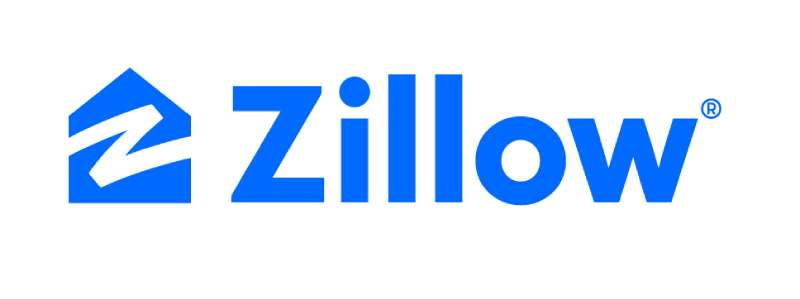
Zillow uses Open Sans as its primary product typeface, a humanist sans-serif font designed by Steve Matteson and commissioned by Google.
Open Sans was released in 2011 and is delivered via Google Fonts CDN across Zillow’s web and mobile interfaces. Zillow’s logo wordmark has consistently used custom-modified sans-serif lettering across all brand iterations since 2006.
What Type of Font Is Open Sans?

Open Sans is a humanist sans-serif typeface. That classification matters because humanist designs pull character shapes from calligraphic traditions, which gives letters a slightly warmer feel compared to geometric or grotesque alternatives.
A few defining traits:
- Large x-height: letters like “a,” “e,” and “n” sit tall relative to capitals, which improves readability at small sizes
- Wide apertures: open counters on letters like “c” and “s” reduce confusion at body text sizes
- Upright stress, neutral letterforms, and a true italic style (not just a slanted roman)
- 6 weights from Light 300 to Extra Bold 800, each with a matching italic
For Zillow, those characteristics are practical. Property listings pack a lot of information into tight spaces. A typeface with strong legibility at small sizes reduces friction while browsing.
The typographic hierarchy Zillow applies runs from roughly 12px for metadata up to 32px for headlines, with property prices typically sitting at 24px. That scale works cleanly with Open Sans because the font holds its weight and form across that full range.
Who Designed Open Sans?
Steve Matteson designed Open Sans while serving as Type Director at Ascender Corporation, a foundry later acquired by Monotype.
Google commissioned the typeface specifically for the open web. It was released in 2011 as part of Google Fonts, the same year the platform started reshaping how web designers handled typography at scale.
Matteson’s track record is worth knowing here. He also designed Droid Sans (the original Android UI font), Segoe (used across Microsoft Windows), and custom typefaces for Toyota, Xbox, and Unilever. Open Sans evolved directly from Droid Sans, but with wider characters and italic variants added for broader use.
The font is not exclusive to Zillow. It’s one of the most widely used typefaces on the internet, serving billions of page views per week at its peak. Zillow’s choice is a practical one, not a differentiating one.
Is Open Sans Free to Use?
Yes. Open Sans is released under the Apache License 2.0, which allows free use in personal and commercial projects, including web, app, and print contexts.
Where to get it:
- Google Fonts – free download or CDN embed, the simplest route for web use
- Adobe Fonts – available as part of any Adobe Fonts account at no additional cost
- GitHub – the full open-source repository is publicly available at googlefonts/opensans
For web implementation, the standard Google Fonts embed drops straight into the HTML <head>. Zillow specifically uses font-display: swap to speed up initial renders and keeps Arial, Helvetica, and system defaults as fallbacks. That stack ensures listings stay readable even before Open Sans finishes loading.
The font licensing situation is about as clean as it gets. No fees, no restrictions on commercial use, no need to credit the designer.
What Font Did Zillow Use Before?
Zillow has used sans-serif lettering across every logo version since the company launched in 2006, but the specific style shifted noticeably across redesigns.
Here’s how the logo font evolved:
| Era | Font Style | Key Change |
|---|---|---|
| 2006 (launch) | Thin sans-serif, mixed with “LLC” | Minimal, text-only wordmark |
| 2006–2019 | Wider sans-serif with diagonal letter tops on “i” and “l” | Added house/arrow icon; bolder weight |
| 2019 rebrand | Thicker, brighter blue sans-serif; diagonal tops removed | Simpler letterforms, new icon colors |
| 2024 refresh | Title case lettering turned black; “w” made more square | Darker blue icon, black wordmark text |
The 2019 rebrand was the most significant shift. Zillow redesigned the logo as part of a broader brand refresh that also launched Zillow Home Loans and restructured the Premier Agent program.
The 2024 update was more subtle. The lowercase “w” got a more square, extended form. The wordmark color changed from blue to black. The core identity stayed intact.
What Are the Best Free Alternatives to Open Sans?
Open Sans is free, so you can just use it. But if you want something with a slightly different character or better fit for your project, these are the closest alternatives:
| Font | Similarity | License | Source |
|---|---|---|---|
| Lato | Humanist sans-serif, warm tone, comparable x-height | OFL (free) | Google Fonts |
| Nunito | Similar weight range, slightly more rounded terminals | OFL (free) | Google Fonts |
| Source Sans Pro | Humanist sans-serif designed specifically for UI legibility | OFL (free) | Google Fonts / Adobe Fonts |
| Roboto | Geometric-humanist hybrid, wider character set | Apache 2.0 (free) | Google Fonts |
| Work Sans | Optimized for screen use, clean neutrality | OFL (free) | Google Fonts |
If you’re building something for real estate specifically, Lato and Source Sans Pro are probably the most natural substitutes. Both carry the same professional, neutral quality without leaning too heavily on any personality.
Inter is also worth mentioning. It’s become the default for a lot of product UI work in the last few years and shares Open Sans’s large x-height and screen optimization. Check out some Inter font pairing ideas if you’re building a property platform or dashboard.
How to Use Open Sans in Your Design Tools
Web and CSS
Add this to your <head> to pull Open Sans from the Google Fonts CDN:
<link href="https://fonts.googleapis.com/css2?family=Open+Sans:wght@300;400;600;700&display=swap" rel="stylesheet">
Then apply it in your CSS:
body {
font-family: 'Open Sans', Arial, Helvetica, sans-serif;
}
That fallback stack mirrors what Zillow uses. Arial and Helvetica cover Windows and older systems. The font-display: swap parameter (added inside the Google Fonts URL) prevents a flash of invisible text on slow connections.
Figma and Design Apps
Figma: Open Sans is available directly inside Figma through the Google Fonts integration. No manual install needed. Just type “Open Sans” in the font picker.
Photoshop / Illustrator: Download the font files from Google Fonts, then install them at the OS level. After that, they appear in every Adobe app automatically. If you need a walkthrough, see how to add fonts to Photoshop or how to add fonts to Adobe Illustrator.
Canva: Open Sans is built into Canva’s font library. Search for it directly in any text element.
Why Did Zillow Choose Open Sans?
Zillow didn’t choose Open Sans to stand out typographically. They chose it because it gets out of the way.
Real estate platforms carry an unusually high density of information per page. Listing prices, square footage, neighborhood data, agent details, mortgage estimates. The visual hierarchy has to work hard across all of that without ever feeling cluttered.
Open Sans handles that because:
- Its large x-height keeps body copy readable even at 13–14px
- The wide apertures prevent letters from collapsing together on low-resolution mobile screens
- The neutral tone doesn’t compete with listing photography
There’s also the trust factor. Font psychology research consistently shows that humanist sans-serifs score higher on warmth and approachability than geometric or grotesque alternatives. For a platform where people are making some of the biggest financial decisions of their lives, approachability matters.
Beyond those reasons, using a standard web font over a custom proprietary typeface has real performance benefits. Google Fonts CDN delivery is fast and cached across millions of sites, which means returning visitors often already have Open Sans loaded before they hit Zillow’s page.
Zillow has never publicly documented specific reasoning for the Open Sans choice. But when you look at the design principles behind the platform, the decision is fairly self-evident. Legibility, trust, performance. Open Sans checks all three without requiring a custom type license or extended development time.
Other platforms in the same space, including competitors like Redfin and Realtor.com, also lean toward neutral, high-legibility sans-serifs for similar reasons. There’s a reason the best fonts for websites in data-heavy categories tend to cluster around the same humanist families.
FAQ on The What Font Does Zillow Use
What is the main font Zillow uses on its website?
Zillow uses Open Sans as its primary UI font.
It’s a humanist sans-serif typeface designed by Steve Matteson and commissioned by Google. Zillow delivers it via Google Fonts CDN across both desktop and mobile interfaces.
Does Zillow use a custom font or a standard one?
Standard. Zillow relies on Open Sans rather than a proprietary or custom typeface.
That’s a deliberate call. Using a widely available web font prioritizes loading speed and cross-platform consistency over typographic uniqueness.
What font does the Zillow logo use?
The Zillow logo wordmark uses a custom-modified sans-serif style, not a publicly available typeface.
Every logo version since 2006 has stayed within the grotesque sans-serif category, with each redesign refining the letterforms rather than switching type families entirely.
Who designed the font Zillow uses?
Steve Matteson designed Open Sans while at Ascender Corp, under commission from Google. He also created Droid Sans and Segoe.
Open Sans was released in 2011. It was built specifically for legibility across screens at varying sizes and resolutions.
Is the Zillow font free to download?
Yes. Open Sans is free under the Apache License 2.0, covering both personal and commercial use.
You can download it directly from Google Fonts or access it through Adobe Fonts. No fees, no attribution required.
What font does the Zillow app use?
The Zillow mobile app uses Open Sans as its primary typeface, consistent with the web platform.
The font stack for mobile falls back to system defaults when Open Sans hasn’t loaded, keeping listings readable on slower connections.
Has Zillow ever changed its font?
The logo lettering has shifted with each major rebrand: 2006, 2019, and 2024. Each update refined the sans-serif style without switching type families.
The 2019 rebrand was the biggest change. Letter terminals were simplified, weight increased, and the color moved to a brighter blue.
What fonts are similar to the one Zillow uses?
Close alternatives include Lato, Source Sans Pro, and Nunito. All are free humanist sans-serifs with comparable x-height and screen legibility.
Work Sans and Roboto also work well for real estate UI projects that need a neutral, data-friendly grotesque feel.
Why did Zillow choose Open Sans over other fonts?
Open Sans handles high information density well. Its large x-height and wide apertures keep property data readable at small sizes on any screen.
The neutral tone also avoids competing with listing photography, which matters a lot in real estate UI design.
How can I use the same font as Zillow on my website?
Add the Google Fonts embed link to your HTML <head>, then set font-family: 'Open Sans', Arial, Helvetica, sans-serif in your CSS.
That mirrors Zillow’s own web font stack almost exactly, including the system font fallbacks they use for performance.
{
  "@context": "https://schema.org",
  "@type": "FAQPage",
  "mainEntity": [
    {
      "@type": "Question",
      "name": "What is the main font Zillow uses on its website?",
      "acceptedAnswer": {
        "@type": "Answer",
        "text": "Zillow uses Open Sans as its primary UI font. It's a humanist sans-serif typeface designed by Steve Matteson and commissioned by Google. Zillow delivers it via Google Fonts CDN across both desktop and mobile interfaces."
      }
    },
    {
      "@type": "Question",
      "name": "Does Zillow use a custom font or a standard one?",
      "acceptedAnswer": {
        "@type": "Answer",
        "text": "Standard. Zillow relies on Open Sans rather than a proprietary or custom typeface. That's a deliberate call. Using a widely available web font prioritizes loading speed and cross-platform consistency over typographic uniqueness."
      }
    },
    {
      "@type": "Question",
      "name": "What font does the Zillow logo use?",
      "acceptedAnswer": {
        "@type": "Answer",
        "text": "The Zillow logo wordmark uses a custom-modified sans-serif style, not a publicly available typeface. Every logo version since 2006 has stayed within the grotesque sans-serif category, with each redesign refining the letterforms rather than switching type families entirely."
      }
    },
    {
      "@type": "Question",
      "name": "Who designed the font Zillow uses?",
      "acceptedAnswer": {
        "@type": "Answer",
        "text": "Steve Matteson designed Open Sans while at Ascender Corp, under commission from Google. He also created Droid Sans and Segoe. Open Sans was released in 2011. It was built specifically for legibility across screens at varying sizes and resolutions."
      }
    },
    {
      "@type": "Question",
      "name": "Is the Zillow font free to download?",
      "acceptedAnswer": {
        "@type": "Answer",
        "text": "Yes. Open Sans is free under the Apache License 2.0, covering both personal and commercial use. You can download it directly from Google Fonts or access it through Adobe Fonts. No fees, no attribution required."
      }
    },
    {
      "@type": "Question",
      "name": "What font does the Zillow app use?",
      "acceptedAnswer": {
        "@type": "Answer",
        "text": "The Zillow mobile app uses Open Sans as its primary typeface, consistent with the web platform. The font stack for mobile falls back to system defaults when Open Sans hasn't loaded, keeping listings readable on slower connections."
      }
    },
    {
      "@type": "Question",
      "name": "Has Zillow ever changed its font?",
      "acceptedAnswer": {
        "@type": "Answer",
        "text": "The logo lettering has shifted with each major rebrand: 2006, 2019, and 2024. Each update refined the sans-serif style without switching type families. The 2019 rebrand was the biggest change. Letter terminals were simplified, weight increased, and the color moved to a brighter blue."
      }
    },
    {
      "@type": "Question",
      "name": "What fonts are similar to the one Zillow uses?",
      "acceptedAnswer": {
        "@type": "Answer",
        "text": "Close alternatives include Lato, Source Sans Pro, and Nunito. All are free humanist sans-serifs with comparable x-height and screen legibility. Work Sans and Roboto also work well for real estate UI projects that need a neutral, data-friendly grotesque feel."
      }
    },
    {
      "@type": "Question",
      "name": "Why did Zillow choose Open Sans over other fonts?",
      "acceptedAnswer": {
        "@type": "Answer",
        "text": "Open Sans handles high information density well. Its large x-height and wide apertures keep property data readable at small sizes on any screen. The neutral tone also avoids competing with listing photography, which matters a lot in real estate UI design."
      }
    },
    {
      "@type": "Question",
      "name": "How can I use the same font as Zillow on my website?",
      "acceptedAnswer": {
        "@type": "Answer",
        "text": "Add the Google Fonts embed link to your HTML `<head>`, then set `font-family: 'Open Sans', Arial, Helvetica, sans-serif` in your CSS. That mirrors Zillow's own web font stack almost exactly, including the system font fallbacks they use for performance."
      }
    }
  ]
}
Conclusion
So, what font does Zillow use? Open Sans, a humanist sans-serif typeface commissioned by Google and designed by Steve Matteson in 2011.
The choice reflects a clear priority: legibility over personality. For a property search platform handling dense listing data across millions of mobile and desktop sessions, that trade-off makes sense.
Open Sans is free, widely supported, and easy to implement in any web font stack. If you’re building something in the real estate UI space, it’s a practical starting point, and the best fonts for branding in data-heavy platforms tend to follow exactly this logic.

Renowned for his expertise in logo design and visual branding, Bogdan has developed a multitude of logos for various clients.
His skills extend to creating posters, vector illustrations, business cards, and brochures. Additionally, Bogdan's UI kits were featured on marketplaces like Visual Hierarchy and UI8.
He also wrote in the past years on sites like Design Your Way, WebDesignerDepot, WPDean, Designmodo, Speckyboy, Slider Revolution, and more.
- The Windsurf Logo History, Colors, Font, And Meaning - 10 October 2026
- How to Remove Background From Product Photos (No Photoshop) - 10 October 2026
- How Designers can Build a Stronger Online Creative Identity - 9 October 2026

Bogdan Sandu is a seasoned designer who has been designing websites since 2008. Renowned for his expertise in logo design and visual branding, Bogdan has developed a multitude of logos for various clients. His skills extend to creating posters, vector illustrations, business cards, and brochures. Additionally, Bogdan's UI kits were featured on marketplaces like Visual Hierarchy and UI8. He also wrote in the past years on sites like Design Your Way, WebDesignerDepot, WPDean, Designmodo, Speckyboy, Slider Revolution, and more.
You Might Also Like