The Washington Wizards logo represents one of the most recognized symbols in professional basketball, combining patriotic elements with modern sports design.
Since 1997, when the franchise rebranded from the Bullets, the team has refined its visual identity through multiple iterations. The current logo features a circular badge with a stylized basketball, Washington Monument imagery, and the team wordmark encircling the design.
The franchise began as the Chicago Packers in 1961, relocating to Baltimore in 1963 as the Bullets before settling in Washington, D.C. in 1973. Over six decades, the team has introduced 14 different primary logos, each reflecting shifts in team identity and basketball culture.
The 2015 redesign marked a significant departure from wizard imagery. The new emblem prioritizes geometric precision and architectural symbolism over character-based mascots.
What is the Washington Wizards Logo?
The Washington Wizards logo is a circular emblem featuring a stylized basketball with the Washington Monument positioned centrally, introduced in 2015 during the NBA playoffs. The design includes three stars representing D.C., Maryland, and Virginia, with “WASHINGTON” and “WIZARDS” wordmarks in white lettering around the perimeter. This combination mark replaced the wizard character used from 1997 to 2015.
Design Type: Combination mark (emblem + wordmark)
Primary Elements:
- Stylized basketball with red and blue striping
- Washington Monument silhouette
- Three stars (representing tri-state region)
- Circular frame with team name
- Monument ball design (introduced 2011)
Official Introduction Date: December 2014 (unveiled), active from 2015 NBA Playoffs
Designer/Agency: Not publicly disclosed
Trademark Status: Registered trademark of Monumental Sports & Entertainment
Color Palette:
- Navy Blue: #002B5C (Pantone 289 C)
- Red: #E31837 (Pantone 186 C)
- Silver: #C4CED4 (Pantone 877 C)
- White (supplementary)
Usage Context: Court floor designs, team uniforms, official merchandise, digital platforms, Capital One Arena branding, NBA broadcast graphics
How Has the Washington Wizards Logo Evolved Over Time?
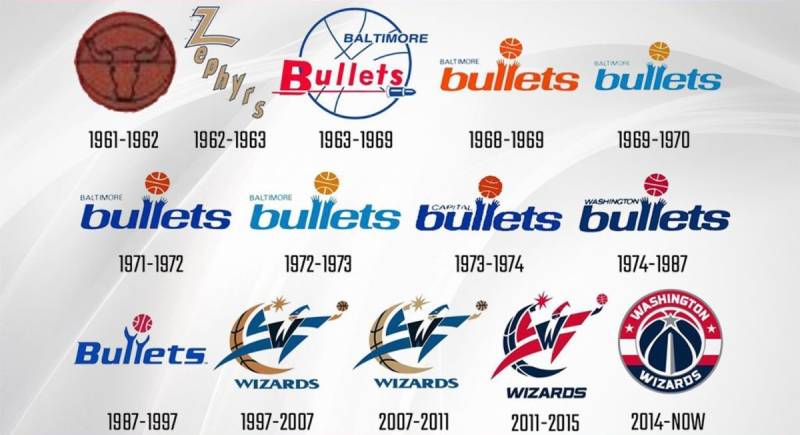
The franchise logo history spans from 1961 to present, transitioning through three team names and 14 primary logo designs. The Baltimore Bullets introduced the hands-reaching-for-basketball motif in 1968, which persisted for nearly 30 years through multiple color refinements.
The 1997 rebrand to Wizards brought wizard character imagery that lasted 18 years before returning to monument-based designs in 2015.
Original Chicago Packers Logo (1961-1962)
Years Active: 1961-1962
Design Description: Basketball player silhouette dribbling, enclosed in circular frame
Color Scheme: Red, white, blue
Designer: Unknown
Context: First season in NBA, Chicago franchise
Key Changes from Previous: Inaugural logo for expansion franchise
Cultural Significance: Short-lived identity before relocation
Chicago Zephyrs Logo (1962-1963)
Years Active: 1962-1963
Design Description: Basketball with directional lines suggesting wind motion
Color Scheme: Orange, blue
Designer: Unknown
Context: Name changed to Zephyrs (Greek wind deity) for second season
Key Changes from Previous: Complete redesign, wind-themed imagery
Cultural Significance: Brief experiment before Baltimore move
Baltimore Bullets Logo (1963-1968)
Years Active: 1963-1968
Design Description: Bullet piercing through basketball with “Baltimore Bullets” wordmark
Color Scheme: Orange, blue, white
Designer: Unknown
Context: Franchise relocated to Baltimore, adopted historic Bullets name
Key Changes from Previous: Military-inspired imagery, horizontal layout
Cultural Significance: Established Bullets brand identity
Baltimore Bullets Hands Logo (1968-1973)
Years Active: 1968-1973
Design Description: Wordmark “Bullets” with letter “L”s forming two hands reaching for basketball
Color Scheme: Blue, red, orange
Designer: Unknown
Context: Visual innovation in sports logo design
Key Changes from Previous: Typography integrated with iconography
Cultural Significance: This design template persisted through 1997
Capital Bullets Logo (1973-1974)
Years Active: 1973-1974
Design Description: Same hands-reaching design with “Capital” replacing “Baltimore”
Color Scheme: Blue, red
Designer: Unknown
Context: Franchise moved to Landover, Maryland (Capital Centre)
Key Changes from Previous: Geographic identifier changed
Cultural Significance: Transition year before Washington identity
Washington Bullets Logo (1974-1987)
Years Active: 1974-1987
Design Description: Hands-reaching-for-basketball with “Washington” above “Bullets”
Color Scheme: Blue, red
Designer: Unknown
Context: Team adopted Washington identity
Key Changes from Previous: “Washington” replaced “Capital”
Cultural Significance: Logo during 1978 NBA championship season
Washington Bullets Refined Logo (1987-1997)
Years Active: 1987-1997
Design Description: Cleaner hands design, title case typography, simplified five-finger rendering
Color Scheme: Blue, red
Designer: Unknown
Context: Visual modernization while maintaining brand recognition
Key Changes from Previous: Minimalist hand contours, improved legibility
Cultural Significance: Final Bullets logo before 1997 rebrand
Washington Wizards Original Logo (1997-2007)
Years Active: 1997-2007
Design Description: Wizard character with black “W” forming body, holding basketball and star, crescent moon at feet
Color Scheme: Light blue, gold, black, white
Designer: Unknown
Context: Complete rebrand following owner Abe Pollin’s decision to abandon gun-violence associations
Key Changes from Previous: Eliminated Bullets name, introduced mascot character
Cultural Significance: Controversial name change, Ku Klux Klan title concerns in African American community
Washington Wizards Refined Wizard Logo (2007-2011)
Years Active: 2007-2011
Design Description: Same wizard character with lighter, softer color palette
Color Scheme: Lighter blue, softer gold, black
Designer: Unknown
Context: Subtle aesthetic refinement
Key Changes from Previous: Softer shades, maintained character design
Cultural Significance: Transitional period in team identity
Washington Wizards Patriotic Logo (2011-2015)
Years Active: 2011-2015
Design Description: Wizard redesigned with red, white, and blue American flag colors
Color Scheme: Navy blue, red, white, gold
Designer: Unknown
Context: Reconnection with D.C. patriotic symbolism
Key Changes from Previous: Complete color overhaul matching American flag
Cultural Significance: Emphasized Washington D.C. national capital identity
Washington Wizards Monument Logo (2015-Present)
Years Active: 2015-Present
Design Description: Circular badge, basketball with Washington Monument, three stars, team wordmark perimeter
Color Scheme: Navy blue, red, silver, white
Designer: Unknown
Context: Mid-season logo change (rare in professional sports), playoff unveiling
Key Changes from Previous: Eliminated wizard character, architectural focus, monument ball integration
Cultural Significance: Modern minimalist approach, D.C. landmark emphasis
What Do the Design Elements of the Washington Wizards Logo Mean?
The Washington Monument silhouette symbolizes the nation’s capital and connects the team to D.C.’s historical and governmental significance. The three stars represent the tri-state region (District of Columbia, Maryland, Virginia) that comprises the team’s fan base.
The basketball striping echoes uniform design elements introduced in team apparel.
Why Did Washington Wizards Choose These Specific Colors?
Navy Blue (#002B5C)
The deep navy represents loyalty, stability, and trust. In color psychology, blue evokes confidence and professionalism.
The shade connects to American flag symbolism and federal government associations in Washington D.C.
Red (#E31837)
Red symbolizes passion, energy, and competitive intensity. The vibrant shade creates visual impact and attracts attention in arena environments.
This color also references patriotic American iconography, reinforcing the national capital connection.
Silver (#C4CED4)
Silver adds sophistication and modernity to the color palette. The metallic element provides contrast against primary colors.
Silver suggests innovation while maintaining elegant restraint in the overall composition.
What Typography Style Is Used in the Washington Wizards Logo?
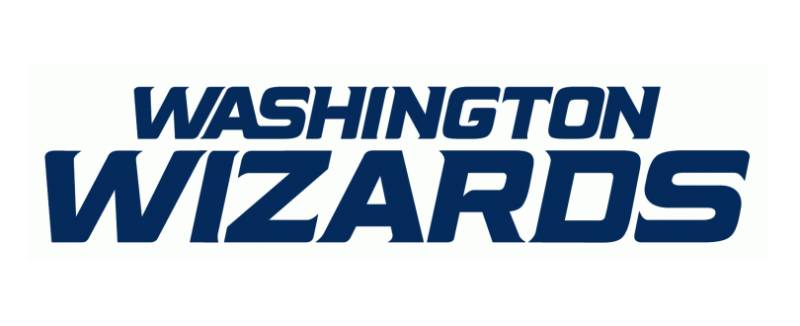
The wordmark uses a bold, angular custom sans-serif typeface. Letter forms feature sharp terminals and geometric construction, creating a modern athletic aesthetic.
The typography maintains readability at small sizes while projecting strength through thick stroke weights. Rounded corners on some letterforms balance the aggressive angularity.
The font resembles Friz Quadrata Bold in some iterations, adapted for team branding specifications.
What Are the Hidden Meanings in the Washington Wizards Logo?
The monument design creates a subtle “W” shape when viewed from specific angles. The basketball striping pattern mirrors the team’s uniform design, creating cohesive visual identity across apparel and branding.
The three stars form a triangular arrangement suggesting upward movement and aspiration. The circular badge format references championship rings and excellence in professional sports.
Some fans interpret the monument ball as a trophy, though designers haven’t confirmed this intention.
How Does the Washington Wizards Logo Compare to Competitor Logos?
Among Southeast Division teams, the Wizards logo emphasizes architectural symbolism rather than mascot characters. The Miami Heat logo uses flame imagery, while the Charlotte Hornets logo features insect iconography.
The Wizards’ monument-centered approach parallels civic identity strategies seen in NFL and MLB branding.
Compared to Chicago Bulls logo or Boston Celtics logo, the Wizards design prioritizes location over mascot personality. The geometric precision resembles Golden State Warriors logo bridge imagery.
The NBA logos landscape shows varying approaches, with the Wizards falling into the architectural monument category alongside teams like the Brooklyn Nets logo.
What Are the Technical Specifications of the Washington Wizards Logo?
Official Color Codes:
Primary Color: Navy Blue
- Hex: #002B5C
- RGB: (0, 43, 92)
- CMYK: (100, 64, 0, 60)
- Pantone: PMS 289 C
Secondary Color: Red
- Hex: #E31837
- RGB: (227, 24, 55)
- CMYK: (0, 100, 81, 4)
- Pantone: PMS 186 C
Accent Color: Silver
- Hex: #C4CED4
- RGB: (196, 206, 212)
- CMYK: (5, 0, 0, 20)
- Pantone: PMS 877 C
Dimensions and Proportions:
Aspect ratio: 1:1 (circular badge)
Minimum size requirements: 0.5 inches diameter for print, 32px for digital
Clear space specifications: Minimum clearance equal to height of one star element
Official usage guidelines: Maintained in Monumental Sports & Entertainment brand style guide
The logo should maintain proportional integrity when scaling. Vector graphics formats (SVG, EPS, AI) ensure quality across applications.
When converting for print, use CMYK color mode. For digital displays, RGB maintains color accuracy.
The DPI should be 300 for professional print applications. Screen resolution requires 72 DPI minimum.
What Cultural Impact Has the Washington Wizards Logo Had?
The 1997 name change from Bullets to Wizards sparked national debate about sports branding and social responsibility. Owner Abe Pollin’s decision followed the assassination of Israeli Prime Minister Yitzhak Rabin, his friend.
The wizard imagery faced immediate controversy within Washington’s predominantly African American community due to “Wizard” being a Ku Klux Klan title.
The 2015 monument logo redesign represented reconciliation with D.C. civic pride. Fans embraced the architectural symbolism over controversial mascot associations.
The mid-season logo change in professional sports was unprecedented, demonstrating franchise commitment to visual identity evolution despite playoff implications.
How Does the Washington Wizards Logo Fit Into the Overall Brand Identity?
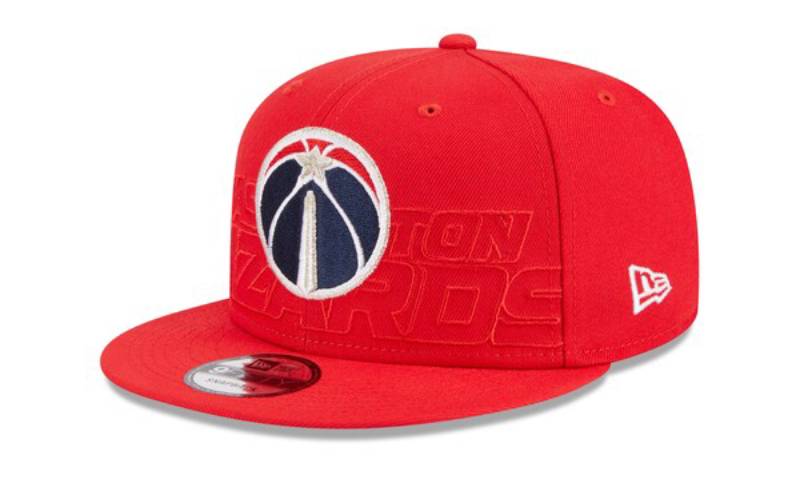
The logo serves as the anchor for comprehensive team branding across uniforms, arena design, and merchandise. Capital One Arena features monument ball imagery integrated into court floor design and seating sections.
The tri-state stars appear on alternate uniforms and City Edition jerseys. Brand guidelines specify logo placement on apparel, maintaining consistent visual hierarchy.
Nike partnership (current apparel provider) produces uniforms incorporating logo elements. Association uniforms feature white jerseys with red striping, while Icon uniforms use red with black accents.
The emphasis on D.C. geography creates regional connection beyond Washington proper, encompassing Maryland and Virginia markets.
How Should the Washington Wizards Logo Be Used?
Official Usage Guidelines:
Do maintain specified color codes across all applications
Do preserve clear space around logo perimeter
Do use approved file formats (SVG, EPS for print; PNG for digital)
Do scale proportionally without distortion
Don’t alter colors or substitute unauthorized shades
Don’t rotate or skew logo geometry
Don’t add effects, shadows, or gradients
Don’t place on busy backgrounds reducing legibility
Where to Access Official Logos:
NBA Media Central provides approved assets for media use
Monumental Sports & Entertainment offers brand resources for partners
Fan merchandise from official team store guarantees authentic logo reproduction
Licensing Information:
Commercial use requires licensing agreement with Monumental Sports & Entertainment
Editorial and news coverage permitted under fair use guidelines
Fan art for non-commercial purposes generally accepted
Trademark Protection Details:
Registered trademark symbols (®) must accompany commercial logo usage
Unauthorized commercial reproduction violates intellectual property law
Monumental Sports & Entertainment actively enforces trademark rights
When preparing files for professional printing, ensure proper bleed settings. The best file formats for printing logos include vector formats.
FAQ About the Washington Wizards Logo
When was the Washington Wizards logo created?
The original Wizards logo was created in 1997 when the franchise rebranded from the Bullets. The current monument-based logo design was introduced in December 2014 and became active during the 2015 NBA Playoffs, making it one of the rare mid-season logo changes in professional sports history.
Who designed the Washington Wizards logo?
The designer of the Washington Wizards logo has not been publicly disclosed. Monumental Sports & Entertainment, which owns the team, worked with design agencies but has not credited specific designers for the 2015 monument logo or earlier wizard character designs from 1997.
What do the colors in the Washington Wizards logo mean?
Navy blue symbolizes loyalty and stability, red represents passion and competitive energy, and silver adds modern sophistication. The red, white, and blue color scheme deliberately mirrors the American flag, emphasizing the team’s connection to the nation’s capital and creating patriotic resonance with the Washington D.C. fan base.
How many times has the Washington Wizards logo been redesigned?
Since the franchise began as the Chicago Packers in 1961, there have been 14 primary logo iterations. Three major redesigns occurred as the Wizards specifically: the original wizard character (1997), the patriotic color revision (2011), and the current monument badge (2015). This doesn’t include minor refinements and alternate logos.
Where can I download the official Washington Wizards logo?
Official logo files are available through NBA Media Central for credentialed media and through Monumental Sports & Entertainment for business partners. Fans can find approved logo imagery on the team’s official website and NBA.com. Unauthorized reproduction or commercial use without licensing violates trademark protections.
Is the Washington Wizards logo trademarked?
Yes, the Washington Wizards logo is a registered trademark owned by Monumental Sports & Entertainment. All logo iterations, including the current monument design and historical wizard imagery, are protected intellectual property. Commercial use requires licensing agreements, though editorial and non-commercial fan use generally falls under fair use guidelines.
What font is used in the Washington Wizards logo?
The logo uses a custom bold sans-serif typeface with angular letterforms and rounded terminals. Earlier wizard-era logos used typography inspired by Friz Quadrata Bold, a glyphic serif typeface. The current monument logo wordmark features proprietary lettering designed specifically for team branding and is not commercially available.
Why did Washington Wizards choose the Washington Monument for their logo?
The Washington Monument provides instant visual recognition of the nation’s capital and creates strong geographic identity. The 2015 redesign prioritized D.C. architectural symbolism over mascot characters, addressing previous controversy around wizard imagery. The monument also forms a subtle “W” shape and symbolizes aspiration and excellence in competitive achievement.
Conclusion
The Washington Wizards logo represents more than team identification. It embodies six decades of franchise evolution through three cities and two names.
The current monument-centered design connects basketball to Washington D.C.’s civic identity. Navy blue, red, and silver create patriotic resonance while maintaining modern athletic aesthetics.
From the hands-reaching Bullets wordmark to the wizard character to today’s architectural emblem, each iteration reflected contemporary design trends and cultural contexts. The 2015 logo positions the franchise within NBA branding’s architectural monument category.
As the team continues competing in the Eastern Conference, the logo serves as visual shorthand for D.C. basketball heritage and regional pride across the tri-state area.
There are also similar articles discussing the Dallas Mavericks logo, the Atlanta Hawks logo, the Brooklyn Nets logo, and the New York Knicks logo.
And let’s not forget about articles on the Orlando Magic logo, the Denver Nuggets logo, the Los Angeles Lakers logo, and the Minnesota Timberwolves logo.

Renowned for his expertise in logo design and visual branding, Bogdan has developed a multitude of logos for various clients.
His skills extend to creating posters, vector illustrations, business cards, and brochures. Additionally, Bogdan's UI kits were featured on marketplaces like Visual Hierarchy and UI8.
He also wrote in the past years on sites like Design Your Way, WebDesignerDepot, WPDean, Designmodo, Speckyboy, Slider Revolution, and more.
- The Cursor Logo History, Colors, Font, And Meaning - 24 September 2026
- Top 7 Web Design Subscription Services That Replace Full-Time Hires - 24 September 2026
- Canva vs PowerPoint: Which Is Better for Presentations? - 22 September 2026

Bogdan Sandu is a seasoned designer who has been designing websites since 2008. Renowned for his expertise in logo design and visual branding, Bogdan has developed a multitude of logos for various clients. His skills extend to creating posters, vector illustrations, business cards, and brochures. Additionally, Bogdan's UI kits were featured on marketplaces like Visual Hierarchy and UI8. He also wrote in the past years on sites like Design Your Way, WebDesignerDepot, WPDean, Designmodo, Speckyboy, Slider Revolution, and more.
You Might Also Like