The Sony logo is one of the most recognized corporate marks on the planet. Four letters. Black ink. That’s it. And yet those four letters carry decades of consumer trust across electronics, gaming, film, and music. Sony Group Corporation, headquartered in Minato, Tokyo, was founded on May 7, 1946 by Masaru Ibuka and Akio Morita under the name Tokyo Tsushin Kogyo. The company rebranded to Sony in 1958, and the current version of the logo has been in use since 1973. Across roughly six design iterations, the wordmark has been refined but never fully overhauled, a testament to its original strength.
What Is the Sony Logo?
The Sony logo is a wordmark consisting of the company name “SONY” set in a modified version of the Clarendon typeface. It was introduced in its current form in 1973, designed in-house by Yasuo Kuroki under the direction of former president Norio Ohga. The mark communicates simplicity, precision, and global reliability.
Here’s a breakdown of the logo’s core attributes:
- Design Type: Wordmark (also called a logotype). No icon, no symbol, no mascot. Just the company name rendered in a specific font treatment.
- Primary Elements: The four uppercase letters S, O, N, Y set in a bold slab serif style with clean rectangular serifs and slightly modified letterforms.
- Official Introduction Date: The current version dates to 1973. The “Sony” name first appeared on products in 1955, and the first wordmark logo was formally introduced in 1957.
- Designer: Yasuo Kuroki, Sony’s in-house designer from 1961 to 1973, with oversight from Norio Ohga. Akio Morita also contributed direction on the brand’s visual identity.
- Trademark Status: The Sony wordmark was registered as a trademark in the late 1950s. It is protected globally and managed strictly through Sony’s corporate identity program.
- Color Palette: Primary color is black (#000000). Secondary is white (#FFFFFF). That’s the whole color palette. A monochrome scheme with no additional accent colors in the corporate mark.
- Usage Context: The logo appears on all Sony consumer electronics (TVs, cameras, headphones), PlayStation consoles, Sony Pictures film titles, Sony Music releases, product packaging, retail signage, digital platforms, and corporate communications worldwide.
How Has the Sony Logo Evolved Over Time?
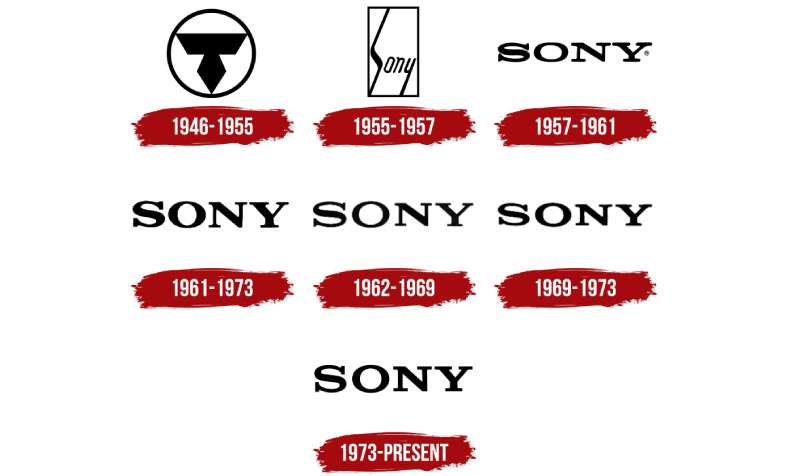
Sony’s visual identity has gone through about six versions since 1946. But here’s the thing: only the first two looked dramatically different from what we see today. The rest were refinements. Tiny tweaks to letter weight, serif shape, and spacing.
The company found its formula early and stuck with it. Most consumers probably never noticed the differences between the 1961, 1962, 1969, and 1973 versions. That kind of restraint is rare.
The Tokyo Tsushin Kogyo Emblem (1946-1955)
Years Active: 1946 to 1955
The original logo wasn’t really a “Sony” logo at all. The company was still called Tokyo Tsushin Kogyo (TTK), and the emblem reflected that.
It was a circular monochrome badge with an abstract geometric figure, a kind of trapezoid connected to a rhombus shape. Think of it like a stylized car emblem. Very mid-century, very geometric.
Black on white. No text spelling “Sony” because the name didn’t exist yet.
The psychology behind those shapes suggested exchange, energy, and forward movement. Looking back, it feels almost prophetic for a company that would eventually push consumer technology forward for decades.
The First Sony Wordmark (1955-1957)
Years Active: 1955 to 1957
This is where the “Sony” name first showed up. The mark was a handwritten-style logotype enclosed in a vertically oriented rectangular frame.
The “S” had elongated strokes reaching toward the top and bottom of the frame. The “Y” tail touched the bottom edge. It felt almost like a script font treatment, smooth and stylistic.
This version was registered as Sony’s trademark in 1955.
The shift from an abstract emblem to a typographic wordmark was significant. It showed the founders already understood that the name itself was the brand’s strongest asset.
The Bold Serif Wordmark (1957-1961)
Years Active: 1957 to 1961
Yasuo Kuroki entered the picture. He dropped the rectangular frame entirely and set “SONY” in bold uppercase letters with large, rounded serifs.
The serifs were exaggerated at their tips, giving the wordmark a unique personality. It was confident, maybe even a little playful.
This was also the version that went international. Sony started displaying the logo on neon billboards in cities around the world. The design scaled well (it had to, for those billboards) and translated across cultures because it was just four clean letters.
A registered trademark “R” appeared to the right of the name during this period.
The Refined Wordmark (1961-1962)
Years Active: 1961 to 1962
Kuroki made the letters taller and added more breathing room between them. The letter spacing opened up.
The serifs shrank a bit but remained visible and rounded. The “S” was made slightly larger than the other letters to compensate for a visual effect where it appeared smaller at the same height.
The trademark “R” disappeared from the logo itself.
This version feels like the moment Sony started taking its brand guidelines seriously, thinking about optical corrections and fine spacing adjustments.
The Sharpened Wordmark (1962-1969)
Years Active: 1962 to 1969
The serifs and horizontal strokes were straightened. Gone were the rounded tips. Everything became sharper and more angular.
Letter contours got slightly thinner, which added a quality of classic elegance. The monochrome scheme stayed the same.
This was the era when Sony was becoming a household name through the Trinitron TV and transistor radios. The logo needed to feel precise and trustworthy on product labels, and this version delivered that.
The 1969 Revision (1969-1973)
Years Active: 1969 to 1973
A softer step back. The serifs regained slightly rounded corners, similar to the 1957 version but shorter and more controlled.
The letters were stretched a bit. It was a subtle change, the kind that only a designer would catch if you placed the two versions side by side.
The Current Sony Logo (1973-Present)
Years Active: 1973 to present
This is the one. The version Norio Ohga finally approved after years of pushing for the right visual.
The typography closely resembles the Clarendon Medium font, originally created by Robert Besley in the mid-1800s, but with Sony-specific modifications. The serifs are straight and clean. The letter weight is bold but not heavy. Everything looks balanced and intentional.
Black on white. No gradients, no effects, no extras.
In 1981, for Sony’s 35th anniversary, the company ran a worldwide competition to find a new logo. They received around 30,000 submissions. Co-founder Masaru Ibuka wasn’t impressed by any of them. They kept the 1973 version.
That’s a pretty strong endorsement for a design. Fifty-plus years and counting.
What Do the Design Elements of the Sony Logo Mean?

The Sony logo is pure wordmark. No hidden icons, no secondary marks to decode. The meaning lives in the typographic choices, the color selection, and the deliberate absence of decoration.
Everything communicates through restraint. The boldness of the letters carries authority while the clean geometry suggests precision engineering, which is exactly what Sony wants you to associate with its products.
Why Did Sony Choose Black and White for Its Logo?

Sony’s official logo color is black (#000000). That’s it.
RGB values: 0, 0, 0. CMYK: 75, 68, 67, 90. Pantone: PMS Black 6 C.
In terms of color psychology, black represents authority, sophistication, and permanence. It’s the most “serious” color you can use. For a company selling precision electronics, cameras, and professional equipment, that seriousness translates directly into perceived quality.
White serves as the background, providing maximum contrast. The pairing is as straightforward as it gets, and that’s the point. No secondary colors compete for attention. The name stands alone.
It’s worth noting that among black logos from major corporations, Sony’s is one of the most enduring. The monochrome approach also makes the mark extremely versatile across different media, from tiny product labels to massive building signage.
What Typography Style Is Used in the Sony Logo?
The Sony logo uses a custom modification of the Clarendon typeface. Clarendon is a serif classification known as a slab serif, originally designed by Robert Besley in 1845.
Sony’s version has slightly shorter, straighter serifs than standard Clarendon. The letter weight is bold, and the x-height proportions were refined by Yasuo Kuroki to make the “S” optically match the height of the other three letters.
The choice of a slab serif says something. Sans-serif fonts are the default for most tech companies these days. But Sony went with serifs back in the 1950s and never wavered. It gives the logo a sense of permanence that pure sans-serif marks sometimes lack.
The result sits among the most recognizable font-based logos in corporate history.
What Are the Hidden Meanings in the Sony Logo?
There aren’t hidden symbols in the traditional sense. No arrow tucked between letters, no clever negative space trick. The meaning is entirely in the name itself.
“Sony” comes from the Latin word “sonus,” meaning sound, which connects to the company’s origins in audio equipment. It also draws from “sonny,” a term used in post-war Japan to describe young, spirited individuals.
If there’s a hidden design choice, it’s the optical size adjustment of the “S.” Without correction, the letter would appear shorter than O, N, and Y due to how the human eye perceives curved versus straight-topped characters. Kuroki deliberately made the “S” slightly taller. Most people never notice. That’s the point.
How Does the Sony Logo Compare to Competitor Logos?
Look at Sony’s competitors and you’ll see a pattern. Most of them have moved toward sans-serif wordmarks or abstract symbols.
The Panasonic logo uses a clean sans-serif. LG’s logo combines a wordmark with a stylized face icon. Samsung went full sans-serif inside an oval. Microsoft paired a sans-serif wordmark with a four-color window icon.
Sony is one of the few major electronics brands still using a serif-based logo. And honestly, that’s part of what makes it stand out. In a sea of Helvetica-inspired tech marks, Sony’s Clarendon-based wordmark feels different. More grounded, maybe.
The HP logo is another interesting comparison. It uses a circular emblem with initials inside, a completely different approach. Dell uses a tilted “E” within a circle. These are all combination marks or letter marks, while Sony stays committed to the pure wordmark format.
Sony’s approach relies entirely on the strength of the name and the typeface. No backup symbol. No icon to fall back on. That takes confidence.
What Are the Technical Specifications of the Sony Logo?
Official Color Codes
- Primary Color: Black
- Hex: #000000
- RGB: (0, 0, 0)
- CMYK: (75, 68, 67, 90)
- Pantone: PMS Black 6 C
- Secondary Color: White
- Hex: #FFFFFF
- RGB: (255, 255, 255)
- CMYK: (0, 0, 0, 0)
Dimensions and Proportions
Sony’s corporate identity program specifies strict rules around logo reproduction. The aspect ratio of the wordmark is roughly 3.5:1 (width to height), though exact ratios depend on the application context.
Minimum size requirements ensure the logo stays legible at small scales. For print applications, a minimum character height is specified (typically around 4-5mm for product labels). For digital screens, minimum pixel heights are defined to prevent rendering issues.
Clear space (the area around the logo that must stay empty) is generally defined as a proportion of the letter height. No other text, images, or graphic elements can enter this zone.
The logo must always appear in its official form. No stretching, no recoloring outside the approved black/white scheme, no modification of the letterforms.
What Cultural Impact Has the Sony Logo Had?
The Sony wordmark has been printed on Walkman cassette players, Trinitron TVs, PlayStation consoles, Handycam camcorders, and thousands of other products since the late 1950s. It appeared in film company title cards through Sony Pictures. It fronted music releases through Sony Music Entertainment.
That kind of cross-industry presence means the logo carries different associations for different people. To a gamer, it’s PlayStation. To a filmmaker, it’s Columbia Pictures. To an audiophile, it’s high-end headphones and speakers.
Few logos function across that many industries simultaneously. The wordmark’s simplicity is what makes that possible. It doesn’t carry visual baggage from any single product category.
The 1981 anniversary competition, where 30,000 design submissions were rejected in favor of keeping the existing logo, became a widely cited example of brand consistency. It showed that a well-designed mark doesn’t need to chase trends.
How Does the Sony Logo Fit Into the Overall Brand Identity?
Sony operates a family branding structure. The corporate Sony wordmark sits at the top, and sub-brands like PlayStation, Sony Pictures, Sony Music, Alpha, BRAVIA, and Xperia each carry their own visual identity underneath it.
The corporate logo acts as the trust signal. When you see “SONY” on a PlayStation box or a BRAVIA TV, it connects that product to the larger company’s reputation.
Sony’s brand style guide governs how the corporate mark interacts with sub-brand logos, specifying spacing, hierarchy, and placement rules. The corporate wordmark is always positioned prominently but never competes visually with the sub-brand’s own identity.
Previous slogans like “make.believe,” “It’s a Sony,” and “Be Moved” were always secondary to the wordmark. The logo never needed a tagline to function, which is a sign that the visual hierarchy was built correctly from the start.
The consistency of this system, same typeface, same monochrome palette, same four letters, across every product and division for over fifty years, is what builds the kind of recognition that most brands only dream about.
How Should the Sony Logo Be Used?
Official Usage Guidelines
Sony’s trademark and identity guidelines are strict. Here’s what they typically cover:
- Do: Reproduce the logo from official digital files only. Maintain the required clear space around the mark. Use only approved black or white versions depending on background.
- Don’t: Alter the letterforms, change the color saturation or hue, stretch or compress the logo, add drop shadows or effects, place it on busy backgrounds that reduce readability, or combine it with other logos without authorization.
Accessing Official Logo Files
Sony doesn’t make its corporate logo freely downloadable for public use. Partners, licensees, and authorized dealers access logo files through Sony’s brand management portal or directly through partnership agreements.
For specific product sub-brands (like Sony Digital Cinema 4K or PlayStation), Sony provides dedicated brand and logo guideline documents that include downloadable assets and usage terms.
Trademark and Licensing
The Sony wordmark is a registered trademark of Sony Group Corporation. Unauthorized use is a trademark infringement. This includes using the logo on merchandise, in advertising, or on websites without written permission from Sony.
If you’re developing content that references Sony products (like reviews or editorial), you can typically reference the brand name in text. But reproducing the actual logo graphic requires compliance with Sony’s trademark usage policies. When in doubt, contact Sony’s licensing department first. They are protective of this mark, and for good reason. It took them 27 years to get it right and another 50-plus to prove it was worth keeping.
FAQ on The Sony Logo
What font is used in the Sony logo?
The Sony logo uses a custom modification of Clarendon, a slab serif typeface originally designed by Robert Besley in 1845. Sony’s in-house designer Yasuo Kuroki refined the letterforms between 1961 and 1973. The serifs are straighter and shorter than standard Clarendon.
When was the current Sony logo introduced?
The current Sony wordmark was finalized in 1973. Former president Norio Ohga approved the design after years of revisions.
It has remained unchanged since. The company even rejected 30,000 submissions during a 1981 anniversary competition and kept this version.
Who designed the Sony logo?
Yasuo Kuroki, Sony’s full-time corporate designer, created the wordmark. He worked under the direction of Norio Ohga and alongside co-founder Akio Morita. The logo evolved through multiple iterations from 1957 to 1973 before reaching its final form.
What does the word “Sony” mean?
The name combines the Latin word “sonus,” meaning sound, with “sonny,” which in post-war Japan described a young person with a free spirit. Masaru Ibuka and Akio Morita chose it because it was short, memorable, and easy to pronounce globally.
What are the official colors of the Sony logo?
Black and white. The primary color is black (Hex #000000, Pantone PMS Black 6 C). White (#FFFFFF) serves as the background.
No secondary or accent colors exist in the corporate identity. The monochrome scheme communicates elegance and integrity.
How many times has the Sony logo changed?
Sony has gone through roughly six logo versions since 1946. The first two were significantly different. The rest were subtle refinements to letter weight, serif shape, and spacing.
Only the original Tokyo Tsushin Kogyo emblem and the 1955 handwritten wordmark look noticeably different from today’s version.
Is the Sony logo trademarked?
Yes. Sony registered its wordmark as a trademark in the late 1950s. It is protected globally under Sony Group Corporation. Unauthorized reproduction on merchandise, advertising, or websites constitutes trademark infringement. Sony actively enforces these protections.
Why is the Sony logo so simple?
Sony chose a pure wordmark with no icons or symbols. The four-letter name was distinctive enough on its own.
This approach follows a minimalist design philosophy. Fewer elements mean better scalability across products, from tiny headphone labels to massive billboard signage worldwide.
What type of logo is the Sony logo?
It’s a wordmark, also called a logotype. The entire logo is the company name rendered in a specific typographic treatment. No symbol, mascot, or icon accompanies it. Companies like Samsung and Cisco use similar wordmark-based approaches.
Can I use the Sony logo for my project?
Not without permission. Sony does not make its corporate logo freely available for public use. Partners and licensees access files through Sony’s brand management portal.
Editorial references to the brand name in text are generally acceptable. But reproducing the actual graphic requires written authorization from Sony Group Corporation.
Conclusion
The Sony logo proves that a wordmark doesn’t need complexity to become iconic. Four letters, a modified Clarendon slab serif, and a black-and-white palette have carried this Japanese multinational corporation through over fifty years without a single major redesign.
From PlayStation consoles to Sony Pictures film credits to BRAVIA televisions, the mark works everywhere because it commits to nothing but clarity.
Yasuo Kuroki and Norio Ohga got it right in 1973. The principles behind great logo design haven’t changed much since. Keep it simple, make it scalable, and trust the name to do the heavy lifting.

Renowned for his expertise in logo design and visual branding, Bogdan has developed a multitude of logos for various clients.
His skills extend to creating posters, vector illustrations, business cards, and brochures. Additionally, Bogdan's UI kits were featured on marketplaces like Visual Hierarchy and UI8.
He also wrote in the past years on sites like Design Your Way, WebDesignerDepot, WPDean, Designmodo, Speckyboy, Slider Revolution, and more.
- Death Note Font Generator - 26 October 2026
- Versatile Georgia Font Pairing for Timeless Layouts - 24 October 2026
- How to Turn Inconsistent UI into One Design System (Without a Full Redesign) - 24 October 2026

Bogdan Sandu is a seasoned designer who has been designing websites since 2008. Renowned for his expertise in logo design and visual branding, Bogdan has developed a multitude of logos for various clients. His skills extend to creating posters, vector illustrations, business cards, and brochures. Additionally, Bogdan's UI kits were featured on marketplaces like Visual Hierarchy and UI8. He also wrote in the past years on sites like Design Your Way, WebDesignerDepot, WPDean, Designmodo, Speckyboy, Slider Revolution, and more.
You Might Also Like