

The Oracle logo is one of those marks you’ve probably seen hundreds of times without really thinking about it. It sits on database dashboards, cloud platforms, enterprise software suites, and even on Formula 1 cars. But there’s more going on behind that red wordmark than most people realize.
Oracle Corporation, founded in 1977 by Larry Ellison, Bob Miner, and Ed Oates, started life as Software Development Laboratories. The logo we know today didn’t show up until 1995, after the company went through a handful of name changes and visual overhauls. It’s a custom sans-serif wordmark rendered in bold red on white, and it’s been doing its job quietly for close to three decades now.
That kind of staying power is rare in tech branding. Most companies can’t go five years without a refresh. Oracle’s approach says something about how a well-built identity holds up when the foundation is solid.
What Is the Oracle Logo?
The Oracle logo is a custom wordmark featuring the company name “ORACLE” in uppercase, bold, sans-serif lettering. It was introduced in its current form in 1995 and uses a proprietary typeface with sharp edges and distinctive letterforms. The design pairs Oracle Red (Pantone PMS 485) with white to communicate strength and reliability in enterprise technology.
Here’s what defines it:
- Design Type: Wordmark (text-only mark), sometimes paired with a standalone oval “O” icon for digital applications
- Primary Elements: Custom sans-serif typography with modified letterforms. The “O” reads as a horizontal oval, the “A” has an angled crossbar, and the “E” features a rounded extension. No additional graphic symbols in the primary version
- Official Introduction Date: The current version was finalized in 1995. The first Oracle-branded logo appeared in 1983
- Designer/Agency: Created internally. The closest commercially available match is Good Times Regular by Ray Larabie (Typodermic), but Oracle’s typeface is proprietary
- Trademark Status: Registered trademark of Oracle Corporation. Protected under U.S. and international trademark law. The mark covers software, cloud services, hardware, and related technology products
- Color Palette: Oracle Red (Hex: #C74634, Pantone PMS 485) as the primary color. White (#FFFFFF) as the secondary. Black (#000000) permitted for monochrome applications. A custom RGB gradient is also allowed for on-screen use
- Usage Context: Enterprise software interfaces, Oracle Cloud Infrastructure branding, marketing materials, corporate communications, Oracle Red Bull Racing sponsorship, hardware products, conference signage (Oracle CloudWorld), and digital platforms
How Has the Oracle Logo Evolved Over Time?
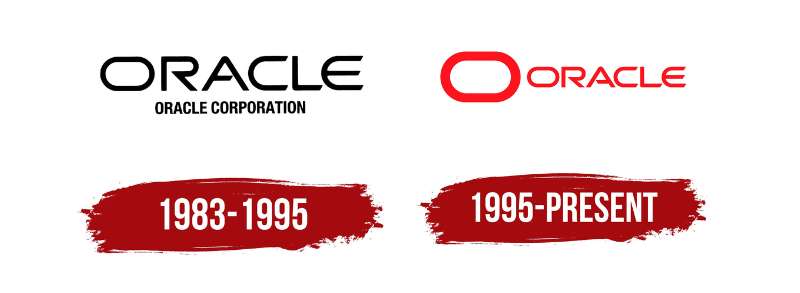
Oracle’s visual identity has gone through four main stages since 1977. The changes track closely with the company’s growth from a small database startup to one of the biggest enterprise tech companies on the planet.
Each version stripped away complexity and moved toward something cleaner. Actually, that’s the interesting part. Most tech brands add elements over time. Oracle kept removing them.
The Software Development Laboratories Era (1977-1979)
Years Active: 1977-1979
Oracle didn’t have a real logo during this period. The company was called Software Development Laboratories (SDL), and branding wasn’t exactly a priority. The team was focused on building what would become the Oracle Database, working on a project tied to a CIA contract codenamed “Oracle.”
Whatever basic marks existed were purely functional. No thought toward brand guidelines or visual systems. Just a name on a door, basically.
This phase matters because the CIA project name is where “Oracle” actually comes from. The branding DNA started before anyone thought about branding at all.
The Relational Software Logo (1979-1983)
Years Active: 1979-1983
When the company rebranded to Relational Software, Inc. (RSI), they picked up a temporary wordmark. It used a bold, rounded sans-serif font in a gradient red shade, set against geometric rectangular shapes in the background.
Honestly? It looked dated even for 1979. The bubbly letterforms and boxy layout felt more like a local print shop than a technology company building the future of database management.
The red was already there, though. That stuck around.
Color Scheme: Gradient red on dark geometric background
Context: The company needed a visual identity after outgrowing the SDL name. Their Oracle v.2 database was gaining commercial traction, and looking like a real company mattered more now.
Cultural Significance: Minimal. But the choice of red at this early stage would prove to be lasting.
Oracle Systems Corporation Logo (1983-1995)
Years Active: 1983-1995
This is where things get interesting. The company became Oracle Systems Corporation in 1983, and the logo that came with it laid the groundwork for everything after.
Two clean sans-serif wordmarks appeared. “ORACLE” on top, “ORACLE CORPORATION” below, both in black. The letters were horizontally stretched with sharpened edges on several characters.
The designers introduced some hand-drawn details that became signature elements. The “O” was shaped as a horizontal oval. The “A” got an angled crossbar. The “E” featured a rounded extension that some people compare to the Ukrainian letter “Ye.” These details gave the wordmark personality without adding clutter.
Key Changes from Previous: Completely abandoned the gradient background and bubbly font. Moved to a clean, minimalist design focused purely on type. The shift from decorative to stripped-back was significant for a tech company in the early 1980s.
Cultural Significance: This was Oracle declaring itself a serious enterprise player. The no-nonsense approach matched the corporate market they were selling into. Database administrators and IT directors don’t need flashy graphics. They need to trust you.
The Current Oracle Logo (1995-Present)
Years Active: 1995-present
The 1995 update is really more of a refinement than a redesign. Oracle added the enlarged “O” as a standalone graphic element, a stretched ellipse placed to the left of the wordmark. Everything was repainted in red.
The text lost the “Corporation” subtitle. Just “ORACLE” now, in that same custom typeface with sharp edges and deep curves.
Then in 2010, Oracle acquired Sun Microsystems and folded their diamond-shaped ambigram (designed by Stanford professor Vaughan Pratt) into a secondary mark used on hardware products. That version sits the Sun logo above the red Oracle rectangle.
Color Scheme: Oracle Red (Pantone PMS 485) and white
Key Changes from Previous: Introduction of the oval “O” icon, shift from black to red, removal of “Corporation” text
Cultural Significance: The red branding cemented Oracle’s identity during its biggest growth period. This was when the company expanded beyond databases into ERP, cloud services, and hardware. The logo needed to work across all of it, and it did.
What Do the Design Elements of the Oracle Logo Mean?
The Oracle logo communicates through restraint. Every element in the mark serves a specific purpose, from the modified letterforms to the color choice.
There’s no mascot. No abstract swoosh. No hidden arrow or smile. It’s a wordmark that relies on the quality of its typography elements and color to carry the brand.
That approach works well for B2B companies. Your audience is enterprise buyers, CTOs, procurement teams. They respond to clarity, not cleverness.
Why Did Oracle Choose These Specific Colors?
Oracle Red
Hex: #C74634 / Pantone: PMS 485 / RGB: (199, 70, 52) / CMYK: (0, 100, 100, 0)
Red signals energy and confidence. In color psychology, it triggers feelings of urgency and action. For a company selling mission-critical database and cloud infrastructure, that fits. You want your clients to feel that you’re active, not passive.
Among red logos in the tech space, Oracle’s shade runs warmer and darker than, say, YouTube’s red or Netflix’s crimson. It reads as mature and corporate rather than playful.
White
Hex: #FFFFFF
White provides the contrast needed for the red to hit hard. It also signals professionalism and cleanliness, which matters when your product is handling someone’s entire business database.
Black (Monochrome Version)
Hex: #000000
Used for print contexts where color reproduction is limited. Newspapers, faxes (yes, enterprise still uses faxes), single-color print runs.
What Typography Style Is Used in the Oracle Logo?
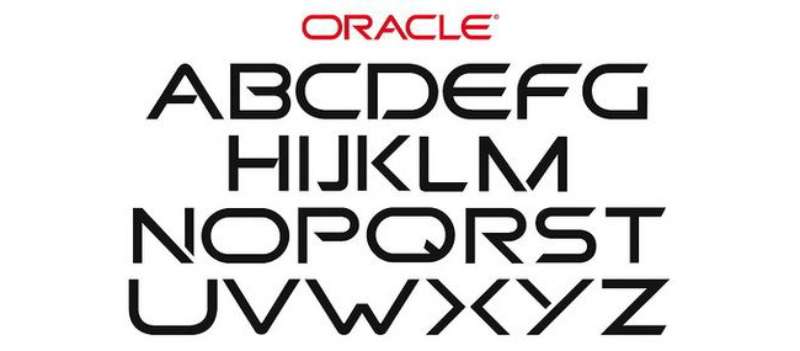
Oracle uses a custom proprietary typeface. It’s a geometric sans-serif with some unique modifications that you won’t find in any commercial font library.
The closest publicly available match is Good Times Regular, designed by Ray Larabie at Typodermic. But it’s not exact.
What makes Oracle’s type distinctive: all horizontal strokes are cut at angles, including the crossbar on the “A.” The “O” is wider than tall, giving it that stretched oval shape. The “E” has a rounded terminal that’s unlike any standard typeface. And the “R” has a leg that kicks out with a sharp edge.
The lack of serifs keeps it modern. The custom cuts keep it ownable. Took me a while to appreciate how much personality you can inject into a six-letter word without adding any extra graphics. The kerning is tight but readable, and the overall weight feels authoritative without being heavy-handed.
What Are the Hidden Meanings in the Oracle Logo?
The standalone oval “O” icon doubles as a subtle symbol. Some interpret it as a portal or gateway, a reference to Oracle being the entry point to data and cloud infrastructure. Others see it as representing unity across Oracle’s product ecosystem (software, hardware, cloud).
The name itself carries meaning. “Oracle” suggests a source of wisdom or prophecy, which ties directly to the company’s roots in data and information retrieval.
There’s no officially confirmed hidden message from Oracle’s design team. But the combination of the commanding uppercase letters, the distinctive “O,” and the aggressive red creates a visual shorthand for authority and reliability that goes beyond the literal text.
How Does the Oracle Logo Compare to Competitor Logos?
Enterprise tech logos tend to fall into two camps: clean wordmarks and abstract icon-plus-text combos. Oracle sits firmly in the first camp, alongside companies like SAP and Cisco.
But the differences matter.
Salesforce goes with a cloud icon and a friendlier blue palette, aiming to feel approachable. IBM uses its iconic striped lettering, which reads as established and institutional. Microsoft‘s four-color window mark leans toward accessibility and diversity.
Oracle’s red wordmark stands apart because it’s more aggressive than most enterprise brands. Where Workday and HubSpot use warm oranges and approachable styling, Oracle doesn’t try to be friendly. It tries to be trusted. There’s a difference.
Among tech company logos, Oracle’s is one of the few that has barely changed in three decades. That consistency is a competitive advantage itself. When Atlassian or Splunk rebrand every few years, Oracle just… stays. Your mileage may vary on whether that’s stubbornness or smart strategy, but for their customer base, stability means something.
What Are the Technical Specifications of the Oracle Logo?
Official Color Codes
Primary Color: Oracle Red
- Hex: #C74634
- RGB: (199, 70, 52)
- CMYK: (0, 100, 100, 0)
- Pantone: PMS 485
Secondary Color: White
- Hex: #FFFFFF
- RGB: (255, 255, 255)
- CMYK: (0, 0, 0, 0)
Monochrome: Black
- Hex: #000000
- RGB: (0, 0, 0)
- CMYK: (0, 0, 0, 100)
Dimensions and Proportions
Oracle’s logo uses a horizontal aspect ratio where the wordmark is significantly wider than it is tall. The letterforms are stretched to create a sense of breadth and stability.
The standalone “O” icon maintains a roughly 1:0.8 width-to-height ratio (wider than a circle, narrower than a standard ellipse). Minimum reproduction sizes and clear space requirements are defined in Oracle’s official brand style guide, which mandates padding around the mark equal to at least the height of the “O” character on all sides.
The logo must appear in vector graphics format (SVG, EPS, AI) for print and large-format applications. Rasterized versions in PNG at high DPI are acceptable for digital-only use.
What Cultural Impact Has the Oracle Logo Had?
Oracle’s logo gained a massive visibility boost through the Oracle Red Bull Racing partnership in Formula 1. Suddenly the mark wasn’t just on database dashboards and conference banners. It was on cars doing 200+ mph in front of global television audiences.
That sponsorship deal shifted how people outside the tech industry perceive Oracle. Before, it was a name IT professionals knew. Now it’s a brand that casual sports fans recognize.
Within the tech community, the Oracle logo has become shorthand for enterprise-grade software, for better or worse. It carries the weight of decades of database dominance, even as newer cloud-native companies try to chip away at that position. The mark appears on everything from Java development kits to autonomous database products, giving it reach across both developer and executive audiences.
Oracle Park, the home of the San Francisco Giants baseball team, keeps the brand visible in sports culture too. That kind of physical-world presence matters in ways that digital advertising can’t fully replicate.
How Does the Oracle Logo Fit Into the Overall Brand Identity?
The logo sits at the center of a broad identity system that covers Oracle Cloud, Oracle Database, Oracle NetSuite, Java, MySQL, and the hardware lines inherited from Sun Microsystems.
Each sub-brand uses the Oracle wordmark as an anchor, with product names appended below or beside it. The red stays consistent across everything. That unity across dozens of product lines is tough to pull off.
Oracle’s identity also extends into physical spaces. Oracle CloudWorld (their annual conference) uses the logo as a structural design element in stage graphics, wayfinding, and attendee materials. The repetition of the mark across touchpoints builds recognition even when people aren’t consciously paying attention to it.
For a company with this many products and services, keeping visual balance between the corporate brand and individual product identities is a constant challenge. Oracle handles it by keeping the master logo untouchable and letting sub-brands live underneath it in a clear visual hierarchy.
How Should the Oracle Logo Be Used?
Oracle takes trademark enforcement seriously. If you’re using the logo for any reason, here’s what you need to know.
Do:
- Use the official logo files from Oracle’s brand resource center
- Maintain required clear space around the mark
- Use approved color versions only (red on white, white on red, or black monochrome)
- Scale proportionally without distortion
Don’t:
- Alter the colors, stretch the proportions, or add effects like drop shadows or gradients (unless using Oracle’s approved RGB gradient for screens)
- Place the logo on busy or low-contrast backgrounds
- Combine the Oracle logo with other company marks in a way that suggests partnership or endorsement without authorization
- Use the logo in any context that implies Oracle endorses your product or service
Official logo files are available through Oracle’s partner portal and press resource pages. If you’re an Oracle partner, your agreement includes specific guidelines on co-branding and logo placement.
The Oracle name and logo are registered trademarks. Unauthorized commercial use can result in legal action. For editorial or informational use (like this article), standard fair use principles apply, but always attribute the mark to Oracle Corporation.
FAQ on The Oracle Logo
What does the Oracle logo look like?
The Oracle logo is a red wordmark spelling “ORACLE” in uppercase custom sans-serif lettering. A standalone oval “O” icon sometimes appears alongside it. The design uses Oracle Red on white, with no additional graphic symbols in the primary version.
What font is used in the Oracle logo?
Oracle uses a proprietary geometric sans-serif typeface. It’s not publicly available.
The closest commercial match is Good Times Regular by Ray Larabie. The custom letterforms feature angled horizontal strokes, a stretched oval “O,” and a rounded “E” terminal that make it unique to the Oracle brand identity.
What color is the Oracle logo?
The primary color is Oracle Red, which corresponds to Pantone PMS 485 and Hex #C74634. White serves as the secondary color.
A black monochrome version exists for single-color print applications. Oracle also permits a custom RGB gradient for on-screen use in certain contexts.
When was the current Oracle logo introduced?
The current version launched in 1995 when Oracle Corporation dropped “Systems Corporation” from its name. That update added the enlarged oval “O” graphic element and shifted the entire color scheme from black to red.
Who designed the Oracle logo?
The Oracle logo was developed internally by the company’s own design team. No external agency has been publicly credited.
The wordmark has been refined over multiple iterations since 1983, but Oracle has kept the design process in-house throughout its logo history.
What does the Oracle logo symbolize?
The name “Oracle” originates from a CIA project that Larry Ellison worked on before co-founding the company. It suggests a source of knowledge and answers.
The oval “O” is sometimes read as a gateway or portal to data and cloud technology solutions.
How many times has the Oracle logo changed?
Oracle’s visual identity has gone through four main stages. The Relational Software mark in 1979, the Oracle Systems Corporation wordmark in 1983, the red redesign in 1995, and the Sun Microsystems integration in 2010 for hardware products.
Can I download and use the Oracle logo?
Official logo files are available through Oracle’s partner portal and press resource pages. The mark is a registered trademark of Oracle Corporation.
Unauthorized commercial use is not permitted. Partner agreements include specific co-branding and placement rules.
Why is the Oracle logo red?
Red communicates energy, confidence, and action. For an enterprise software company selling mission-critical database and cloud infrastructure, those associations make sense. The color choice dates back to 1979 when early branding already used red tones.
What is the Oracle Sun Microsystems logo?
When Oracle acquired Sun Microsystems in 2010, it created a combined mark. The Sun diamond-shaped ambigram (designed by Stanford professor Vaughan Pratt) sits above the red Oracle rectangle. This version appears on Oracle hardware products only.
Conclusion
The Oracle logo has survived nearly three decades without a major overhaul. That’s rare for any brand, let alone one in enterprise technology where trends shift constantly.
Its strength comes from simplicity. A custom wordmark, a single red color palette, and letterforms that are impossible to confuse with another company.
From Oracle Database to Oracle Cloud Infrastructure and the Red Bull Racing sponsorship, the mark scales across every touchpoint without losing clarity.
Whether you’re building a web design project or studying logo design principles, Oracle’s approach is worth studying. Keep it clean. Make it ownable. Then leave it alone.

Renowned for his expertise in logo design and visual branding, Bogdan has developed a multitude of logos for various clients.
His skills extend to creating posters, vector illustrations, business cards, and brochures. Additionally, Bogdan's UI kits were featured on marketplaces like Visual Hierarchy and UI8.
He also wrote in the past years on sites like Design Your Way, WebDesignerDepot, WPDean, Designmodo, Speckyboy, Slider Revolution, and more.
- Versatile Work Sans Font Pairing for Every Project - 16 September 2026
- Organize Digital Files Like a Pro Before Your Next Client Handoff - 16 September 2026
- How to Set Up a Digital Menu Board: Hardware to Layout - 15 September 2026

Bogdan Sandu is a seasoned designer who has been designing websites since 2008. Renowned for his expertise in logo design and visual branding, Bogdan has developed a multitude of logos for various clients. His skills extend to creating posters, vector illustrations, business cards, and brochures. Additionally, Bogdan's UI kits were featured on marketplaces like Visual Hierarchy and UI8. He also wrote in the past years on sites like Design Your Way, WebDesignerDepot, WPDean, Designmodo, Speckyboy, Slider Revolution, and more.
You Might Also Like


