


Nobody can build a pack that a determined person won’t get into. What a designer can do is make sure the attempt shows. That is the whole job of tamper-proof packaging design: an irreversible, visible indicator or barrier, so any opening leaves evidence a buyer or inspector can see. Induction seals, shrink bands, tear strips and void labels are the usual features.
FDA requires a tamper-evident feature on most OTC drug packs, and the EU requires an anti-tampering device on most prescription medicines.
The 1980s numbers show why people read packs at all. FDA complaints of possible tampering rose from 37 before 1982 to over 1,700 by 1986, and fewer than 5 percent proved potentially harmful (FBI Law Enforcement Bulletin, 1992). Most were false alarms, but people were looking, and that is what the evidence is for.
What does tamper-proof packaging design mean in practice?
It means building an irreversible, visible indicator or barrier into the pack, so any opening or interference leaves evidence that a buyer, retailer or inspector can see.
The word “proof” oversells it. No pack stops a determined person.
FDA’s definition is more careful. A tamper-evident package has indicators or barriers to entry that, once breached or missing, can reasonably be expected to show consumers that tampering happened (21 CFR 211.132). Evidence, not impossibility.
Within the wider field of packaging design, tamper evidence is a structural job first and a graphic job second. The feature lives in the construction of the pack, not in its artwork.
People mix up the terms constantly, and they don’t promise the same thing. Tamper-evident shows interference after it happens. Tamper-resistant impedes or delays entry, and a resistant pack can sometimes be resealed. Tamper-proof is a sales phrase, and no pack can actually have that property.
M’s data sheet for its tamper-indicating label material says no tamper-indicating feature is 100% tamper proof.
FDA made the same point in law. Its 4 November 1998 final rule renamed the program from tamper-resistant to tamper-evident, so the wording points consumers at evidence of tampering instead of implying a pack is resistant or proof.
The vocabulary still shifts by regime. FDA says tamper-evident package for OTC drugs (21 CFR 211.132) but tamper-resistant package for cosmetics (21 CFR 700.25), wording the 1998 change did not touch. The EU talks about an anti-tampering device, ISO 21976 about a tamper verification feature, and vendor catalogues about tamper-proof.
Corrugated suppliers use the “proof” label too. Smurfit Kappa sells tamper proof cases built around a printed tear strip that cannot be replaced and locking tabs that drop into the case when broken. Both features work by leaving evidence.
So design for evidence, and don’t promise more than that.
Which products need tamper-evident packaging under US and EU rules?
In the US, the federal rule covers OTC human drugs, cosmetic liquid oral hygiene and vaginal products, and contact lens solutions. In the EU, it covers prescription medicines plus a short list of OTC products.
The US rules trace to September 1982, when seven people in the Chicago area died after taking cyanide-laced Extra-Strength Tylenol capsules, according to the University of Illinois Chicago School of Public Health. FDA published its first tamper-resistant packaging regulations in the Federal Register that November (FDA compliance policy guide 450.500).
Johnson & Johnson relaunched the capsules in November 1982 in triple-sealed packs. The carton had glued flaps, and the bottle got a plastic neck ring and a foil inner seal. Congress followed with the Federal Anti-Tampering Act, now codified at 18 U.S.C. 1365, which makes tampering with food, drugs, devices and cosmetics a federal crime.
OTC drugs under 21 CFR 211.132
The rule applies to every OTC drug sold at retail and accessible to the public, except dermatological, dentifrice, insulin and lozenge products.
- The retail package needs at least one tamper-evident feature.
- Two-piece hard gelatin capsules also need a tamper-evident sealing technology on the capsule itself.
- The feature has to be distinctive by design or carry an identifying characteristic such as a logo, pattern or trademark, so it cannot be copied with commonly available materials.
- It has to stay intact through reasonable handling in manufacture, distribution and retail display.
Older guidance is out of date on one point. FDA’s compliance policy guide 450.500 (last revised May 1992) let capsule products meet the rule with two features instead of sealed capsules, while the current text, as amended in 1998, requires the capsule seal on top of one feature (eCFR, current to September 2026).
The labelling statement is part of the design brief. It has to name every tamper-evident feature and sit prominently on the pack, and it must be unaffected if the feature is breached or missing.
A bottle with a shrink band, for example, can say “For your protection, this bottle has an imprinted seal around the neck.” That statement joins the wider set of FDA label design requirements a pack already carries, and FDA’s guidance rejects placing it only on a bottle cap or an insert.
Cosmetics under 21 CFR 700.25
The rule applies only to cosmetic liquid oral hygiene products and vaginal products that are accessible to the public while held for sale. Skin care and hair care products fall outside it, as does makeup.
EU medicines
Directive 2001/83/EC, as amended by the Falsified Medicines Directive 2011/62/EU, requires prescription medicines to carry an anti-tampering device and a unique identifier unless Annex I of Delegated Regulation (EU) 2016/161 exempts them. Annex II adds a short list of OTC products, and Member States can extend the device to any medicine under Article 54a.
The regulation defines the device as a safety feature that allows verification of whether the pack has been tampered with.
The two regimes differ in what they specify. FDA prescribes how the feature behaves (distinctive, durable, labelled). The European Commission’s Q&A (version 22, published 10 July 2026, item 1.14) asks that the device allow verification of whether the pack has been tampered with. It expects removal or breakage to be visibly evident from the pack, that evidence to hold through shelf life, and the device not to break under normal handling in the supply chain. It also invites manufacturers to consider EN ISO 21976:2020.
A few dates and numbers are worth keeping straight. An OTC drug retail pack needs a minimum of 1 tamper-evident feature (21 CFR 211.132, eCFR text current to September 2026). FDA’s first tamper-resistant packaging regulations hit the Federal Register on 5 November 1982 (FDA CPG 450.500), and the final rule renaming the program from tamper-resistant to tamper-evident followed on 4 November 1998 (Federal Register). The EU safety features regulation started to apply on 9 February 2019 (Delegated Regulation (EU) 2016/161).
Tamper-evident feature types and where each one fits
ISO 21976:2018 sorts tamper verification features by pack format. Named categories include glued folding boxes, specially constructed folding boxes, sealing labels and tapes, film wrappers, sleeves, breakable or tear-away closures, container inner seals, and flexible packaging.
Each category carries its own criteria of tamper verification and a verification method. ISO published the standard in November 2018 and confirmed it in 2024, and in Europe it replaced EN 16679 as EN ISO 21976:2020.
It is written for medicines, and its principles can be applied to other sectors where appropriate.
| Feature | Evidence shown | Best fit | Main limit |
|---|---|---|---|
| Induction seal | Foil torn or left on the neck | Bottles and jars | Liner must match product and neck |
| Shrink band | Band cut or torn | Cap-and-neck bottles | Must not work off and back on |
| Breakable cap | Cap or ring stays broken | Screw-cap bottles | Leftover ring hinders recycling |
| Blister or pouch | Torn compartment or seam | Single doses | Backing must not separate cleanly |
| Void label | VOID pattern on label and surface | Cartons, lids, closures | Depends on adhesion to the substrate |
Closure-based features
Closure features work by breaking.
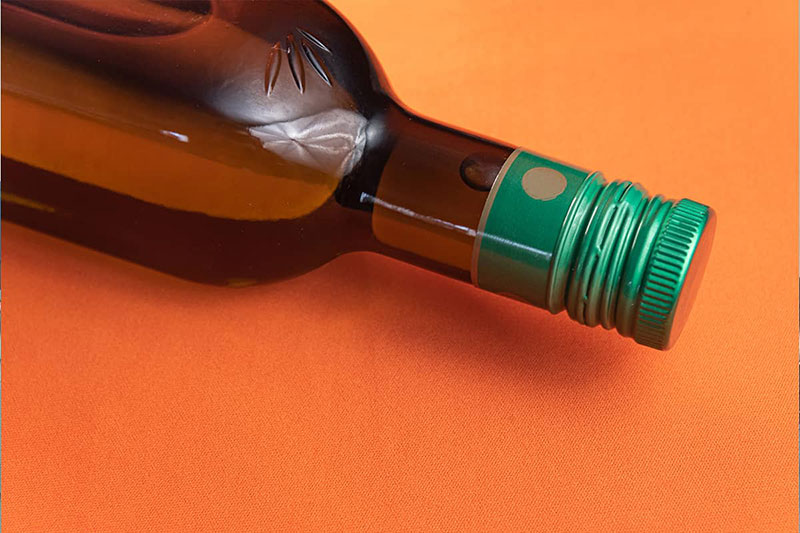
FDA’s guidance describes the breakable cap as a plastic or metal cap that either breaks away completely or leaves part of itself on the container, and that cannot go back on in its original state. Some caps separate entirely on opening. Others keep a ring on the neck, and bridge-and-ring caps rely on frangible bridges.
The design problem is the leftover. A Canadian closure patent (CA 1129813) notes that a ring staying on the container is hard to remove for recycling.
A stock catalogue cap is also a weak answer to FDA’s distinctiveness test unless the design or an identifying characteristic cannot be copied with commonly available materials.
Seals and membranes
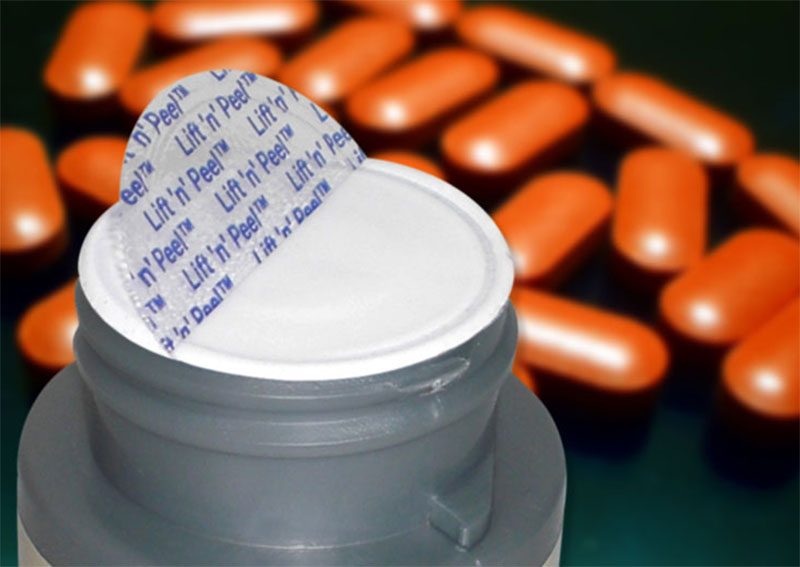
FDA’s guidance says heat-induction seals on plastic containers appear to offer more tamper resistance than seals that depend on an adhesive to bond.
An inner seal is paper, plastic film, foil or a combination sealed to the container mouth under the cap. It has to tear or break to open, and it cannot be lifted and reapplied without visible evidence.
Blister, strip and pouch packs work differently. Each compartment has to be torn or broken to reach the product, the backing cannot separate from the blister or be replaced without a trace, and pouch end seams cannot be opened and resealed cleanly.
Polystyrene foam seals held by pressure-sensitive adhesive no longer qualify. They come off and go back with no visible evidence.
Wraps, bands and sleeves
FDA’s guidance names what passes and what no longer does.
Film wrappers shrunk tight around the whole container are accepted in principle. So are heat shrink bands at the cap-and-container joint, cut or torn to open, and perforated tear strips added to the band.
Cellophane wrappers with overlapping end flaps, cellulose wet shrink seals, and tinted bands or wrappers used as the identifying characteristic are no longer accepted. The reason repeats each time. Opening and reclosing them without a trace is widely known, or the material is easy to copy.
Cartons, labels and tapes
About 10% of the packs the Danish Medicines Agency tested in a 2024 project had an anti-tampering device that did not work. The flawed devices were stickers that could be removed with no visible mark on the pack.
The agency had checked glued, taped, perforated tape, label, perforated label and perforated cardboard designs. Its advice to marketing authorisation holders was to test their own devices.
The dieline decides where a tear strip, locking tab or glued flap sits. Evidence has to be designed in at that stage.
Smurfit Kappa’s tamper proof corrugated case shows the idea. The bottom is flat, so there is no entry point there. Up top, a printed tear strip on the upper flap cannot be replaced, and two locking tabs drop into the case if broken.
The rulebooks disagree here. ISO 21976 has categories for glued folding boxes and for sealing labels and tapes. FDA’s 1992 guidance says adhesive-only tape seals and glued paperboard cartons cannot meet the US rule on their own, though it allows that new technology could change that.
A category name doesn’t settle compliance. That comes down to how the thing is built.
Materials behind induction seals, shrink bands, labels and cartons
Induction seals use a thin aluminum layer coated with a heat-sealable layer such as polyethylene (US patent 4,687,113). Supplier guides list glass, PET and HDPE necks as compatible.
Shrink bands come in PVC, PETG or polyolefin film, chosen for shrink range, tear behavior and recycling stream.
Labels run on void polyester, destructible vinyl, frangible film or fiber-tear paper, all of which sit in Avery Dennison’s security labeling range. Cartons are corrugated or paperboard with perforations, tear strips and locking tabs.
Liner choice follows the product. Induction liner suppliers pair aggressive or oily contents with polyester-backed foil and a matched heat-seal layer, and prefer two-piece liners for pharmaceuticals because foil stays on the bottle after the cap comes off.
For void labels, 3M’s data sheets state that the VOID message depends on adequate adhesion to the substrate. They also advise against relying on the label as the only tamper indication where tampering could cause significant loss.
Supplier guides push PVC users toward PET or PETG sleeves because those recycle better. RecyClass’s design guidelines for PET bottles (current editions) point the other way. They flag sleeves denser than 1 g/cm3, PET and PETG included, and prefer polyolefin sleeves that float.
The Association of Postconsumer Plastic Recyclers asks for the same thing in its sleeve guidance: sleeves that float in water and separate from PET flakes.
The same RecyClass guidelines list metals among liner and seal materials above that density, and an induction liner is a foil. Tamper evidence and recyclability pull in different directions here.
Pick the film for its tear behavior first. Then check it against the local recycling stream.
The tamper-proof packaging design process, step by step
- Define the threat. Who handles the pack between sealing and purchase, and what can they reach? It might be a retail shelf, a parcel network or a hospital store.
- Check which rule applies, since the regime sets the minimum feature count and the labelling duty (see the regulation section above).
- Choose the feature and the material together. The film or liner decides whether the evidence survives handling.
- Set the identifying characteristic and the statement. FDA’s guidance recommends a characteristic that is proprietary and different for each product size. When the feature sits on the outer carton and the inner container could be shelved alone, it also asks the container to say it should be in a carton.
- Test opening effort against child-resistance, older users and the space a serialisation code needs.
- Attack the prototype. Try to open and reseal it without a trace, then fix the weakest route.
- Lock the specification and file the change. NDA holders can change packaging and labelling before FDA approval, but a new capsule sealing method needs prior approval (21 CFR 211.132(e)).
The simplest feature that gives unambiguous visible evidence is usually the right pick. Add a second layer only when the threat or the capsule rule demands it.
The identifying characteristic is artwork, so the usual rules for designing a product label apply. One twist: art on a shrink band goes on flat and ends up compressed, so proof it on the shrunk film.
Don’t skip step six. A feature nobody has tried to defeat has not been tested.
How tamper-evident features get defeated
The plainest failure is a reseal nobody notices. US patent 4,702,383 opens by noting that supposedly tamper-proof packs have been penetrated unnoticed, with injury and death as the result. Its fix is a colour contrast between pack parts that stays visible from above even after a careful reseal.
Then there is going around the feature entirely. One that guards only the closure does nothing when the wall is the entry point. US patent 4,436,203 answers with an inner enclosure held above atmospheric pressure inside an outer one held below it, so an aperture shows.
Roger Johnston’s vulnerability assessment team at Los Alamos and Argonne says defeating a seal is more about fooling people than breaking the seal. A feature the buyer does not check protects nobody.
Damage can also happen before the pack ships. 3M’s data sheet warns that pulling a label off its liner by hand can pre-destruct the VOID message, which lessens the label’s effect once it is on the pack.
The strongest evidence of limits comes from outside retail packaging. A Los Alamos assessment of tamper-indicating seals, listed in the US Justice Department’s NCJRS library, found every seal tested could be defeated quickly with low-tech methods, and price did not predict effectiveness.
Those were security seals, not retail packs. Johnston and Jon Warner’s 2006 paper argues that consumer tamper-evident packaging does not give reliable tamper detection either.
Here the sources disagree. FDA’s reasonable-expectation test accepts features that the Los Alamos and Argonne team considers easy to defeat, and a designer has to choose which bar to test against.
Not every reopening is an attack. The European Commission’s Q&A lets parallel traders place a new anti-tampering device over a broken one, but only if the new device seals the whole pack and covers every sign of the old one.
The work also has to follow good manufacturing practice under supervision, and the unique identifier and the original device’s integrity must be verified before the pack is opened.
Evidence also starts at the sealing station. A feature says nothing about what happened to the product before the pack was closed.
A costlier seal isn’t automatically a safer one, so test the one you have.
Testing seal strength and tamper verification
ASTM F88/F88M measures the force needed to separate a test strip containing the seal and records how the specimen failed. ASTM describes seal strength as a quantitative measure for process validation and control, relevant to opening force and package integrity.
So F88 tells you the force to open the seal, how it failed, and whether the sealing process stays consistent. It cannot tell you whether a tamperer can reseal without a trace, or whether a buyer notices the damage.
ASTM adds that it is sometimes desirable to limit seal strength so the pack opens easily. That is exactly where tamper evidence and usability pull against each other.
ISO 21976 covers the feature itself. Beyond the criteria and verification clauses for each feature category, it addresses the purpose of the features (clause 4.2), their application and use (4.3), and how features are checked (4.4).
Then someone has to attack the prototype the way a tamperer would. Johnston’s 1997 paper in the Journal of Testing and Evaluation says an effective vulnerability assessment needs appropriate assessment personnel and an assessment at the earliest possible stage of development. It also needs a rejection of findings of zero vulnerabilities, and a characterization of the degree of defeat.
The zero-vulnerabilities point matters most. A tester who reports no way in has not tried hard enough.
In the EU, verification continues after launch. Delegated Regulation 2016/161 places verification duties on manufacturers, wholesalers and dispensing points, because checking the device shows whether the pack has been opened or altered since it left the manufacturer.
Passing F88 only means the seal holds. Whether the feature tells the truth shows up when someone attacks it, and none of these checks replaces the others.
Combining tamper evidence with child-resistance and serialisation
These requirements share one pack but get tested separately, so meeting one says nothing about the others. 21 CFR 211.132 says outright that it does not affect child-resistant “special packaging” duties under the Poison Prevention Packaging Act of 1970.
| Requirement | Governing text | Checked by | Pull on the design |
|---|---|---|---|
| Tamper evidence | 21 CFR 211.132, EU anti-tampering device | Visible evidence, ISO 21976 criteria | Hard to hide, impossible to undo |
| Child resistance | PPPA, 16 CFR 1700, ISO 8317 | Child and adult panels | Hard for children, easy for adults |
| Serialisation | EU 2016/161, DSCSA | Code scan and database check | Clear space for a 2D code |
Child-resistant packaging
Under 16 CFR 1700.20, child testing uses panels of 50 children aged 42 to 51 months, up to 200 in total. For adults aged 50 to 70, 90 percent of those tested must open and properly close the pack, according to the Consumer Healthcare Products Association’s 2025 summary of the rule.
The adult panel was not always that old. A 1995 Federal Register rule from the Consumer Product Safety Commission replaced the earlier 18-to-45 panel with older adults.
ISO 8317:2015 covers child resistance and adult access for reclosable packs, and it is intended for type approval only, not quality assurance. ASTM D3475 only classifies child-resistant packages by the motions, skills or tools they need, and a listing is not proof the package passed the CFR tests.
The conflict shows up at the closure. A child-resistant cap plus a tear band asks the user for two opening actions, and US patent 4,436,203 names arthritis sufferers among the users a design has to allow for.
Serialisation
The EU treats the two requirements as one set of safety features, an anti-tampering device and a unique identifier in a 2D data matrix. EMVO announced on 8 February 2019 that the European Medicines Verification System was live, one day before the regulation applied.
The European Hub connects the national systems. Before dispensing, the pharmacist verifies the identifier and the system decommissions it, so it cannot be reused.
A GS1 DataMatrix carries the GTIN, serial number, lot and expiry date in one symbol (GS1).
In the US, serialisation sits in a different law. The DSCSA calls for a product identifier on prescription drug packages, and its enhanced requirements took effect on 27 November 2023, with small dispensers exempt until 27 November 2027 after FDA extended the exemption on 6 August 2026 (FDA, as of October 2026).
Scope explains the gap. 21 CFR 211.132 covers OTC products while the DSCSA covers prescription products, so the tamper rule and the serialisation rule meet on the same pack far less often in the US than in the EU, where a prescription pack carries both.
Keep the code off the tear line. A symbol split by a tear strip cannot be scanned.
Tamper-proof packaging design FAQ
Is tamper-evident packaging required for food?
Not by the FDA packaging rules, which cover OTC drugs, two cosmetic categories and contact lens solutions (21 CFR 211.132, 700.25 and 800.12).
FDA’s 2002 food security guidance raises tamper-evident packaging as a preventive measure, and it does not bind anyone.
Do aerosol cans need a tamper-evident feature?
No separate one. FDA’s guidance names aerosol containers as inherently tamper-resistant by design, so the can itself serves as the barrier to entry.
The labelling statement is also waived for aerosol products that expel their contents with liquefied or compressed gas.
Can a drug maker request an exemption from the tamper-evident rule?
Yes. Under 21 CFR 211.132(d), the manufacturer files a citizen petition under 21 CFR 10.30, marked as a request for exemption, explaining why compliance is unnecessary or cannot be achieved.
The petition also describes alternative steps that reduce the risk of malicious adulteration.
How much does tamper-evident packaging cost?
No authoritative price applies across features. Cost follows the feature, the cap or film, and the line equipment.
Supplier guides note that induction sealing needs a lined cap and a sealing head, while shrink bands add little component cost.
Which countries have tamper-evident packaging rules besides the US and EU?
Australia is one example. The TGA’s code of practice for therapeutic goods asks for one tamper-evident feature, or two for unsealed two-piece capsules (sealed capsules need one packaging feature), plus a tamper-evident statement on the pack.
The code is not mandatory, but some industry associations make it a condition of membership.
Where to Start When Auditing an Existing Pack
Auditing a tamper-proof packaging design starts with features that rely on adhesive alone: stickers, tapes and glued flaps. A pack with no compliant feature or statement counts as adulterated or misbranded under 21 CFR 211.132.
After that, check the statement wording and placement, then opening effort and code space. The order follows consequence. Adhesive-only features fail quietly, wording is the cheapest fix, and opening effort and code space change only through redesign.
The one-feature minimum in 21 CFR 211.132 and the removable stickers found in Danish checks give one rule: pair any adhesive feature with a structural second feature, such as a film wrapper or inner membrane.
Position verified against the eCFR text current to 30 September 2026. A revised FDA compliance policy guide or a new ISO 21976 edition would change which technologies count.
Tear strips and perforations also reach the printer as cut lines for packaging printers, so specify them there.

Renowned for his expertise in logo design and visual branding, Bogdan has developed a multitude of logos for various clients.
His skills extend to creating posters, vector illustrations, business cards, and brochures. Additionally, Bogdan's UI kits were featured on marketplaces like Visual Hierarchy and UI8.
He also wrote in the past years on sites like Design Your Way, WebDesignerDepot, WPDean, Designmodo, Speckyboy, Slider Revolution, and more.
- The Windsurf Logo History, Colors, Font, And Meaning - 10 October 2026
- How to Remove Background From Product Photos (No Photoshop) - 10 October 2026
- How Designers can Build a Stronger Online Creative Identity - 9 October 2026

Bogdan Sandu is a seasoned designer who has been designing websites since 2008. Renowned for his expertise in logo design and visual branding, Bogdan has developed a multitude of logos for various clients. His skills extend to creating posters, vector illustrations, business cards, and brochures. Additionally, Bogdan's UI kits were featured on marketplaces like Visual Hierarchy and UI8. He also wrote in the past years on sites like Design Your Way, WebDesignerDepot, WPDean, Designmodo, Speckyboy, Slider Revolution, and more.
You Might Also Like


