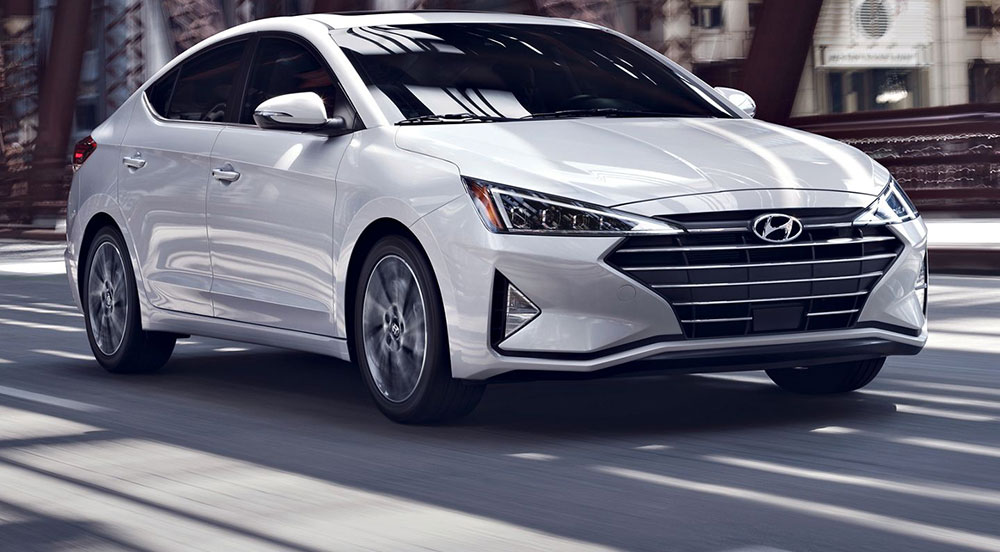
The Hyundai Logo stands as one of the most recognized automotive emblems worldwide. At first glance, it looks like a simple italic “H” inside an oval shape. But there’s more going on here.
The current version was introduced in 1990 and has remained largely unchanged since then. Hyundai Motor Company was founded in 1967 in South Korea. The logo has gone through roughly four major iterations before landing on the design we see today.
Within the automotive industry, the emblem represents a significant shift in how Asian car manufacturers approached branding. It helped establish Hyundai’s visual identity during the company’s aggressive global expansion in the late 20th century.
What is the Hyundai Logo?
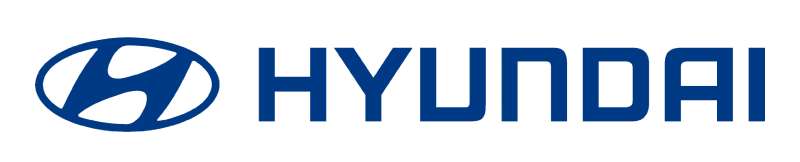
The Hyundai logo features a stylized italic “H” enclosed within an oval frame. It was officially introduced in 1990 and designed by Hyundai’s internal team. The emblem symbolizes a handshake between company and customer, representing trust and partnership.
Design Type: Combination mark (letterform with enclosing shape)
Primary Elements:
- Slanted capital letter “H”
- Oval border frame
- Three-dimensional chrome rendering for vehicle applications
Official Introduction Date: 1990
Designer/Agency: Hyundai Motor Company internal design team
Trademark Status: Registered trademark in all major global markets
Color Palette:
- Primary Blue: #002C5F (Hyundai Blue)
- Silver/Chrome: Used for 3D vehicle badges
- White: Background applications
Usage Context: Vehicle grilles, steering wheels, trunk badges, dealership signage, marketing materials, digital platforms, merchandise
How Has the Hyundai Logo Evolved Over Time?
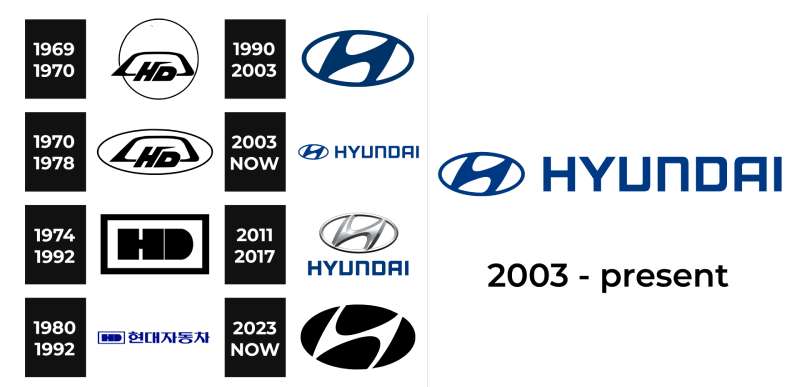
Hyundai’s visual identity has shifted dramatically since 1967. The company started with text-based marks before moving to the iconic “H” symbol.
Four distinct eras define this evolution. Each redesign reflected the company’s growth and changing market position.
Original Hyundai Logo (1967-1969)
Years Active: 1967-1969
Design Description: Simple wordmark featuring “HD” letters in a basic sans-serif style. No oval, no special symbol. Just straightforward lettering that felt industrial and functional.
Color Scheme: Black and white
Designer: Unknown
Context: Hyundai was primarily a construction company at this point. The car division was just getting started, and branding wasn’t a priority yet.
Cultural Significance: Represented the humble beginnings of what would become a global automotive giant.
Second Hyundai Logo (1969-1974)
Years Active: 1969-1974
Design Description: Stylized “H” appeared for the first time. Still quite angular and sharp compared to what came later.
Color Scheme: Blue and white
Key Changes from Previous: Introduction of the signature “H” motif. Blue color entered the brand palette.
Context: The company was establishing itself in the Korean automotive market. This logo marked the first real attempt at distinctive branding.
Third Hyundai Logo (1974-1990)
Years Active: 1974-1990
Design Description: The “H” became more refined. A horizontal bar connected both uprights of the letter. The overall shape grew rounder.
Color Scheme: Blue remained dominant
Key Changes from Previous: Softer edges, more automotive feel. The design started looking less industrial.
Cultural Significance: This era saw Hyundai’s first exports. The logo needed to work internationally.
Current Hyundai Logo (1990-Present)
Years Active: 1990-Present
Design Description: Italic “H” inside an oval. The letter tilts to the right, suggesting forward motion. Clean lines. Modern feel.
Color Scheme: Hyundai Blue (#002C5F) with silver/chrome for vehicle applications
Key Changes from Previous: Addition of the oval frame. Refined proportions. The “H” gained its distinctive slant.
Context: Hyundai was pushing hard into the U.S. and European markets. The company needed a logo that could compete with established brands.
Cultural Significance: This version put Hyundai on the global map. It’s been remarkably stable, with only minor refinements over 30+ years.
What Do the Design Elements of the Hyundai Logo Mean?
The tilted “H” does double duty. It’s obviously the first letter of “Hyundai.” But look closer.
The design shows two figures shaking hands. One represents the company. The other represents the customer.
This handshake concept drives everything about the logo’s meaning.
Why Did Hyundai Choose These Specific Colors?
Hyundai Blue (#002C5F)
This deep blue communicates reliability and professionalism. It’s calmer than the reds and blacks many competitors use.
Understanding color psychology helps explain this choice. Blue builds trust. It suggests stability.
In automotive branding, blue often signals technology and innovation. Think about how many tech companies use blue too.
Silver/Chrome
The metallic finish on physical badges adds premium appeal. Chrome catches light and looks expensive on vehicle grilles.
What Typography Style Is Used in the Hyundai Logo?
The “H” uses a custom letterform, not a standard font. It was specifically designed for this logo.
The italic angle suggests speed and forward momentum. Pretty common in automotive typography, actually.
The stroke weight stays consistent throughout. No thin-to-thick variation like you’d see in a serif font.
Readability wasn’t really a concern here since it’s just one letter.
What Are the Hidden Meanings in the Hyundai Logo?
The handshake is the big one. Most people miss it entirely until someone points it out.
The oval shape represents globalization. Hyundai officially states this symbolizes their worldwide presence.
Some see a road stretching into the distance. Others notice how the “H” could be two people bowing to each other (a nod to Korean culture).
The designers have confirmed the handshake interpretation. The other meanings? Those might be happy accidents.
How Does the Hyundai Logo Compare to Competitor Logos?
Korean automaker Kia’s emblem takes a different approach entirely. Their recent redesign went bold and angular.
Japanese competitors like Toyota and Honda also use oval-enclosed symbols. There’s clearly something about that shape that works for Asian automakers.
European brands tend toward more complex emblems. Look at BMW’s roundel or the Audi rings.
American manufacturers like Ford and Chevrolet prefer wordmarks and simple geometric shapes.
Hyundai sits somewhere in the middle. Not as minimal as some. Not as ornate as others. It’s practical, which fits the brand’s value proposition.
What Are the Technical Specifications of the Hyundai Logo?
Official Color Codes:
Primary Color: Hyundai Blue
Secondary Color: Silver
- Hex: #A5A5A5
- RGB: (165, 165, 165)
- Used primarily for metallic badge applications
Dimensions and Proportions:
- Aspect ratio: Approximately 1.2:1 (width to height)
- Minimum size: 12mm height for print applications
- Clear space: Equal to 25% of logo height on all sides
The logo works well as vector graphics, allowing infinite scaling without quality loss.
What Cultural Impact Has the Hyundai Logo Had?
The logo helped shift Western perceptions of Korean manufacturing. In the 1980s, “Made in Korea” didn’t carry much prestige.
Hyundai’s consistent visual identity built recognition over decades. People started associating the emblem with affordable reliability.
The handshake symbolism resonated globally. It communicated partnership without needing translation.
Today, the logo appears at major sporting events, on soccer jerseys, and in city centers worldwide. That kind of visibility took years to build.
How Does the Hyundai Logo Fit Into the Overall Brand Identity?

The logo anchors everything else. Dealership architecture echoes the oval shape. Marketing materials use Hyundai Blue consistently.
Following solid logo design principles, the mark works across all touchpoints.
Hyundai’s brand guidelines specify exactly how the logo should appear in every context.
The premium Genesis sub-brand uses a completely different emblem, interestingly. That Genesis logo needed to stand apart from Hyundai’s value-focused image.
This separation shows smart brand architecture. Different customers, different visual identities.
How Should the Hyundai Logo Be Used?
Official Usage Guidelines:
Do:
- Maintain minimum clear space around the logo
- Use official color codes for accuracy
- Scale proportionally (never stretch or squash)
- Place on contrasting backgrounds for visibility
Don’t:
- Rotate the logo
- Apply effects like shadows or gradients (unless specified)
- Change the colors arbitrarily
- Combine with other logos in ways that suggest partnership
Where to Access Official Logos: Hyundai provides brand assets through their media portal and authorized dealer networks.
Licensing: Commercial use requires explicit permission from Hyundai Motor Company.
Trademark Protection: The logo is protected under international trademark law. Unauthorized reproduction can result in legal action.
FAQ on The Hyundai Logo
What Does the Hyundai Logo Represent?
The Hyundai emblem represents a handshake between company and customer. Two stylized figures form the italic H shape.
This symbolizes trust, partnership, and commitment. The oval frame suggests global reach.
Pretty clever when you actually see it.
Why Is the Hyundai Logo Slanted?
The italic angle creates a sense of movement and forward momentum. It suggests progress and speed.
Automotive brands love this trick. A tilted letterform feels dynamic, not static.
The slant also helps form that hidden handshake image.
What Color Is the Official Hyundai Logo?
Hyundai Blue (#002C5F) is the primary brand color. It falls into the category of blue logos that dominate automotive branding.
Chrome and silver appear on physical vehicle badges. White backgrounds are standard for print applications.
When Was the Current Hyundai Logo Created?
The current version launched in 1990. It replaced an earlier, less refined H design.
Hyundai Motor Company was founded in 1967 in South Korea. The logo has seen roughly four major versions since then.
Who Designed the Hyundai Logo?
Hyundai’s internal design team created the emblem. No single designer receives public credit.
This is common among large corporations. Unlike work by famous graphic designers, corporate logos often emerge from team efforts.
What Is the Hidden Meaning in the Hyundai Logo?
Two people shaking hands. That’s the main one.
The psychology of shapes matters here. The oval suggests unity and completeness. Some see a road stretching forward.
Others notice a bowing gesture, reflecting Korean culture.
How Is the Hyundai Logo Different From Other Car Logos?
Most car logos use complex emblems or detailed crests. Hyundai keeps it simple.
Compare it to the Porsche emblem or Alfa Romeo badge. Those are intricate. Hyundai’s approach leans toward minimalist design.
Can I Download the Hyundai Logo for Free?
Official assets are available through Hyundai’s media portal. Authorized dealers also have access.
For commercial use, you need permission. The trademark is protected globally.
Personal or editorial use typically falls under fair use guidelines.
What File Formats Is the Hyundai Logo Available In?
Official brand assets come in multiple formats. Vector files (SVG, EPS, AI) allow infinite scaling.
Raster formats like JPEG and PNG work for web design and digital use. Higher DPI versions exist for print.
Has the Hyundai Logo Changed Recently?
The core design has stayed consistent since 1990. Minor refinements happened, but nothing dramatic.
The color palette and proportions remain stable. Hyundai values brand recognition over trendy redesigns.
Stability works when you’ve built decades of equity.
Conclusion
The Hyundai Logo proves that simple designs can carry deep meaning. A slanted H inside an oval. That’s it. Yet it communicates trust, global ambition, and customer partnership all at once.
The handshake symbolism gives the emblem its soul. Most people never notice it until someone points it out.
Since 1990, this Korean automaker has kept the design remarkably consistent. Smart move. Brand recognition compounds over time.
Whether on a steering wheel badge, dealership signage, or digital marketing, the emblem maintains strong visual hierarchy and instant recognition.
Good logo design ages well. This one certainly has.

Renowned for his expertise in logo design and visual branding, Bogdan has developed a multitude of logos for various clients.
His skills extend to creating posters, vector illustrations, business cards, and brochures. Additionally, Bogdan's UI kits were featured on marketplaces like Visual Hierarchy and UI8.
He also wrote in the past years on sites like Design Your Way, WebDesignerDepot, WPDean, Designmodo, Speckyboy, Slider Revolution, and more.
- The Windsurf Logo History, Colors, Font, And Meaning - 10 October 2026
- How Designers can Build a Stronger Online Creative Identity - 9 October 2026
- Minecraft Font Generator - 8 October 2026

Bogdan Sandu is a seasoned designer who has been designing websites since 2008. Renowned for his expertise in logo design and visual branding, Bogdan has developed a multitude of logos for various clients. His skills extend to creating posters, vector illustrations, business cards, and brochures. Additionally, Bogdan's UI kits were featured on marketplaces like Visual Hierarchy and UI8. He also wrote in the past years on sites like Design Your Way, WebDesignerDepot, WPDean, Designmodo, Speckyboy, Slider Revolution, and more.
You Might Also Like