

The Supercell logo is one of the most recognized marks in mobile gaming. It belongs to a Finnish studio that has produced some of the highest-grossing titles on iOS and Android, including Clash of Clans, Brawl Stars, and Clash Royale.
As a brand mark, it sits within a broader tradition of gaming company logos that prioritize strong wordmarks and bold type over complex imagery. Supercell has kept things tight since the beginning. The current version of the logo is a clean, capitalized wordmark rendered in black. It was designed in-house by Supercell Oy’s creative team. The company was founded on May 14, 2010, in Helsinki, and the logo has gone through a handful of refinements over the years, though never a full-scale overhaul.
That kind of restraint says something. Most gaming studios go through dramatic redesigns every few years. Supercell just… didn’t. And it works.
What Is the Supercell Logo?
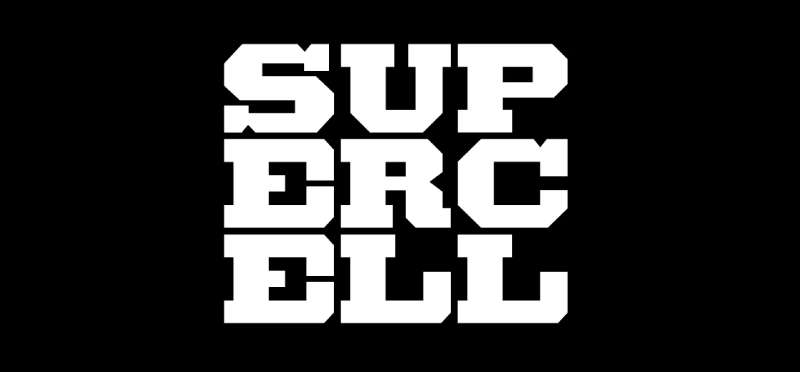
The Supercell logo is a typographic wordmark set in Acropolis Black, a slab serif typeface designed by Hoefler & Co. It uses capitalized letterforms in black against a white background. The mark was introduced around 2012 when the company shifted its focus to mobile gaming. It was created by Supercell’s in-house design team and represents strength, clarity, and a no-nonsense approach to branding.
- Design Type: Wordmark (text-based logotype)
- Primary Elements: Capitalized custom lettering with beveled slab serif characteristics, no icon or mascot component
- Official Introduction: Circa 2012, coinciding with the launch of Hay Day and Clash of Clans
- Designer/Agency: In-house creative team at Supercell Oy, Helsinki
- Trademark Status: Registered with the USPTO. Registration #4824684, filed February 7, 2011, registered October 6, 2015. Additional registrations include #4705895 and #5499997.
- Color Palette: Primary Black (#100F0D), White (#FFFFFF). Secondary brand color Dodger Blue (#2D85F4) appears in some digital applications.
- Usage Context: Game splash screens, app store listings, merchandise, esports events, corporate communications, and all web design properties
How Has the Supercell Logo Evolved Over Time?
Supercell’s logo hasn’t gone through dramatic overhauls. The core wordmark has stayed remarkably consistent since 2012.
The changes have been subtle, mostly about refinement and adapting the mark for different platforms. Think of it like tightening screws rather than rebuilding the whole thing.
For a company worth billions, this consistency is actually pretty unusual in the gaming space.
Original Supercell Logo (2010-2012)
- Years Active: 2010-2012
- Design Description: Early branding featured a simpler wordmark as the company was still finding its identity. At this point Supercell was working on its browser game Gunshine.net and hadn’t yet pivoted fully to mobile.
- Color Scheme: Black and white
- Designer: Internal team, Helsinki
- Context: The company had just launched with six co-founders, including CEO Ilkka Paananen. They were a small startup in Espoo, Finland, running on seed funding and government grants. The logo needed to be functional, not flashy.
- Cultural Significance: This early mark reflected a company still searching for its place. It was scrappy. No one outside Finland really knew who they were yet.
Refined Supercell Wordmark (2012-Present)
- Years Active: 2012-present
- Design Description: The bold slab serif wordmark in Acropolis Black that we know today. All caps, strong letter spacing, beveled serif details. It sits confidently with plenty of clear space around it (measured by the height of the letter “E” in the wordmark).
- Color Scheme: Black (#100F0D) on white, with Dodger Blue (#2D85F4) in secondary applications
- Designer: Supercell Oy in-house team
- Context: This version arrived alongside Hay Day and Clash of Clans, the two games that turned Supercell into a global force. The logo needed to work at app-icon scale and on splash screens, which is probably why they kept it so clean.
- Key Changes from Previous: Tighter letterforms, more polished execution, beveled serif details that give the type a chiseled, almost engraved quality
- Cultural Significance: This is the version that billions of players worldwide see every time they open a Supercell game. The five-note synth-piano glissando that plays alongside it has become nearly as iconic as the mark itself. Took me a while to realize that little audio cue was just as much a part of the brand as the visual.
What Do the Design Elements of the Supercell Logo Mean?
The wordmark’s slab serif letterforms give it a sense of weight and permanence. There’s nothing accidental about those thick, beveled strokes.
They communicate durability. Which makes sense for a company whose games are designed to last years, not weeks.
The all-caps treatment adds authority, and the generous spacing between letters keeps the mark legible at small sizes. Something a lot of people overlook, but it matters when your logo shows up on a phone screen.
Why Did Supercell Choose These Specific Colors?

The primary palette is dead simple. Black and white. That’s it for the core logo.
Black (#100F0D) brings authority and seriousness. It reads well on any background and doesn’t compete with the colorful, character-heavy artwork of their games. According to color psychology, black carries connotations of power, sophistication, and control.
White (#FFFFFF) gives the mark breathing room. It’s not a “color” in the traditional sense, but it does the heavy lifting by keeping everything clean and giving the white space around the wordmark room to do its job.
The secondary Dodger Blue (#2D85F4) appears in some digital applications and the Supercell ID branding. Blue builds trust, and it pairs nicely with the black without fighting for attention.
What Typography Style Is Used in the Supercell Logo?
The typeface is Acropolis Black, part of The Proteus Project by Hoefler & Co. It’s a “Grecian” style slab serif with beveled edges, inspired by 19th-century typography.
That’s not a common choice for a gaming company. Most studios go with chunky sans-serifs or custom display type. Supercell went with something that has historical roots, and honestly, it stands out because of that.
The letterforms are wide and balanced. Kerning is tight but not cramped. Readability holds up at every size, from a tiny app icon to a conference banner.
What Are the Hidden Meanings in the Supercell Logo?
There aren’t really hidden symbols buried in the design. Look, not every logo needs a clever arrow tucked between letters.
What’s intentional is the name itself. “Supercell” refers to a type of severe thunderstorm, one of the most powerful weather phenomena on earth. The bold, heavy type reflects that sense of force.
The beveled edges on the letterforms give a subtle 3D quality, like the text has been carved from stone. Whether that was deliberate or just a byproduct of the typeface choice, it does match the game worlds Supercell builds. Think about the stone architecture in Clash of Clans. It fits.
How Does the Supercell Logo Compare to Competitor Logos?
Put it next to other major gaming studio logos and you’ll notice something right away. Supercell’s mark is quiet. Almost restrained.
Epic Games uses a sharp, angular icon. Riot Games has a bold fist symbol. EA relies on a circular emblem that’s been around forever. Nintendo keeps it in a rounded rectangle.
Supercell skips the icon entirely. No mascot, no emblem, no abstract shape. Just the name.
Among other video game logos, that level of simplicity is unusual. Rockstar Games at least has the star icon. Valve has the head. Ubisoft keeps its swirl thing going.
But here’s the thing. Because Supercell’s games are so visually loud and character-driven, the neutral wordmark works as an anchor. It doesn’t compete with Barbarian Kings and Brawlers. It just says, “we made this,” and steps aside.
What Are the Technical Specifications of the Supercell Logo?
Official Color Codes
- Primary Color: Black
- Hex: #100F0D
- RGB: (16, 15, 13)
- CMYK: (0, 0, 0, 100)
- Secondary Color: White
- Hex: #FFFFFF
- RGB: (255, 255, 255)
- CMYK: (0, 0, 0, 0)
- Accent Color: Dodger Blue
- Hex: #2D85F4
- RGB: (45, 133, 244)
- CMYK: (82, 45, 0, 4)
Dimensions and Proportions
The logo is distributed as vector graphics in SVG format, so it scales without losing quality. No fixed pixel dimensions are required because vectors are resolution-independent.
Clear space around the logo is defined by the height of the capital letter “E” in the wordmark. That measurement gets applied on all four sides.
There’s no publicly listed minimum size requirement, but given the slab serif details, the mark starts losing legibility below about 40 pixels in height on screen. For print design, maintaining adequate DPI is recommended, typically 300 for any physical material.
The aspect ratio of the wordmark is roughly 5:1 (width to height), which gives it a wide, horizontal footprint. That’s worth considering if you’re working with square or vertical formats.
What Cultural Impact Has the Supercell Logo Had?
The Supercell logo appears on games that have been downloaded billions of times globally. That kind of exposure changes how people think about mobile gaming brands.
Before Supercell, most mobile game studios didn’t have logos that players could name on sight. You knew the game, not the studio. Supercell flipped that, partly because of the animated splash screen that plays before every game launch.
The five-note piano jingle paired with the logo appearing on screen has become a shared cultural moment for over a hundred million players. Kids recognize it instantly. Parents hear it from the backseat of the car.
Among tech company logos, Supercell’s mark holds a unique position. It belongs to a company that generates billions in revenue but still operates with a team of around 400 people. The logo’s simplicity reflects that lean, focused identity.
How Does the Supercell Logo Fit Into the Overall Brand Identity?
The logo sits at the center of a brand system that also includes individual game logos, character art, and the Supercell ID visual identity. Each game, like Clash of Clans or Brawl Stars, has its own elaborate, colorful branding.
The corporate wordmark stays monochrome and simple on purpose. It’s the parent brand, the umbrella. The games are the loud ones.
This follows a smart visual hierarchy where the studio mark doesn’t compete with individual titles. Supercell’s brand guidelines outline specific rules about logo placement, clear space, and color usage to keep everything consistent across platforms, merchandise, and marketing materials.
If you compare this approach to how film studios handle their logos relative to individual movie branding, the strategy is similar. The studio mark is the seal of quality. The product branding does the selling.
How Should the Supercell Logo Be Used?
Do’s
- Use the official logo files from Supercell’s press or media kit
- Maintain the required clear space (height of the letter “E” on all sides)
- Place on solid backgrounds, preferably white or very light tones
- Keep the logo at a legible size, don’t shrink it below recognition threshold
Don’ts
- Don’t alter the colors, stretch, rotate, or distort the wordmark
- Don’t place on busy or patterned backgrounds that reduce readability
- Don’t combine it with other logos without proper spacing
- Don’t recreate the logo using alternative fonts, even if they look similar
Official logo assets can typically be accessed through Supercell’s press page or media kit section on their website. For any commercial use, written permission from Supercell Oy is required. The mark is a registered trademark under multiple USPTO registrations.
Fan content and community projects fall into a gray area. Supercell generally allows fan-created content that doesn’t imply official endorsement or generate direct revenue, but that’s something worth checking against their current content creator policy before assuming anything.
FAQ on The Supercell Logo
What font does the Supercell logo use?
The Supercell logo uses Acropolis Black, a slab serif from Hoefler & Co’s Proteus Project. It’s a Grecian-style font with beveled edges inspired by 19th-century type design.
Not what you’d expect from a mobile game developer based in Helsinki. But it works.
What colors are in the Supercell logo?
The primary color palette is black (#100F0D) and white (#FFFFFF). A secondary Dodger Blue (#2D85F4) shows up in some digital brand applications like Supercell ID.
Keeping the logo monochrome lets it sit cleanly alongside colorful game art from titles like Clash of Clans and Brawl Stars.
Who designed the Supercell logo?
The in-house creative team at Supercell Oy in Helsinki designed it. No external agency was involved. The company tends to keep things internal, which tracks with their small-team philosophy across game development too.
When was the Supercell logo created?
The current wordmark appeared around 2012, when Supercell launched Hay Day and Clash of Clans. The company itself was founded on May 14, 2010, so the early branding existed before that.
The refined version has stayed mostly unchanged since.
Is the Supercell logo trademarked?
Yes. Supercell Oy holds multiple USPTO registrations, including Registration #4824684 filed in February 2011. Commercial use requires written permission from the company.
Fan content exists in a gray area. Check their current policy before using it.
What does the Supercell logo mean?
The name “Supercell” refers to a powerful thunderstorm formation. The heavy slab serif lettering reflects that force. No hidden icons or symbols. Just bold type that communicates strength and confidence in the mobile gaming space.
Can I download the Supercell logo in SVG or PNG format?
Official logo files are available through Supercell’s press and media kit. SVG versions scale without quality loss. For PNG, export at 300 DPI for print or 72-150 for screen use.
Always grab assets from official sources, not random download sites.
How does the Supercell logo appear in games?
It shows up on the splash screen before every Supercell game loads. A quick animation plays the wordmark alongside a five-note synth-piano jingle. Brawl Stars and Clash Royale each use slightly different audio versions.
What type of logo is the Supercell logo?
It’s a wordmark, meaning text only, no icon or symbol paired with it. This puts it in the same category as logos from studios that rely purely on typographic elements for brand recognition.
Simple choice. Hard to pull off. They managed it.
How does the Supercell logo compare to other game studio logos?
Most competitors use icon-based marks. Capcom, Sega, and Square Enix all pair symbols with their names. Supercell skips that entirely.
Among game logos, a pure wordmark with no graphic element is genuinely rare.
Conclusion
The Supercell logo proves that a wordmark can carry just as much weight as any elaborate emblem. No mascot, no abstract icon. Just Acropolis Black doing its thing across every app store listing and splash screen on the planet.
For a freemium game company pulling in $3 billion annually, that kind of visual restraint takes real confidence.
The black and white palette keeps the corporate mark out of the way while Clash Royale, Hay Day, and Brawl Stars handle the visual fireworks. Smart brand architecture, honestly.
Whether you’re studying logo design principles or just curious about what makes Finnish game studio branding tick, Supercell’s approach is worth paying attention to. Sometimes the best move is knowing what to leave out.

Renowned for his expertise in logo design and visual branding, Bogdan has developed a multitude of logos for various clients.
His skills extend to creating posters, vector illustrations, business cards, and brochures. Additionally, Bogdan's UI kits were featured on marketplaces like Visual Hierarchy and UI8.
He also wrote in the past years on sites like Design Your Way, WebDesignerDepot, WPDean, Designmodo, Speckyboy, Slider Revolution, and more.
- The Windsurf Logo History, Colors, Font, And Meaning - 10 October 2026
- How to Remove Background From Product Photos (No Photoshop) - 10 October 2026
- How Designers can Build a Stronger Online Creative Identity - 9 October 2026

Bogdan Sandu is a seasoned designer who has been designing websites since 2008. Renowned for his expertise in logo design and visual branding, Bogdan has developed a multitude of logos for various clients. His skills extend to creating posters, vector illustrations, business cards, and brochures. Additionally, Bogdan's UI kits were featured on marketplaces like Visual Hierarchy and UI8. He also wrote in the past years on sites like Design Your Way, WebDesignerDepot, WPDean, Designmodo, Speckyboy, Slider Revolution, and more.
You Might Also Like


