A surgeon who is only “OK” sold more phone plans than any coverage map ever did.
AT&T ads span 47 years, 4 lead agencies and 9 flagship campaigns, from “Reach Out and Touch Someone” in 1979 to the AT&T Guarantee work of 2025.
N.W. Ayer, BBDO, David Fincher, Saul Bass and a store employee named Lily all left fingerprints on it.
This page covers the campaigns by name, with the agency, year and market behind each one, plus the print layouts, palette and typography decisions that hold them together.
- Campaign-by-campaign breakdown with taglines and directors
- How the globe, AT&T Blue and the wordmark work in print
- Agency credits, TV versus print strategy, and takeaways for designers
AT&T advertising spans 47 years, 4 lead agencies and 9 flagship campaigns, from “Reach Out and Touch Someone” in 1979 to the AT&T Guarantee work that launched in January 2025. The creative model is emotional demonstration rather than spec-sheet selling, executed mostly through national TV, newspaper inserts and cinema.
This page covers the campaigns by name, with the agency, year and market behind each one, plus the layout, palette and typography decisions that hold them together.
- Campaign-by-campaign breakdown, 1979 to 2026
- Print composition, typeface history and the Bass globe
- Agency credits, directors and the takeaways worth stealing
AT&T Advertising at a Glance
AT&T has advertised nationally since the Bell System era, working primarily with N.W. Ayer & Son and BBDO. Its best-known campaigns are “Reach Out and Touch Someone,” “You Will” and “Just OK Is Not OK.” The visual signature combines the striped globe, AT&T Blue and an uppercase wordmark.
| Attribute | Value |
|---|---|
| First major campaign | Reach Out and Touch Someone (1979), N.W. Ayer & Son |
| Lead agencies | N.W. Ayer (through the 1990s), BBDO New York and BBDO LA (2007 to present), Dieste, Critical Mass, Hearts & Science (media, 2016 to present) |
| Best-known taglines | “Reach out and touch someone” (1979), “You will” (1993), “More bars in more places” (2006), “Rethink possible” (2010), “Mobilizing your world” (2014), “Just OK is not OK” (2019) |
| Primary media | National TV, newspaper inserts, cinema, out of home, digital, social |
| Awards | Gold Cannes Lion for Direction, “Close to Home” (It Can Wait), directed by Frederic Planchon |
| Visual signature | Bass globe, AT&T Blue (#00A8E0 / PMS 298 C), uppercase black wordmark |
| Ad spend | $2.576 billion in 2023, up from $2.462 billion in 2022 (AT&T financials via WallStreetZen) |
Which AT&T Ad Campaigns Are the Most Famous?
The 7 campaigns that defined AT&T advertising are Reach Out and Touch Someone (1979), You Will (1993), More Bars in More Places (2006), Rethink Possible (2010), It Can Wait (2010), Just OK Is Not OK (2019) and The AT&T Guarantee (2025). Each one reset the brand’s tone rather than extending the last.
Reach Out and Touch Someone (1979 to 1984)

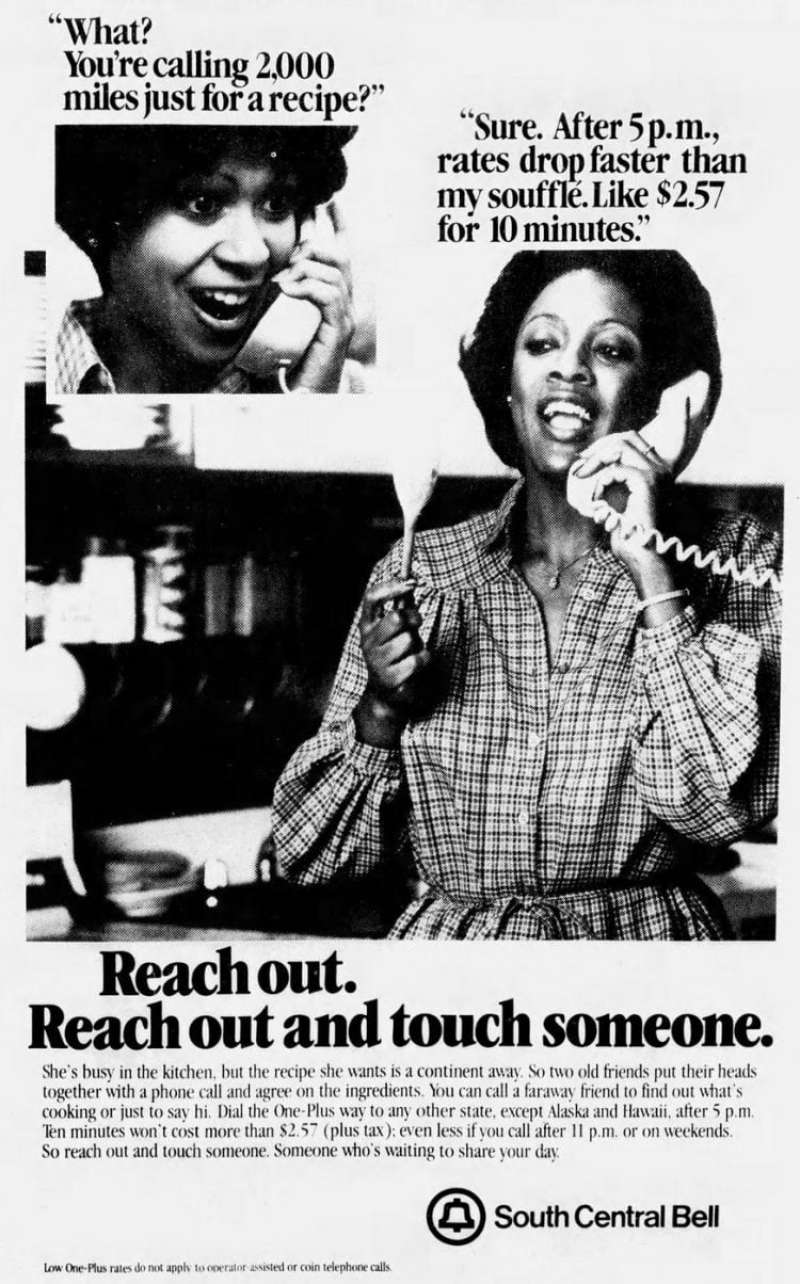
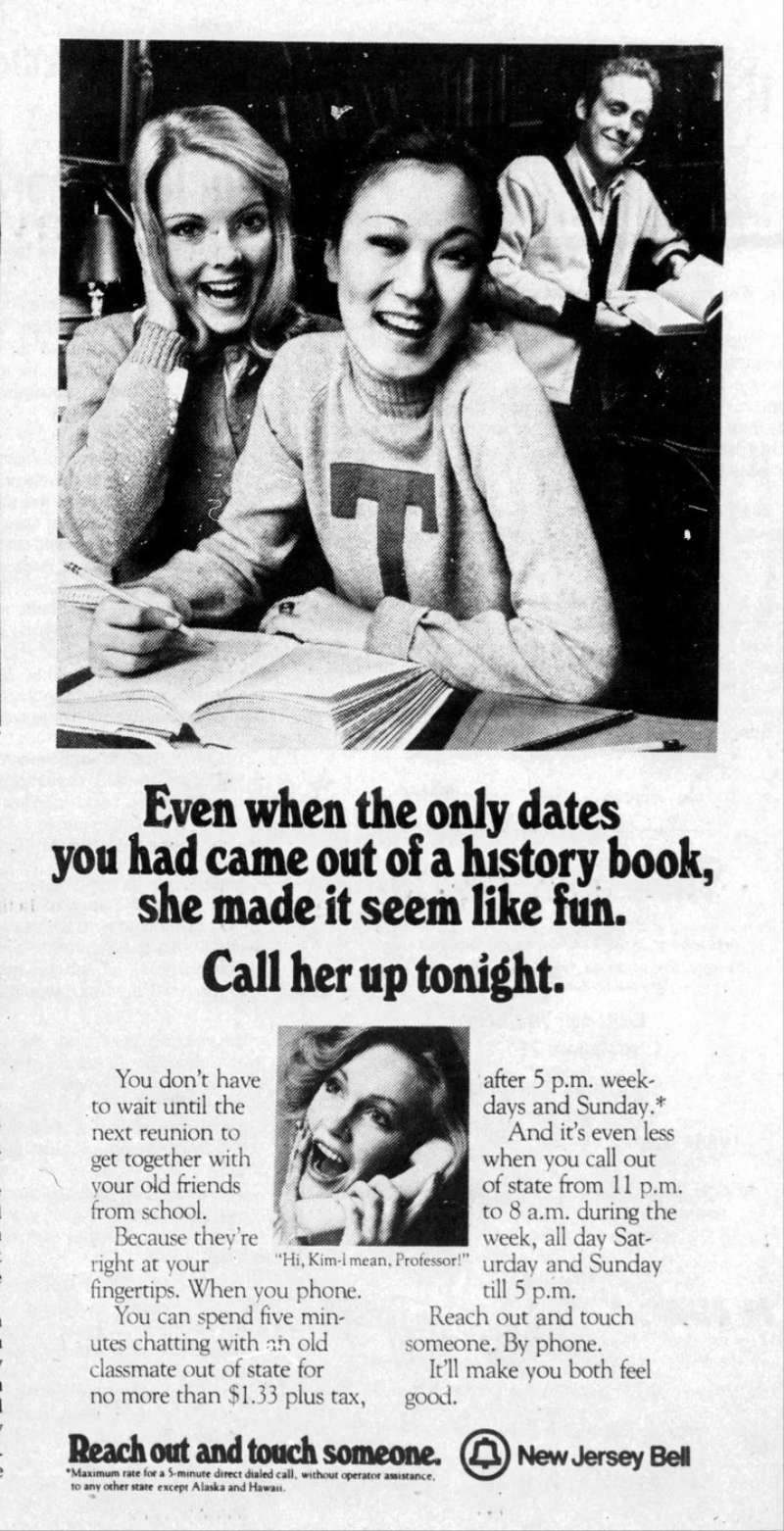
N.W. Ayer & Son created the campaign for the Bell System in 1979 to sell long distance calling to American households. Copywriter Tony Galli and Stanley Lomas coined the line, David Lucas composed the music, and the first spot ran on The Tonight Show.
The print work built on warm, grainy documentary photography with the copy block below the optical center. Layouts kept one figure per frame, one call, one emotional beat. Nothing in the frame competes with the face.
Ayer’s stated goal was to make long distance calling feel simple and non-traumatic while softening Bell’s monopoly image ahead of divestiture.
You Will (1993 to 1995)
N.W. Ayer & Partners produced “You Will” in 1993 with David Fincher directing and Tom Selleck narrating. Each spot opened with “Have you ever” and closed with “You will. And the company that will bring it to you: AT&T.” The films ran during Super Bowl XXVII.
Frame logic: one imagined technology per spot, shown in use, never explained.
Type treatment: the tagline arrives as a plain white line over black, no display font, no motion flourish.
Footnote worth knowing: one of the first web banner ads ever sold ran on HotWired on October 27, 1994, carrying the same line.
Robin Williams voiced the first cut. Ayer tested it, got a lukewarm result, and swapped in Selleck. That single casting change is the whole campaign, really.
More Bars in More Places and Your World Delivered (2006 to 2010)

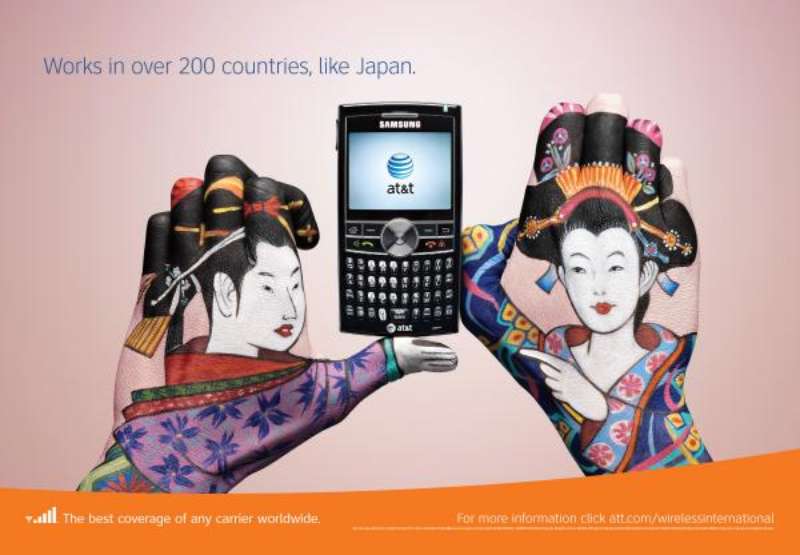
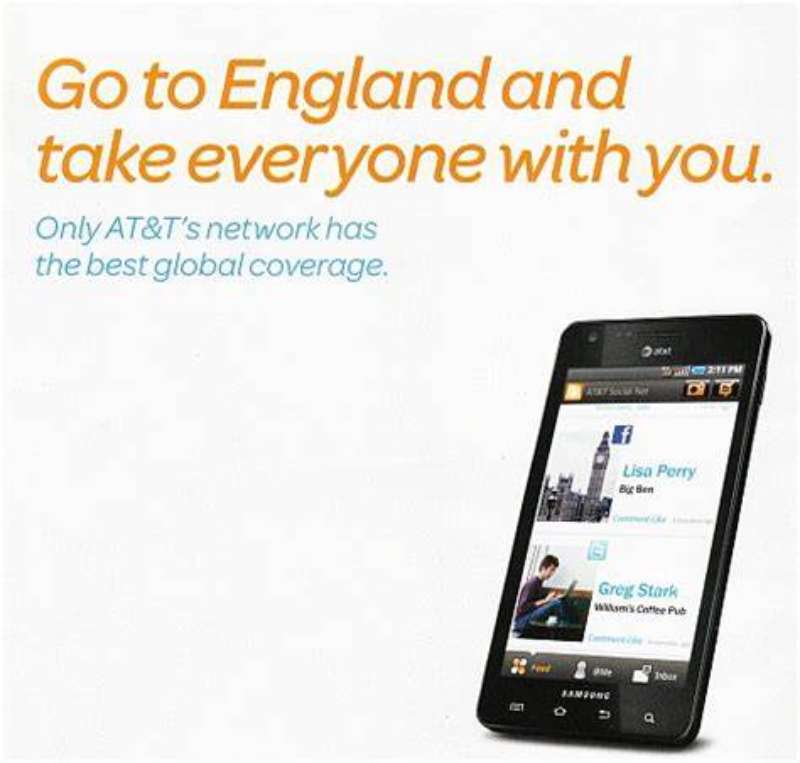
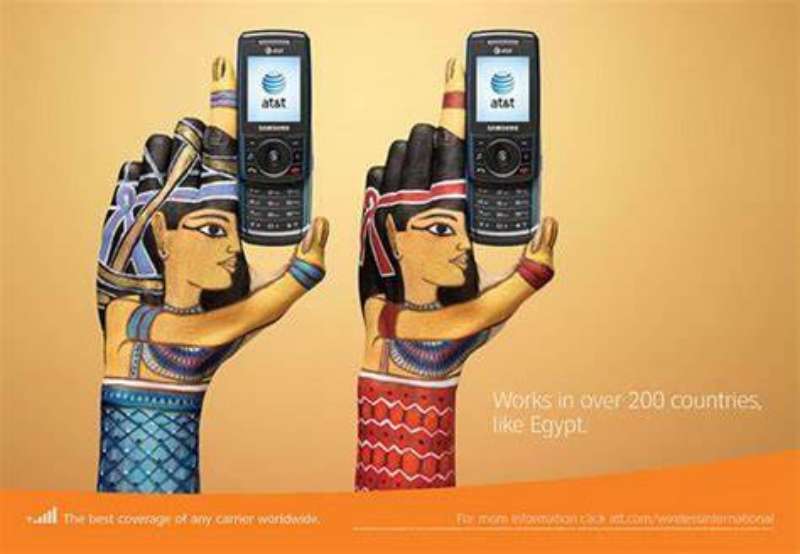
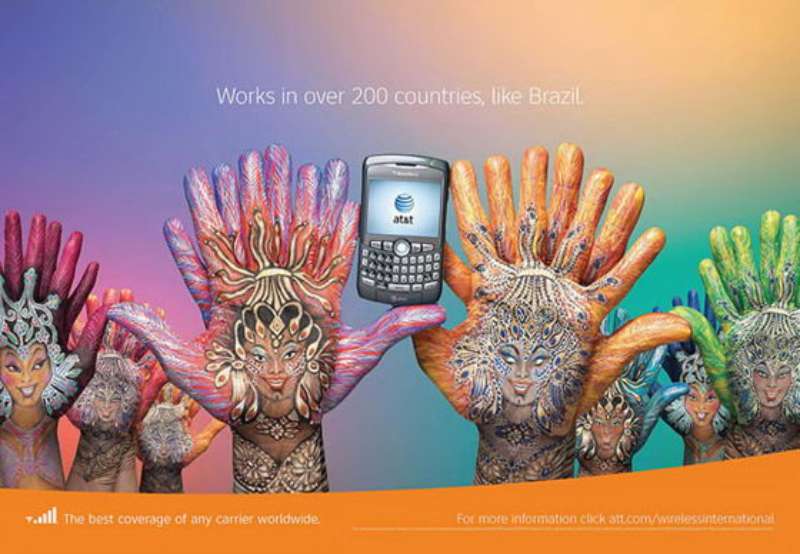
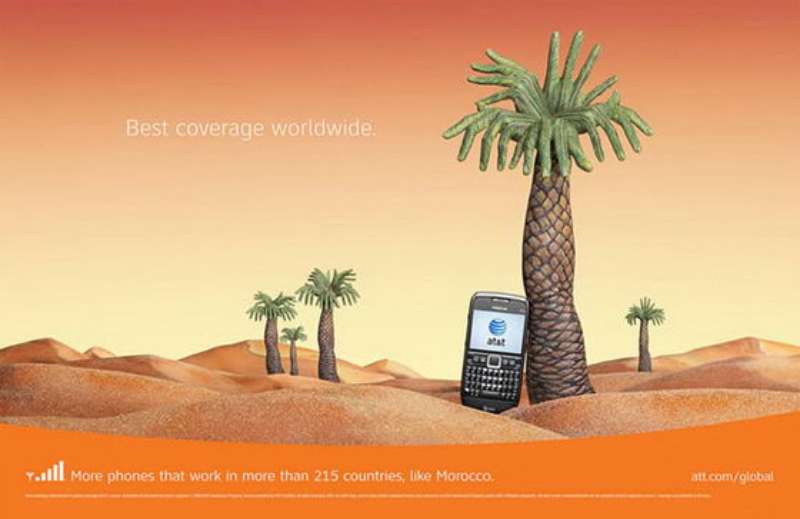
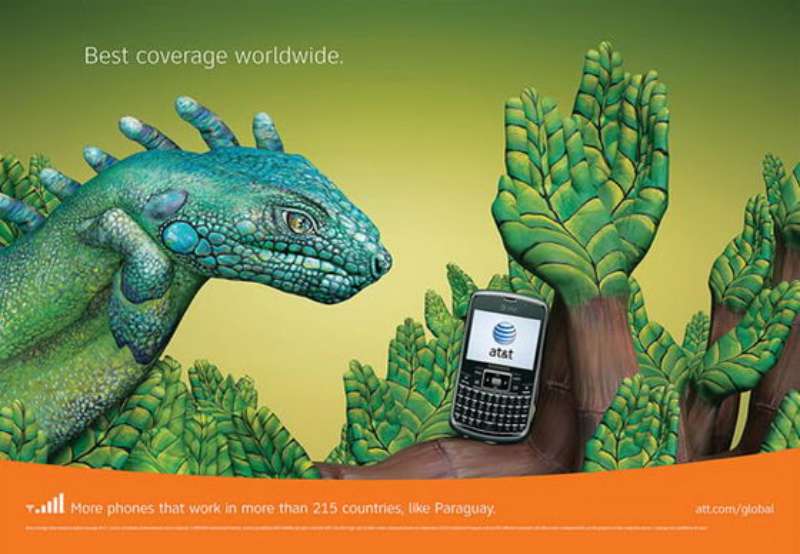
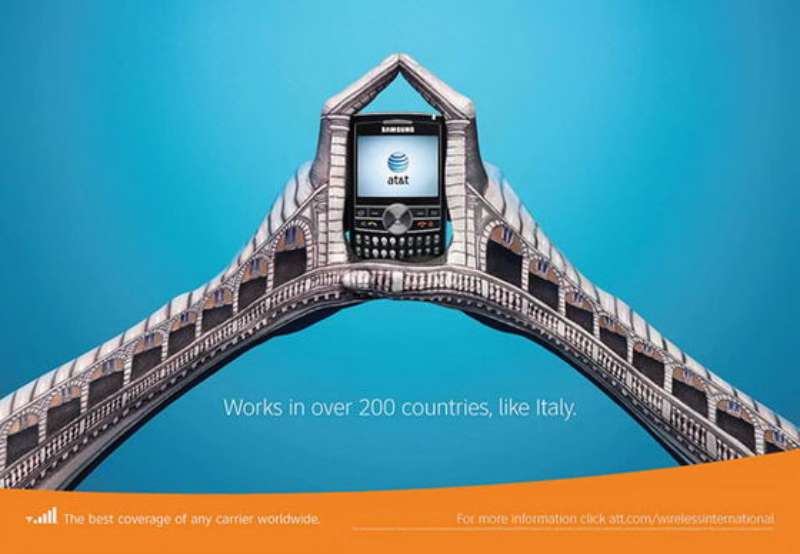
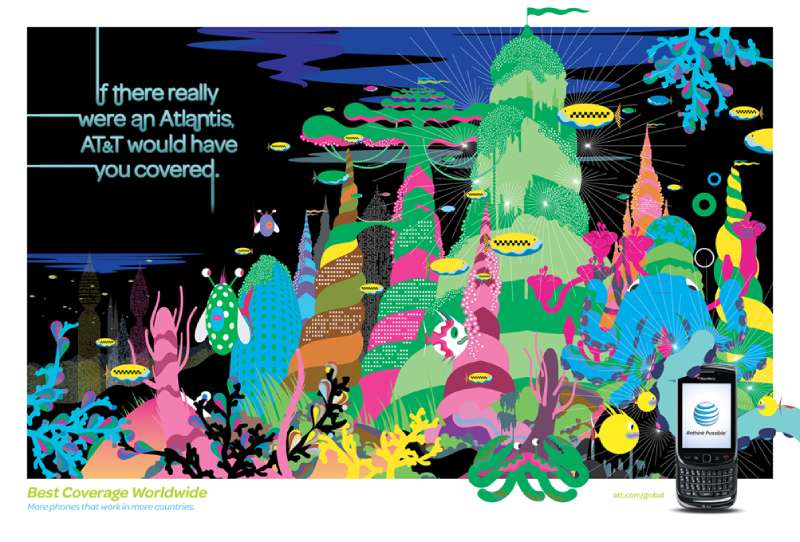
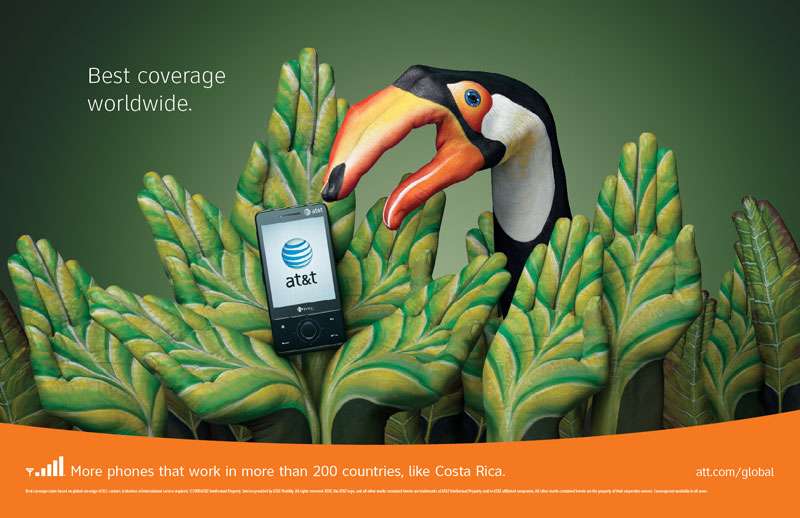
AT&T ran “More bars in more places” from 2006 to 2007 after the Cingular merger, then “Your world. Delivered.” from 2007 to 2010 alongside its exclusive iPhone deal. Both platforms sold coverage as a literal, countable thing.
Creative leaned on signal-bar iconography reproduced at billboard scale, which was smart and also a trap. Coverage claims age badly when the network buckles, and this one did in New York and San Francisco.
- Orange Cingular equity folded into AT&T Blue over roughly 18 months
- Bar graphics doubled as the layout’s focal point in print
It Can Wait (2010 to present)

AT&T launched the distracted driving campaign in March 2010, first internally, then as a national program across TV, radio, print and online. The message never changed: no text is worth dying for.
Pledges collected: more than 36 million Americans, per the Shorty Awards case study.
Media footprint: 200-plus premium partners including CBS, NBC and Today.
Award: the film “Close to Home,” directed by Frederic Planchon, took a Gold Cannes Lion for Direction.
The 2018 mobile flight reached 18.2 million people and drove a 13.3% lift in awareness, with 45% average video completion against a 25% to 30% benchmark. Six-second cuts with the actor in frame from the opening beat outperformed everything else.
Lily Adams Retail Spots (2013 to 2017, 2020)
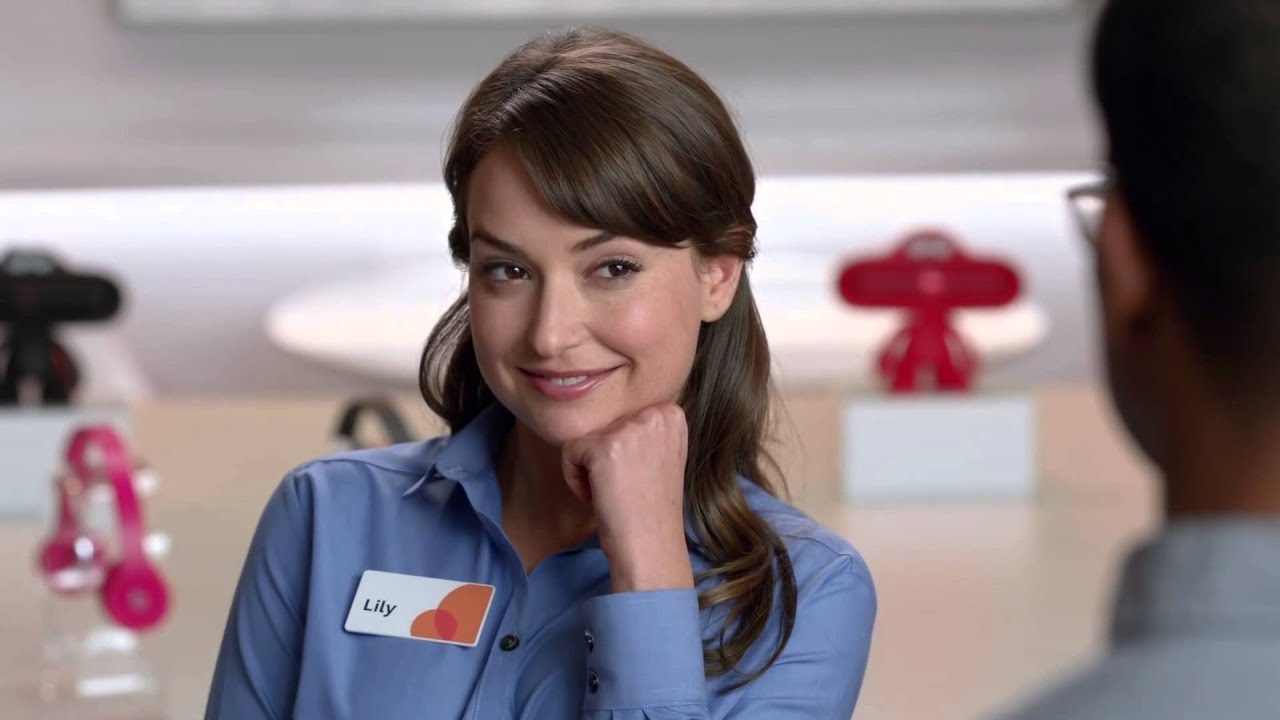
Milana Vayntrub was cast for one spot, “Supervisor,” in late 2013. BBDO kept her. Lily Adams appeared in more than 40 commercials through 2017, then returned in 2020 with BBDO LA and Critical Mass.
Set design does the heavy lifting here. Blue polo, white counter, product wall behind. The framing is identical across every spot, so viewers recognize the scene before anyone speaks.
Vayntrub shot the 2020 spots in her own home during lockdown. Same character, worse lighting, and it barely mattered.
Just OK Is Not OK (2019 to 2020)

iSpot recorded roughly $73 million in TV spend within days of the campaign’s debut, against $38.2 million for all of December 2018 and $10.1 million for December 2017.
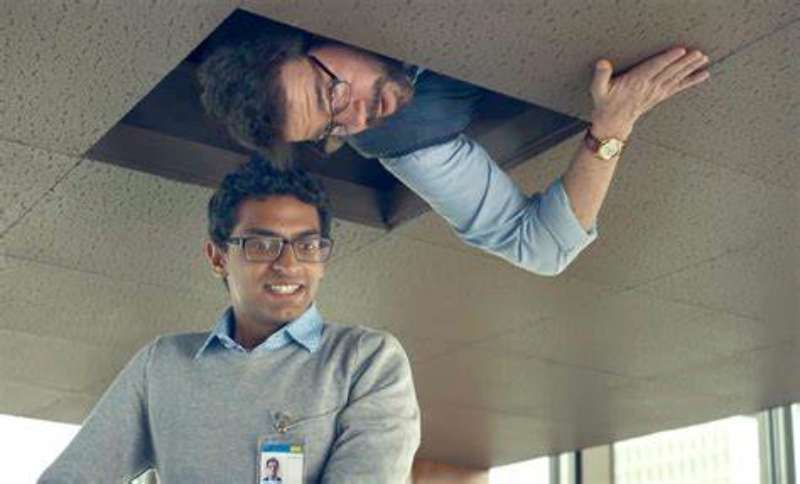
BBDO LA built the platform around deadpan scenarios where mediocrity is unacceptable: an “OK” surgeon, an “OK” tattoo artist, “OK” sushi. Lena Waithe voiced the spots. It debuted during the College Football Playoff and extended into March Madness.
The comedy is structural, not written. Flat rooms, flat lighting, no reaction shots, no music cue telling you where the joke lands. If you like funny ads that trust the audience, this is the reference file.
The National Advertising Division cleared the tagline while pushing back on the “America’s best network” claim attached to it.
The AT&T Guarantee (2025 to 2026)
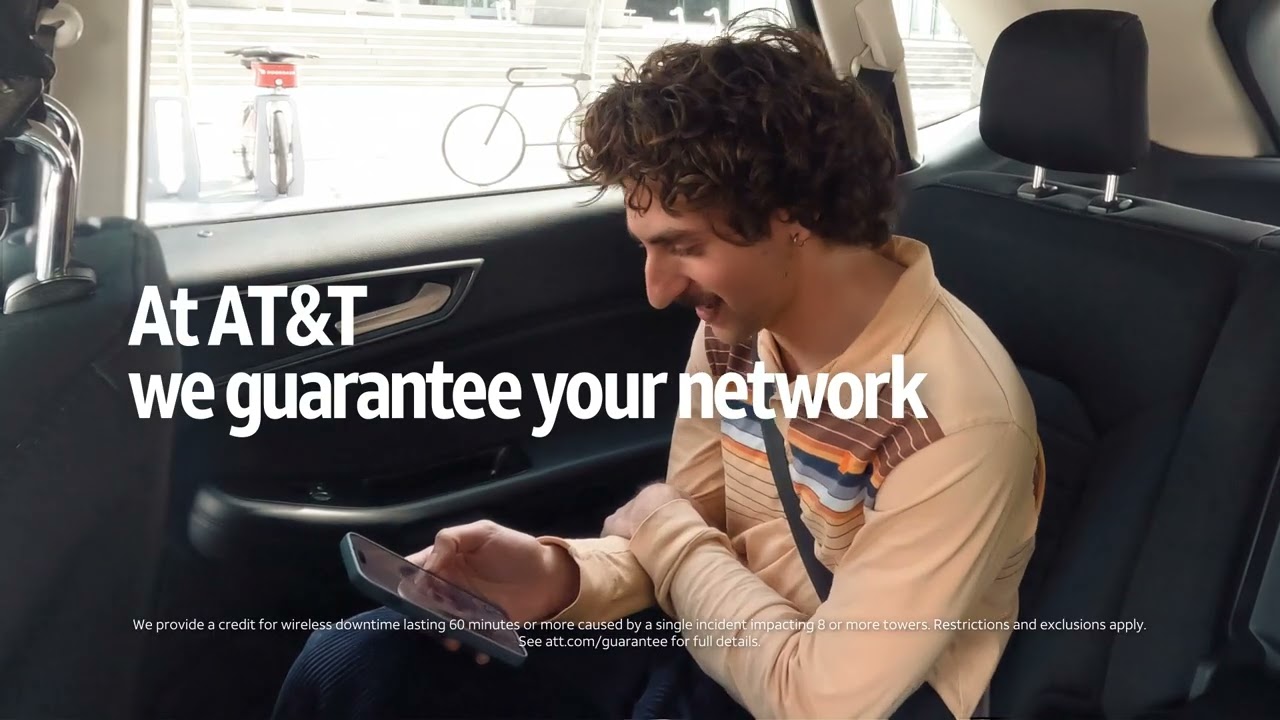
AT&T launched the Guarantee on January 9, 2025, with a 360 campaign from BBDO New York, BBDO Dallas, Critical Mass LA and Dieste LA. Mark Molloy directed, Smuggler produced, Sofia Vergara narrated. The work debuted around the Orange Bowl with Tim Tebow, DeMarcus Ware and Marshawn Lynch.
Creative device: everyday things that are never guaranteed (butter tubs, in-laws) set against network reliability.
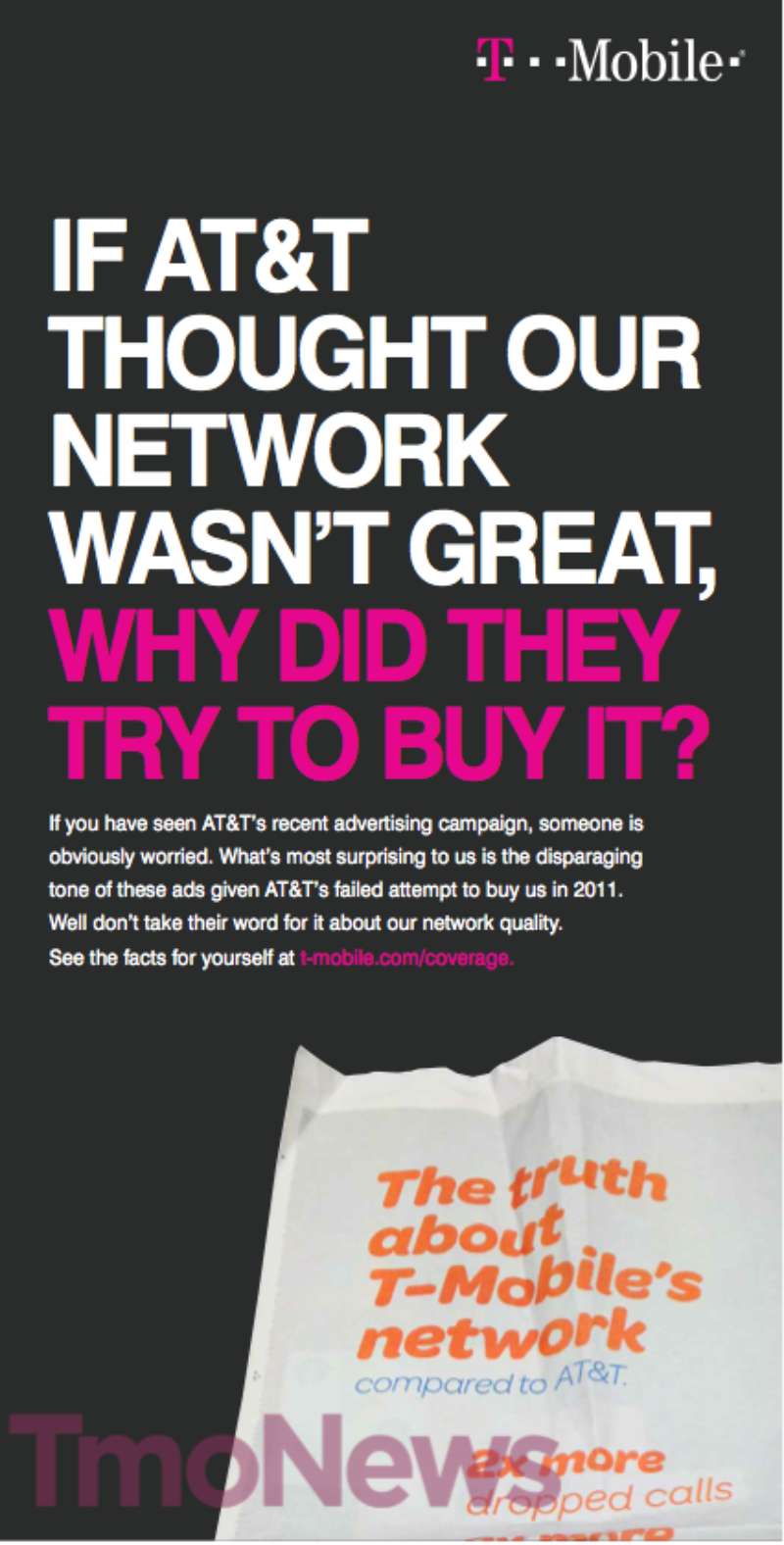
October 2025 extension: Luke Wilson fronted “Ain’t Our First Rodeo” and “Check the Scoreboard,” both aimed directly at T-Mobile.
Supporting number: $145 billion invested in U.S. connectivity from 2020 to 2024, per AT&T.
AT&T Print Ads From the Bell System Era
Pre-1984 print sits in a different world from everything after it.
Full-page magazine placements carried long body copy, a single photograph and the bell mark bottom right. These read like editorial, which was deliberate. Anyone studying vintage ads from regulated monopolies will recognize the tone: institutional, unhurried, faintly civic.
The 2016 “Power of &” B2B work brought long-form print back briefly with eight-page inserts in The New York Times and The Wall Street Journal, created by BBDO New York.
How Do AT&T Print Ads Work Visually?
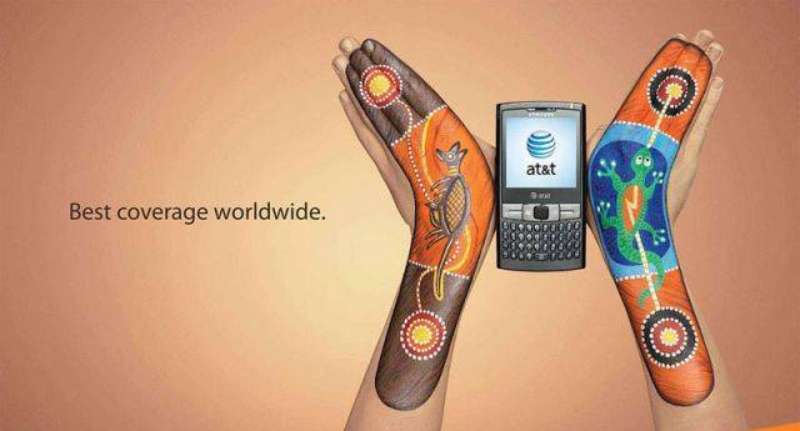
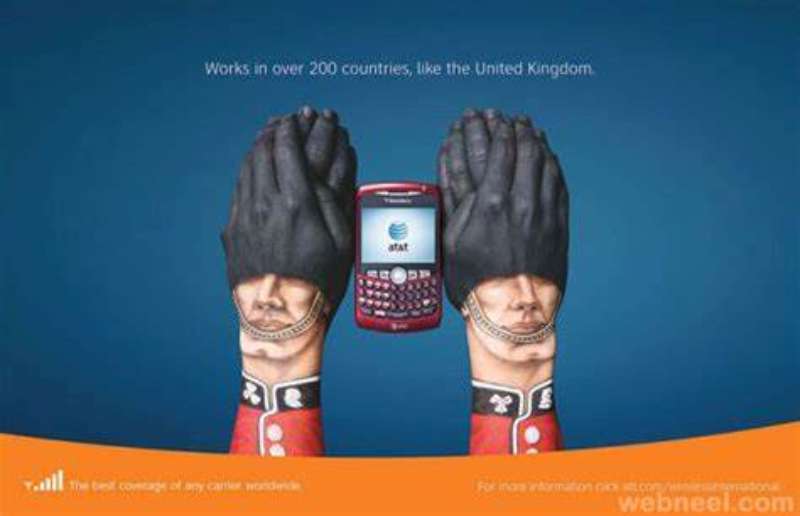
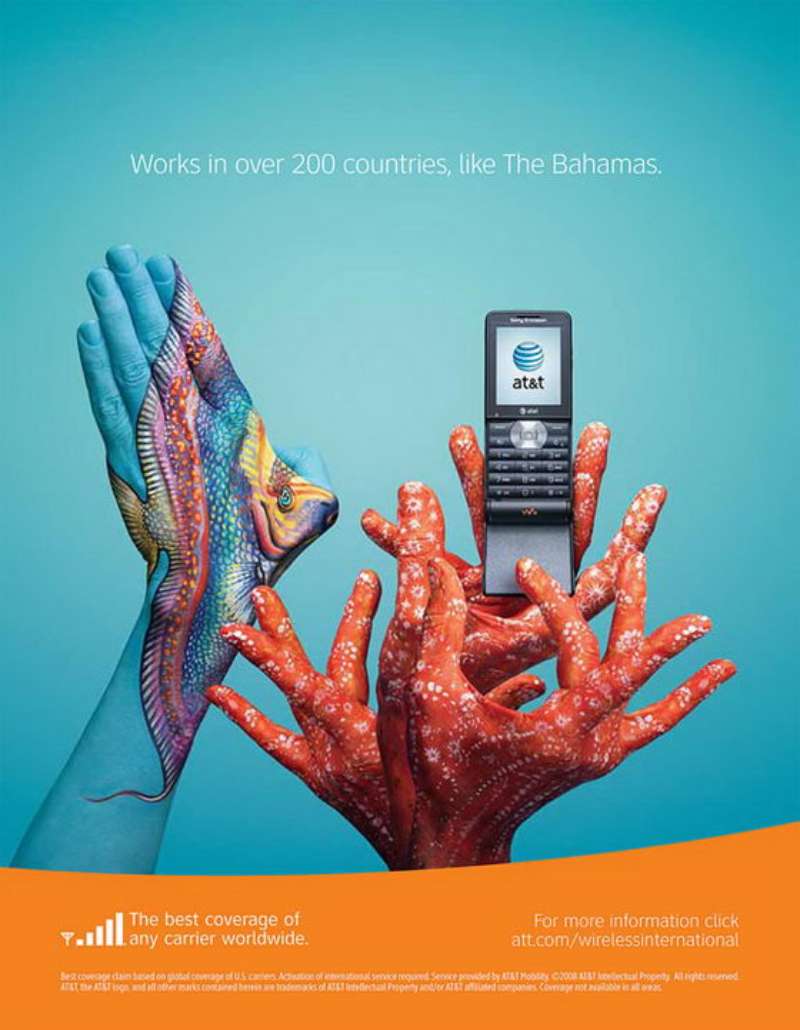
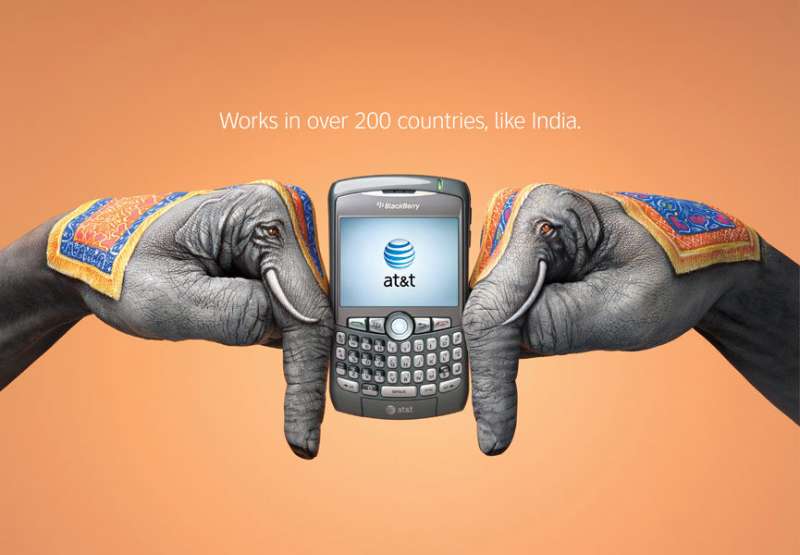
AT&T print layouts run on 3 fixed rules: a single dominant image, a left-aligned or centered copy block below the optical center, and the globe locked to a corner. Text never wraps around the mark. Color is restricted to AT&T Blue, black and white.
The visual hierarchy is deliberately shallow. Image, headline, mark. Three levels, no fourth. Body copy, when it exists, drops to a size that signals “read this only if you want to,” which keeps the scan path clean at newsstand distance.
Typography
The wordmark moved through Helvetica-era settings and Omnes before Interbrand set the 2005 version in Avenir Medium, designed by Adrian Frutiger. AT&T later commissioned Aleck Sans as a proprietary typeface, which removed its font licensing dependency across markets.
Headline setting is almost always a single weight of a geometric sans-serif font at one size. The 2015 return to uppercase in the wordmark was a posture change, from approachable to authoritative.
Color and the globe
AT&T Blue is #00A8E0, PMS 298 C, paired with PMS Black 6 C. That two-value system is why the Pantone spec survives across newsprint inserts, backlit airport panels and 5-inch phone screens without drifting.
Saul Bass designed the globe in 1983 with G. Dean Smith at Bass/Yager, after the antitrust ruling barred AT&T from the bell. Stripe count has dropped with each redesign: 12 in the original, 8 in 1999, 6 from 2005. Simplification for small screens, mostly, and a decent case study in logo design principles under real constraints.
White space around the mark is codified in AT&T’s brand guidelines as clear space equal to the globe’s radius. Print executions respect it. Retail signage, in my experience, does not always.
How Do AT&T TV Commercials Differ From Its Print Ads?
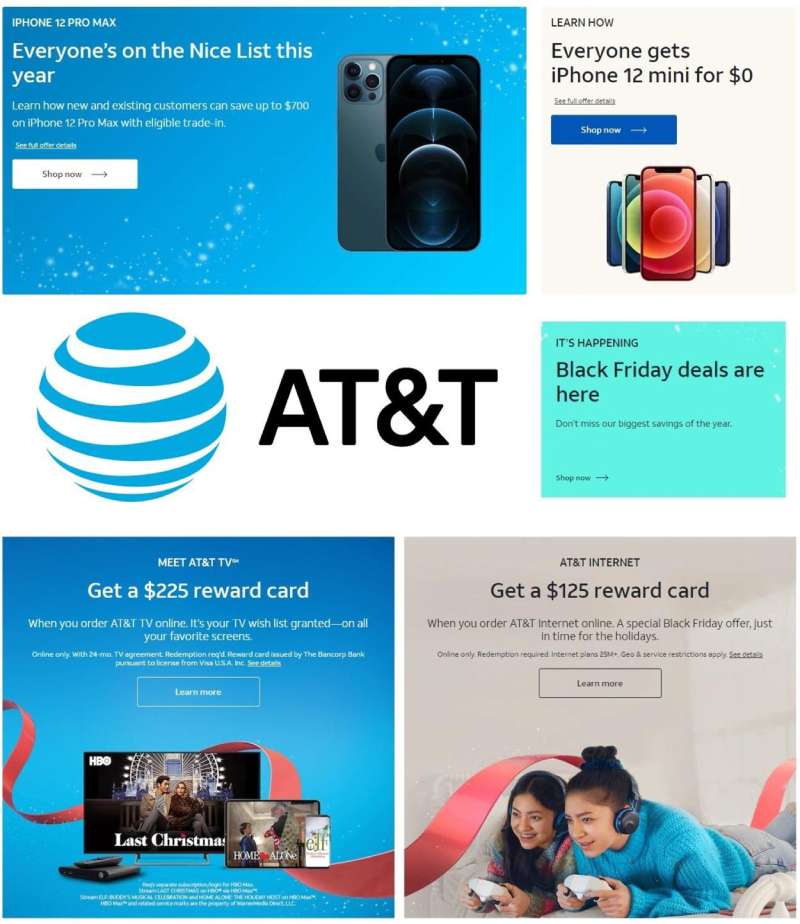
TV carries the narrative load. Print carries the claim. AT&T commercials build a scenario over 30 to 90 seconds and hold the logo until the final 2 seconds, while print states the offer immediately and never delays the mark.
“Close to Home” (2014, BBDO, directed by Frederic Planchon). A single-take collision sequence for It Can Wait. No dialogue, no music bed, no product. The Gold Lion for Direction was for restraint, not spectacle.
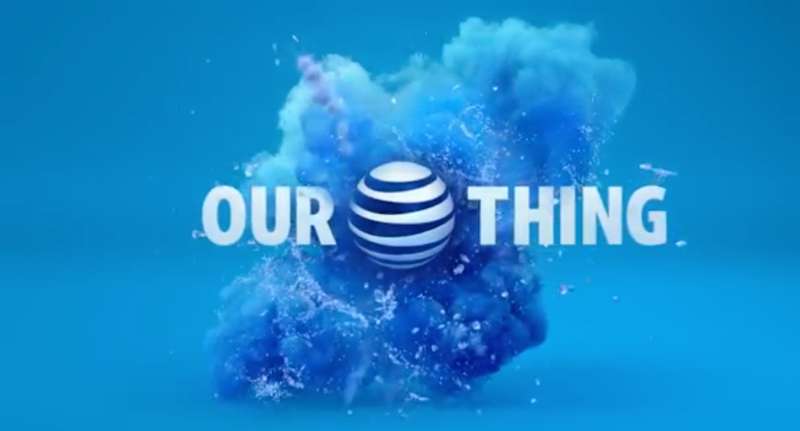
“Shot” (2018, BBDO, cinema). Ninety seconds that start as a sports movie and turn into a sci-fi thriller, part of the “More For Your Thing” genre-mashup run with National CineMedia.
“Anthem” (2014, BBDO). Sixty seconds launching “Mobilizing your world,” written by Bill Heater and Marc Klein after a year spent replacing “Rethink possible.”
“When the Connection Matters” (2026, WEST BBDO). Five national March Madness spots with NBA and WNBA athletes, fronted by Arturo Castro as the character Ted, under the “Connecting Changes Everything” platform.
Broadcast is where AT&T does its storytelling. Print is where it does its arithmetic.
How Has AT&T Advertising Evolved Since 1979?
AT&T advertising has moved through 4 strategic eras: emotional utility (1979 to 1984), future vision (1993 to 1995), coverage combat (2006 to 2014) and reliability proof (2019 to 2026). Each shift followed a business event, not a creative whim.
| Era | Strategic shift | Representative campaign |
|---|---|---|
| 1979 to 1984 | Soften the monopoly, sell long distance as feeling | Reach Out and Touch Someone |
| 1993 to 1995 | Reposition post-divestiture as an innovation company | You Will |
| 2006 to 2014 | Defend coverage claims against Verizon | More Bars in More Places, Rethink Possible |
| 2019 to 2026 | Prove reliability with guarantees and comparisons | Just OK Is Not OK, The AT&T Guarantee |
The 1993 relaunch came with a new globe treatment and a new agency brief at the same time. Esther Lee, then SVP of brand marketing, framed the 2010 “Rethink possible” reset as an attempt to stop being read as a phone company, right as the iPhone exclusivity was ending.
Spanish-language platforms ran in parallel, not as translations. “Ponemos tu mundo a tu alcance” covered 2005 to 2010, “Piensa Sin Limites” covered 2010 to 2014, both handled by Dieste.
Which Agencies Created AT&T Advertising?
Four agencies account for most of the work. N.W. Ayer & Son created Reach Out and Touch Someone in 1979 and You Will in 1993. BBDO has held the creative account since 2007. Hearts & Science won media in 2016. Dieste handles Hispanic-market creative.
| Agency | Role | Signature work |
|---|---|---|
| N.W. Ayer & Son | Agency of record through the 1990s | Reach Out and Touch Someone, You Will |
| BBDO New York / BBDO LA / WEST BBDO | Creative AOR since 2007 | Rethink Possible, Just OK Is Not OK, The AT&T Guarantee |
| Hearts & Science | Media AOR since 2016 | Cinema buys with National CineMedia |
| Dieste | Hispanic-market creative | Feel It Again And Again, Guarantee multicultural cuts |
Omnicom consolidated the entire account in 2016 after a closed review against WPP, roughly two years into the DirecTV acquisition. BBDO kept creative, Hearts & Science took media, and Grey lost the DirecTV business it had held since 2010.
Named directors matter to this account: David Fincher (You Will), Noam Murro (Rethink Possible), Frederic Planchon (Close to Home) and Mark Molloy (The AT&T Guarantee). David Lubars, chief creative officer at BBDO Worldwide, has overseen the relationship across most of it.
What Can Designers Learn From AT&T Ads?
Six things transfer directly to advertising design work, whether or not you ever touch a telecom brief.
- Lock the mark to one corner and defend its clear space in the brand style guide
- Limit the palette to one brand color plus black and white, then specify it in spot ink and hex
- Build the headline in one weight at one size, and let the image carry the contrast
- Drop the copy block below the optical center so the eye lands on the subject first
- Reduce ornament with every redesign instead of adding it, the way the globe went from 12 stripes to 6
- Cast a recurring character before you cast a celebrity, because recognition compounds and fees do not
That last one is the cheapest lesson on this page. Lily Adams cost AT&T a single audition and returned seven years of brand recall.
How Do AT&T Ads Compare to Verizon Ads?
Both carriers sell the same invisible product, so both fight over how to make a network visible. The approaches split cleanly.
AT&T argues by analogy. “Just OK Is Not OK” never shows a tower or a coverage map, it shows a bad surgeon and lets you finish the thought. The 2025 Guarantee work does the same with butter tubs and in-laws.
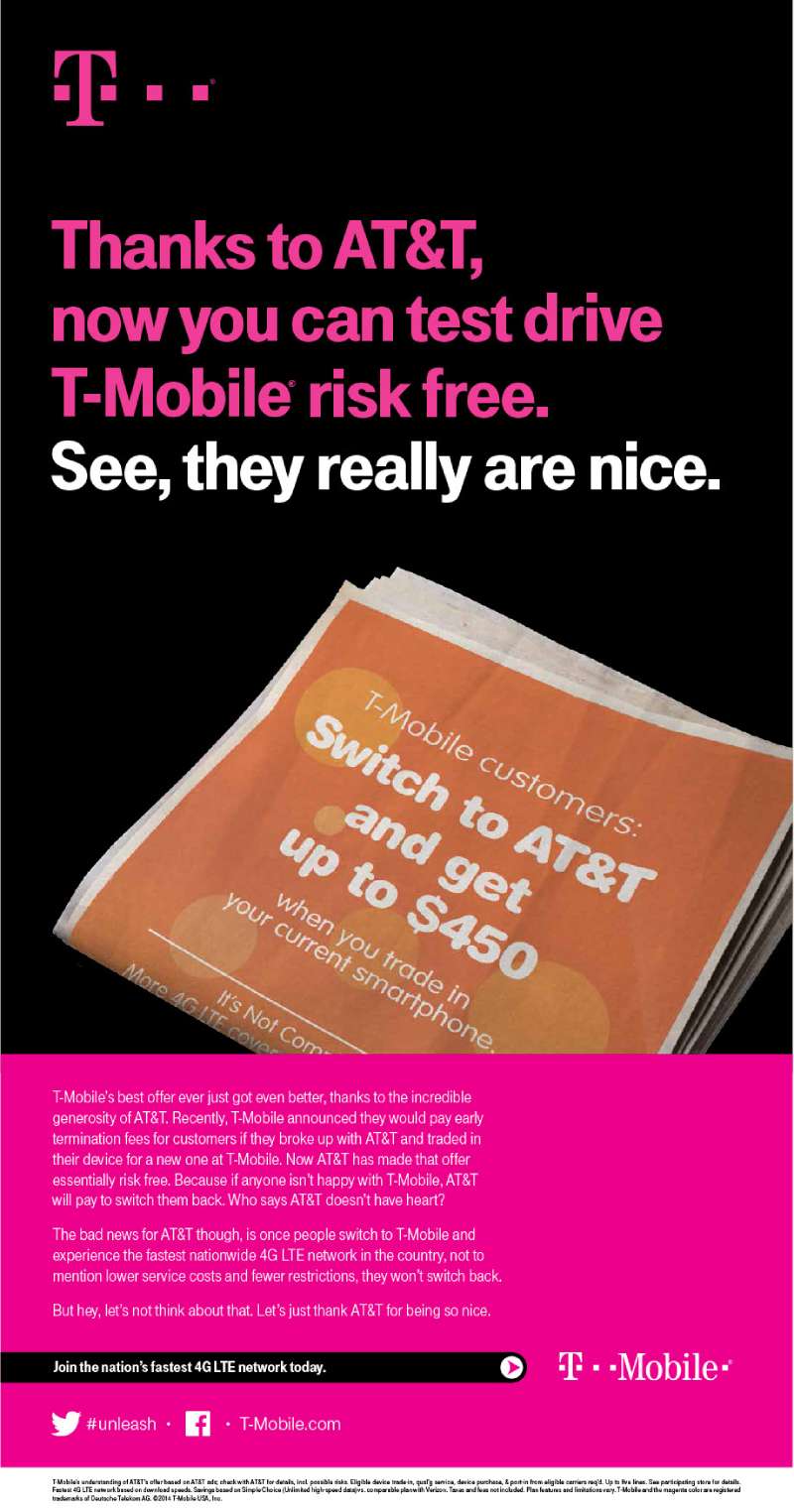
Verizon ads historically argue by evidence. Coverage maps, “Can you hear me now,” side-by-side speed claims. Red against white, literal against literal. When the two ran competing map campaigns around 2009, it ended in lawsuits, which tells you how close to the line both sides were working.
The tech-sector comparison is more useful than the telecom one, honestly. IBM ads and Sony ads both solved the same problem, selling infrastructure and engineering to people who cannot see either, and both landed on restraint rather than volume. AT&T sits closer to IBM than to any carrier.
What Makes AT&T Advertising Work?
The through line across five decades is subtraction. One image, one claim, one mark, and a palette that has never needed a third color.
Every era of this work solved the same problem, which is selling something nobody can see. The answer was never a better diagram of a network. It was a face on a phone call, a boy shooting a basket, a surgeon who is merely acceptable.
That approach only holds because the frame around it never moves. Same blue, same globe, same corner, same weight of type. Novelty lives in the story, discipline lives in the layout, and the two do not trade places.
For anyone practicing minimalist design on a brand that has to speak to 100 million households, this is the reference set worth studying.
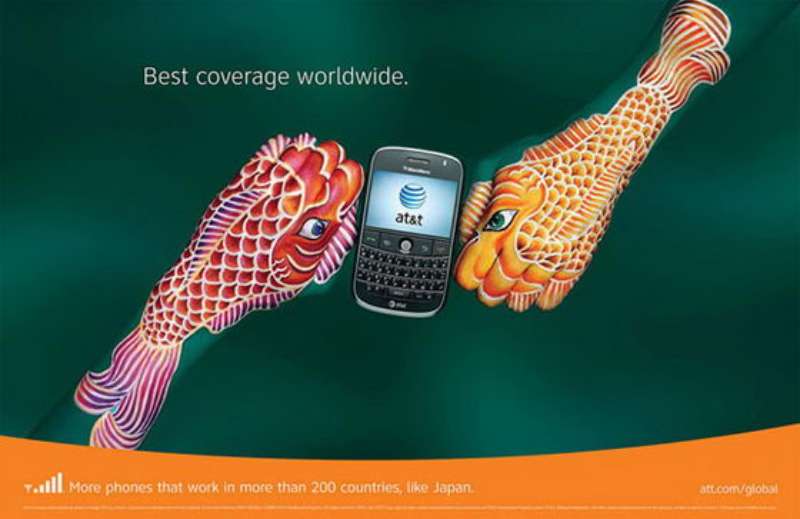
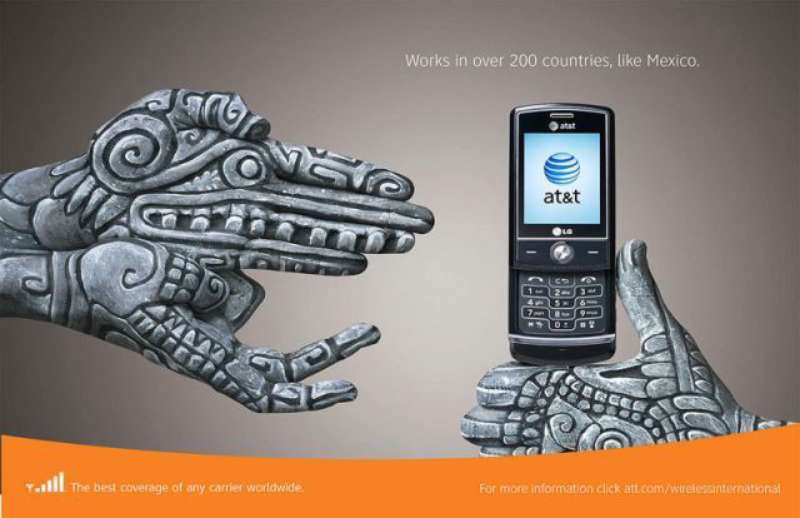
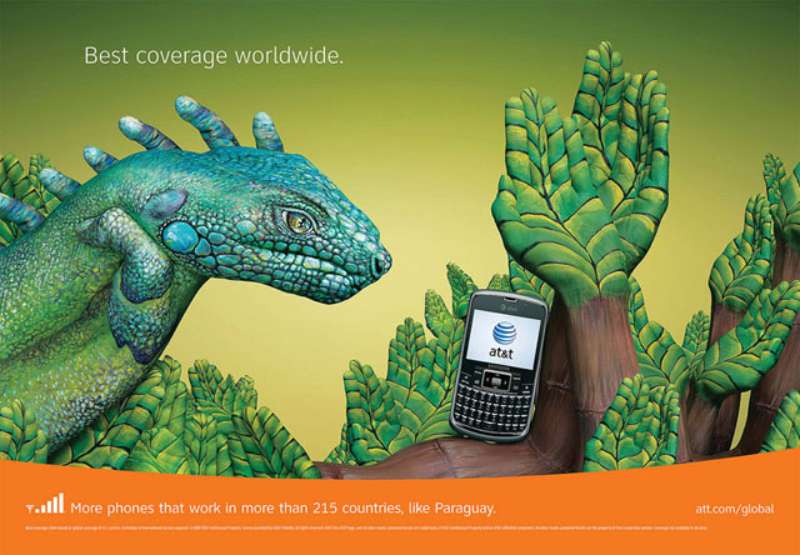
AT&T Ads Examples
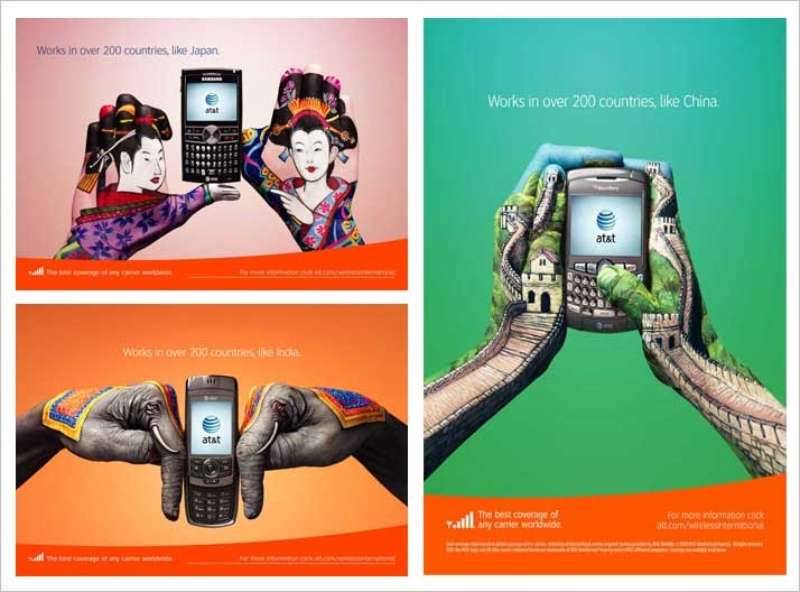
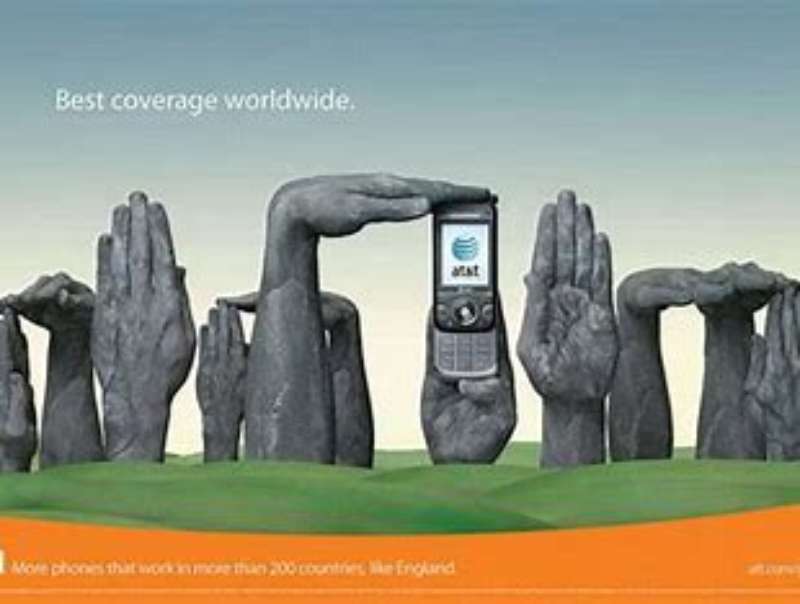
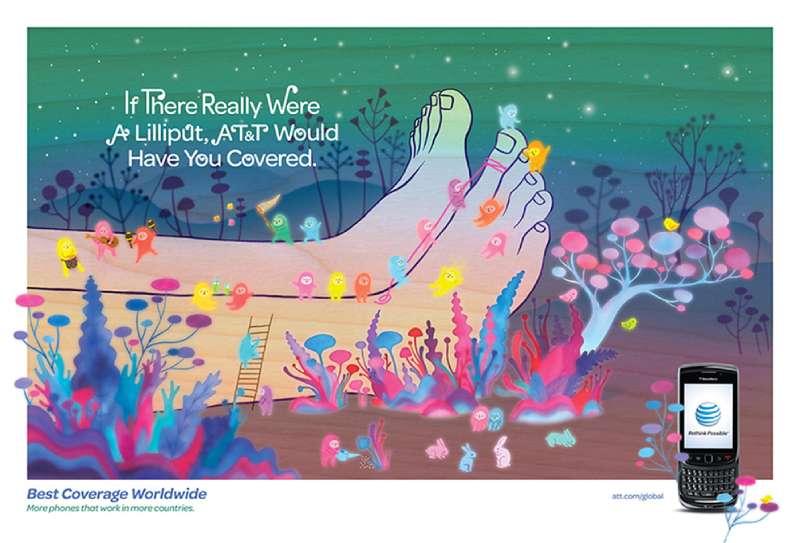
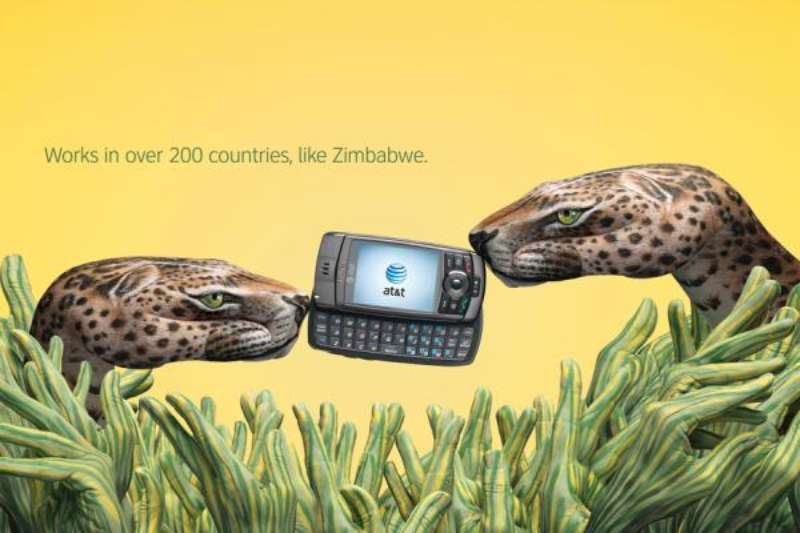


FAQ on AT&T Ads
Who is the woman in the AT&T commercials?
Milana Vayntrub plays Lily Adams, a fictional store employee. She was cast for a single 2013 spot called “Supervisor,” then appeared in more than 40 commercials through 2017 and returned to the role in 2020.
Why did Lily stop appearing in AT&T commercials?
AT&T moved on from the retail-counter format after 2017. Vayntrub returned in 2020 with BBDO LA and Critical Mass, filming from home during lockdown, and has since spoken publicly about the online harassment tied to the role.
Who narrates the “Just OK is not OK” ads?
Lena Waithe voiced the campaign, which BBDO LA launched during the College Football Playoff in January 2019. The spots feature deadpan scenarios: an OK surgeon, an OK tattoo artist, OK sushi, OK brakes.
Why is the AT&T logo nicknamed the Death Star?
The striped globe Saul Bass delivered in 1983 resembled the Star Wars station released six years earlier. Bass described his intent differently, as a world girdled by information, with line weights faking dimensionality on a flat mark.
How much does AT&T spend on advertising each year?
AT&T reported $2.576 billion in advertising expense for 2023, up from $2.462 billion in 2022. iSpot tracked roughly $73 million in TV spend within days of the “Just OK is not OK” debut alone.
Where can I watch old AT&T commercials?
Three sources cover most of it: the AT&T Tech Channel archive for Bell System films, Ads of the World for 68 catalogued campaigns with agency credits, and the Smithsonian’s N.W. Ayer collection for print proofs.
Has AT&T ever run a Super Bowl commercial?
Yes. AT&T Wireless launched “mLife” with a 60-second spot from Ogilvy & Mather during Super Bowl XXXVI in 2002. Later appearances include two Beats Music spots in 2014 and a Spanglish Lily ad in 2024.
Which sports properties carry AT&T branding?
The AT&T Pebble Beach Pro-Am has run since 1986, the longest title sponsorship on the PGA Tour. AT&T Stadium followed in 2013 at a reported $17 million to $19 million a year. The Byron Nelson deal ended in 2023.
What happened to N.W. Ayer & Son?
Founded in Philadelphia in 1869, Ayer merged into the MacManus Group in 1996 and later Bcom3. The name was retired in 2002 and folded into Kaplan Thaler Group, ending 133 years of operation.
Has AT&T been challenged over its advertising claims?
More than once. The BBB’s National Advertising Division cleared the “Just OK” tagline but ruled against the attached “America’s best network” claim. In 2024, AT&T settled with state attorneys general, including New York and Texas, over deceptive advertising.
Conclusion
Five decades of AT&T ads keep landing on the same answer to the same problem, which is how to make an invisible network feel like something worth paying for.
The solution was never a better coverage claim. It was a mother’s voice on a long distance call, a wrecked car in a single unbroken take, a surgeon described as adequate.
It Can Wait collected 36 million pledges and a Gold Cannes Lion. Just OK Is Not OK turned a wireless spec sheet into a running joke that people quoted at work.
What holds it together is the layout underneath: one image, one claim, one mark, two colors.
Steal the discipline, not the jokes.

Renowned for his expertise in logo design and visual branding, Bogdan has developed a multitude of logos for various clients.
His skills extend to creating posters, vector illustrations, business cards, and brochures. Additionally, Bogdan's UI kits were featured on marketplaces like Visual Hierarchy and UI8.
He also wrote in the past years on sites like Design Your Way, WebDesignerDepot, WPDean, Designmodo, Speckyboy, Slider Revolution, and more.
- The Windsurf Logo History, Colors, Font, And Meaning - 10 October 2026
- How to Remove Background From Product Photos (No Photoshop) - 10 October 2026
- How Designers can Build a Stronger Online Creative Identity - 9 October 2026

Bogdan Sandu is a seasoned designer who has been designing websites since 2008. Renowned for his expertise in logo design and visual branding, Bogdan has developed a multitude of logos for various clients. His skills extend to creating posters, vector illustrations, business cards, and brochures. Additionally, Bogdan's UI kits were featured on marketplaces like Visual Hierarchy and UI8. He also wrote in the past years on sites like Design Your Way, WebDesignerDepot, WPDean, Designmodo, Speckyboy, Slider Revolution, and more.
You Might Also Like