

Most people who say they want to design games are thinking of a different job. Usually it’s the concept artist’s, or the programmer’s. The game designer decides how the game works, meaning the rules and whatever choices the player gets to make.
Bigger studios split that work between level designers, systems designers and narrative designers. The work isn’t judged on looks. It gets tested with real players to see whether the game is fun.
You can get in with a degree. Plenty of people get in with a portfolio and a couple of finished prototypes instead.
There are real jobs out there. The Entertainment Software Association’s 2024 Economic Impact Report counts over 104,000 direct video game jobs in the United States, with average industry pay reaching $168,600 a year. I wouldn’t read that as a starting salary, though.
What Is a Game Designer
On a development team, the designer owns how the game plays. How it looks or how fast it runs belongs to other people.
That means the rules and mechanics, plus every small decision a player makes from one second to the next.
The role sits between art and code. You take an idea and turn it into a system other people can build and test.
It’s a different track from becoming a graphic designer, even though both lean on composition and visual thinking.
Shigeru Miyamoto is the classic example. At Nintendo he worked out Mario’s jump and momentum before anyone drew a single background.
Game design is one of the creative and technical professions inside video game development, next to art, programming, and production. What separates it from the others is how you get judged. Players (and your leads) care how the game feels to play, not about the code underneath or the art on top.
What Does a Game Designer Do Day to Day
Mechanics design, level design, balancing, documentation. The same tasks come back every week, and most of that week is spent reworking things rather than writing first drafts.
- Sketching a new mechanic on paper before opening the engine
- Tweaking balance numbers in a spreadsheet, then testing again
- Updating the design doc so artists and engineers have something to build from
- Watching playtests and changing things based on what players actually did (which is rarely what the doc predicted)
On a small team all of this blurs together.
Valve has openly described a setup where designers move between projects on their own initiative instead of staying locked to one title.
Bigger studios go the other way. A level designer, a systems designer and a narrative designer might each own their own part of the work.
Then there are the meetings. Newcomers are usually surprised how much time goes into pitching, because a mechanic rarely ships until a producer or director has been convinced it should.
What Skills Does a Game Designer Need
It’s a mix. Creative instincts matter, but so does being able to script a bit and explain your ideas to people who don’t think like you. Being strong in only one of those rarely gets you far.
Creative Skills
I’d put systems thinking first. You have to picture how one rule change affects the whole game, not just the screen in front of you.
Player psychology helps a lot, since people almost never behave the way the design intends. A sense of story matters too. Whether a boss fight feels earned or a level twist lands depends mostly on what came before it.
Pattern recognition is the slow one. You build it over years of playing games critically instead of casually.
Supercell shows how much each person ends up owning. Its teams are small, and often just five or six people are responsible for a shipped game’s core mechanics end to end.
Technical Skills
If you can script, you can prototype your own ideas. If you can’t, you wait on a programmer for every single test, and that gets old fast.
C# is the usual starting point, mostly because it’s also Unity’s primary language.
Spreadsheet math matters just as much as code, which surprises people. Balancing damage numbers, drop rates and in-game economies is closer to accounting than to art.
Communication Skills
A mechanic that never gets approved never ships. So you learn to pitch clearly.
Design docs are harder. The same document has to make sense to an artist, an engineer and a producer, and each of them reads it looking for something different.
Communication also carries into UX design, especially when you’re explaining why a menu or onboarding flow is confusing players.
A couple of habits I’d call non-negotiable are writing short design docs and taking blunt playtest feedback without flinching. You also have to defend a decision without getting defensive about it, which is harder than it sounds.
What Tools and Engines Do Game Designers Use
Unity, Unreal Engine and Godot cover most working designers. Which one you learn first matters less than finishing something in it.
For a sense of the split, Video Game Insights’ 2025 analysis of Steam data found that 51% of games released in 2024 were built in Unity, compared to 28% in Unreal Engine, 5% in Godot, and 4% in GameMaker.
Unity
This is the one I’d point most beginners to. Scripting is in C#, which is approachable without a coding background, and the large asset store saves a lot of time when you just want a prototype running. It’s especially comfortable for 2D, mobile and small-team projects.
Team Cherry built the entire game Hollow Knight in Unity, working as a three-person studio.
One caution. Unity’s past licensing changes pushed some teams toward competitors, so check the current terms before you commit long term.
Unreal Engine
Unreal Engine leans on visual scripting through Blueprints, so designers can build logic without writing code line by line. The rendering is best-in-class, and it handles large 3D worlds well.
The learning curve is steeper than Unity’s, though. It also wants heavier hardware, and solo beginners will find the documentation thinner than they’d like.
Godot and No-Code Tools
Godot has grown fastest among small teams, mostly because of its open-source license and how light it is.
If you’re not ready to script at all, no-code tools take that barrier away completely.
| Tool | Coding Required | Best For |
|---|---|---|
| Godot | Light scripting (GDScript) | Indie and solo projects |
| Construct | None | Browser-based prototypes |
| Twine | None | Narrative and text-based games |
None of these replace design skill. They just make it cheaper to test an idea.
Do You Need a College Degree to Become a Game Designer
Strictly speaking, you don’t. Plenty of studios still prefer one, though.
Some filter resumes by degree before they ever open a portfolio, particularly in Japan and parts of Europe. Small and mid-size indie teams tend to care only about what you’ve shipped.
Software and game development in general is more self-taught than people assume. Stack Overflow’s 2024 Developer Survey found that 66% of developers hold a bachelor’s or master’s degree, even though only 49% say they learned to code at school in the first place.
I read that gap as people teaching themselves first and picking up the degree later.
Markus “Notch” Persson never finished a design-related degree before building Minecraft, the game that defined his career.
What a degree does give you, beyond skill, is structured feedback on early work and a network that comes with it. Internship pipelines are also much easier to get into from inside a school.
Still, a degree with no portfolio attached rarely gets anyone hired. The reverse happens constantly.
Degree vs Bootcamp vs Self-Taught: Which Path Fits You

These paths don’t end up in very different places. Cost and time are where they really differ.
| Path | Typical Cost | Typical Length | Best For |
|---|---|---|---|
| Degree | Around $40,000 per year at a specialized school | 3 to 4 years | Studios that filter by credential, students who want a built-in network |
| Bootcamp | $9,900 to $16,500 total | 7 to 12 months | Career changers who want structure without a full degree |
| Self-taught | Mostly the cost of a laptop and free tools | Variable, often 1 to 2 years | Disciplined learners who finish projects unsupervised |
DigiPen Institute of Technology’s own tuition page lists flat rate tuition near $40,000 per year for the 2025-2026 cycle. Over four years that comes to just under $160,000, before housing and books.
Bootcamps cost far less. Flatiron School’s Game Design Bootcamp starts at $9,900 for a 40-week program, while Furman University’s version runs $14,900 to $16,500 over 48 weeks.
They sit in the middle on purpose. You spend less time and money than on a degree and get more structure than you’d have on your own.
The choice usually comes down to money and discipline, not talent. If the studios you’re targeting require a degree, or you want the network and internship access, go that way. People who need a deadline and a curriculum to stay consistent tend to do better in a bootcamp. And if you already finish personal projects without anyone pushing you, teaching yourself is probably fine.
A strong portfolio changes the math for all three. The better it is, the less the other two matter.
How Do You Build a Game Design Portfolio With No Experience
For a first game design job the portfolio beats the resume, and you don’t need a single day of paid work to build one.
Game jams are the fastest way to get something real. The Global Game Jam alone drew 35,371 participants who built 12,098 games across 795 sites in 97 countries during its 2025 event. A finished 48-hour project is a normal starting point, not an exception.
When no jam is running, personal projects and small mods work just as well. A mod that changes the core mechanics of an existing game counts. So does a paper prototype you turned into a playable digital version.
Even a tiny solo game, built and finished in under a month, is worth more than a big one you abandoned.
Include a design document sample too. Studios look at it almost as closely as the game. Explain one mechanic clearly and diagram a level or system, then add the part most people skip: a first version that failed and how you reworked it.
Put your work somewhere public.
Itch.io has grown past 1 million hosted projects as of November 2024, and it’s still the easiest place for a first game to sit in front of a real audience instead of a private folder.
Vlambeer co-founder Rami Ismail has spoken publicly about how early game jam entries opened his first industry contacts, long before any studio credit existed.
What Entry Level Jobs Lead Into a Game Design Career
Very few game designers start in a design role.
The usual way in is quality assurance, an internship or a junior level design seat, and people work their way over from there.
| Entry Path | What It Involves | Why It Works |
|---|---|---|
| QA Tester | Testing builds, logging bugs, flagging balance issues | Puts you inside a studio next to working designers |
| Design Intern | Assisting a design team on a live project | Gives you a supervised first design credit |
| Junior Level Designer | Building levels or encounters under a senior designer | Fastest route when a portfolio is already strong |
QA is still the most common way into a studio. Writing bug reports forces you to understand systems closely, and that’s the same skill a designer relies on later.
Arnaldo Licea worked in QA at Naughty Dog on The Last of Us and Uncharted 4 before landing a game designer role on The Last of Us Part II.
Starting pay is modest. Glassdoor’s 2025 data puts average entry-level game designer base pay at $58,393, rising to roughly $74,080 once bonuses and overtime are counted.
Level design and narrative design roles sit a step above pure QA work. Level designers often start by dressing or tuning levels someone else already blocked out. Narrative designers tend to write barks and item descriptions for a while before they get near the main story beats.
Either one turns into a full design title once a few shipped credits build up.
What Are the Exact Steps to Become a Game Designer

Roughly in this order:
- Learn core design skills and one engine. Pick Unity, Unreal Engine or Godot and stay with it long enough to finish something small.
- Build two to three portfolio projects. Personal projects, mods and solo prototypes all count, as long as they’re finished.
- Enter game jams. A 48-hour jam produces a complete, playable credit far quicker than a solo project does.
- Apply to entry-level or QA roles, and treat them as the way in rather than a detour from design work.
- Keep improving the portfolio while you apply. Replace the weakest project every few months so it doesn’t go stale.
Vampire Survivors began as a one-person prototype uploaded with no studio behind it, and it later turned into a commercial hit that reshaped its creator’s career.
The order matters more than any single step. Jumping straight to applications without a finished project mostly wastes the work you put into the first two.
What Career Path Do Game Designers Follow After the First Job
Titles usually go junior designer, designer, senior designer, lead designer, creative director. At each step you own more of the game, and the pay goes up too.
Junior to Senior
As a junior you own one system or a handful of levels, and someone reviews your work closely.
Seniors own a full feature end to end and start mentoring juniors instead of only receiving feedback. They also get more say in what gets prototyped next, and they work directly with production and art leads rather than just the design lead. Defending decisions in front of the wider team becomes part of the job.
GDC’s 2024 State of the Game Industry survey found that 56% of respondents have ten years or less of experience. That sounds like a young workforce, given how fast titles move people up.
Lead to Creative Director
A lead designer sets the design vision for an entire game or a major system and answers for it in front of leadership.
The creative director’s scope goes past design. Tone and story fall under that role as well, across every discipline.
Amy Hennig moved from writer and designer up to creative director across the Uncharted series at Naughty Dog.
Few designers reach creative director without first leading a shipped title as a lead designer.
Is Becoming a Game Designer Worth It: Salary and Job Outlook
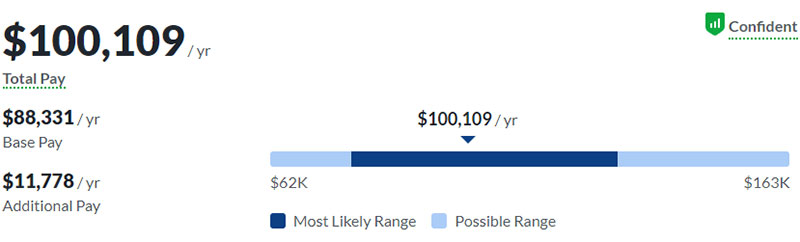
Pay covers a wide range, and studio size and location decide a lot of it.
Median total pay for video game designers in the US is $84,000 (Glassdoor, April 2025).
The BLS category that covers the role is special effects artists and animators, with a median wage of $99,800 (U.S. Bureau of Labor Statistics, May 2024). The lowest 10th percentile in that category earns $57,220 a year, and the highest 10th percentile earns $174,630.
Those numbers don’t contradict each other. Glassdoor’s figure leans toward self-reported game designer titles, while the BLS category bundles in higher-paid animation and effects roles.
Studio size moves pay more than almost anything else. Large publishers in tech hubs like California and Washington consistently pay above the national median. Small indie teams often pay less but offer equity or profit share instead.
Demand is still there, but the market is tighter than it was during the pandemic hiring boom.
So is it worth it? At mid-level and above, the salary is livable and sometimes strong. Getting in is competitive, though, and early pay is modest.
When Does the Self-Taught or Portfolio-Only Path Fail
Portfolio-first works well in mid-size and indie studios. It stops working in a few specific cases.
- Large publishers and government-adjacent studios that filter resumes by degree before a portfolio is ever opened
- Regions such as Japan and South Korea, where formal credentials count for more in hiring than in North America
- Portfolios with volume but no reasoning, like ten finished mechanics and not a word on why any of them work
- Markets in the middle of active layoffs, where studios lean on safer, credentialed hires over unproven self-taught candidates
That last one hits harder than usual right now.
InGameJob’s 2025 Big Games Industry Employment Survey of 1,650 professionals across 85 countries found that 39% of junior-level professionals exited the games industry between 2024 and 2025.
That’s not a portfolio problem. It’s the market, and no amount of polish fixes a hiring freeze.
If you hit that wall, widen the search to adjacent roles like QA or community management. Keep shipping small projects publicly, and expect the timeline to stretch while the market is down.
FAQ on How To Become A Game Designer
What is the difference between a game designer and a game developer?
The designer decides the mechanics, levels and player choices. Writing the code that makes those systems run is the game developer’s job.
Small studios often blend the two. Larger teams keep design and programming as separate jobs with different daily tasks.
Which game engine should a beginner start with?
For most beginners, Unity, thanks to the gentle learning curve and huge asset store. Godot is a good pick if you’d rather have something lightweight and open-source.
I’d leave Unreal Engine for later, once 3D projects and Blueprints feel less intimidating.
What game design frameworks or theory should you know?
Start with the MDA framework (mechanics, dynamics, aesthetics). It’s the most cited model for reasoning about player experience.
Jesse Schell’s lens-based approach and Raph Koster’s writing on fun give you practical ways to critique a design beyond gut feeling.
How do you land a game design internship?
Apply directly to studio internship postings, and look at student programs at schools with game design tracks. A finished prototype or game jam entry counts for more than grades.
Cold outreach to small studios often works better than large publisher portals.
How long does it take to become a game designer?
Self-taught, expect one to two years of steady portfolio building before a first job offer arrives. Bootcamps bring that under a year.
A degree adds three to four years but often bundles in internships along the way.
Can you become a game designer without coding skills?
Yes. Basic scripting does expand what you can prototype alone, but no-code tools like Construct or Twine remove that barrier for narrative and 2D projects.
Most studios still value candidates who can test ideas without waiting on a programmer.
Should you go freelance or join a studio?
A studio job gives you steadier pay and mentorship, plus access to a full production pipeline. Freelance work suits designers who already have a strong network and savings to cover the gaps.
For most beginners, a first studio role is the better bet.
What Should You Fix First in How To Become A Game Designer?
Fix the portfolio before the resume. Studios open a finished prototype long before they open a cover letter.
One finished prototype is worth more than a polished resume, and one engine learned properly beats three you’ve only sampled. Send applications the same week the portfolio goes live, not a month later.
One more thing about those numbers. Put GDC’s finding that 56% of the workforce has ten years or less of experience next to InGameJob’s finding that 39% of junior professionals left the field last year. It looks less like a young industry and more like a thinning entry-level pipeline.
If interface and menu work pulls you more than mechanics and balancing, how to become a UI designer is the closer path.

Renowned for his expertise in logo design and visual branding, Bogdan has developed a multitude of logos for various clients.
His skills extend to creating posters, vector illustrations, business cards, and brochures. Additionally, Bogdan's UI kits were featured on marketplaces like Visual Hierarchy and UI8.
He also wrote in the past years on sites like Design Your Way, WebDesignerDepot, WPDean, Designmodo, Speckyboy, Slider Revolution, and more.
- Beautiful Fonts Similar to Poppins You Should Try - 22 October 2026
- Website Redesign: How to Improve Your Website without Losing SEO Rankings - 22 October 2026
- The Coda Logo History, Colors, Font, And Meaning - 20 October 2026

Bogdan Sandu is a seasoned designer who has been designing websites since 2008. Renowned for his expertise in logo design and visual branding, Bogdan has developed a multitude of logos for various clients. His skills extend to creating posters, vector illustrations, business cards, and brochures. Additionally, Bogdan's UI kits were featured on marketplaces like Visual Hierarchy and UI8. He also wrote in the past years on sites like Design Your Way, WebDesignerDepot, WPDean, Designmodo, Speckyboy, Slider Revolution, and more.
You Might Also Like


