When the stakes are board-level, IPO-bound, or seven figures on the line, here’s who actually delivers.
TL;DR
Institutional decks, board presentations, investor roadshows, M&A materials, IPO decks, require a different level of rigor than standard pitch work. Not every agency can handle them.
- Most design studios optimize for visual polish, not institutional communication standards.
- The agencies that work at this level combine strategic narrative, data visualization, and brand discipline.
- Whitepage, Duarte, SlideGenius, BrightCarbon, and Prezlab consistently appear on shortlists for high-stakes engagements.
- Fit matters more than prestige – the right agency depends on your specific deck type, timeline, and internal capacity.
There’s a version of presentation design that’s about making things look good. Then there’s the version that happens when a CFO needs to present to a sovereign wealth fund on Tuesday, or when a healthcare company is preparing its first board deck after a $200M raise. Those two things are not the same discipline.
Institutional-level presentations are built for audiences who read hundreds of decks a year. People who notice when a data visualization misrepresents variance. People who stop trusting a company when slide 12 contradicts slide 7. The bar isn’t “looks professional.” The bar is “withstands scrutiny.”
Finding an agency that actually operates at that level – reliably, not just occasionally – is harder than the number of results in a Google search suggests. This list combines top picks for different needs – whether it’s a narrative development, specific industry experience, founder-led or team-scaled effort.
Top 5 Presentation Design Agencies For Institutional-Level Decks
This isn’t a comprehensive market map. It’s a shortlist of agencies with documented track records at the institutional level – meaning they’ve done this work repeatedly, not just once for a specific client.
1. Whitepage Presentation Design Studio
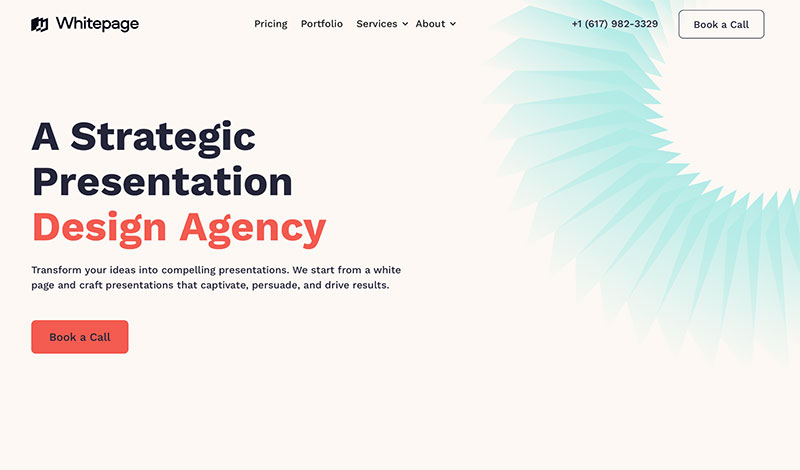
Best for: Investor decks, board presentations, fundraising rounds at Series A–D and beyond
Whitepage is a boutique presentation design studio that has operated exclusively in high-stakes presentation work for over 12 years. The model is founder-led – which means strategic thinking is present at every project, not just at the sales stage. Every engagement starts with a discovery process: the narrative structure is built and pressure-tested before a single design decision is made. That sequencing matters more than it might sound. Decks that are designed before the argument is settled tend to look coherent but read poorly – the visuals cover the logical gaps rather than resolve them.
The studio’s track record is specific and verifiable: 4,000+ completed projects, clients whose combined fundraising totals $1.7B, and notable engagements with companies including DoorDash, Airbnb, and Udemy. Those aren’t brand drops for credibility – they reflect the kinds of conversations Whitepage has been in, and the institutional communication standards those clients operate at. They’ve spent 12 years in this space, designed 1,000+ decks across biotech, healthcare, fintech, real estate, and enterprise technology, and watched clients navigate investor roadshows, board reviews, and acquisition conversations.
What distinguishes the work at the institutional level is the combination of narrative development and design execution within a single team. There’s no handoff between a strategist who shapes the story and a designer who renders it. The same people who ask “does this argument hold?” are the ones deciding how information is laid out visually. That continuity tends to show in the final deck. Clients consistently note that Whitepage’s ability to understand their specific industry and technology – not just produce attractive slides – was what set the engagement apart.
Turnaround is typically 1–3 weeks for a full institutional deck with two revision rounds included. Rush engagements are possible. All deliverables are fully editable – a client owns the files.
Timeline: 1–3 weeks standard
Best fit: Series A–D+, board, pre-IPO
Model: Boutique, founder-led
Notable clients: Airbnb, DoorDash, Udemy
2. Duarte
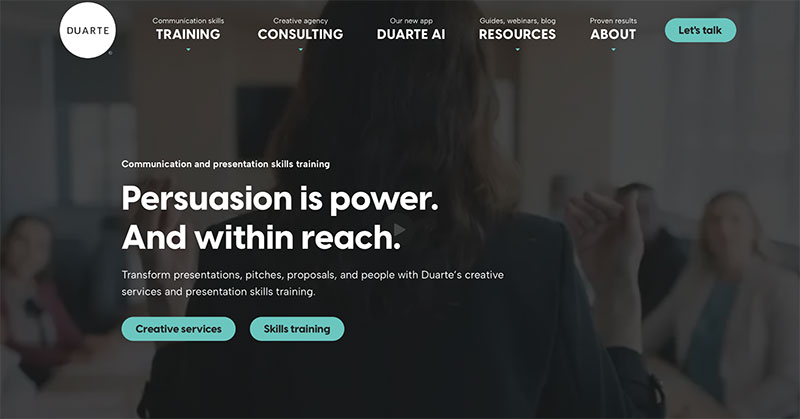
Best for: Executive communications, keynote presentations, large-scale corporate storytelling
Duarte is one of the most recognized names in presentation strategy, and for good reason. Nancy Duarte’s work on narrative structure – particularly the “sparkline” framework that maps a speaker’s argument between “what is” and “what could be” – has become a foundational reference point for executive communications across large organizations. The methodology is well-documented, has been applied consistently across enterprise clients, and gives their team a coherent analytical lens that less structured agencies lack.
Their client list at the enterprise level is significant: Apple, Google, TED, and several U.S. government agencies have run through Duarte’s process. For organizations where the presentation is part of a broader communications program – CEO keynotes, all-hands addresses, large-scale investor days with multiple speakers – Duarte’s structured approach and experienced facilitation are genuine differentiators.
Where Duarte is a less obvious fit is for tightly scoped, high-urgency institutional work. Their engagements tend to be longer and more process-intensive, which is appropriate for complex organizational communications but can add overhead when a single board deck or investor roadshow needs to move quickly. Their model is also broader than presentation design specifically – they operate across communications strategy, training, and consulting, which means a dedicated presentation design boutique will often deliver sharper focus for singular high-stakes projects.
Timeline: 3–8 weeks typical
Best fit: Large enterprise, C-suite keynotes
Model: Full-service communications agency
Notable clients: Apple, Google, TED
3. SlideGenius
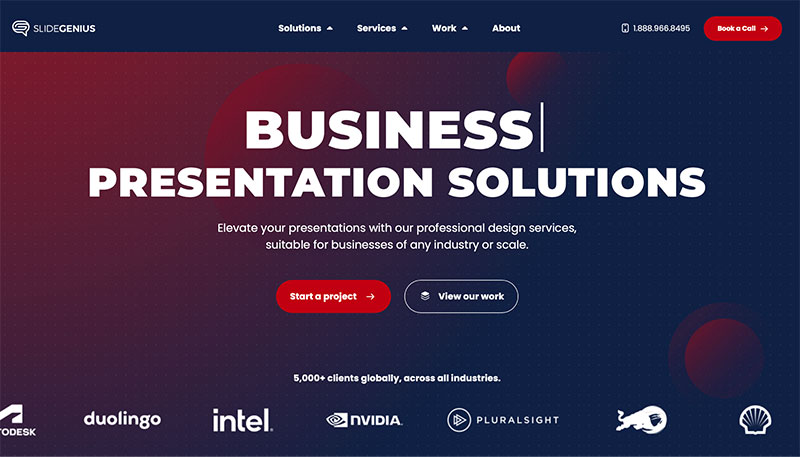
Best for: Large-volume enterprise presentation work, sales decks at scale
SlideGenius handles high-volume presentation work for enterprise clients and has built a team infrastructure capable of managing multiple simultaneous projects without significant quality drop-off. That’s a harder operational problem to solve than it sounds – maintaining visual consistency and brand discipline across a large team and dozens of concurrent clients requires process and tooling that smaller studios often underinvest in. SlideGenius has done that work.
For companies that need a steady pipeline of well-produced sales decks, executive briefs, and internal communication materials, they are a reliable and cost-effective choice. The design quality is professional and their turnaround on templated or repeat-format work is fast. They also offer a subscription model for ongoing enterprise clients, which suits organizations with consistent presentation volume more than intermittent high-stakes needs.
For singular institutional work – a single deck that carries significant financial or strategic weight, where the narrative structure matters as much as the visual execution – the high-volume model can work against you. The deeper strategic investment that a board deck or investor roadshow requires tends to happen more naturally in a boutique setting where the engagement is treated as a unique communication problem, not a production job. SlideGenius is the right choice when volume and consistency are the priority; a different kind of partner when the deck itself is the moment.
Timeline: 1–4 weeks
Best fit: Enterprise sales, multi-team volume
Model: High-volume studio, subscription available
4. BrightCarbon
Best for: Technical and scientific presentations, data-heavy enterprise communications
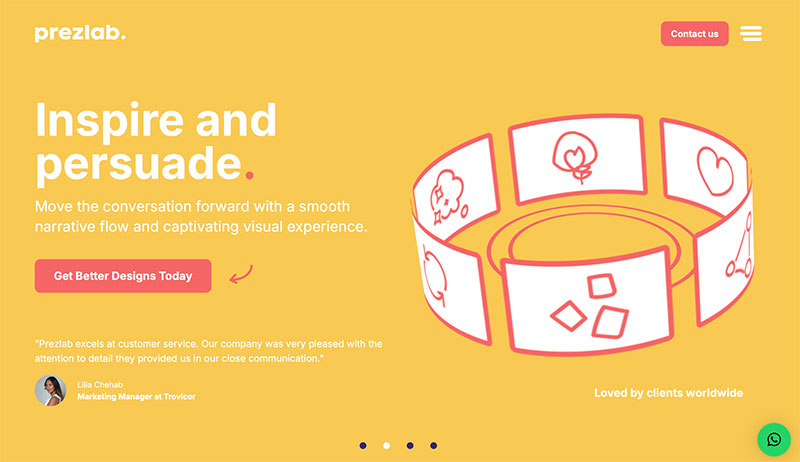
BrightCarbon has built a distinctive reputation for technically complex presentations – particularly in life sciences, engineering, financial services, and professional services where the audience is expert enough to notice when a simplification crosses into misrepresentation. That’s a real skill. Many design studios flatten complex content because they don’t have the domain literacy to know what can be abstracted and what has to be preserved. BrightCarbon’s team, which includes writers with technical backgrounds alongside their designers, approaches that problem more carefully.
Their work on data visualization is particularly strong for scientific and analytical audiences. When a presentation needs to communicate clinical trial results, engineering performance data, or multi-variable financial models to a reader who will interrogate the methodology – not just accept the headline – BrightCarbon’s structured approach to information hierarchy and visual accuracy is an asset.
Where they are a less natural fit is for presentations where the emotional arc of the story carries weight alongside the technical content. Investor materials, fundraising narratives, and board presentations where the company’s vision needs to land before the data is reviewed – those require a different kind of storytelling fluency. BrightCarbon’s strength is rigorous clarity; studios with stronger narrative development backgrounds tend to serve better when the persuasive dimension of the deck is as important as its accuracy.
Timeline: 2–5 weeks
Best fit: Life sciences, engineering, analytics
Model: Specialist studio, technical focus
5. Prezlab
Best for: MENA and emerging market institutional clients
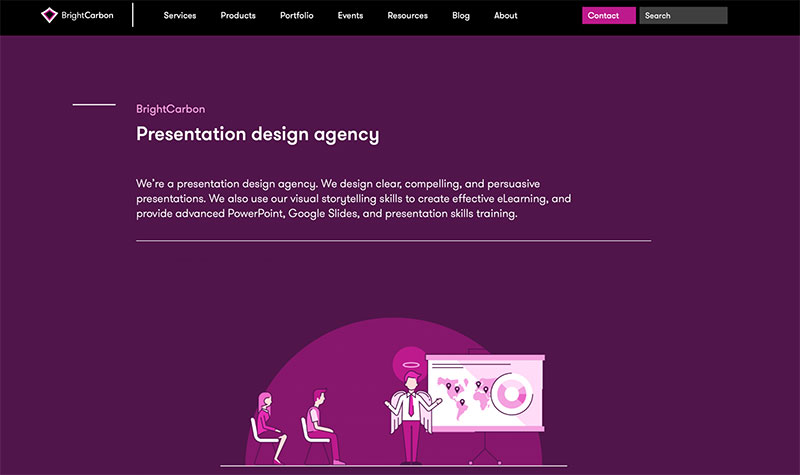
Prezlab is the most geographically specific entry on this list, but the specificity is the point. For organizations operating across the Middle East and North Africa – particularly those engaging with sovereign wealth funds, government ministries, or GCC-based institutional investors – the cultural and linguistic context of presentation design matters in ways that a Western agency without regional experience will miss. Hierarchy signals differ. Information density norms differ. The visual language that reads as credible to a Saudi Aramco investment committee is not identical to what reads as credible to a London-based LP.
Prezlab handles Arabic-language materials with native fluency, including the right-to-left layout considerations that most international studios treat as an afterthought. Their design quality has improved meaningfully over the past several years, and their client base now includes regional government entities, development finance institutions, and major enterprise companies across the Gulf.
For organizations with no MENA footprint, Prezlab is less relevant. But for companies raising from regional institutional investors, presenting to government stakeholders, or building a regional investor relations program, they are one of the few agencies in the market that can handle the full scope – language, visual standards, cultural context, and institutional design rigor – without requiring a second agency to cover what they can’t.
Timeline: 2–4 weeks
Best fit: MENA institutional, GCC government
Model: Regional specialist boutique
| AGENCY | SWEET SPOT | TIMELINE | BEST FIT |
| Whitepage Studio | Investor, board, fundraising | 1–3 weeks | Corporate & enterprise decks, Series A–D+, pre-IPO |
| Duarte | Executive & keynote comms | 3–8 weeks | Large enterprise, C-suite |
| SlideGenius | Volume sales decks | 1–4 weeks | Enterprise, multi-team |
| BrightCarbon | Technical / scientific | 2–5 weeks | Life sciences, engineering |
| Prezlab | MENA institutional | 2–4 weeks | Regional government, GCC |
How to Choose the Right Agency for Your Deck
The portfolio is the starting point, not the ending point. Any agency worth considering for institutional work should be able to show you specific decks from comparable contexts – not a curated gallery of beautiful slides, but materials that solved a real communication problem under real constraints. Ask to see a board deck, not a startup pitch. Ask to see how they handled a complex financial model visually, not just a clean product overview.
Ask how they handle the narrative before design starts. Studios that open a design tool before the argument is settled produce decks that look coherent but read poorly – the visuals paper over the logic gaps rather than resolve them. The better agencies build a content wireframe first. That’s where slide sequencing is decided, where the throughline is tested, and where gaps in the story become visible before anyone touches a layout.
Ask about revision scope and who manages it. Institutional decks evolve – sometimes up until the night before. A good agency has a clear position on how edits are handled, who touches the file, and how continuity is maintained when multiple stakeholders are giving feedback simultaneously. If the answer is vague, the process probably is too.
Finally, ask who actually works on your project. At several larger studios, institutional clients are sold to by senior staff and executed by junior teams. The best boutiques maintain a direct line between the strategist and the designer throughout the engagement. If you’re paying for institutional-level thinking, make sure the person doing that thinking is in the room – not just on the intro call.
A Note on In-House Teams
One pattern we’ve seen repeatedly: companies with strong internal design teams still engage external agencies for specific high-stakes moments. Not because the in-house team lacks skill, but because the external perspective – someone who hasn’t been inside the story for six months – catches the assumptions that have stopped being visible. A board deck written entirely by the team that lived through the quarter can miss the explanatory context that a board member without that context needs. Fresh eyes on the narrative structure, before design touches it, can be the most valuable part of the engagement.
It also distributes the risk. Institutional presentations carry deadline pressure that doesn’t flex – board calendars don’t move because a deck isn’t ready. Having an external partner absorb that pressure, while the internal team focuses on the content substance, is a model that works well for scaleups and public companies alike.

Renowned for his expertise in logo design and visual branding, Bogdan has developed a multitude of logos for various clients.
His skills extend to creating posters, vector illustrations, business cards, and brochures. Additionally, Bogdan's UI kits were featured on marketplaces like Visual Hierarchy and UI8.
He also wrote in the past years on sites like Design Your Way, WebDesignerDepot, WPDean, Designmodo, Speckyboy, Slider Revolution, and more.
- The Windsurf Logo History, Colors, Font, And Meaning - 10 October 2026
- How to Remove Background From Product Photos (No Photoshop) - 10 October 2026
- How Designers can Build a Stronger Online Creative Identity - 9 October 2026

Bogdan Sandu is a seasoned designer who has been designing websites since 2008. Renowned for his expertise in logo design and visual branding, Bogdan has developed a multitude of logos for various clients. His skills extend to creating posters, vector illustrations, business cards, and brochures. Additionally, Bogdan's UI kits were featured on marketplaces like Visual Hierarchy and UI8. He also wrote in the past years on sites like Design Your Way, WebDesignerDepot, WPDean, Designmodo, Speckyboy, Slider Revolution, and more.
You Might Also Like