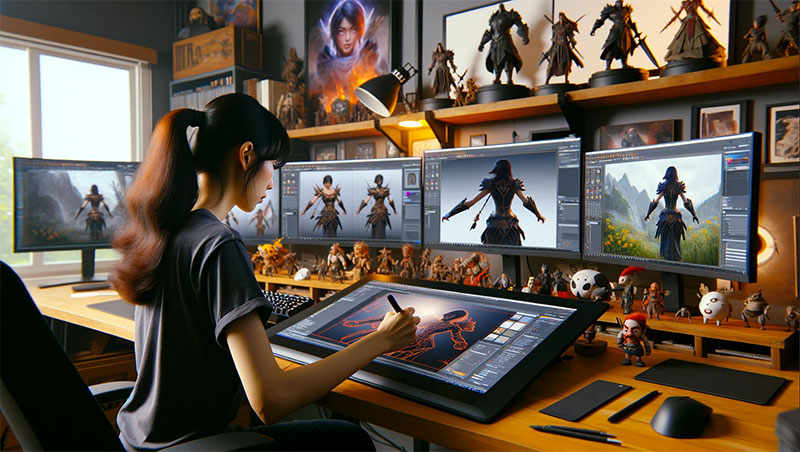
3D Animation for Games is like opening a door to a universe where art meets technology. Picture this: characters that feel almost real, landscapes that take your breath away, and moments that stay with you. That’s the magic of 3D animation in the gaming world. It’s not just about making things look pretty; it’s about bringing a game to life, giving it a heartbeat.
Evolution of 3D Animation in the Gaming Industry
Early Developments
Rewind to the early days, when 3D animation in games was like a newborn – a bit clunky but full of potential. The first steps were all about basic shapes and movements. Think of it as the stick-figure phase of 3D animation. But hey, every Picasso starts with a scribble, right?
Recent Advances
Fast forward to today, and it’s like stepping into a sci-fi movie. Real-Time Rendering, Character Modeling, and Motion Capture have revolutionized 3D Animation for Games.
It’s not just animation; it’s an art form. Characters now move with the grace of a ballet dancer and the precision of a robot. Environments are so detailed that you feel like you could step right into your screen.
Fundamentals of 3D Animation
Understanding 3D Modeling
Modeling Techniques
Let’s break down 3D Modeling. Imagine sculpting, but in the digital world. You start with a lump of virtual clay and mold it into whatever your heart desires. This could be a fearless warrior, a mystical creature, or even a whimsical teapot! The techniques vary – some artists prefer to start with basic shapes, while others go straight for the fine details.
Tools and Software
Now, the tools of the trade. Software like Blender and Maya are the paintbrushes and chisels of the 3D artist. They’re the magic wands that turn coffee-fueled ideas into digital masterpieces. But remember, a tool is only as good as the artist wielding it. It’s the creativity and skill that truly bring characters to life.
Texturing and Lighting
Texturing Methods
Texturing is like giving skin and clothes to your 3D models. It’s all about adding colors, patterns, and, well, textures. You’re telling the world whether your character has rough skin, shiny scales, or fluffy fur. It’s what makes a character feel tangible, even in a digital universe.
Lighting Effects in 3D Animation
Ah, lighting – the unsung hero of 3D Animation for Games. Lighting sets the mood. It’s like the difference between a sunny day and a spooky night. Good lighting can make a scene feel warm and inviting or cold and eerie. It’s all about playing with shadows and highlights to add depth and drama to your animation.
Animation Techniques and Technologies
Keyframe Animation
Principles of Keyframe Animation
Alright, let’s get into the groove with Keyframe Animation. It’s like the bread and butter of 3D Animation for Games. Imagine you’re a puppeteer, and each keyframe is a pose you set for your puppet. You decide the start and end points, and the software fills in the movement. It’s a dance between control and letting go. You set the keyframes, and the magic happens in between.
Applications in Games
In games, keyframe animation brings characters to life, from a hero’s triumphant jump to a villain’s menacing glare. It’s all about capturing those epic moments frame by frame. It’s like stitching together a series of photographs to create a fluid, dynamic motion.
Motion Capture
The Process of Motion Capture
Now, let’s suit up for Motion Capture. Picture wearing a funky suit with sensors – these are your brushes and paints for capturing real-life movements. Actors perform, and their movements get translated into digital awesomeness. It’s like grabbing a piece of reality and planting it right into the game world.
Game developers can also leverage 3D animation techniques to create engaging and immersive game trailers and demos, which can be used to generate buzz and gather feedback during the crucial process of how to softlaunch a game, ensuring a successful full release.
Advantages and Challenges
The cool part? Realism that’s just mind-blowing. The challenge? It’s a high-tech tango. You need the right gear, space, and some seriously skilled actors. Plus, blending it seamlessly into your game’s world takes some serious tech wizardry.
Procedural Animation
Concept and Techniques
Okay, time to talk about Procedural Animation. It’s less about handcrafting each movement and more about setting rules for how things move. Think of it as creating a mini-universe with its own laws of physics. You’re not just an animator; you’re a digital Newton!
Use Cases in Gaming
In gaming, procedural animation is like the secret sauce for dynamic environments and responsive character movements. It’s what makes a character adjust their step on uneven terrain or a tree sway just right in the wind. It’s about crafting a world that feels alive and reactive.
Character and Environmental Animation
Character Design and Animation
Creating Compelling Characters
Okay, let’s talk about the stars of the show in 3D Animation for Games: the characters. Crafting a character isn’t just about making them look cool (though that’s a big part of it). It’s about breathing life into them. How? Well, it’s a mix of Character Modeling, art, and a bit of psychology. You gotta think about who they are, where they’ve been, and what drives them. It’s like you’re a detective and an artist rolled into one.
Animating Characters for Games
Now, animating these characters? That’s where the fun begins. It’s like being a puppet master, but the strings are digital. Using techniques like Keyframe Animation and Motion Capture, you make them walk, talk, and throw punches. The goal? To make players forget they’re playing a game and feel like they’re part of a whole new world.
Environmental Elements
Designing Game Environments
Let’s not forget where all the action happens: the environment. It’s more than just a pretty backdrop; it’s a character in its own right. Whether it’s a bustling city or a desolate wasteland, every rock, tree, and building tells a story. It’s about using elements like Texturing and Lighting Effects to set the mood. Think of yourself as an architect and a storyteller, creating worlds that captivate and immerse players.
Animating Environmental Elements
Animating the environment is like adding the final layer of magic. It’s not just about making things look pretty; it’s about making them feel real. The wind rustling through the trees, the water flowing in a stream, the flickering of lights in a distant city – all these small details add up to create a living, breathing world. Using Procedural Animation and Real-Time Rendering, you make the game environment not just a static scene, but a dynamic player in the game’s story.
The Role of Storytelling in 3D Animation
Narrative Development in Games
Storytelling Techniques
So, let’s chat about stories. Not just any stories, but the kind that make 3D Animation for Games something special. It’s like being a director and a writer at the same time. You’re not just making things move; you’re giving them a reason to. Each character, each environment, they’re all part of a larger tale. It’s about using narrative techniques, like building tension, creating relatable characters, and crafting immersive worlds. The trick? Balancing the techy side of things, like Physics Engine and Character Rigging, with good old-fashioned storytelling.
Integrating Story with Animation
Here’s where things get really interesting. Integrating the story with animation is like conducting an orchestra. Every movement, every expression of your characters, contributes to the narrative. It’s not just about making them look real; it’s about making them feel real. When a character’s facial expression reflects their inner turmoil, or their body language tells a story of its own, that’s when you know you’ve hit the sweet spot.
Emotional Engagement through Animation
Conveying Emotions
Animation in games isn’t just eye candy. It’s about connecting with the player on an emotional level. Imagine making someone laugh, cry, or jump out of their skin, all with a few well-animated scenes. It’s about using techniques like Keyframe Animation and Motion Capture to breathe life and emotion into your characters. It’s all about the subtleties – a slight frown, a nervous twitch, a joyful leap.
Creating Immersive Experiences
Lastly, creating immersive experiences is what sets great games apart. It’s like inviting players into a new world and making them never want to leave. Every element, from Procedural Animation of the environment to the narrative-driven Character Animation, works together to create a rich, believable world. It’s not just playing a game; it’s living a story.
Challenges and Considerations
Balancing Aesthetics and Performance
Optimization Techniques
Alright, let’s get real for a sec. In the world of 3D Animation for Games, it’s not all smooth sailing. You’ve got to balance making things look awesome with making sure they actually run smoothly. It’s a bit like juggling – keeping all the balls in the air without dropping any. You need to get your hands dirty with Optimization Techniques.
This means making sure your stunning animations don’t turn the game into a slow, glitchy mess.
It’s a fine line between high-quality graphics and performance that doesn’t make your computer cry. Sometimes, this even involves using a render farm to handle the heavy lifting of processing complex animations, ensuring the final product is both visually stunning and technically sound.
Hardware Limitations
And then, there’s the hardware side of things. Not everyone has the latest, greatest gaming rig. You’ve got to consider players who are rocking older setups. So, you’re playing this constant game of balancing – pushing the boundaries of Real-Time Rendering and Physics Engines without leaving anyone behind.
Ethical Considerations
Representation and Diversity
Now, let’s talk ethics. In animation and game design, representation matters. Big time. It’s about creating characters and worlds that reflect the diverse, vibrant world we live in. We’re talking diversity in all forms – race, gender, culture, the whole spectrum. It’s crucial, not just because it’s the right thing to do, but because it makes for richer, more engaging games.
Moral Implications of Animation
Also, think about the stories we tell and how we tell them. The power of 3D Animation for Games isn’t just in the cool visuals; it’s in the ability to influence, inspire, and sometimes even challenge players. We’ve got a responsibility to consider the messages our games are sending. It’s not just about entertaining; it’s about respecting our audience and the impact we have.
Conclusion
So, what have we learned on this wild ride through 3D Animation for Games? We’ve seen how it’s not just about making pretty pictures move. It’s an art form that combines technology, storytelling, and a whole lot of creativity.

Renowned for his expertise in logo design and visual branding, Bogdan has developed a multitude of logos for various clients.
His skills extend to creating posters, vector illustrations, business cards, and brochures. Additionally, Bogdan's UI kits were featured on marketplaces like Visual Hierarchy and UI8.
He also wrote in the past years on sites like Design Your Way, WebDesignerDepot, WPDean, Designmodo, Speckyboy, Slider Revolution, and more.
- Best Visual Regression Testing Tools for Web and App Design in 2026 - 13 October 2026
- Jujutsu Kaisen Font Generator - 12 October 2026
- The Windsurf Logo History, Colors, Font, And Meaning - 10 October 2026

Bogdan Sandu is a seasoned designer who has been designing websites since 2008. Renowned for his expertise in logo design and visual branding, Bogdan has developed a multitude of logos for various clients. His skills extend to creating posters, vector illustrations, business cards, and brochures. Additionally, Bogdan's UI kits were featured on marketplaces like Visual Hierarchy and UI8. He also wrote in the past years on sites like Design Your Way, WebDesignerDepot, WPDean, Designmodo, Speckyboy, Slider Revolution, and more.
You Might Also Like