Few brand marks in gaming carry the same instant recognition as the Sega logo. That blue, italicized wordmark has been printed on arcade cabinets, console shells, and game cartridges since the mid-1970s. It’s one of those designs that people can picture from memory, even decades after their last time playing a Sega Genesis.
The Sega Corporation, founded in 1960 in Tokyo, Japan (originally as Service Games), has gone through roughly five to six logo changes. The current version, a clean blue wordmark with rounded, italic lettering, was solidified in the early 2000s and remains the company’s primary visual mark today. Within the broader history of video game logos, Sega’s sits comfortably among the most recognized globally.
What Is the Sega Logo?
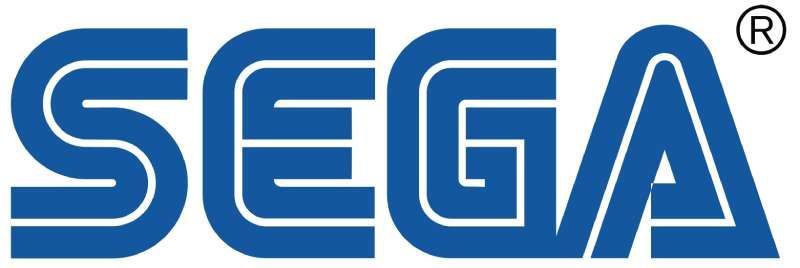
The Sega logo is a custom wordmark featuring the company name “SEGA” in bold, rounded, italic sans-serif lettering, rendered in a signature blue color. It was first introduced in a recognizable form in 1975 and refined over the following decades. The design communicates speed, accessibility, and technological fun.
Design Type: Wordmark (logotype). No icon or emblem accompanies the primary mark. It’s purely typographic.
Primary Elements: Four uppercase letters, “S-E-G-A,” set in a custom sans-serif font with soft, rounded terminals and a slight rightward slant. The letters are tightly spaced and sit within a geometric framework.
Official Introduction Date: The earliest version appeared around 1956, but the blue wordmark people recognize today took shape in 1975, with refinements in the early 1980s and 2000s.
Designer/Agency: No single designer has been publicly credited. The logo evolved internally within Sega’s corporate and marketing teams across its Tokyo and U.S. offices.
Trademark Status: “SEGA” is a registered trademark of Sega Corporation. The wordmark and its associated visual identity are protected globally across multiple jurisdictions.
Color Palette: The primary color is Sega Blue, approximately #0060A8. White is used as a background or secondary contrast color. Some variations feature the logo on dark backgrounds using a lighter blue or white rendering.
Usage Context: The logo appears on video game consoles, cartridges, digital storefronts, packaging, arcade cabinets, marketing materials, merchandise, and corporate communications. It’s used across both physical products and digital platforms.
How Has the Sega Logo Evolved Over Time?
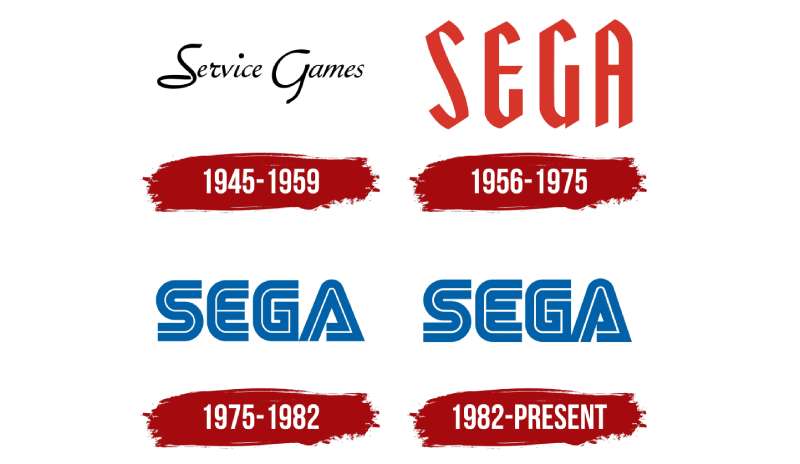
Sega’s logo has moved through about five distinct phases since the 1950s. Each version tracked a shift in the company’s business focus, from slot machine distribution to arcade dominance to home console wars.
The changes were never dramatic. More like gradual tightening. The core idea of a bold, readable wordmark stayed consistent, but the letterforms, colors, and proportions shifted to match each era’s visual language.
The Service Games Mark (1956-1965)
Years Active: Roughly 1956 to 1965.
Design Description: This was the original company mark when the business still operated under the name “Service Games.” The logo used a straightforward serif or semi-serif treatment. Nothing flashy. It looked more like a parts supplier than a future gaming giant.
Color Scheme: Primarily black and white, consistent with corporate printing norms of the 1950s.
Context: Service Games was manufacturing coin-operated amusement machines for U.S. military bases in Japan. The branding reflected utility, not entertainment.
Cultural Significance: This version is mostly a footnote. It represents the company’s pre-gaming identity, before the “SEGA” abbreviation even existed as a brand name.
Early Sega Wordmark (1965-1975)
Years Active: Approximately 1965 to 1975.
Design Description: After officially becoming “Sega Enterprises,” the company adopted its first true wordmark. The letters were blocky, with thick strokes and minimal stylization. Think functional, not fashionable.
Color Scheme: Black on white in most applications.
Key Changes from Previous: The shift from “Service Games” to “SEGA” as the primary identifier. This was the birth of the four-letter brand.
Context: Sega was expanding its arcade business rapidly during this period. The logo needed to work on cabinet marquees and attract attention in dimly lit arcades.
The Iconic Blue Wordmark (1975-Early 1990s)
Years Active: 1975 through the early 1990s.
Design Description: This is where things got interesting. The letters became rounded, italic, and distinctly Sega. Soft curves on the “S” and “G,” a balanced “E,” and a slightly flared “A.” The whole thing leaned forward, suggesting speed and movement.
Color Scheme: Sega Blue (#0060A8) on white. This was the first time blue became the signature color.
Key Changes from Previous: Completely new letterforms. The typography went from rigid and blocky to fluid and rounded. The italic slant was introduced. The identity shifted from “corporate” to “fun.”
Cultural Significance: This is the version that shipped on the Sega Master System and early Genesis/Mega Drive units. For an entire generation of gamers, this IS the Sega logo. It’s the one that played with the “SE-GA!” audio sting at boot-up.
Console Wars Era Refinement (Early 1990s-2000)
Years Active: Early 1990s to approximately 2000.
Design Description: Subtle refinements rather than a full redesign. The letterforms were cleaned up. Curves became smoother. Proportions tightened. The kerning between characters was adjusted for better consistency across different sizes and media.
Color Scheme: Same Sega Blue, though some console-specific variations (like the Dreamcast branding) occasionally used an orange swirl alongside the blue wordmark.
Context: The 1990s console wars against Nintendo and Sony pushed Sega to sharpen every brand touchpoint. The logo appeared on Genesis, Saturn, and Dreamcast hardware, each time with slight optical adjustments.
Key Changes from Previous: Refinement, not revolution. Better optical spacing, cleaner curves, improved reproduction at small sizes.
Modern Sega Logo (2000-Present)
Years Active: 2000 to present.
Design Description: The current mark is the most polished version of the blue wordmark. Digital-first optimization. The curves are mathematically precise, the weight is even, and the italic angle is consistent across all four characters.
Color Scheme: Sega Blue (#0060A8) remains primary. White and occasionally black serve as secondary colors depending on application.
Context: After exiting the console hardware market with the Dreamcast, Sega transitioned to a third-party publisher and developer. The logo needed to work as a software brand, not a hardware brand. It now lives on game title screens, digital storefronts, and web platforms rather than console shells.
Key Changes from Previous: Optimized for digital rendering. Better performance at screen resolution versus print. The overall silhouette is unchanged, but the execution is tighter.
What Do the Design Elements of the Sega Logo Mean?
The Sega logo is built on speed and approachability. The italic slant pushes the eye forward. The rounded letterforms keep things friendly.
Together, these choices say “we’re a fun company that moves fast.” Nothing about the design feels corporate or cold. It’s warm, bold, and made for entertainment.
Why Did Sega Choose These Specific Colors?

Sega Blue (approximately #0060A8) is the backbone of the entire identity. It falls in the mid-range of blue, not too dark, not too electric.
Blue, from a color psychology standpoint, suggests trust, reliability, and technology. But Sega’s specific shade leans slightly warmer than corporate blues like IBM’s. It’s inviting rather than authoritative.
In RGB terms, it sits around (0, 96, 168). For print applications using CMYK, it translates to roughly (100, 43, 0, 34). The closest Pantone match is PMS 2945 C.
Within the gaming industry, this blue became so associated with Sega that it stood in direct visual opposition to Nintendo’s red. That wasn’t accidental. The two brands positioned themselves as opposites in every way, including their color palettes.
White serves as the secondary color. Clean, simple, high-contrast against the blue. No gradients, no effects. Just solid color doing its job.
What Typography Style Is Used in the Sega Logo?
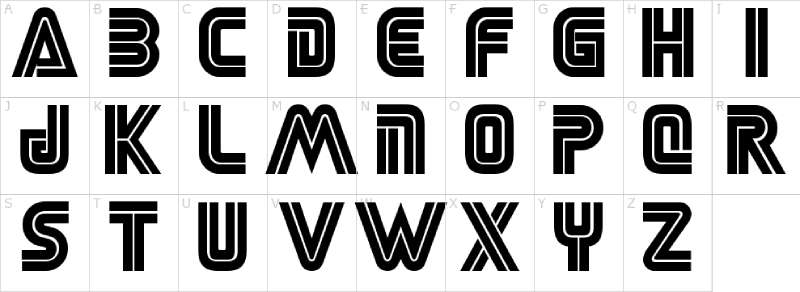
Sega uses a custom typeface that doesn’t map directly to any commercially available font.
The characters are sans-serif, rounded at the terminals, and set at an italic angle. The stroke weight is heavy but uniform, which gives it a bold presence without feeling aggressive.
The x-height equivalence across the four uppercase letters creates strong horizontal alignment. The tracking is tight but not cramped, giving each letter enough room to breathe while maintaining a unified block shape.
Readability at small sizes is good because the forms are simple and open. No thin strokes to disappear. No serifs to muddy at low resolution.
What Are the Hidden Meanings in the Sega Logo?
Honestly? There aren’t many “hidden” elements in the traditional sense. Sega’s logo isn’t a puzzle. It’s direct.
But look at the forward lean. Every character tilts right, which creates implied speed. This wasn’t subtle, it was Sega’s entire brand promise during the Genesis era: “we’re faster.”
The rounded forms also carry meaning. Compared to the angular, sometimes aggressive typography competitors used, Sega’s soft curves suggested a more playful, accessible experience. The psychology of shapes plays a real role here, round forms feel safer and friendlier than sharp ones.
Some fans have pointed out that the “S” vaguely resembles a wave or a road curving into the distance. Whether that was intentional is debatable. But it does reinforce themes of movement and journey that match Sega’s arcade racing heritage.
How Does the Sega Logo Compare to Competitor Logos?
Sega’s logo sits in a unique position among gaming company logos. It’s one of the few major publishers that relies entirely on a wordmark. No icon. No mascot baked into the mark itself (Sonic is a brand mascot, but separate from the logo).
Compare that to Nintendo, which also uses a wordmark but houses it inside a rounded rectangle frame. Nintendo’s treatment is more contained, almost cautious. Sega’s letters float free, unboxed.
EA went the opposite direction with an abstract circular monogram. Epic Games uses a stylized icon. Ubisoft combines a swirl icon with its wordmark.
Sega’s approach is arguably the most confident of the bunch. Just four blue letters. No safety net of an enclosing shape or supporting graphic. The logo trusts its own recognition power.
Among Japanese gaming companies specifically, Capcom uses a more angular, aggressive wordmark. Konami has shifted to a clean, modern sans-serif. Square Enix relies on a geometric symbol paired with text.
Sega’s rounded, italicized forms make it the friendliest-looking of its peers. That tracks with their brand positioning, especially during the Sonic era.
What Are the Technical Specifications of the Sega Logo?
Official Color Codes
Primary Color: Sega Blue
- Hex: #0060A8
- RGB: (0, 96, 168)
- CMYK: (100, 43, 0, 34)
- Pantone: PMS 2945 C (approximate match)
Secondary Color: White
- Hex: #FFFFFF
- RGB: (255, 255, 255)
- CMYK: (0, 0, 0, 0)
Dimensions and Proportions
The Sega wordmark has an approximate aspect ratio of 3:1 (width to height). The clear space requirement, based on standard brand guidelines practice, is typically the height of one letter on all sides.
Minimum size for legibility in print is generally around 0.75 inches wide. For digital use, the logo should maintain clarity at sizes down to about 80 pixels wide, though Sega’s marketing teams have used various minimum thresholds depending on platform.
The logo should always appear in solid Sega Blue on white, or reversed in white on darker backgrounds. Distortion, recoloring outside approved palettes, and adding effects like shadows or outlines are restricted per standard corporate usage rules.
For high-quality print reproduction, a vector graphics file (typically AI or EPS format) is required. At higher DPI settings for print, the logo retains its sharpness because the letterforms are vector-based, not rasterized bitmap images.
What Cultural Impact Has the Sega Logo Had?
The Sega logo is one of the most nostalgia-triggering marks in gaming. For people who grew up in the late 1980s and 1990s, seeing that blue wordmark triggers an almost Pavlovian response, especially when paired with the “SE-GA!” audio jingle.
That jingle, by the way, turned the logo into something multisensory. Most logos are visual only. Sega made theirs audible. Took me years to realize how smart that was.
The logo became a cultural signifier during the console wars. Wearing Sega merchandise was a statement. You were either a Sega kid or a Nintendo kid, and the logos were the flags.
Even today, with Sega out of the console hardware business, the logo carries weight. Retro gaming culture keeps it alive on t-shirts, posters, and social media. Blue logos in the gaming space still get compared back to Sega’s, whether fairly or not.
The mark has appeared in movies, TV shows, and music videos as a visual shorthand for “90s gaming culture.” It’s become bigger than the company’s current market position would suggest.
How Does the Sega Logo Fit Into the Overall Brand Identity?
The Sega logo anchors an identity system that includes Sonic the Hedgehog as a brand mascot, a consistent blue color scheme, and a tone that skews playful and irreverent.
The wordmark ties directly into sub-brands. Sega Genesis, Sega Saturn, Sega Dreamcast, each used the master logo alongside console-specific branding. The parent mark stayed consistent while the sub-brands carried their own visual personality.
Sega’s brand style guide governs how the logo interacts with other elements. Spacing rules, color restrictions, and placement hierarchy all follow a structured system. The logo always takes visual priority over sub-brand marks in co-branded layouts.
There’s a clear visual hierarchy at play. The Sega wordmark sits at the top. Individual game titles or studio names (like Sonic Team or Atlus, which Sega owns) live below it. This layered identity structure lets Sega operate across arcade, console, PC, and mobile markets while keeping the master brand visible.
How Should the Sega Logo Be Used?
Sega maintains strict usage guidelines for its logo. The wordmark should never be stretched, rotated, or altered in proportions. The italic angle is fixed. Don’t try to “correct” it to upright.
Approved color applications are Sega Blue on white, white on dark backgrounds, and single-color black for certain print contexts. Using the logo in unapproved colors, adding high-saturation effects, or placing it on visually busy backgrounds that reduce legibility are all restricted.
Official logo files can typically be obtained through Sega’s corporate press portals or media contact channels. Third-party fan use, while widespread, technically falls under trademark restrictions. Commercial use without a license is not permitted.
The Sega trademark covers the wordmark, the specific letterforms, and the associated blue color in context. Font licensing doesn’t apply in the traditional sense because the letterforms are proprietary, not based on a licensed retail font.
For game developers publishing through Sega, logo placement on title screens, box art, and digital storefronts follows co-branding guidelines that specify minimum sizes, positioning, and clear-space requirements relative to the developer’s own mark.
FAQ on The Sega Logo
What Does the Sega Logo Look Like?
The Sega logo is a blue italic wordmark spelling “SEGA” in custom rounded sans-serif lettering. No icon, no emblem. Just four bold letters leaning forward.
The Sega blue color (#0060A8) has been the signature shade since 1975. White serves as the only secondary color in most applications.
Who Designed the Sega Logo?
No single designer has been publicly credited. The logo evolved through Sega’s internal teams across its Tokyo headquarters and Sega of America offices over several decades.
It wasn’t a one-shot creation. The wordmark went through gradual refinements from the mid-1970s through the early 2000s, shaped by marketing needs rather than a single creative brief.
When Was the Sega Logo First Introduced?
The recognizable blue wordmark first appeared around 1975. Earlier versions existed dating back to 1956, when the company still operated as Service Games.
The current polished version took its final form around 2000, optimized for digital platforms after Sega exited console hardware manufacturing.
What Font Is Used in the Sega Logo?
Sega uses a completely custom display font that isn’t commercially available. The closest matches people often cite include fonts like “Sega Logo Font” recreations made by fan communities.
The letterforms are rounded at the terminals with uniform stroke weight. Tight font spacing holds the four characters together as a single visual block.
Why Is the Sega Logo Blue?
Blue communicates trust and technology. But Sega’s specific shade runs warmer than most corporate blues, which makes it feel approachable rather than stiff.
The color choice also created direct visual contrast with Nintendo’s red branding during the 1990s console wars. That opposition was deliberate.
Has the Sega Logo Changed Over the Years?
Yes, roughly five to six times. The original Service Games mark from 1956 looks nothing like today’s version.
The biggest shift happened in 1975 when Sega adopted rounded, italic letterforms and the signature blue. Everything since then has been refinement, not reinvention. The Sega Mega Drive and Sega Genesis era solidified the version most people remember.
What Does “Sega” Actually Mean?
It’s short for “Service Games.” The company originally manufactured coin-operated amusement machines for U.S. military bases stationed in Japan during the 1950s.
The abbreviation stuck. By the time Sega Enterprises formally adopted the name in the 1960s, the four letters had already become the brand identity.
Can I Use the Sega Logo for My Project?
Not without permission. The Sega wordmark is a registered trademark of Sega Corporation, protected globally.
Fan art and personal projects exist everywhere, but commercial use requires a license. Official logo files are available through Sega’s corporate press channels for approved media use only.
What Makes the Sega Logo Italic?
The forward slant suggests speed and energy. During the Genesis era, Sega’s entire marketing pushed the idea that their console was faster than the competition.
The italic angle bakes that message directly into the logo’s design. It’s not decoration. It’s brand strategy expressed through emphasis and forward motion built into the letterforms.
Where Can I Download the Official Sega Logo?
Sega’s official press portal provides logo assets for journalists and licensed partners. These include vector files suitable for both print and digital reproduction.
Random downloads from logo aggregator sites often have incorrect colors or proportions. If accuracy matters, always source directly from Sega’s corporate media channels. A proper mood board for any project referencing Sega should pull from official assets only.
Conclusion
The Sega logo has survived console wars, a complete business pivot, and decades of shifting design trends. That says something about the strength of its core identity.
Four rounded blue letters, tilted forward. That’s it. And it still works across print, digital storefronts, and retro gaming merchandise without losing any punch.
Sega Sammy Holdings may have moved beyond hardware, but the Sega brand identity remains one of the most recognized marks in the video game industry. The wordmark doesn’t need a redesign. It needs exactly what it has, simplicity backed by decades of cultural weight.
Sometimes the best design principles come down to knowing what not to change.

Renowned for his expertise in logo design and visual branding, Bogdan has developed a multitude of logos for various clients.
His skills extend to creating posters, vector illustrations, business cards, and brochures. Additionally, Bogdan's UI kits were featured on marketplaces like Visual Hierarchy and UI8.
He also wrote in the past years on sites like Design Your Way, WebDesignerDepot, WPDean, Designmodo, Speckyboy, Slider Revolution, and more.
- The Windsurf Logo History, Colors, Font, And Meaning - 10 October 2026
- How to Remove Background From Product Photos (No Photoshop) - 10 October 2026
- How Designers can Build a Stronger Online Creative Identity - 9 October 2026

Bogdan Sandu is a seasoned designer who has been designing websites since 2008. Renowned for his expertise in logo design and visual branding, Bogdan has developed a multitude of logos for various clients. His skills extend to creating posters, vector illustrations, business cards, and brochures. Additionally, Bogdan's UI kits were featured on marketplaces like Visual Hierarchy and UI8. He also wrote in the past years on sites like Design Your Way, WebDesignerDepot, WPDean, Designmodo, Speckyboy, Slider Revolution, and more.
You Might Also Like