
A website attracts visitors and leads when it speaks to a clearly defined audience, looks and works well, publishes content that answers real questions, shows proof from happy customers, makes contact easy and gives people a reason to share it. There are about 1.13 billion websites, although only around 200 million of them are active, so having a site is no longer an advantage on its own. What matters is whether the right people find yours and leave their details. The sections below cover seven changes that move a site in that direction, and you can start with any one of them.
Why do website visitors and leads matter?
A website only helps the business if it attracts people who are actually interested in what you sell. A good-looking site with no relevant traffic produces nothing, however useful it is.
The customer journey runs from brand awareness through consideration to purchase, and on to customer retention. Your website sits in the middle of that path, and two outcomes make it worth the effort.
- Better brand awareness. Interested visitors stay longer and learn more, and some become leads who recommend you to friends.
- More revenue. When the audience is right, turning visitors into leads and customers is easier, and sales grow over time.
If you also want ideas on how to make your website stand out, that guide pairs well with this one. First, the foundation: knowing who you are building for.
How do you find out who your target audience is?
Start with research, not assumptions. Almost every industry has competitors who sell similar things, so a site that tries to speak to everyone ends up speaking to no one. Three methods work well together.
- Market research: define your ideal customer profile, including needs, wants and preferences, before you design anything.
- Web analytics: look at which pages hold attention and what visitors do, so you can see what they actually want.
- Direct questions: customers will often tell you what they think if you ask. Surveys and one-to-one interviews both work.
Damian Grabarczyk, co-founder of PetLab Co., describes how this played out for his company. Focused research into pet owners showed a strong interest in pet health and wellness, so the team built a detailed customer persona and shaped its content around those topics. He credits that approach with a rise in relevant traffic and more leads. Once you know your audience that well, the next question is how the site should look to them.
How much does web design affect visitors and leads?
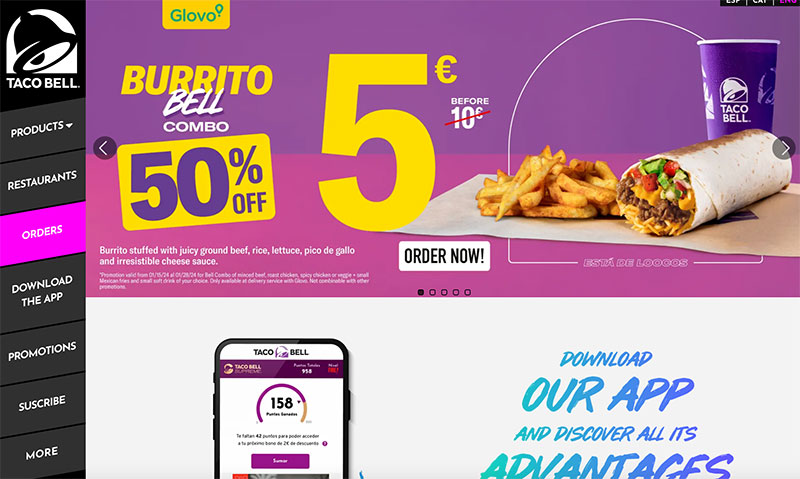
A lot, because people judge a site visually before they read a word. Researchers often cite visual learners as a majority of the population, and whatever the exact share, visual information is quicker to take in than long text. A well-made design grabs attention, holds it and nudges visitors toward the next step.
Taco Bell’s site is a handy example. It uses a bright color palette, bold fonts, a clear “Order Now” call to action and strong product photography, all of which tell visitors what to look at and what to do. The same elements are available to smaller brands, and a layout that is also easy to use does more for you than one that is merely striking. For instance, pages that load slowly or confuse people push bounce rates up. The link between web design and conversion rates is well worth reading if you are weighing how much to invest.
Most small businesses cannot keep an in-house design team, and that is where outsourcing helps. A digital design agency can build a site that holds attention and encourages visitors to stay and read more.
What content attracts visitors and leads?
Content that answers visitors’ questions or solves their problems. People arrive with their own concerns, not an interest in your product, so show your expertise early in their search. Useful content draws visitors in, builds trust and gives happy readers something worth passing on.
Formats that work for most businesses include:
- Podcasts
- Niche blog posts
- Expert roundups
- Customer testimonials
- Coverage of niche trends
- Case studies
- Guides and checklists
- FAQs
Add social share buttons to your best pages. They make it easy for satisfied visitors to share useful content with their own audience, which brings more people to the pages that already perform well.
How do customer testimonials help a website?
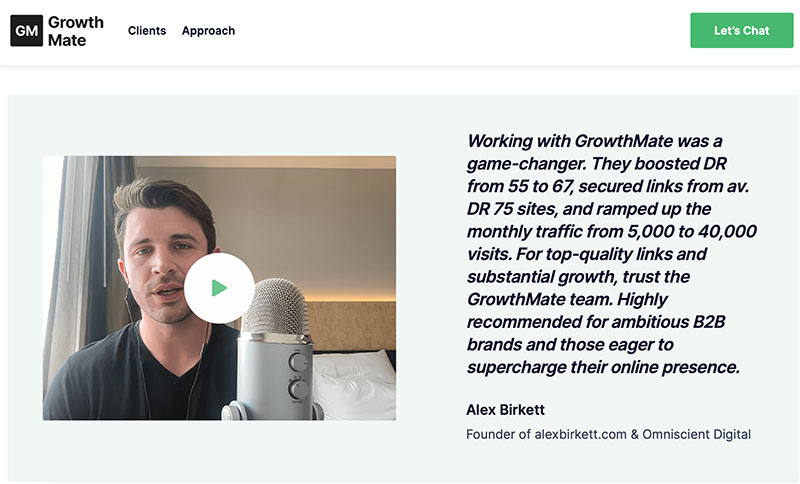
They provide social proof, which many shoppers now want before they trust a business. A testimonial from a real customer says what you cannot say about yourself credibly. Several formats are available.
- Customer reviews
- Case studies
- Interviews
- User-generated content
Video testimonials usually feel more trustworthy than text because viewers can see and hear the customer. GrowthMate uses them on its site, as shown above. If you want to go further, learn how to turn customer reviews into brand videos. Testimonials also stand you apart from your competitors and support wider business credibility. Trust gets people to consider you, and a lead form gives them somewhere to act on it.
What makes a lead generation form work?
A short, simple form that is easy to finish. Every extra step or field costs you people, so ask only for what you need to follow up. A form is where interest turns into contact information you can use to offer something valuable.
The elements worth including are:
- A landing page with no distractions
- A time-limited offer, also known as a lead magnet
- A clear, direct form
- Personalized questions where they make sense
- A call-to-action button that says exactly what happens next
If you would rather not build forms from scratch, a roundup of the best lead generation tools shows what is available. Even with a good form, some visitors will hesitate and want to ask something first, which is why support needs to be easy to reach.
Why should customer support be easy to reach on your website?

Because visitors with a question expect a quick reply, and the website is now where most of them look first. A worried visitor is also more willing to share contact details if it gets them a personal answer fast. Show your contact options clearly. Vueling gives questions their own contact box and points visitors to its Customer Services Centre, as shown above.
Prompt answers raise customer satisfaction, and satisfied customers recommend you to others. That recommendation effect leads naturally to the last item on the list.
How do referral and affiliate programs bring more visitors?

They give people a concrete reason to recommend your site. Recommendations from peers carry a lot of weight in purchase decisions, so turning loyal customers into advocates is valuable. A referral or affiliate program rewards both sides: the person who spreads the word and the person who tries your product.
Those advocates will mention you on their social media profiles or personal websites, which reaches an audience you could not easily reach yourself. The example above shows a simple version: a personal referral link to copy, plus an option to invite friends by email.
Frequently asked questions
How long does it take to attract visitors and leads?
It depends on your starting point, your niche and how often you publish. Content and search visibility usually build gradually over months, while changes to forms and calls to action can show results sooner.
Which change should I make first?
Start with the audience. Once you know who you are writing for, every other decision about design, content and forms gets easier to make.
How short should a lead form be?
As short as you can make it while still collecting what you need to follow up. A name and an email address is often enough for a first contact.
Do small businesses need professional web design?
It helps, but you do not need a large team. Outsourcing to an agency or a freelancer is a common way to get a clean, usable design on a smaller budget.
Which of the seven changes should you start with?
Pick the one your site is weakest at today. If visitors arrive but do not leave details, fix the form and the offer. If few people arrive at all, work on audience research and content. Make one improvement, watch the numbers in your analytics for a few weeks, then move to the next.

Renowned for his expertise in logo design and visual branding, Bogdan has developed a multitude of logos for various clients.
His skills extend to creating posters, vector illustrations, business cards, and brochures. Additionally, Bogdan's UI kits were featured on marketplaces like Visual Hierarchy and UI8.
He also wrote in the past years on sites like Design Your Way, WebDesignerDepot, WPDean, Designmodo, Speckyboy, Slider Revolution, and more.

Bogdan Sandu is a seasoned designer who has been designing websites since 2008. Renowned for his expertise in logo design and visual branding, Bogdan has developed a multitude of logos for various clients. His skills extend to creating posters, vector illustrations, business cards, and brochures. Additionally, Bogdan's UI kits were featured on marketplaces like Visual Hierarchy and UI8. He also wrote in the past years on sites like Design Your Way, WebDesignerDepot, WPDean, Designmodo, Speckyboy, Slider Revolution, and more.
You Might Also Like