Two things have to happen before a new typeface shows up in your text tool, and people tend to treat them as one. The file has to land somewhere the device can read it. Then Clip Studio Paint has to notice it exists.
The app reads OpenType and TrueType files. You either install one through the operating system, or feed it straight to the app’s own Font list through a separate built in importer.
CELSYS wrote that importer for Windows, Mac, and iPad. Android and Chromebook never got it. Same font file, different behavior, and on two of those platforms no behavior at all.
Clip Studio’s own support documentation dates the built in importer to version 1.11.6, released December 14, 2021, the update that let artists skip a system wide install entirely.
What Does Adding a Font to Clip Studio Paint Mean?
Two separate jobs hide inside that one phrase. Getting a typeface onto your device is the first. Getting this particular app to see it is the second, and that’s the one that trips people up.
CELSYS reported in January 2026 that Clip Studio Paint had passed 60 million creators worldwide, across Windows, Mac, iPad, Android, and Chromebook. That spread is why there isn’t one clean font pipeline to point at.
A font is a packaged set of instructions telling a display or a printer how to draw each character. Clip Studio Paint reads two of the common packaging formats for that.
Professional lettering foundries like Comicraft build typefaces specifically for comic dialogue and sound effects, and those files arrive in the same formats a casual hobby font does.
The version history is worth keeping straight, since half the troubleshooting threads online predate the current buttons.
- Supported formats: OpenType (OTF) and TrueType (TTF), per Clip Studio’s own support documentation
- Add font from files, the built-in multi-file importer, arrived in version 1.11.6 (CELSYS support)
- Ligatures were added to the Font category in version 2.0, released March 14, 2023 (CELSYS)
- Contextual alternates followed in version 3.0.0, released March 14, 2024 (Clip Studio official support)
OS-Level Install or Add Font From Files: Which Method Should You Use?
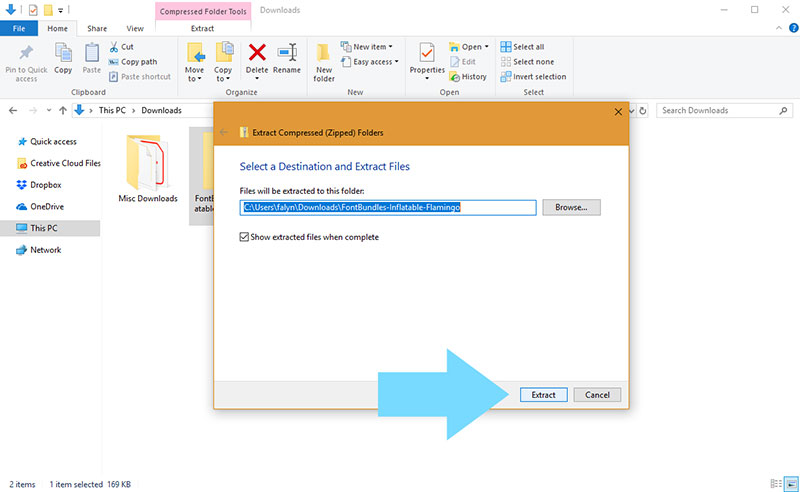
Install through the operating system when you want the font in every program you own. Use Add font from files when it only ever needs to exist inside Clip Studio Paint.
| Platform | Font add method | Needs app restart | Works outside Clip Studio Paint |
|---|---|---|---|
| Windows | OS install or Add font from files | Only for the OS route | Yes, for the OS route |
| Mac | Font Book or Add font from files | Only for Font Book | Yes, for Font Book |
| iPad | Add font from device, or Add font from files | No | Yes, once it’s on the device |
| Android / Chromebook | Not available | Not applicable | Not applicable |
A system-wide install puts the file at the OS level, so Word, Photoshop, Krita, and Clip Studio Paint all pick it up at once. The cost is a restart, and it has to be a real one. Clip Studio Paint refreshes its font list on launch and not before.
Add font from files works the other way around. You add the file straight from the Font drop-down in Tool Property, and it lives only inside Clip Studio Paint’s own list. Nothing else on the computer sees it. In most cases you don’t even need to restart.
Other painting programs split along the same line. The steps for getting a new typeface into FireAlpaca look nothing like Clip Studio Paint’s dropdown import.
If you letter the same series every week, the in-app route keeps your system font folder from filling with faces you’ll never open in a browser or a Word doc.
How Do You Add Fonts to Clip Studio Paint on Windows and Mac?
On desktop it’s a file and a decision. Pick the file, then decide whether the operating system or the app does the importing.
One prerequisite before any of it: Clip Studio Paint has to be in Studio Mode. Simple Mode hides the Add font from files option completely.
Installing Fonts on Windows
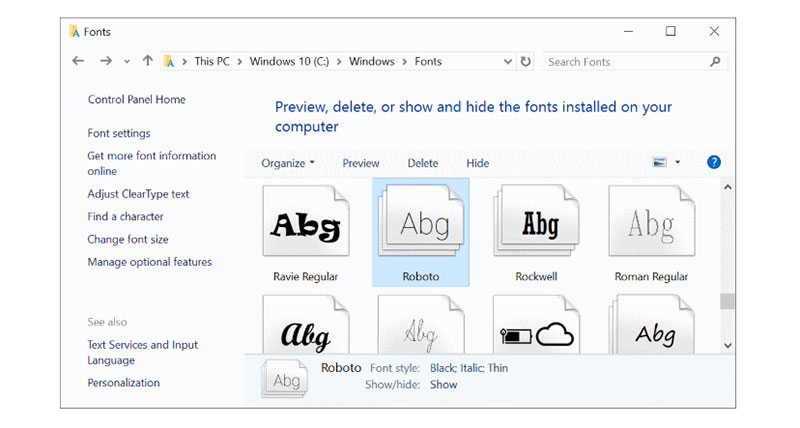
- Download the font and unzip it if it arrives as a compressed folder
- Right-click the OTF or TTF file and select Install, or drag it into the Control Panel Fonts folder
- Close Clip Studio Paint completely, then reopen it
- Open the Font list in the Tool Property palette to confirm it appears
Skip steps 2 and 3 entirely if you’d rather use Add font from files from the Font drop-down instead of the OS route.
Installing Fonts on Mac
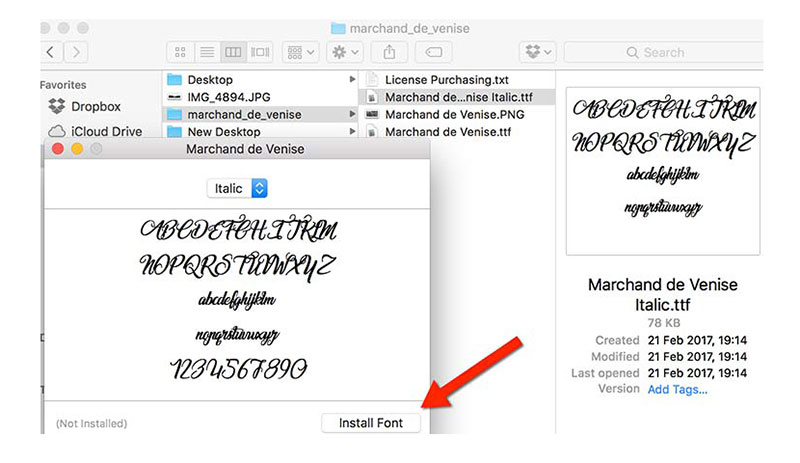
Mac has a dedicated app for this. Installing new type system-wide on a Mac runs through Font Book rather than a right-click menu.
- Double-click the downloaded OTF or TTF file
- Click Install Font in the Font Book window that opens
- Quit and relaunch Clip Studio Paint
There’s a quicker path if you’re comfortable poking around your user folder. Drag the font file straight into the hidden Library/Fonts folder inside your account and Font Book never enters the picture. I do this whenever I’m adding a batch, because Font Book gets slow about anything over a handful of files.
How Do You Add Fonts to Clip Studio Paint on iPad?
iPadOS handles the install first. A button inside Clip Studio Paint then pulls from whatever the system already has.
- Newer versions show an Add font from device button right in the Font list
- Older versions (before 1.11.6) use a font picker under “Search for fonts not in this list”
- That older picker needs iOS 13 or later to work at all
None of that matters until the font is actually on the iPad. Getting it there usually means a font-installer app, because iPadOS ships with no plain Install button the way desktop systems do.
AnyFont is what most creators end up reaching for. It wraps the font in an installable profile the device will accept.
Other iPad art apps do the same dance. Getting a custom typeface into Procreate also runs through the iPadOS Files app rather than a device-wide install screen.
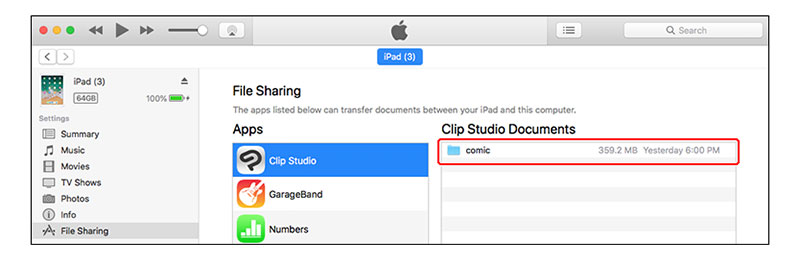
You’ll still find older tutorials syncing fonts through a Clip Studio Cloud account or iTunes File Sharing. It works, mostly. The in-app buttons have made it pointless.
Why Doesn’t a New Font Show Up in Clip Studio Paint?
Usually the install went fine and the app just hasn’t refreshed its list.
Fonts Missing After Installation
Check these before you reinstall anything.
- Clip Studio Paint was left open during the OS-level install and never restarted
- The font was added through Simple Mode, where the import option is hidden
- The file itself is corrupted or only partially downloaded from a zip
Closing the app fully, not minimizing it, clears the first one almost every time.
The Missing Font Warning on Old Files
Open a .clip file from a year ago and you might get a missing font warning even though everything on your current setup looks fine.
The message means the font that was active when the file was saved isn’t installed on this particular device anymore.
You either reinstall the original, or accept the substitute Clip Studio Paint offers and swap the text back to your preferred typeface by hand afterward. Neither option is much fun on a twenty page chapter.
How Do You Organize Fonts Inside Clip Studio Paint?
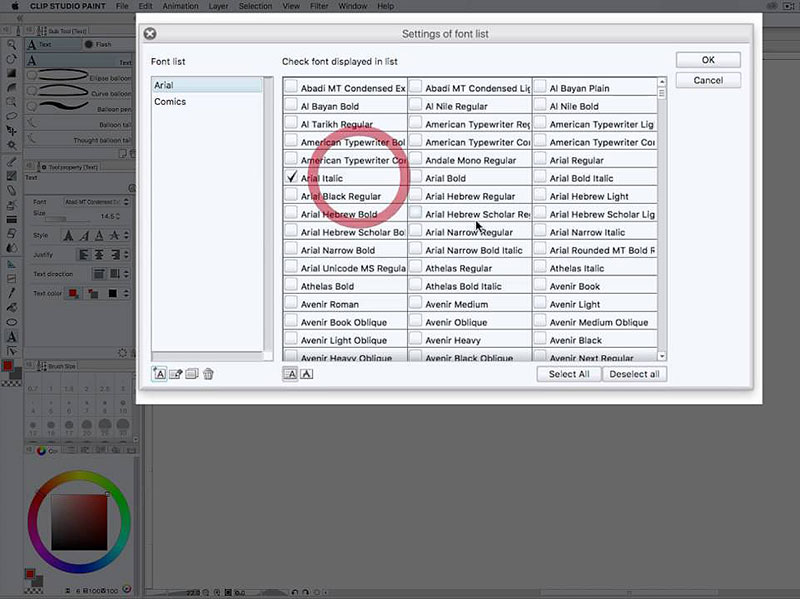
The Font list keeps a running row of your recent picks, capped at 10 entries according to Clip Studio’s own user manual.
Typing a partial name in the search box filters the full list instantly, which starts to matter once you’re past a few dozen installed families.
Three toggle buttons switch the display between plain names, each name shown in its own font, and a live preview of whatever text you’ve selected.
None of that fixes the real problem on a series with a house style, which is scrolling past hundreds of fonts you never touch.
Building a Custom Font List
- Open the Font drop-down in Tool Property and click the gear icon
- Select Create new font list and give it a name
- Check the boxes next to every font you want included
- Click OK, then switch to that list from the dropdown next to All Fonts
Clip Studio’s own official Tips platform has featured creators building a dedicated font list for webtoon lettering, so a chapter’s dialogue font, sound-effect font, and title font all sit in one filtered group instead of the full system list.
What Typography Controls Work Once a Font Is Added?
Select a font and the Sub Tool Detail palette opens up a handful of OpenType-driven controls that change how the letters actually render.
Not every installed font supports them, since the feature has to be built into the font file itself. Clip Studio Paint also doesn’t expose full variable font technology the way some dedicated type-design apps do.
Ligatures and Contextual Alternates
Ligatures join certain letter pairs, “fi” or “ffi” for instance, into a single combined glyph instead of two shapes sitting awkwardly next to each other.
Contextual alternates swap a glyph’s shape based on what sits around it, so a lowercase “I” used as a personal pronoun can render differently than one buried inside a word.
Letterers writing on comics-industry sites and podcasts like ComicLab publicly flagged the lack of this feature for years, before Clip Studio Paint finally caught up with Version 3.0.0 in March 2024.
CELSYS marked that same release by launching Clip Studio Comic, a font built with the Japanese type foundry Iwata Corporation (a company that has produced Japanese typefaces since 1920) that ships four alternate glyphs per character to show the feature off.
Mixing Fonts for Alphabet and Japanese Characters
A mixing font pairs one physical font with alphabet characters and a completely different one with Japanese characters in the same text block.
It doesn’t randomize glyph variants. It doesn’t apply ligatures either. All it does is swap which font file handles which character set, which is worth being clear about before you go looking for effects it was never built to produce.
More than 80 percent of Clip Studio Paint’s user base sits outside Japan, according to CELSYS, and that’s exactly the audience this feature was built to serve.
Pair a mixing font with adjusted spacing between characters too, since a Latin font and a Japanese font rarely sit at the same visual size by default.
Where Can You Find Fonts for Clip Studio Paint Projects?
Clip Studio Paint doesn’t care where an OTF or TTF file came from. It reads the format, and that’s the entire test.
Where you got that file changes how much digging you’ll do afterward, mostly around licensing and quality control.
- CLIP STUDIO ASSETS is built into the app already, so there’s no browser detour. The catalog leans heavily toward Japanese-style lettering and manga sound-effect fonts specifically.
- Google Fonts clears every family for commercial use with no license file to hunt down, though the library skews toward clean web and UI type rather than comic dialogue faces.
- DaFont takes open submissions, which is why the catalog is enormous and still growing. Licensing is inconsistent from font to font, and a lot of it is personal use only.
- Font Squirrel pre-clears every single font for commercial work before listing it. The hand-picked approach keeps the library much smaller than DaFont’s.
Google Fonts’ own directory listed 1,942 font families as of July 2026, and every one of them carries an open license.
DaFont’s open-submission model has pushed its catalog past 46,000 individual styles, according to a 2026 review comparing it against Font Squirrel’s smaller, hand-picked library.
There’s also a curated set of fonts cleared for commercial use if checking individual licenses one by one isn’t how you want to spend an afternoon.
Behance, Adobe’s portfolio platform, is worth a look too. Designers post free typefaces alongside their case studies there.
Specialist foundries exist for this exact niche. Blambot is the name that keeps coming up in comic lettering circles, selling and giving away fonts built for dialogue balloons and sound effects.
Is a Downloaded Font Safe to Use in Commercial Comic or Manga Work?
The letterforms themselves are almost never the legal risk. The file is.
US federal regulation (37 CFR 202.1(e)) states plainly that a typeface as a typeface isn’t something copyright law protects. The font software that draws those letters on screen is a different story, and it can be copyrighted like any other piece of code.
That gap is why two fonts that look identical can carry completely different licenses. One file might be personal-use only. A near-identical one from a different foundry might be cleared for print runs and merchandise.
Clip Studio Assets is a partial exception here. Clip Studio’s own support documentation confirms that materials published there, fonts included, can be used in both private and commercial comics without crediting the creator, unless the listing is flagged as a separately licensed material with its own stated terms.
A font with no visible license attached isn’t automatically safe just because Clip Studio Paint let you install it.
Adobe Systems, Inc. v. Southern Software, Inc. is still the case most IP lawyers point to on this. A federal court found Southern Software’s Veracity font infringed Adobe’s Utopia font software, confirming that font files themselves hold real, enforceable copyright.
Check the license file or the source page before a page goes to print, not after. Clip Studio Paint has no built-in check for any of this. It will happily render a font it has no legal right to.
Can You Add Custom Fonts on Android or Chromebook?
No. This is the one part of the whole process that doesn’t work at all on these two platforms.
- No system-level font folder to install a file into
- No Add font from files option in the Font drop-down
- No Add font from device button like the iPad version has
Clip Studio Paint’s own user manual states it directly: on Android and Chromebook devices, you can only use the default fonts already in the app, and fonts installed elsewhere on the device don’t carry over.
Side-loading a font through a third-party Android font-installer app doesn’t get around it either, since those tools change the device’s system font rather than Clip Studio Paint’s separate font list.
Which leaves Windows, Mac, and iPad as the only platforms where any of the install methods above actually apply.
FAQ on How To Add Fonts To Clip Studio Paint
Does It Matter Whether a Font Is OTF or TTF for Lettering?
Not for basic dialogue text. Clip Studio Paint reads OTF and TTF identically.
OTF carries OpenType extras like ligatures and contextual alternates more reliably, which is why professional comic lettering fonts often ship as OTF rather than TTF.
Do You Need Studio Mode Instead of Simple Mode to Add a Font?
Yes. Simple Mode strips out advanced menus, including Add font from files in the Tool Property palette and the OpenType controls under Sub Tool Detail.
Switch to Studio Mode from the top menu before importing anything.
What Happens to Your Fonts After an Update or Reinstall?
Fonts don’t follow you through a full reinstall or a move to a new machine on their own. The operating system route and the built in importer store files in two separate places, and only one of those gets picked up by a normal backup.
OS-level fonts ride along with a system backup. Fonts added through Add font from files live only inside that one installation, so they disappear the moment the app is removed. The exception is Back up app settings in Clip Studio’s Cloud Settings, since Clip Studio Paint’s own user guide lists installed fonts as part of that app settings backup and lets you restore them after a reinstall.
- Turn on app settings backup in Cloud Settings before you uninstall, or save the original font files yourself as a fallback
- Reinstall Clip Studio Paint itself
- Restore your app settings backup, or re-add each font through Add font from files if you didn’t back one up
CELSYS shipped Windows EX and PRO as version 5.1.2 on August 6, 2026. There’s still no dedicated feature that mirrors added fonts across devices in real time, so a font backup, cloud or local, is the only thing standing between you and re-adding everything by hand.
The remaining decision is which typeface actually reads well on the page, and that question turns on what typefaces comics typically use for dialogue versus sound effects.

Renowned for his expertise in logo design and visual branding, Bogdan has developed a multitude of logos for various clients.
His skills extend to creating posters, vector illustrations, business cards, and brochures. Additionally, Bogdan's UI kits were featured on marketplaces like Visual Hierarchy and UI8.
He also wrote in the past years on sites like Design Your Way, WebDesignerDepot, WPDean, Designmodo, Speckyboy, Slider Revolution, and more.
- The Windsurf Logo History, Colors, Font, And Meaning - 10 October 2026
- How to Remove Background From Product Photos (No Photoshop) - 10 October 2026
- How Designers can Build a Stronger Online Creative Identity - 9 October 2026

Bogdan Sandu is a seasoned designer who has been designing websites since 2008. Renowned for his expertise in logo design and visual branding, Bogdan has developed a multitude of logos for various clients. His skills extend to creating posters, vector illustrations, business cards, and brochures. Additionally, Bogdan's UI kits were featured on marketplaces like Visual Hierarchy and UI8. He also wrote in the past years on sites like Design Your Way, WebDesignerDepot, WPDean, Designmodo, Speckyboy, Slider Revolution, and more.
You Might Also Like